
Who's Afraid of the Big Bad Wolf (The 3 Little Pigs) Lyrics
Who's Afraid of the Big Bad Wolf (The 3 Little Pigs)
(Cícero)I built my house of straw
I built my house of hay
I toot my flute
I don't give a hoot
And play around all day
(Heitor)
I built my house of sticks
I built my house of twigs
With a hey-diddle-diddle
I play on the fiddle
And dance all kinds of jigs
(Prático)
I built my house of stone
I built my house of bricks
I have no chance
To sing and dance
For work and play don't mix
(Cícero e Heitor)
He don't take no time to play
Time to play
Time to play
All he does is work all day
(Prático)
You can play and laugh and fiddle
Don't you think you'll make me sore
I'll be safe and you'll be sorry
When the wolf comes to your door
(Cícero e Heitor)
Who's afraid of the big bad wolf
Big bad wolf
Big bad wolf
Who's afraid of the big bad wolf
Who's afraid of the big bad wolf
Big bad wolf
Big bad wolf
Who's afraid of the big bad wolf
I'll punch him in the nose
I'll tie him in a knot
I'll kick him in the shin
We'll put him on the spot
Who's afraid of the big bad wolf
Big bad wolf
Big bad wolf
Who's afraid of the big bad wolf
Song Overview
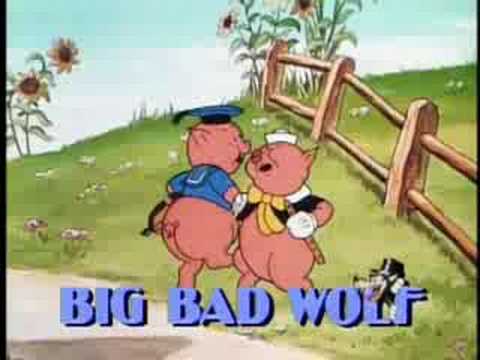
Review and Highlights
Quick summary
- Where it lives: Introduced in Disney's Silly Symphony short Three Little Pigs (1933).
- Writers: Music by Frank Churchill with additional lyrics by Ann Ronell.
- Why it mattered fast: A cartoon hook that jumped into real-world popularity during the Great Depression.
- How it plays on screen: Sung as a cocky chant by the carefree pigs, then reprised when the wolf is beaten back.
- Afterlife: Reused and reshaped in sequels, wartime propaganda, and Disney TV music retrospectives.
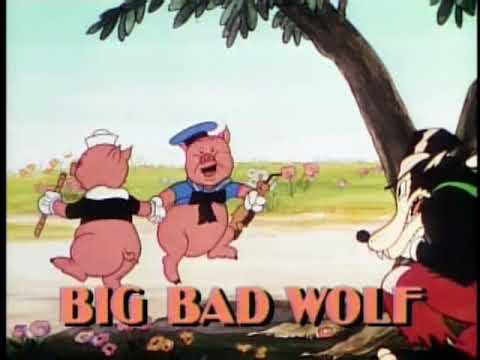
Three Little Pigs (1933) - animated short - diegetic. The chant is performed as part of the pigs' day-to-day music making, first as a taunt and later as a victory lap. It matters because the story turns on that swagger: the tune is the mask for denial, and the brick house is the moment reality wins.
This number is built like a street rhyme in a Sunday suit: short phrases, bright cadence, and a refrain that invites clapping on instinct. The melody keeps its feet moving - you can hear why it traveled so well beyond the cartoon. What makes it work is its timing, not its complexity. The chorus is a dare, repeated until it becomes a spell, and then the spell breaks the second the wolf actually shows up. That snap from bravado to panic is the whole gag, and the music sells it with a wink.
Key takeaways
- Hook-first writing: A refrain engineered for repetition, perfect for radio-era memory.
- Character logic in music: Two pigs sing to avoid responsibility, the third builds while the tune circles him like peer pressure.
- Comedy with teeth: The refrain is funny until it is not, and that switch is the point.
Creation History
Disney wanted original tunes that could stand on their own, not just background wallpaper, and this was the breakthrough that proved the idea. The song was quickly pushed into sheet music circulation, and popular bandleaders recorded it for the commercial market. According to TIME magazine, the piglets' refrain stayed in conversation well after the short opened, helped by holds and repeat bookings in big-city theaters.
Song Meaning and Annotations
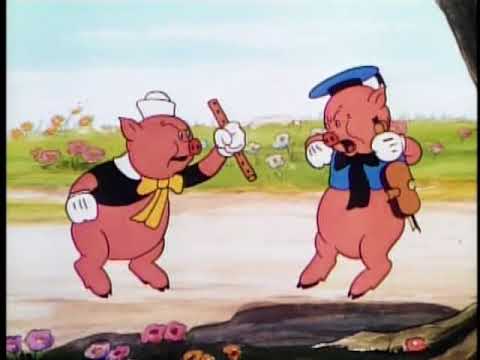
Plot
Three brothers split into three philosophies. Two treat life like a jam session: build quick, play hard, and laugh at warnings. The third works like a foreman, building in brick and refusing to confuse play with planning. When the wolf arrives, the first two houses fail instantly, and the carefree pigs scramble for refuge. The brick house holds, the wolf's tricks collapse, and the brothers learn - loudly - that the punchline only lands if you survive it.
Song Meaning
On the surface, it is a playground chant aimed at a storybook villain. Underneath, it is a study in how people talk themselves into courage. The refrain is not bravery, it is bravado - a repeated claim that tries to make fear disappear through sheer volume. That is why the tune hit its moment: it gave listeners a simple line to sing at a time when the world felt full of wolves, financial or otherwise. As stated in a Smithsonian description of the period sheet music, the title and credits connect the song directly to its 1933 publishing push, the kind of move that turns a film gag into a living standard.
Annotations
Who's afraid of the big bad wolf?
Eight words that behave like a drum. The question is rhetorical, but the rhythm demands an answer, and the cartoon gives one twice: first with arrogance, later with earned confidence.
Big bad wolf, big bad wolf.
Notice the naming. Repetition turns the threat into a toy - say it enough and it sounds less dangerous. That is the trick, and the wolf arriving is the counter-trick.
Tra la la la la.
That nonsense syllable is not filler, it is insulation. When language runs out, people hum. In this number, humming becomes denial with a grin.
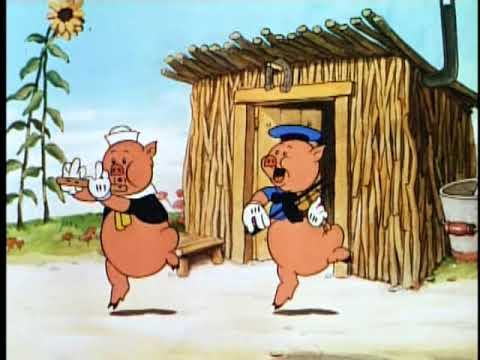
Genre and rhythm fusion
The writing borrows from novelty-song simplicity and dance-band swing-era bounce: a brisk, almost march-like pulse that can be felt as either quick two or snappy four. That dual reading is why tempo measurements online often disagree. In practice, the feel stays light and forward, like a skipping rope that never touches the ground.
Symbols and cultural touchpoints
The wolf is a walking variable: any looming force can wear that top hat. In the 1930s, listeners heard the refrain as a kind of defiant self-talk; later, Disney repurposed the pigs and their signature chorus in wartime messaging, proving how easily the song's framework can be loaded with new meaning. The brick house is the blunt metaphor - labor, foresight, savings, preparedness - but the sharper metaphor is the chant itself, a reminder that slogans can comfort without protecting.
Technical Information
- Artist: The Three Little Pigs cast
- Featured: None
- Composer: Frank Churchill
- Producer: Walt Disney Productions (film context)
- Release Date: May 27, 1933
- Genre: Film song, novelty standard
- Instruments: Vocal ensemble, cartoon orchestra
- Label: Irving Berlin, Inc. (sheet music publisher)
- Mood: Defiant, playful
- Length: Varies by recording
- Track #: Not applicable
- Language: English
- Album: Not applicable
- Music style: Hook-driven refrain song
- Poetic meter: Accentual, chant-based phrasing
Questions and Answers
- Who actually sings the tune in the original cartoon?
- It is voiced as the pigs' performance inside the story, led by the carefree brothers early on, with the trio circling back to it after the wolf is defeated.
- Why does the chorus feel like it belongs outside the film?
- Because it is written like a public chant: short, repeatable, and built for group participation, the same design you hear in playground call-and-response.
- Is the song a joke or a warning?
- Both. The joke is the pigs' confidence. The warning is that confidence without preparation is just noise.
- What makes the refrain so sticky?
- Repetition, simple pitch motion, and a rhythm that sits comfortably in quick two. It can be sung by almost anyone, which is the secret ingredient.
- Why did it resonate during the Great Depression?
- It offered a light, defiant line people could borrow, a way to mock fear without pretending fear did not exist.
- Did Disney reuse the song later?
- Yes. It reappears across pig-related follow-ups and was spotlighted in Disney television programming that dramatized how studio songs were made.
- What is the brick house in musical terms?
- A structural punchline. The chorus brags, the plot proves the brag false, and the brick house lets the chorus return with a new meaning.
- Are there famous later covers?
- Yes. It has been recorded across decades, from classic pop interpretations to hip-hop flips tied to Disney tribute projects.
- How does the wolf function as a symbol?
- As a movable target. In later wartime reuse, the wolf is reshaped into an explicit enemy figure, showing how the song's frame can carry new politics.
Awards and Chart Positions
The song's biggest trophy is indirect: Three Little Pigs won the Academy Award for Short Subject (Cartoon), locking the tune to a piece of film history that the industry itself crowned. Decades later, the short was selected for the United States National Film Registry, a second kind of institutional stamp that keeps the piglets' chant in the cultural attic, safely wrapped.
| Category | Work | Result | Year |
|---|---|---|---|
| Academy Awards | Three Little Pigs (Short Subject - Cartoon) | Winner | 1934 |
| National Film Registry | Three Little Pigs | Selected | 2007 |
| Year | Recording artist | Market note |
|---|---|---|
| 1933 | Don Bestor and His Orchestra (Victor 24410) | Commercial release tied to the song's peak popularity in 1933 |
| 1963 | Barbra Streisand | Album reinterpretation that treats the tune like a showpiece |
| 1991 | LL Cool J | Disney tribute-era flip that frames the hook as pop culture shorthand |
| 2022 | Lang Lang | Piano-forward modern recording that turns the refrain into a miniature |
How to Sing Who's Afraid of the Big Bad Wolf
There are two honest ways to sing this: as a playground chant with crisp consonants, or as a period novelty number with a wink. Tempo readings vary by edition and by whether you count in two or four, so focus on feel: buoyant, forward, and slightly mischievous.
- Tempo: Start in a comfortable quick two, then tighten the pulse until the refrain feels like skipping rope.
- Diction: Make the hard consonants pop on "big" and "bad" without chewing them. The joke lives in clarity.
- Breathing: Take small, frequent breaths between repeated phrases. Do not save air for drama - it is a chant, not an aria.
- Flow and rhythm: Keep the repeated "big bad wolf" evenly spaced. Rushing makes it sound anxious, which undercuts the brag.
- Accents: Lean gently on the first beat of each phrase. Too much accent turns it into a march.
- Ensemble choices: If you have a group, assign the question to one voice and the answer to the others. Call-and-response gives it lift.
- Mic technique: If amplified, back off slightly on plosives. The repeated B sounds can thump the mic.
- Pitfalls: Do not slow down for cuteness. The tune stays charming because it stays moving.
Practice materials: Count in two, clap the refrain, then speak it in rhythm before you sing a note. Once the words sit cleanly, add pitch and keep the same speech-like attack.
Additional Info
The tune moved fast from screen to sheet music, published in New York by Irving Berlin, Inc., which is the kind of machinery that turns a cartoon moment into a living standard. It also became a template for Disney's later music strategy: write it so audiences leave the theater humming, then give them a way to take it home. Animation historian writing at AWN has pointed to this song as the ignition point for a broader wave of original Silly Symphony songwriting.
Disney later repurposed the pigs in The Thrifty Pig (1941), a Canadian war-bond short that rewrites the threat into explicit wartime imagery and adjusts the song's words to fit the message. The melody stays recognizable, which is the tell: a strong refrain can carry very different meanings without changing its bones.
Key Contributors
| Entity | Type | Relationship (S-V-O) |
|---|---|---|
| Frank Churchill | Person | Churchill composed the song. |
| Ann Ronell | Person | Ronell added lyrics to the song. |
| Walt Disney | Person | Disney produced the short film that introduced the song. |
| Walt Disney Productions | Organization | The studio produced Three Little Pigs. |
| Irving Berlin, Inc. | Organization | The publisher issued sheet music for the song. |
| Academy of Motion Picture Arts and Sciences | Organization | The Academy awarded Three Little Pigs in 1934. |
| Library of Congress | Organization | The Library selected Three Little Pigs for the National Film Registry. |
| Three Little Pigs | Work | The short features the song as a narrative motif. |
| The Thrifty Pig | Work | The wartime short reuses the song with revised lyrics. |
| Cavalcade of Songs | Work | The TV episode reenacts the song's creation as Disney mythology. |
Sources: TIME magazine archive feature on the song, Smithsonian collection note for the 1933 sheet music, Academy Awards ceremony page (1934), D23 A to Z entries for Three Little Pigs and Thrifty Pig, Library of Congress National Film Registry page, Animation World Network article on Silly Symphony songs, Discography of American Historical Recordings (UCSB), American Theatre profile of Ann Ronell, Decca site listing for Lang Lang The Disney Book