
Heffalumps and Woozles (Winnie the Pooh and the Blustery Day) Lyrics
Heffalumps and Woozles (Winnie the Pooh and the Blustery Day)
They're black, they're brownThey're up, they're down
They're in, they're out
They're all about
They're far, they're near
They're gone, they're here
They're quick and slick
They're insincere
Beware, beware
Be a very wary bear
A heffalump or woozle
Is very confuzle
A heffalump or woozle's very sly, sly, sly, sly
They come in ones and twoozles
But if they so choozles
Before your eyes you'll see them multiply, ply, ply, ply
They're extraordinary, so better bewary
Because they come in every shape and size, size, size, size
If honey's what you covet
You'll find that they love it
Because they'll guzzle up the thing you prize!
Beware, beware
Be a very wary bear
They're extraordinary
So better bewary
Because they come in every shape and size, size, size, size
If honey's what you covet
You'll find that they love it
Because they'll guzzle up the thing you prize!
They're black, they're brown
They're up, they're down
They're in, they're out
They're all about
They're far, they're near
They're gone, they're hear
They're quick and slick
They're insincere
Beware, beware, beware, beware, beware !!
Song Overview
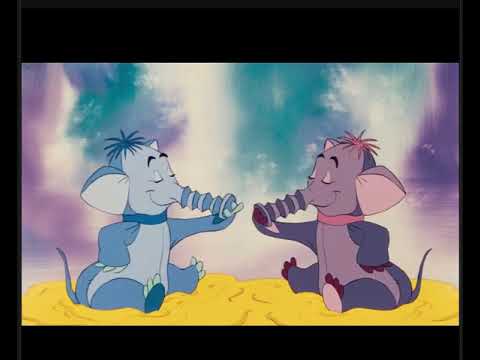
"Heffalumps and Woozles" sits in that sweet spot where a childrens tune stops behaving and starts grinning at the camera. It is a nightmare chorus from Walt Disneys Winnie the Pooh and the Blustery Day, built like a warning label and staged like a carnival hallucination. You can hear the Sherman Brothers having fun with fear: not terror, but the kind that comes from a bedtime story told a little too late and a little too fast.
In the featurette, the song arrives as Poohs imagination spins a rumor into a full parade. The result is a compact piece of musical mischief: a singable hook, a slyly insistent rhythm, and a set of made-up creatures that feel both harmless and unstoppable. According to D23, the short is packed with set pieces that helped define Disneys Pooh era, and this dream passage is the one people remember in the dark.
Review and Highlights
Quick summary
- Type: animated featurette song, dream-sequence chorus number.
- Writers: Richard M. Sherman and Robert B. Sherman.
- Most-cited early performers on record: The Mellomen on the Disneyland Records story-and-songs album configuration.
- Function: turns a spoken warning into a looping chant that powers the visuals.
- Afterlife: reappears in compilation releases and later Pooh presentations, including the 1977 feature compilation.
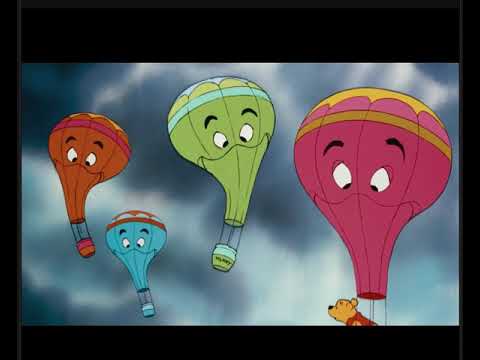
Winnie the Pooh and the Blustery Day (1968) - animated featurette - non-diegetic. The number plays under Poohs nightmare montage, roughly mid-featurette, shortly after Tiggers warning about honey thieves (often around the 13-minute region, depending on the cut). What it does: it turns a simple scare into a mechanical loop, like a music-box that will not stop winding. The animation can go wild because the chorus stays steady - a musical handrail while the screen tilts.
Creation History
The Sherman Brothers wrote the music for the short and its record tie-ins, and the song shows their knack for making a phrase feel inevitable. On the soundtrack-album listings tied to the period, it was positioned as a side-two jolt: a short, punchy number credited to The Mellomen, sitting among gentler chorus pieces and character tunes. That placement matters - it is designed as the spike in the listening experience, the moment when the storybook record suddenly grows teeth. On screen, the same idea lands as pure audiovisual sync: the chant repeats while the imagery keeps mutating, giving the sequence its hypnotic pull.
Song Meaning and Annotations
Plot
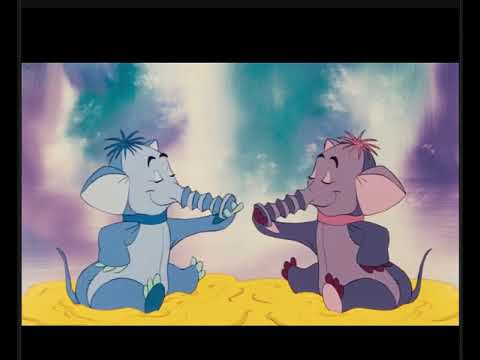
Pooh hears a warning about strange creatures that steal honey. He takes it seriously, because that is what Pooh does with new information: he hugs it, worries it, and turns it into a picture. Sleep arrives, and the picture becomes a parade. The dream floods the screen with shifting shapes and honey imagery, while the chorus acts like a narrator that refuses to explain itself. When Pooh wakes, the threat dissolves - but the earworm remains.
Song Meaning
The songs core is not really about monsters. It is about how anxiety reproduces: one idea repeats, the repetition feels like proof, and suddenly the room looks different. The chant turns misheard words into creatures and then turns those creatures into inevitability. The joke is that the fear is childish, yet the mechanism is adult - the mind rehearsing a worst-case scenario until it starts to feel like news.
Annotations
"Heffalumps and Woozles"
The hook is a two-part spell. It sounds like a catalog entry and a warning at the same time, which is why it sticks: the words are nonsense, but the cadence is authoritative.
"steal your honey"
That single motive is enough. No backstory, no logic, just a direct hit to Poohs one soft spot. The lyric economy is deliberate: the smaller the premise, the bigger the imagination has to work.
"theyre very confuzle"
The near-rhyme and the playful mangling are doing narrative work. Confusion is part of the threat - not claws, but slipperiness, a sense that you cannot get a clean grip on whats coming.
"youll never be rid"
This is the dream talking like a contract. It is funny, but it is also how worry feels: not loud, just certain, repeating itself until you start believing it.
Genre and rhythmic engine
Musically, the number behaves like a novelty chorus filtered through vaudeville and a hint of swing-era cartoon scoring. The rhythm drives forward with that marching inevitability, but the harmony and phrasing keep winking, as if the band is playing a haunted funhouse rather than a haunted house. It is a classic Disney trick: keep the beat friendly, let the imagery do the unsettling.
Symbols and cultural touchpoints
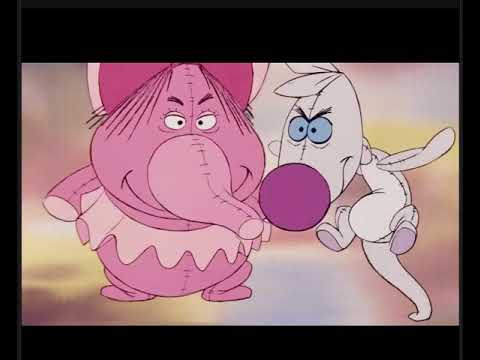
The heffalump is an old storybook mispronunciation made flesh. The woozle is the shadow of the unknown. Put them together and you get a tidy snapshot of mid-century childrens entertainment learning to flirt with surrealism. I have heard people compare the scene to earlier Disney dream logic, and the kinship is real: the studio understood that you can show a kid something strange as long as the music gives them a pattern to hold.
Technical Information
- Artist: The Mellomen
- Featured: None
- Composer: Richard M. Sherman; Robert B. Sherman
- Producer: Salvador Camarata (soundtrack-album configuration)
- Release Date: December 20, 1968
- Genre: Children's; soundtrack; novelty chorus
- Instruments: Vocal quartet/chorus; orchestral accompaniment
- Label: Disneyland Records
- Mood: Playful, jittery, mock-threatening
- Length: About 2:03 (common catalog timing for widely circulated recordings)
- Track #: Side 2, Track 5 (soundtrack-album listing)
- Language: English
- Album: Winnie the Pooh and the Blustery Day (soundtrack album)
- Music style: Vaudeville-leaning cartoon chorus with a looping hook
- Poetic meter: Mostly trochaic bursts with patter-style internal rhymes
Questions and Answers
- Who wrote the song?
- Richard M. Sherman and Robert B. Sherman, the songwriting team behind much of Disneys classic family musical catalog.
- Where does it appear in the story?
- It underscores Poohs nightmare after he is warned about honey-stealing creatures, turning a casual scare into a full dream montage.
- Are the creatures real in the plot?
- No. The point is that the fear is self-generated. The dream gives shape to a rumor because Poohs mind is trying to make the warning concrete.
- Why is the hook so persistent?
- Because it is built like a chant, not a narrative verse. The repetition feels like proof, which is exactly how the dream is trying to convince Pooh.
- Is it meant to be scary?
- It is scary the way a spooky story for kids is scary: more strange than threatening, with humor baked into the phrasing and the nonsense names.
- What does the song say about Pooh as a character?
- It highlights his innocence and his single-minded love of honey. The dream attacks the one thing he cannot shrug off.
- Why does the music pair so well with surreal animation?
- The chorus stays structured while the visuals mutate. The stable rhythm gives the animators freedom to get weird without losing the viewer.
- Did the song continue beyond the original featurette?
- Yes. It has been recycled in compilations, sing-along contexts, and later Pooh packages, helping it survive as a stand-alone Halloween-season favorite.
- Is this connected to the 1977 Pooh compilation film?
- Yes. The original short was later included as a segment in the 1977 feature compilation, which helped the song reach new audiences.
Awards and Chart Positions
The song itself is best understood as part of a larger award-winning package. Winnie the Pooh and the Blustery Day won the Academy Award for Best Animated Short Film, credited to Walt Disney as producer, and that recognition has followed the short for decades. In practice, the dream sequence acts like the shorts calling card: the moment audiences cite when they explain why the film still feels bold.
| Award | Year | Work | Result |
|---|---|---|---|
| Academy Award - Best Animated Short Film | 1969 ceremony | Winnie the Pooh and the Blustery Day | Won |
How to Sing Heffalumps and Woozles
This is a chorus-driven patter piece, and it rewards clarity more than vocal fireworks. Reported metrics for common catalog recordings often list it around 120 BPM in a C-centered framework, with a practical singable span that sits comfortably for many ensembles.
- Tempo first: Lock the pulse at a steady medium-fast pace. If the tempo drifts, the joke loses its snap.
- Diction: Treat the nonsense words like tongue twisters. Over-articulate consonants on the first few run-throughs, then relax without smearing.
- Breathing: Plan breaths around phrase endings, not around anxiety. Short phrases invite panic-breathing, so mark your inhalations like a drummer marks fills.
- Flow and rhythm: Keep syllables even. The song sells the idea of inevitability, and that comes from unbroken forward motion.
- Accents: Punch key nouns and threats, then back off. If every word is stressed, none of them land.
- Ensemble blend: If you are singing in a group, aim for a single chorus voice. The creepiness comes from unanimity.
- Mic and placement: Use a slightly brighter placement for intelligibility, but avoid harshness. Think storybook narrator with a wink.
- Pitfalls: Rushing the ends of lines, swallowing final consonants, and turning it into shouting. It should sound cheerful while describing trouble.
Additional Info
Outside the film, the song has taken on a second life as a Halloween-season staple. It shows up in later compilation releases credited to Disney chorus lineups, and it also pops up in modern genre detours - for example, Powerglove folded it into a 2010 metal-and-cartoon theme album, treating the hook like a riff you can headbang to. Disney has also circulated remix-branded versions in the streaming era, leaning into the fact that this is one of their friendliest spooky tunes.
The dream sequence has also escaped into place-based storytelling. The Many Adventures of Winnie the Pooh theme-park ride incorporates scenes inspired by the short, including the Heffalump-and-Woozle passage, which is a neat endorsement of how visually and musically distinctive the moment remains.
Key Contributors
| Entity | Type | Relationship (S-V-O) |
|---|---|---|
| Richard M. Sherman | Person | Richard M. Sherman wrote the music and lyrics for the song with Robert B. Sherman. |
| Robert B. Sherman | Person | Robert B. Sherman co-wrote the music and lyrics with Richard M. Sherman. |
| The Mellomen | MusicGroup | The Mellomen performed the song on the soundtrack-album listing. |
| Wolfgang Reitherman | Person | Wolfgang Reitherman directed the featurette that contains the song sequence. |
| Salvador Camarata | Person | Salvador Camarata produced the listed soundtrack-album release. |
| Disneyland Records | Organization | Disneyland Records released the soundtrack-album configuration. |
| Winnie the Pooh and the Blustery Day | CreativeWork | The featurette presents the song as a non-diegetic dream montage. |
| The Many Adventures of Winnie the Pooh | CreativeWork | The 1977 compilation includes the earlier featurette as a segment. |
Sources: Academy of Motion Picture Arts and Sciences, D23, Wikipedia, IMDb, SongBPM, SecondHandSongs, Spotify, YouTube