Jesus Christ Superstar Lyrics: Song List
- Act 1
- Overture
- Heaven On Their Minds
- What's The Buzz
- Then We Are Decided
- Strange Thing Mystifying
- Everything's Alright
- This Jesus Must Die
- Hosanna
- Simon Zealotes
- Poor Jerusalem
- Pilate's Dream
- The Temple
- I Don't Know How To Love Him
- Damned For All Time / Blood Money
- Act 2
- The Last Supper
- Gethsemane (I Only Want To Say)
- The Arrest
- Peter's Denial
- Pilate And Christ
- King Herod's Song (Try It And See)
- Could We Start Again Please?
- Judas' Death
- Trial Before Pilate
- Superstar
- The Crucifixion
- John Nineteen: Forty-One
About the "Jesus Christ Superstar" Stage Show
On Broadway, the show was exhibited in 1971; before that, a recording of the rock opera on vinyl was released. Due to the immense popularity of the album, it was decided to make a musical, which became incredibly famous. Mark Hellinger Theatre hosted the show. Jeff Fenholt played the main role. For the first time, the show closed after 2 years & 700+ performances. Some felt the show was too protuberant, while others found it graceful and consistent. Anyway, the play attracted a lot of attention. Andrew Lloyd Webber, the creator of it, for some reason, did not like the original spectacle, which he considered a poor implementation of his ideas, even though the show was nominated for five Tony Awards (though it didn’t win any).
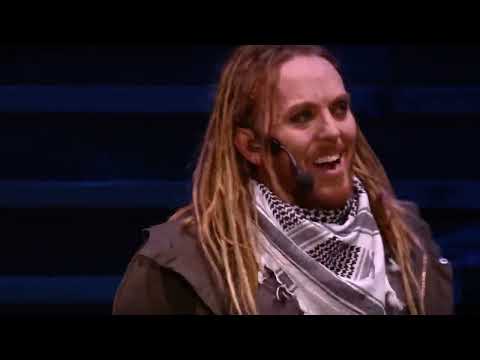
In London in 1972, under the leadership of Jim Sharman, the spectacle lasted 8 fantastic years! At that time, it was an absolute record for the duration of the musical in the UK, with much notable success than on Broadway. Dmitri Shostakovich, the outstanding Belarusian-Polish composer, also attended performances and admired the grace and majesty of the music notes’ overflow, of brass, strings & woodwind.
Other notable stagings of this production were: North America in 1971, Sweden in 1972 (for 5 days only), South Australia in 1972 for 1 day, Melbourne (during 1972-1974), Paris (1973 in Théâtre de Chaillot, for 1 month), Mexico, Peru, and Singapore in 1974, US touring in 1976-1980. The revival was made on Broadway in 1977-1978. Venezuela saw the musical in 1981, with a fantastically huge cast of 163 people. It went to Austria for 3 years, from 1982, and it has also been in Asia and Australia. The Broadway revival was in 1992, New Zealand hosted it in 1994, US small tour was in 1994. In 1996, it went to the Lyceum Theatre in Great Britain, followed by a tour in the UK the same year. It continued from 2002–2012 in various countries.
In recent news, "Jesus Christ Superstar" has seen a resurgence of interest, particularly with the 2018 NBC live television production, which starred John Legend as Jesus, Sara Bareilles as Mary Magdalene, and Alice Cooper as King Herod. This production was widely praised for its contemporary take on the classic musical and brought a new generation of fans to the show.
In 2021, a 50th-anniversary North American tour was announced, celebrating the enduring legacy of the musical. This tour featured updated staging and technology while remaining faithful to the original score and lyrics. The tour has been met with enthusiastic audiences and critical acclaim, demonstrating the show's timeless appeal.
Additionally, a new West End production opened in 2022, directed by Timothy Sheader, which incorporated innovative set designs and modern choreography, adding a fresh perspective to the beloved musical. This production has been lauded for its bold artistic choices and has attracted a diverse audience.
Release date of the musical: 1971
"Jesus Christ Superstar" – The Musical Guide & Song Meanings
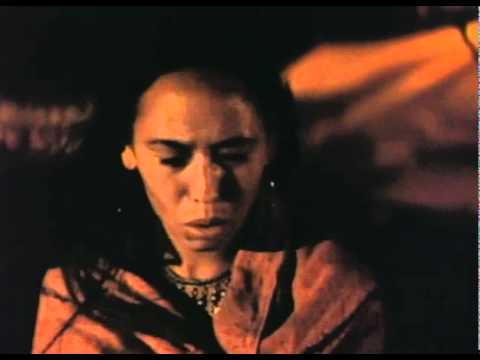
Review: why the lyrics still sting
Is this show about Jesus, or about the panic of being near someone people are starting to worship? Tim Rice’s key move is perspective. He makes Judas the first voice you hear, and he keeps the story tethered to political optics: crowds, headlines, reputations, bodies. That angle turns familiar gospel events into arguments about messaging. The lyrics are rarely “period.” They are blunt, contemporary, and suspicious of anyone selling certainty.
That suspicion is the motor. Judas speaks in warnings and accusations, a man trying to manage a movement he can no longer steer. Jesus, by contrast, is written as a human under impossible projection, increasingly isolated by the myth being built around him. Even the love songs are debates. “I Don’t Know How to Love Him” is not a romantic pause; it is a character trying to name a feeling that keeps changing shape under public scrutiny.
Musically, Lloyd Webber’s score fuses rock with oratorio muscle: recitative-like scenes that never stop moving, choruses that behave like a crowd you cannot mute, and repeated motifs that make the whole piece feel like one long, tightening circuit. The sound matters because it makes theology feel physical. The drums push. The guitars press forward. The chorus arrives like a demonstration march. You do not “reflect” on the Passion here. You get chased through it.
Viewer tip: if you only know the radio staples, listen straight through without shuffle at least once. The score is built on momentum, and the lyrics land hardest when you hear how quickly private doubts get swallowed by public noise.
How it was made: the concept-album gamble
The quickest way to understand the writing is to remember the order of operations. “Jesus Christ Superstar” was written to exist as a record before it could exist as a production. Lloyd Webber and Rice were young, producers were wary of a Bible-based rock opera, and the creators chose an album as a proof-of-concept. They wrote “Superstar” early as a flare in the sky, then built the rest of the score once they saw the public would engage with the premise.
The best origin anecdote is almost too neat for theatre, which is why it has lasted. A melody scribbled on a napkin, later repurposed into the title song, becomes the seed for the whole enterprise. It is a practical reminder that the show’s famous big questions are carried on craft decisions that started small: a hook, a riff, a chorus you can’t shake.
Rice also leaned on gospel texts as raw material, while shaping dialogue with pop immediacy. The result is a libretto that sounds like it belongs to its era of protests and counterculture, not to ancient Judea. That is why it keeps returning. Each revival can swap the costumes and still find a modern argument inside the words.
Key tracks & scenes: lyric moments that turn the plot
"Heaven on Their Minds" (Judas)
- The Scene:
- Night moving toward dawn. Judas paces on the edge of a gathering movement, lit like a man already under interrogation. He is not praying. He is calculating, and he cannot stop.
- Lyrical Meaning:
- The lyric is a warning dressed as intimacy. Judas frames fame as a fuse and devotion as a mob. The show’s thesis arrives immediately: this story will be about consequences, not miracles.
"What's the Buzz / Strange Thing, Mystifying" (Apostles, Jesus, Judas, Mary)
- The Scene:
- Communal energy, restless bodies. People talk over one another the way crowds do. The light feels busy and overheated, like a room that cannot breathe.
- Lyrical Meaning:
- Rice uses chatter as dramaturgy. The lyrics show how quickly a group can turn a person into an idea. Jesus becomes the subject of rumor before he gets to be a man.
"Everything's Alright" (Mary Magdalene, Judas, Jesus)
- The Scene:
- Mary tries to soothe Jesus with touch and practical care. The staging often narrows to lamplight, a brief private corner inside a public storm.
- Lyrical Meaning:
- The words are comfort that never fully convinces. Mary sings reassurance; Judas hears waste; Jesus hears relief he cannot afford to accept. The lyric becomes a three-way argument about what “love” is allowed to be.
"This Jesus Must Die" (Caiaphas, Annas, Priests)
- The Scene:
- Authority meets in shadow. The music feels like policy being written. Lights tend to cut faces into angles, as if power itself is a mask.
- Lyrical Meaning:
- It is chilling because it is administrative. The lyrics treat execution as risk management, which is exactly the point: the state speaks in calm sentences while planning violence.
"The Temple" (Jesus, Ensemble)
- The Scene:
- Noise, commerce, bodies pressing forward. The lighting often turns harsh, almost white-hot, as if moral outrage has its own glare.
- Lyrical Meaning:
- Jesus’s language shifts into command and disgust. The lyric is less sermon than rupture: a man realizing the story around him has already been monetized.
"I Don't Know How to Love Him" (Mary Magdalene)
- The Scene:
- Stillness after chaos. Mary is alone enough to admit she cannot categorize what she feels. The light typically softens, but the moment is not safe. It is exposed.
- Lyrical Meaning:
- Rice writes uncertainty as the purest emotion in the show. The lyric keeps circling the same question because love, here, is a problem with no socially acceptable answer.
"The Last Supper" (Jesus, Judas, Apostles)
- The Scene:
- A table that looks like a press conference. The mood swings fast: celebration, suspicion, collapse. Lighting often isolates Jesus while the group keeps moving, a leader already alone in a room full of followers.
- Lyrical Meaning:
- The lyrics turn betrayal into inevitability. Jesus is exhausted by role-playing. Judas is furious that the narrative is being written without consent. The “meal” becomes a battle over authorship.
"Gethsemane (I Only Want to Say)" (Jesus)
- The Scene:
- Night in the garden. The stage empties. Light becomes lunar and unforgiving. Jesus is physically alone, arguing with God as if trying to negotiate a contract he never signed.
- Lyrical Meaning:
- This is the show’s most human lyric: fear stated plainly, then wrestled into acceptance. The writing makes divinity secondary to dread. The power is that it refuses to tidy the panic.
"King Herod's Song" (Herod)
- The Scene:
- A grotesque nightclub interruption in the middle of a tragedy. Herod’s space is usually lit like an entertainment trap: bright, performative, and hostile.
- Lyrical Meaning:
- The lyric turns skepticism into a circus act. Herod does not ask for truth; he asks for a trick. The show uses comedy as a weapon, then shows how easily power laughs at pain.
Live updates (2025/2026)
Information current as of 28 January 2026. The show remains a reliable revival magnet, especially for limited-run “event” castings. In the US, the Hollywood Bowl mounted a high-profile 2025 edition with Cynthia Erivo as Jesus and Adam Lambert as Judas, a pairing engineered for both vocal fireworks and cultural conversation. In the UK, the Regent’s Park Open Air Theatre revival line continues to travel: a London Palladium season is scheduled for 20 June through 5 September 2026, led by Sam Ryder as Jesus, with the production framed as a retooled version of the Open Air staging.
Regionally, presenters keep booking the modern revival package because it scales: it can play as a stripped concert-oratorio or as a full-throttle rock pageant. That flexibility is part of the show’s long life. It keeps finding new ways to make the same lyric questions feel current: who gets worshipped, who gets blamed, and who gets left holding the guilt.
Notes & trivia
- The score was designed to work as a concept album before it had a producer willing to stage it, and the album’s success powered the first major productions.
- Andrew Lloyd Webber’s official origin story traces the title-song melody to a restaurant napkin sketch, later “resurrected” when the Judas angle clicked.
- The official licensing “musical numbers” list shows how tightly the show is organized around sung-through narrative, with most plot beats carried by continuous music rather than dialogue scenes.
- The original Broadway production opened on 12 October 1971 at the Mark Hellinger Theatre and ran 711 performances, according to IBDB.
- Early controversy came from multiple directions: some Christians objected to the depiction of Jesus and Mary Magdalene, while Jewish organizations raised concerns about portrayals of priestly antagonists.
- Major anniversary reissues of the 1970 recording have packaged demos, interviews, and expanded materials, reinforcing that the “album-first” identity is not a footnote but a brand.
Reception: outrage, praise, and the long afterlife
Critical reaction has always been a tug-of-war between form and subject. Some reviewers treat it as provocative pop. Others treat it as serious theatre using pop as its language. The most interesting through-line is that modern reviews often praise the show most when it leans into human psychology instead of pageantry: when it lets Judas be a fully drawn antagonist and lets Jesus be frightened.
“There are spotty moments … but by the time the final song kicks in, you’ll be a believer.”
“Sure, we’ve taken great dramatic license, but no major trait of character is there that was not in the gospels.”
“In Sam we have a true superstar to play the iconic title role.”
Quick facts: recordings, credits, and releases
- Title: Jesus Christ Superstar
- Broadway opening: 12 October 1971 (Mark Hellinger Theatre)
- Type: Sung-through rock opera
- Music: Andrew Lloyd Webber
- Lyrics: Tim Rice
- Story frame: The final days are filtered through Judas’s anxiety and dissent, rather than treated as a neutral chronicle.
- Core recordings to know: 1970 original concept album (the “album-first” blueprint); 1971 original Broadway cast recording (selected numbers); film soundtrack and later live/cast editions.
- Act structure (numbers list): Act I builds from “Heaven on Their Minds” through “Damned for All Time/Blood Money”; Act II runs “The Last Supper” through “John 19:41.”
- Selected notable placements: “The Temple” as the public rupture; “Gethsemane” as the private breakdown; “King Herod’s Song” as mocking spectacle; “Trial Before Pilate / 39 Lashes” as state violence staged as procedure.
- Major modern staging lineage: The Regent’s Park Open Air Theatre revival track, later touring and transferring into large venues.
Frequently asked questions
- Who wrote the lyrics in “Jesus Christ Superstar”?
- Tim Rice wrote the lyrics, with music by Andrew Lloyd Webber.
- Why does Judas feel like the lead character?
- The show is built around Judas’s viewpoint and his fear that a spiritual movement is turning into a dangerous celebrity machine. Many of the most pointed lyrics belong to him, including the opening number.
- Is the soundtrack album the same as the stage score?
- Not exactly. The 1970 concept album is the foundational version and helped prove the piece could work. The original Broadway cast album is a separate recording that presents selected material from the 1971 production, and later films and tours have their own recordings and edits.
- Where does “Gethsemane” sit in the story?
- It arrives after the Last Supper and before the arrest, when Jesus is alone in the garden and argues with God about the coming execution.
- Why was the show controversial?
- Objections came from multiple directions, including concerns about how Jesus is portrayed, implications about relationships, and how certain antagonists are framed. The work’s rock style and its skepticism toward certainty intensified those reactions.
- Is “Jesus Christ Superstar” touring or reviving right now?
- Yes in intermittent, event-driven ways. A major London Palladium season is scheduled for summer 2026, and there was a headline Hollywood Bowl run in August 2025.
Key contributors
| Name | Role | Contribution |
|---|---|---|
| Andrew Lloyd Webber | Composer | Rock-oratorio score built for continuous narrative drive and recurring motifs. |
| Tim Rice | Lyricist | Modern, argumentative lyric voice; centers Judas’s skepticism and public-pressure themes. |
| Tom O’Horgan | Original Broadway director | Staged the 1971 Broadway production that cemented the show’s early reputation. |
| Timothy Sheader | Director (Regent’s Park revival lineage) | Modern revival approach that has toured and is being re-imagined for major venues. |
| Drew McOnie | Choreographer (Palladium 2026) | Movement language for the current revival track transferring to the London Palladium. |
| Tom Scutt | Designer (Palladium 2026) | Visual world for the contemporary revival package (as publicly credited for the Palladium run). |
Sources: IBDB, Playbill, Andrew Lloyd Webber (official site), ALW Show Licensing, The Guardian, Religion News Service, London Palladium / LW Theatres, Wikipedia (album and show entries for composition and numbers list), uDiscoverMusic.