
Pink Elephants on Parade (Dumbo) Lyrics
Pink Elephants on Parade (Dumbo)
Look out! Look out!Pink elephants on parade
Here they come!
Hippety hoppety
They're here and there
Pink elephants ev'rywhere
Look out! Look out!
They're walking around the bed
On their head
Clippety cloppety
Arrayed in braid
Pink elephants on parade
What'll I do? What'll I do?
What an unusual view!
I could stand the sight of worms
And look at microscopic germs
But technicolor pachyderms
Is really much for me
I am not the type to faint
When things are odd or things
are quaint
But seeing things you know that ain't
Can certainly give you an awful fright!
What a sight!
Chase 'em away!
Chase 'em away!
I'm afraid need your aid
Pink elephants on parade!
Pink elephants!
Pink elephants!
Song Overview
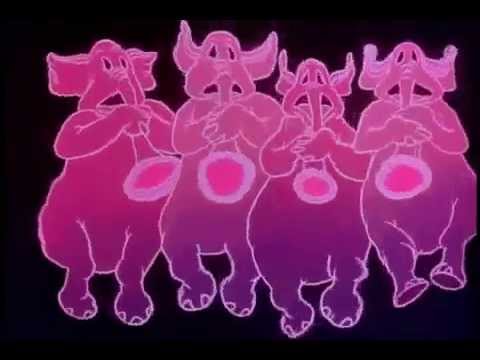
Review and Highlights
Quick summary
- First heard in the 1941 animated feature Dumbo, tied to the champagne-spiked hallucination sequence.
- Written by Oliver Wallace (music) and Ned Washington (lyrics), with a classic Disney chorus delivery credited to The Sportsmen Quartet.
- Built like a carnival march that keeps shapeshifting: a hook, a new costume, then a new mask, all in quick cuts.
- Later echoed in the 2019 live-action Dumbo as a nod rather than a full-on singalong.
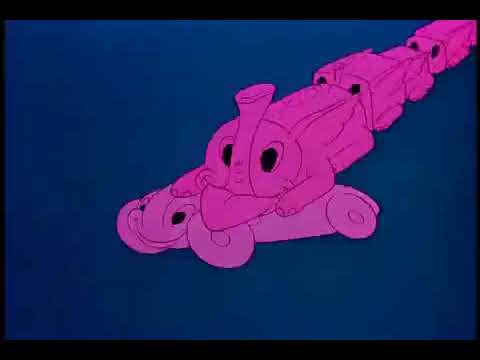
Dumbo (1941) - animated film sequence - non-diegetic. The number underscores Dumbo and Timothy's champagne-induced visions after the clowns' celebration spills into the water trough, landing roughly around the film's mid-point. Its job is not to advance plot with dialogue, but to tilt the movie into surreal motion so the next beat (waking in a tree, the discovery of flight) feels like a hard snap back to reality.
Key takeaways
- Hook as warning siren: the repeated refrain functions like a carnival barker with a flashlight, corralling attention as the visuals turn stranger.
- Rhythm as conveyor belt: the march pulse keeps the listener moving even when the harmony and textures wobble.
- Sound design before the term existed: the vocal shouts and choral punctuations behave like cartoon Foley, glued to edits and transformations.
- A Disney detour with teeth: the sequence is famous because it briefly refuses the studio's usual safety rails.
Creation History
In the Dumbo songbook, this one belongs to Oliver Wallace and Ned Washington, a pairing that leans into theatrical timing: set up a simple march figure, then keep re-coloring it until it feels like the ground is sliding. Contemporary catalog notes list the song among Dumbo's credited numbers, and later soundtrack reissues folded it intozgether with cues and medleys that mirror the film's quick edits. If you hear it on modern platforms, you are often hearing an expanded soundtrack assembly rather than the tighter, scene-locked cut from the movie itself.
Song Meaning and Annotations
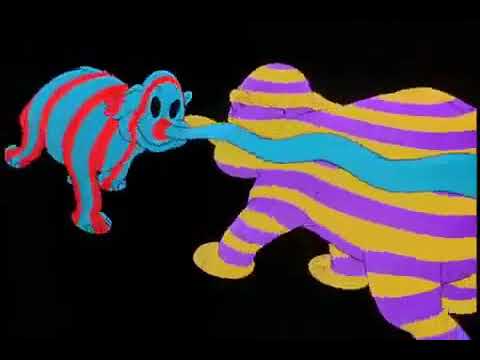
Plot
The story context is blunt and almost comical on paper: a spilled bottle of champagne turns a water trough into trouble, and the hero and his sidekick drift into a hallucinated parade. On screen, the music does the heavy lifting. The march cadence pulls the viewer forward while the visuals fracture into morphing shapes, elephant silhouettes, and impossible instruments, until the sequence burns itself out and the film cuts back to daylight logic.
Song Meaning
The number is a warning disguised as a singalong: when the refrain calls for attention, it is not inviting applause so much as announcing that perception has become unreliable. The parade is both spectacle and trap - a moving line that keeps multiplying, reshaping, and swallowing the frame. I have always heard it as Disney flirting with the idea that wonder can turn abrasive if you push it far enough: the same showmanship that sells a circus act can also swallow the performer.
Annotations
"Pink elephants on parade"
The phrase is delivered like an alarm, not a lullaby. It turns a nonsense image into a marching order, and that is why it sticks: the line is simple, but the command behind it is strict.
"Look out, look out"
A tiny lyric, huge function. It frames the sequence as something happening to the characters, not something they control. The shout also behaves like a rhythmic pickup into each new visual gag.
"hippety, hoppety"
The bounce in the wording is a trick. The rhythm reads playful, but the scene keeps slipping into harsher shapes, which makes the cheeriness feel slightly off-kilter.
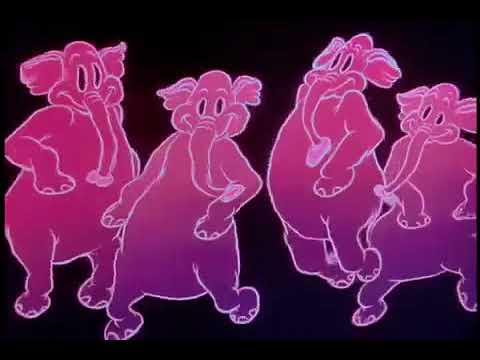
Genre and rhythm fusion
The engine is a march, but the number keeps borrowing from revue writing: short motifs, call-and-response shouts, and quick switches that feel like stage lighting cues. That blend is part of the trick - a rigid pulse supporting a sequence that looks like it is melting.
Production and instrumentation
Listen for how the chorus enters as punctuation rather than narration. The voices do not carry plot the way a Broadway verse might; they act like signage and sound effects, marking entrances, exits, and transformations. Brass-and-percussion gestures sell the parade idea, while the arrangement plays with register and density to suggest swelling crowds, then sudden emptiness.
Cultural touchpoints
The scene has a long afterlife as shorthand for animated surrealism. You still see critics cite it when talking about family films briefly stepping into dream-logic. As stated in TIME magazine coverage of the 2019 remake, the newer film treats the number as a recognizable reference point, even while shifting away from the original's singalong structure.
Technical Information
- Artist: The Sportsmen Quartet
- Featured: None credited
- Composer: Oliver Wallace
- Producer: Not reliably credited in public listings
- Release Date: October 23, 1941 (first theatrical release context)
- Genre: Film soundtrack; march; novelty song
- Instruments: Chorus; brass; percussion; orchestra (soundtrack assemblies vary)
- Label: Walt Disney Records (noted on major soundtrack reissues)
- Mood: Carnival-bright with a slippery undertone
- Length: Varies by release; a common soundtrack version is about 4:30
- Track #: Often listed as a mid-album cue on Dumbo soundtrack editions (varies by configuration)
- Language: English
- Album (if any): Dumbo (Soundtrack from the Motion Picture) (reissue and compilation configurations)
- Music style: March-based choral set piece with revue-style motif switches
- Poetic meter: Mixed and chant-like, built for rhythmic shouts more than strict scansion
Questions and Answers
- Why does the number feel like it is always speeding up, even when the beat stays steady?
- The arrangement keeps changing its clothes. A stable march pulse is masked by rapid motif swaps, sudden choral interjections, and shifting textures that imitate jump cuts.
- Is the song diegetic in the film?
- No. It functions as underscore and chorus commentary for the hallucination sequence rather than a performance the characters stage inside the story world.
- What is the core message behind the parade image?
- Showmanship without control becomes a conveyor belt. The parade keeps moving, multiplying, and reshaping, turning spectacle into something that can swallow the viewer.
- Who wrote it?
- Public catalogs attribute the music to Oliver Wallace and the lyrics to Ned Washington.
- Who is credited as the key vocal presence in the original film context?
- The vocal performance is commonly credited to The Sportsmen Quartet, a studio vocal group heard across several early Disney features.
- Why do modern soundtrack versions sometimes run longer than the scene?
- Reissues and compilations often rebuild cues as listening tracks, combining fragments, bridges, or adjacent underscore so the piece plays cleanly outside the picture.
- How does the 2019 film use the idea without copying the old structure?
- It treats the number as a reference point: a recognizable theme for a parade-like set piece, presented more as atmosphere than a chorus-led singalong.
- What makes the lyric writing stand out despite its simplicity?
- The lines are engineered as rhythmic signals. Short warnings and bouncing syllables act like percussive hits, matching animation beats rather than telling a story.
- Is this connected to the wider cultural phrase "seeing pink elephants"?
- Yes in spirit. The sequence dramatizes intoxication-induced visions, aligning with the idiom's association with drunken hallucinations, but it is stylized for family animation.
- Why does it remain a frequent reference in criticism of Disney animation?
- It is an early, mainstream example of Disney stepping into overt surrealism for a sustained set piece, closer to an experiment than a conventional narrative song.
How to Sing Pink Elephants on Parade (Dumbo)
Because the best-known versions are chorus-driven, "how to sing it" is often about rhythm, diction, and character more than virtuoso range. Streaming metadata commonly lists a soundtrack version around 111 BPM in F major, while some vocal databases and arrangements point to alternative keys and ranges. Treat these as starting points, then match your edition.
- Tempo: about 111 BPM (common soundtrack metadata)
- Key: often listed as F major in soundtrack metadata; some arrangements appear in A minor
- Typical vocal range: some vocal databases suggest D3-F4 for a lead-line arrangement, but chorus editions can sit differently
- Style notes: march articulation, crisp consonants, and clipped phrase endings
- Lock the tempo first. Practice with a metronome at the target pace, then speak the lyric rhythm on a single pitch like a drumline count.
- Dial in diction. Hit the warning words cleanly (especially the repeated calls) and keep vowels short so the march pulse does not sag.
- Breathing plan. Use quick, silent inhales between shouts. Think "sip of air" rather than a long reset, since phrases arrive fast.
- Lean into the bounce. Let the playful syllables land slightly forward, but do not turn it into swing unless your arrangement asks for it.
- Accent like an animator. Mark a few hard accents that match visual cuts: a shout, a stop, a sudden re-entry. Too many accents flatten the surprise.
- If singing with ensemble. Assign roles: one voice for calls, another for responses, and keep unison attacks tight. The effect depends on precision.
- Microphone approach. If amplified, back off on the shouts and come closer on quieter linking phrases to keep levels even.
- Common pitfalls. Rushing the consonants into mush, over-sustaining notes (this is a march, not a ballad), and forcing a "spooky" tone at the expense of clarity.
Additional Info
Cover versions show how flexible the tune is. Sun Ra and His Arkestra recorded it for Hal Willner's Disney tribute project Stay Awake, a choice that reads like a wink: if any artist could have taken the parade into deep space, it was Sun Ra, yet the arrangement is often described as surprisingly faithful. Other artists have treated it as cabaret fuel or indie-theater spectacle, including Circus Contraption and Lee Press-On and The Nails. The tune also shows up in databases of film music as a reference point for Disney's early experiments with surreal set pieces.
Key Contributors
| Entity | Type | Relationship (S-V-O) |
|---|---|---|
| Oliver Wallace | Person | Oliver Wallace composed the music for the song. |
| Ned Washington | Person | Ned Washington wrote the lyrics for the song. |
| The Sportsmen Quartet | MusicGroup | The Sportsmen Quartet performed the vocal parts in the film credit tradition. |
| Dumbo (1941) | Work (Film) | Dumbo (1941) features the song as a hallucination-sequence set piece. |
| Walt Disney Productions | Organization | Walt Disney Productions produced the film that introduced the song. |
| Walt Disney Records | Organization | Walt Disney Records released major soundtrack reissues that include the number. |
| Tim Burton | Person | Tim Burton directed the 2019 adaptation that references the song. |
| Dumbo (2019) | Work (Film) | Dumbo (2019) includes a rendition as a nod to the animated original. |
| Sun Ra and His Arkestra | MusicGroup | Sun Ra and His Arkestra recorded a notable cover for a Disney tribute album. |
Sources: American Film Institute Catalog entry for Dumbo, Wikipedia entry for Pink Elephants on Parade, Apple Music Dumbo soundtrack listing, TIME magazine feature on Dumbo remake differences, Bandcamp listing for Sun Ra and His Arkestra album Pink Elephants on Parade, Discogs listing for Stay Awake Disney tribute album, SongBPM and Tunebat track-metadata pages