
Are We Dancing (The Happiest Millionaire) Lyrics
Are We Dancing (The Happiest Millionaire)
Are we dancingare we really here
is this feeling something real
or will it disappear
are we dancing
does the music soar
was this lovely song I hear
ever heard before
Are you're eyes confessing things
I alone can see
or is my imagination
flying away with me
Are we dancing
say we really are
than I'll know that I reached into the sky
I reached into the sky and touched a star
Is this feeling something real
or will it disappear
was this lovely song I hear
ever heard before
Are you're eyes confessing things
I alone can see
or is my imagination
flying away with me
Are we dancing
say we really are
then I'll know that I reached into the sky
I reached into the sky and touched a star
Song Overview
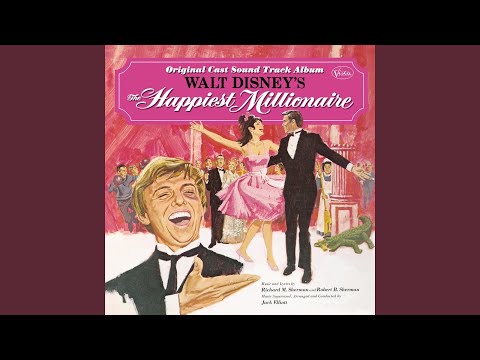
Review and Highlights
Quick summary
- Where it appears: A romantic duet in Disney's live-action musical The Happiest Millionaire, staged as a young-couple escape from a party into a more private moment.
- Who performs it: John Davidson as Angie Duke and Lesley Ann Warren as Cordelia "Cordy" Biddle on the principal soundtrack releases.
- What it sounds like: A waltz-leaning ballad shaped as a string of questions, with a soft-rock sheen that still fits a 1916 setting.
- Why it matters in the story: It seals first love with a kind of polite disbelief - the characters keep asking because the feeling arrives too fast to trust.
- Catalog life: It has stayed visible through soundtrack reissues and tribute albums of Sherman Brothers material.
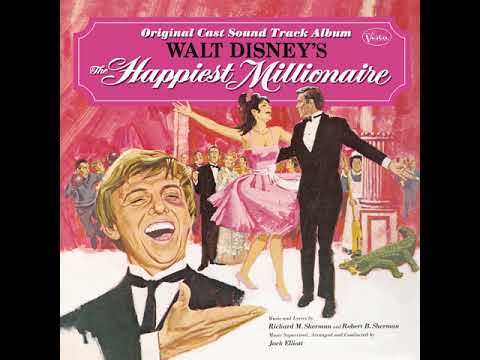
The Happiest Millionaire (1967) - film - diegetic. The lovers first meet amid high-society bustle, then drift out of the crowd and let the melody do what manners cannot. I have always liked how the camera-and-choreography treat it like a doorway: once they step into the duet, the movie lets them breathe.
Here is the trick: the lyric is basically a checklist of doubt, yet the music keeps answering with calm assurance. That tension is the romance. The tune glides in three, the harmony stays warm, and the voices rarely push. Instead, they float in that bright Disney manner where sincerity is carried by phrasing, not volume. The Sherman Brothers were masters at writing "talk-singing" that still felt musical, and this one wears that skill lightly.
Creation History
The song was written by Richard M. Sherman and Robert B. Sherman for a project that arrived in theaters during 1967, after a Hollywood premiere in June. As stated by D23, the film premiered in Hollywood on June 23, 1967, and it went through different roadshow and general-release cuts, which helps explain why some viewers remember slightly different pacing around the musical sequences. The song itself was registered in the mid-1960s during production, a paper trail preserved in the US Copyright Office catalog entries.
Song Meaning and Annotations
Plot
Within the film's 1916 Philadelphia world, Angie and Cordy are thrown together at a party where expectations are loud and personal feelings are supposed to stay buttoned up. The duet happens as they separate from the crowd and discover a pocket of privacy. The lyric keeps circling the same uncertainty: is this real, is it mutual, is it too much too soon? By the end, the questions stop feeling like fear and start feeling like wonder.
Song Meaning
The meaning is courtship under etiquette. In a setting where you cannot simply say "I like you" without sounding reckless, the characters ask questions that give each other permission to answer with a look, a pause, a soft echo. The hook is not the title phrase by itself, but what it implies: if we name the moment, we can stay in it. There is also a social subtext: the film is full of status, family pressure, and old-money choreography, and this duet is the rare space where two people stop performing for everyone else.
Annotations
Are we dancing - are we really here?
A smart opening because it frames romance as disorientation. The melody is steady, but the line admits the characters feel off-balance. In performance, that contrast keeps the duet from turning syrupy.
Is this feeling something real - or will it disappear?
This is the lyric's engine: a repeated fear of vanishing. The question is not tragic, it is young. The waltz pulse keeps it buoyant, like they are trying to talk themselves into courage without making a speech.
Or is my imagination flying away with me?
That phrase gives the number its period flavor. Instead of modern bluntness, you get a genteel self-check, the kind of line you could say in a drawing room without scandal.
Style and rhythm
Many Sherman Brothers love songs move like a formal dance, and this one leans into that idea with a clear triple-meter sway. Yet it also borrows a 1960s pop-smoothness in the vocal writing, which is why it feels easy to cover. According to a Disney song reference entry that summarizes the scene, the duet is staged as the pair dance out to a terrace - a neat visual match for a song built on stepping away from the crowd.
Technical Information
- Artist: John Davidson and Lesley Ann Warren
- Featured: None
- Composer: Richard M. Sherman; Robert B. Sherman
- Producer: Varies by release edition (film soundtrack production credited to Disney label teams)
- Release Date: June 23, 1967 (Hollywood premiere context); November 30, 1967 (New York opening); September 1, 1966 (song copyright registration)
- Genre: Soundtrack; waltz-pop ballad
- Instruments: Lead vocals (duet); orchestral accompaniment typical of 1960s film musicals
- Label: Buena Vista Records / Walt Disney catalog labels (varies by edition)
- Mood: Romantic; tentative; bright
- Length: About 3:25-3:27 on common soundtrack listings
- Track #: Appears on the original cast soundtrack album tracklists (position varies by reissue configuration)
- Language: English
- Album (if any): The Happiest Millionaire - Original Cast Sound Track Album; later appears on Sherman Brothers compilations
- Music style: Triple-meter ballad with question-and-answer lyric structure
- Poetic meter: Stress-driven conversational phrasing, shaped around repeated interrogatives
Questions and Answers
- Who sings it in the film soundtrack?
- John Davidson performs as Angie Duke and Lesley Ann Warren performs as Cordelia "Cordy" Biddle on the principal soundtrack releases.
- Where does the duet land in the story?
- It arrives at the moment the couple steps out of a party atmosphere and realizes the flirtation is turning into something more serious.
- Why is the lyric built from questions?
- Because the characters are trying to verify their own luck. The questions let them confess without making a blunt declaration that would feel out of place in the setting.
- Is it a waltz?
- It is written and performed with a clear triple-meter sway, and many modern catalog analyses list it with a waltz-like dance feel.
- Is there an official paper trail for the song?
- Yes. The US Copyright Office catalog entries list the title with Richard M. Sherman and Robert B. Sherman as writer-composers, with a registration dated in 1966.
- Did it have chart impact as a pop single?
- Not in the usual hit-parade sense. Its visibility comes from the film, soundtrack circulation, and later tribute recordings rather than radio-era single charts.
- What are notable cover or tribute recordings?
- A well-known modern tribute version is performed by Tami Tappan and David Burnham on a Sherman Brothers songs compilation, and medley treatments show up in orchestral-pop contexts.
- Why do singers like to revisit it?
- Because it is a duet that plays on nuance. You can stage it with minimal movement and still communicate a full scene through phrasing and eye-line.
- What is the song really saying, in one sentence?
- It is two people asking permission to believe their own first-love moment.
How to Sing Are We Dancing
Think of this as a dance lesson disguised as a duet. The melody wants to glide, and the lyric wants to hesitate. Many key-and-tempo databases peg the recording around 114 BPM in C-sharp major. Use those numbers as training wheels, then focus on storytelling.
- Tempo: Set 114 BPM and count in three. Practice stepping the pulse quietly so you do not flatten the waltz into straight time.
- Diction: Keep question words crisp (are, is, does), then relax vowels. The song lives in gentle contrast.
- Breathing: Breathe after each interrogative clause, not in the middle of it. If you split a question, the line loses its charm.
- Flow and rhythm: Let the first singer lead slightly, and have the second answer like an echo that grows more confident. That arc is the scene.
- Accents: Use light emphasis on the end of each question, as if you are waiting for a nod. Avoid big musical-theater punches.
- Ensemble and doubles: If you add harmony, keep it sparse. Too much harmony makes it sound like a finale rather than an intimate moment.
- Mic technique: Stay close for the questions, back off a touch on the sustained notes so the tone stays open without strain.
- Pitfalls: Rushing the phrasing, over-singing the romance, and ignoring the three-beat sway. If you keep the sway, the number practically stages itself.
Additional Info
The song has a quiet second life in collector culture. It appears in reissued soundtrack contexts and in curated Sherman Brothers tribute projects, where performers treat it as a scene you can sing without sets. According to Playbill coverage of one such tribute album announcement, the track list includes a duet version by Tami Tappan and David Burnham, which frames the tune in a more contemporary theater-vocal style while keeping the original elegance.
There is also an interesting paper-footnote: the copyright registration records the title in 1966, before audiences saw the film in 1967. I like these bureaucratic breadcrumbs. They remind you that what feels like movie magic is also contracts, lead time, and a calendar full of deadlines.
Key Contributors
| Entity | Type | Statement (S-V-O) |
|---|---|---|
| Richard M. Sherman | Person | Richard M. Sherman co-wrote the song for The Happiest Millionaire. |
| Robert B. Sherman | Person | Robert B. Sherman co-wrote the song for The Happiest Millionaire. |
| John Davidson | Person | John Davidson performed the duet as Angie Duke on the soundtrack release. |
| Lesley Ann Warren | Person | Lesley Ann Warren performed the duet as Cordelia "Cordy" Biddle on the soundtrack release. |
| Buena Vista Records | Organization | Buena Vista Records issued the original cast soundtrack album that includes the track. |
| D23 | Organization | D23 documents the Hollywood premiere date for the film in which the song appears. |
| American Film Institute Catalog | Organization | AFI Catalog documents the New York opening date and release context for the film. |
| US Copyright Office catalog entries | Work | The catalog entry lists the song title and its 1966 registration information. |
Sources: D23 A to Z entry for The Happiest Millionaire, American Film Institute Catalog, US Copyright Office Catalog of Copyright Entries (1966 volume via Internet Archive), Apple Music track and album listings, TuneBat key and BPM listing, SecondHandSongs performance page, Playbill (tribute album track list coverage), Discogs master release page