You Belong to My Heart (The 3 Caballeros) Lyrics — Disney: 60 Years of Musical Magic
You Belong to My Heart (The 3 Caballeros) Lyrics
Now and forever
And our love had its start
Not long ago
We were gathering stars while a million guitars played our love song
When I said, "I love you", every beat of my heart said it, too
'Twas a moment like this
Do you remember?
And your eyes threw a kiss
When they met mine
Now, we own all the stars, and a million guitars are still playing
Darling, you are the song, and you'll always belong to my heart
'Twas a moment like this
Do you remember?
And your eyes threw a kiss
When they met mine
Now, we own all the stars, and a million guitars are still playing
Darling, you are the song, and you'll always belong to my heart
Song Overview
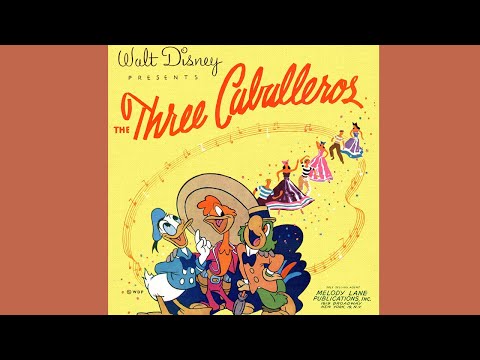
Review and Highlights
Quick summary
- Screen identity: an English-language lyricization of Agustin Lara's bolero "Solamente una vez", tailored for Disney's 1944 feature.
- On-screen role: Dora Luz appears as a stylized, floating presence over a night-lit Mexico City while Donald reacts like a romantic cartoon trapped in live-action gravity.
- Why it lands: the tune stays classic bolero, but the film reframes it as a trigger for surreal visual gags and neon reverie.
- Afterlife: the melody travels far beyond the movie, with mid-1940s pop recordings turning it into a standard.
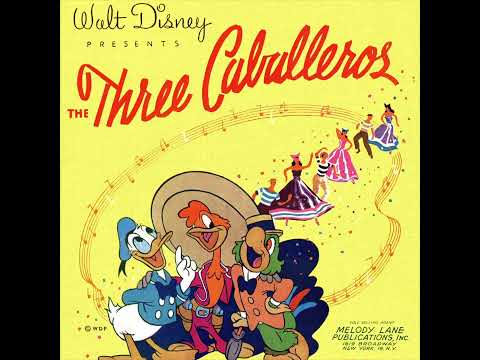
The Three Caballeros (1944) - film - diegetic. Nighttime Mexico City vignette: Dora Luz sings while Donald spirals into a lovestruck fantasy that quickly turns kaleidoscopic (approx. late-film Mexico City chapter). The number matters because it is where the movie stops pretending to be a travelogue and starts behaving like a fever dream with a string section.
The melody is old-school bolero, slow-breath phrasing, long vowels, and a harmony that wants to resolve like a satisfied sigh. The Disney framing adds a second layer: Donald's comic interruptions make the serenade feel both sincere and slightly unruly, like a classy lounge set invaded by a hyperactive mascot. That tension is the hook. The song keeps its candlelit core while the picture turns it into a visual playground.
Key takeaways
- Melody: simple, memorable contour - it survives any arrangement.
- Rhythm: bolero pulse underneath, even when the screen goes abstract.
- Vocal vibe: warm and direct - the performance sells the fantasy without overacting.
- Best lyric image: the famous line about "a million guitars" (kept here as a quick wink, not a sing-along).
Creation History
Agustin Lara wrote "Solamente una vez" in the early 1940s, and it quickly moved through film, radio, and the Latin pop songbook. For Disney's The Three Caballeros, lyricist Ray Gilbert created a new English text rather than a literal translation, giving the tune a different storyline and a Hollywood love-song polish. The film premiered in Mexico City on December 21, 1944, then opened in the United States on February 3, 1945, and the number sits right in the stretch where the movie leans hardest into mixed media spectacle, as stated in the D23 encyclopedia entry for the film.
Song Meaning and Annotations
Plot
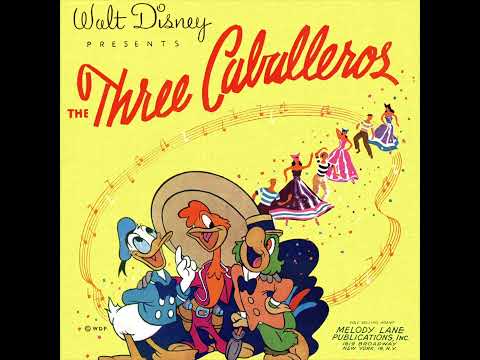
In the movie's Mexico City night sequence, Dora Luz sings while the camera glides through city lights and starry stylization. Donald responds as if the performance is meant only for him, building a private romance out of public imagery. The scene then escalates into a surreal montage: faces in flowers, neon outlines, and interruptions by his two companions that snap the fantasy in and out of focus. It plays like a cartoon courtship ritual staged inside a postcard.
Song Meaning
At its simplest, the English lyric is a vow: the beloved is not just a person but a permanent address in the singer's inner life. The tone is classic ballroom devotion - stars, guitars, memories that replay on cue. But set inside The Three Caballeros, the meaning tilts. What looks like romance also becomes a commentary on desire as projection: Donald is not in love with a partner so much as with an image, a voice, a mood. That is why the animation can turn abstract without losing the thread. The song is the spell, the visuals are the side effects.
Annotations
-
"You belong to my heart now and forever."
A bold promise in one breath. In bolero tradition, that kind of line is not casual flirtation - it is a total claim, delivered softly so it sounds polite while being absolute.
-
"We were gathering stars."
Movie logic loves a line like this: it turns a romance into a landscape. In the film, the sky is not background, it is the stage, so the lyric can be taken literally as set design.
-
"A million guitars."
This is the neat trick of the English adaptation: it replaces the original Spanish song's introspection with a cinematic orchestra of images. It is not about one life-changing love event - it is about turning love into sound and spectacle.
Genre and rhythm fusion
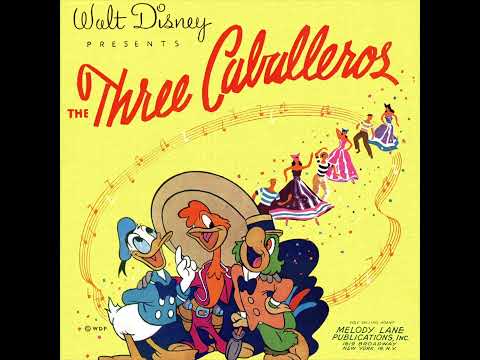
Call it bolero with a Hollywood polish: the pulse is gentle and grounded, but the orchestral dressing pushes it toward studio-era pop. That blend is why the number can sit in a Disney package film and still feel like it wandered in from a grown-up nightclub.
Emotional arc on screen
The vocal begins as a straightforward serenade, then the film reframes it as a catalyst for Donald's runaway imagination. You can hear the steadiness in the phrasing while watching the visuals wobble. That contrast is the point: the song stays composed while the character loses composure.
Touchpoints and context
The Three Caballeros was shaped in the orbit of the Good Neighbor era, with Latin American music presented as both cultural showcase and pop currency. According to the American Film Institute catalog synopsis, the Mexico City fantasy is explicitly anchored by the singer performing this tune, then followed by other dance sequences. That placement makes the song less of a standalone ballad and more of a hinge between travelogue and dream-sequence cinema.
Technical Information
Artist: Dora Luz
Featured: Donald Duck (character response and comic vocalizing in the film sequence)
Composer: Agustin Lara
Producer: Walt Disney Productions (film context); soundtrack production varies by release
Release Date: December 21, 1944 (film premiere, Mexico City); February 3, 1945 (United States release)
Genre: bolero; film song; Latin pop standard
Instruments: vocal with studio orchestra (strings, brass, woodwinds, guitar-like colors, light percussion)
Label: commonly issued on Disney soundtrack and compilation releases (label varies by edition)
Mood: romantic, nostalgic, gently theatrical
Length: about 2:55 (common soundtrack release timing)
Track #: varies by compilation and edition
Language: English (adaptation); related to Spanish original "Solamente una vez"
Album (if any): The Three Caballeros soundtrack and later Disney compilations
Music style: bolero phrasing with studio-pop orchestration
Poetic meter: loose iambic tendency with occasional anapestic lift for melodic fit
Questions and Answers
- Is this the same song as Solamente una vez?
- Yes in melody and lineage. The English text is a new lyricization made for Disney, not a line-by-line translation of the Spanish original.
- Who sings it in The Three Caballeros?
- Dora Luz performs the vocal in the Mexico City night sequence, with the animation reacting around her presence.
- Why does the scene feel half romantic, half chaotic?
- The vocal stays steady and courtly while Donald behaves like a cartoon trying to outrun his own imagination. The contrast is the gag and the charm.
- What is the song really about in the English version?
- A devotion framed as permanence: the beloved is memory, destiny, and home base, expressed through stars-and-music imagery.
- Why do collectors treat it like a standard, not just a Disney tune?
- The melody predates the film and lives comfortably in the bolero and pop repertoire. The movie amplified its reach, then radio and records did the rest.
- Did Disney change the meaning compared to the Spanish song?
- Very much. The Spanish lyric is often read as a once-in-a-lifetime confession, while the English text leans into cinematic romance and spectacle imagery.
- Where else inside Disney does it show up?
- D23 notes it is used in Pluto's Blue Note (1947), where Pluto mimes to a record of the song to attract female dogs.
- Why does the lyric mention guitars so prominently?
- It paints love as accompaniment and atmosphere. In a film built on musical postcards, that image doubles as staging instructions.
- What should listeners focus on first: the voice or the arrangement?
- The phrasing. The line is carried with long breath and careful consonants, which is what makes the orchestral glow feel earned rather than sugary.
Awards and Chart Positions
The Disney film around the number drew awards attention: The Three Caballeros earned Academy Award nominations in the 1946 ceremony for Best Scoring of a Musical Picture and Best Sound Recording. The tune itself escaped the film and hit the pop marketplace hard in 1945 through major band recordings, with documented Billboard Best Seller chart runs.
| Year | Artist or release | Milestone |
|---|---|---|
| 1944 | The Three Caballeros (film sequence) | Premiere in Mexico City on December 21, 1944; United States release on February 3, 1945. |
| 1945 | Bing Crosby with Xavier Cugat orchestra | Billboard Best Seller peak reported at number 4 (entered May 24, 1945). |
| 1945 | Charlie Spivak orchestra | Billboard Best Seller peak reported at number 9 (entered May 17, 1945). |
| 1947 | Pluto's Blue Note (short film) | D23 documents the song as the record Pluto mimes to in the cartoon. |
How to Sing You Belong to My Heart
This is not a showstopper that wants volume. It is a control piece: breath, legato, and tone that stays warm without going syrupy. Streaming-era analyses of the Dora Luz recording commonly place it around 103 to 104 BPM, and in a concert-friendly major key neighborhood (often labeled as B-flat major in chord-based breakdowns). Vocal-range estimates differ by version and transposition, so treat the numbers as starting points, not laws.
Tempo: set a steady bolero pulse first (around 103-104 BPM). Do not rush the ends of lines.
Diction: keep consonants light - think velvet, not typewriter.
Breathing: plan breaths after complete images, not mid-thought. The phrasing wants long arcs.
Flow and rhythm: ride the accompaniment rather than sitting on it. A bolero can drag if you overhold the vowels.
Accents: underline key nouns (stars, guitars, heart) with color, not extra force.
Ensemble and doubles: if you have a second voice or a soft instrument doubling the melody, keep it under the lead to preserve intimacy.
Mic technique: sing closer on softer phrases and step back slightly on lifted notes to keep the tone even.
Pitfalls: avoid over-vibrato on sustained notes and avoid turning it into swing. The charm is in the calm insistence.
Practice materials: rehearse on a simple guitar or piano bolero pattern, then add the orchestral phrasing once the line is stable.
Additional Info
One of the odd pleasures of this song is how cleanly it survives context changes. In the film it is a romantic trigger for animation mayhem; in pop recordings it becomes a straight ballad; in later decades it turns into a nostalgia marker that can be played sincerely or with a wink. According to Consequence magazine's 2023 Disney song ranking, the Disney version keeps much of the gentle Latin feel while Donald's interruptions add a comic edge that not every listener loves, but nobody forgets.
For an archival detail that still matters, the sheet music metadata circulated in collections spells out the credit split plainly: English lyric by Ray Gilbert, with music and Spanish lyric attributed to Agustin Lara. That division is the real story - a melody born in one cinematic world, then re-scripted for another.
Key Contributors
| Entity | Type | Relation | S-V-O statement |
|---|---|---|---|
| Agustin Lara | Person | composer | Agustin Lara wrote the core melody and Spanish lyric for Solamente una vez. |
| Ray Gilbert | Person | lyricist | Ray Gilbert wrote the English lyricization for the Disney adaptation. |
| Dora Luz | Person | performer | Dora Luz performs the vocal in the film's Mexico City sequence. |
| The Three Caballeros | Work (film) | primary screen placement | The film stages the song as a Mexico City night serenade that launches a surreal reverie. |
| Pluto's Blue Note | Work (short film) | reuse | The short uses the tune as the record Pluto mimes to for comedic courtship. |
| Walt Disney Productions | Organization | producer | Walt Disney Productions produced the film that popularized the English adaptation. |
| American Film Institute | Organization | catalog reference | The AFI catalog describes the Mexico City fantasy built around the song performance. |
Sources: D23 A to Z - Three Caballeros, The (film); D23 A to Z - Pluto's Blue Note (film); American Film Institute Catalog - The Three Caballeros; Wikipedia - You Belong to My Heart; Wikipedia - The Three Caballeros; SecondHandSongs - You Belong to My Heart; Internet Archive - You Belong To My Heart (Solamente Una Vez) sheet music item metadata; Chordify - Dora Luz key and BPM listing; MusicStax - Dora Luz timing and BPM estimate; Consequence - Disney songs ranking entry mentioning the performance
Music video
Disney: 60 Years of Musical Magic Lyrics: Song List
- Volume One
- A Whole New World (Aladdin)
- Circle of Life (Lion King)
- Beauty and the Beast (Beauty and the Beast)
- Under the Sea (The Little Mermaid)
- Hakuna Matata (Lion King)
- Kiss the Girl (The Little Mermaid)
- I Just Can't Wait to Be King (Lion King)
- Poor Unfortunate Souls (The Little Mermaid)
- Chim Chim Cher-ee (Mary Poppins)
- Jolly Holiday (Mary Poppins)
- A Spoonful of Sugar (Mary Poppins)
- Let's Get Together (The Parent Trap)
- The Monkey's Uncle (The Monkey's Uncle)
- The Ugly Bug Ball (Summer Magic)
- The Spectrum Song (Walt Disney's Wonderful World of Color)
- Colonel Hathi's March (The Jungle Book)
- A Whale of a Tale (20,000 Leagues Under the Sea)
- You Can Fly! You Can Fly! You Can Fly! (Peter Pan)
- The Work Song (Cinderella)
- A Dream is a Wish Your Heart Makes (Cinderella)
- Zip-A-Dee-Doo-Dah (Song of the South)
- Dance of the Reed Flutes (Fantasia)
- Love Is a Song (Bembi)
- Someday My Prince Will Come (Snow White and the Seven Dwarfs)
- Minnie's Yoo Hoo! (Mickey's Follies)
- Volume Two
- Be Our Guest (Beauty & The Beast)
- Can You Feel the Love Tonight (The Lion King)
- Part of Your World (The Little Mermaid)
- One Jump Ahead (Alladin)
- Gaston (Beauty And the Beast)
- Something There (Beauty And the Beast)
- Supercalifragilisticexpialidocious (Mary Poppins)
- Candle on the Water (Pete's Dragon)
- Main Street Electrical Parade (Disneyland)
- The Age of Not Believing (Bedknobs and Broomsticks)
- The Bare Necessities (The Jungle Book)
- Feed the Birds (Mary Poppins)
- Best of Friends (The Fox and the Hound)
- Let's Go Fly a Kite (Mary Poppins)
- It's a Small World (Disneyland)
- The Tiki, Tiki, Tiki Room (Disneyland)
- Mickey Mouse Club March (Mickey Mouse Club)
- On the Front Porch (Summer Magic)
- The Second Star to the Right (Peter Pan)
- Ev'rybody Has a Laughing Place (Song of the South)
- Bibbidi-Bobbidi-Boo (Cinderella)
- So This is Love (Cinderella)
- When You Wish Upon a Star (Pinocchio)
- Heigh-Ho (Snowwhite & the 7 Dwarfs)
- Who's Afraid of the Big Bad Wolf (The 3 Little Pigs)
- Volume Three
- Colors of the Wind (Pocahontas)
- You've Got a Friend in Me (Toy Story)
- Be Prepared (The Lion King)
- Out There (The Hunchback of Notre Dame)
- Family (James & The Giant Peach)
- Les Poissons (The Little Mermaid)
- Mine, Mine, Mine (Pocahontas)
- Jack's Lament (The Nightmare Before Christmas)
- My Name Is James (Jame & The Giant Peach)
- Heffalumps and Woozles (Winnie the Pooh and the Blustery Day)
- The Mob Song (Beauty & The Beast)
- Portobello Road (Bedknobs and Broomsticks)
- Stay Awake (Mary Poppins)
- I Wan'na Be Like You (The Jungle Book)
- Oo-De-Lally (Robin Hood)
- Are We Dancing (The Happiest Millionaire)
- Once Upon a Dream (Sleeping Beauty)
- Bella Notte (Lady and the Tramp)
- Following the Leader (Peter Pan)
- Trust in Me (The Jungle Book)
- The Ballad of Davy Crockett (Davy Crockett)
- I'm Professor Ludwig Von Drake (Walt Disney's Wonderful World of Color)
- Pink Elephants on Parade (Dumbo)
- Little April Shower (Bambi)
- The Silly Song (Snow White & the 7 Dwarfs)
- Volume Four
- One Last Hope (Hercules)
- A Guy Like You (The Hunchback of Norte Dame)
- On the Open Road (A Goofy Movie)
- Just Around the Riverbend (Pocahontas)
- Home (Beauty & the Beast (Broadway Musical))
- Fantasmic! (Disneyland)
- Oogie Boogie's Song (The Nightmare Before Christmas)
- I Will Go Sailing No More (Toy Story)
- Substitutiary Locomotion (Bedknobs and Broomsticks)
- Stop, Look, and Listen/I'm No Fool (Mickey Mouse Club)
- Love (Robin Hood)
- Thomas O'Malley Cat (The Aristocats)
- That's What Friends Are For (The Jungle Book)
- Winnie the Pooh
- Femininity (Summer Magic)
- Ten Feet Off the Ground (The One and Only, Genuine, Original Family Band)
- The Siamese Cat Song (Lady and the Tramp)
- Enjoy It! (In Search of the Castaways (film))
- Give a Little Whistle (Pinocchio)
- Oh, Sing Sweet Nightingale (Cinderella)
- I Wonder (Sleeping Beauty)
- Looking for Romance / I Bring You A Song (Bambi)
- Baby Mine (Dumbo)
- I'm Wishing/One Song (Snow White & the 7 Dwarfs)
- Volume Five
- I'll Make a Man Out of You (Mulan)
- I Won't Say / I'm in Love (Hercules)
- God Help the Outcasts (The Hunchback of Notre Dame)
- If I Can't Love Her (Beauty and the Beast)
- Steady As The Beating Drum (Pocahontas)
- Belle (Beauty & the Beast)
- Strange Things (Toy Story)
- Cruella De Vil (101 Dalmatians)
- Eating the Peach (James and the Giant Peach)
- Seize the Day (Newsies)
- What's This? (The Nightmare Before Christmas)
- Lavender Blue / Dilly Dilly (So Dear to My Heart)
- The Rain Rain Rain Came Down Down Down (Winnie the Pooh and the Blustery Day)
- A Step in the Right Direction (Bedknobs and Broomsticks)
- Boo Bop Bopbop Bop (Pete's Dragon)
- Yo Ho / A Pirate's Life for Me (Disneyland)
- My Own Home (The Jungle Book)
- Ev'rybody Wants to Be a Cat (The Aristocats)
- In a World of My Own (Alice in Wonderland)
- You Belong to My Heart (The 3 Caballeros)
- Humphrey Hop (In the Bag)
- He's a Tramp (Lady and the Tramp)
- How Do You Do? (Song of the South)
- When I See an Elephant Fly (Dumbo)
- I've Got No Strings (Pinocchio)