Part of Your World (The Little Mermaid) Lyrics — Disney: 60 Years of Musical Magic
Part of Your World (The Little Mermaid) Lyrics
Isn't it neat?
Wouldn't you think my collection's complete?
Wouldn't you think I'm the girl
The girl who has ev'rything?
Look at this trove
Treasures untold
How many wonders can one cavern hold?
Lookin' around here you'd think
(Sure) she's got everything
I've got gadgets and gizmos aplenty
I've got whozits and whatzits galore
(You want thingamabobs?
I got twenty)
But who cares?
No big deal
I want more
I wanna be where the people are
I wanna see
Wanna see 'em dancin'
Walkin' around on those
(Whad'ya call 'em?) oh - feet
Flippin' your fins you don't get too far
Legs are required for jumpin', dancin'
Strollin' along down a
(What's that word again?) street
Up where they walk
Up where they run
Up where they stay all day in the sun
Wanderin' free
Wish I could be
Part of that world
What would I give
If I could live
Outta these waters?
What would I pay
To spend a day
Warm on the sand?
Betcha on land
They understand
Bet they don't reprimand their daughters
Bright young women
Sick o' swimmin'
Ready to stand
And ready to know what the people know
Ask 'em my questions
And get some answers
What's a fire and why does it
(What's the word?) burn?
When's it my turn?
Wouldn't I love
Love to explore that shore above?
Out of the sea
Wish I could be
Part of that world
Song Overview
Review and Highlights
Quick summary
- First written for the 1989 animated film as Ariel's interior monologue set to melody: the template for the modern Disney "I want" song.
- Original performance by Jodi Benson leans on speech-like phrasing that grows into a theater-ready climax.
- Live-action revival: Halle Bailey releases her version as a digital single in 2023, shifting the arrangement higher and adding contemporary vocal ornaments.
- Pop-punk mirror in 2024: New Found Glory reimagines the melody for a Disney tribute compilation, turning yearning into forward motion.
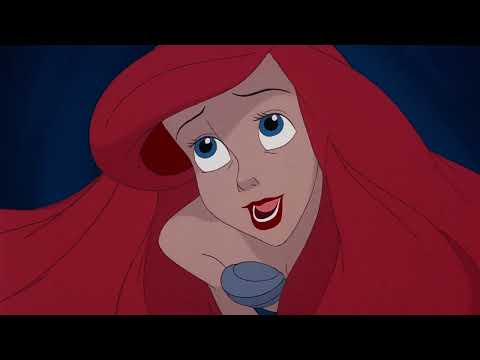
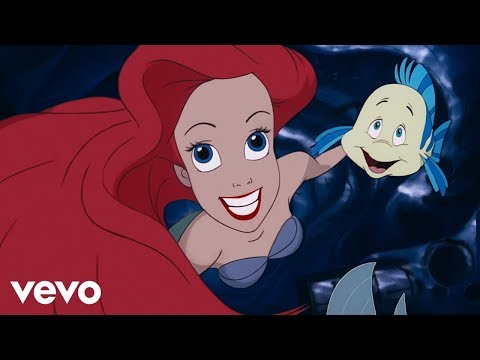
The Little Mermaid (1989) - animated feature film - diegetic. Ariel sings alone in her grotto as she handles human objects and tries to name them, from about 00:15:23 to 00:18:06. The scene is intimate by design: the camera treats a private obsession as a full-scale musical number, and that contrast is the whole point.
This number works because it refuses to hurry. It starts as inventory and ends as a dare. A lesser film song would treat the grotto as a cute set and move on, but here the staging treats each artifact as a syllable in a secret language Ariel is teaching herself. When the melody lifts, it does not "resolve" her conflict - it sharpens it. In my notebook, I call this the hinge moment: the story stops being about a mermaid in a pretty world and becomes about a young person negotiating rules, curiosity, and the risk of wanting.
Musically, it is built like a stage ballad that wandered into animation and realized it could use the entire ocean as reverb. The verses sit busy and conversational, then the pre-chorus tightens like a held breath, and the refrain opens into that bright, belted skyline of a phrase. Variety magazine once described it as a slow-building Broadway-style showstopper, and that is the correct lens: the song is not decoration, it is architecture.
Creation History
Alan Menken and Howard Ashman shaped the song early in development, with Ashman framing it as Ariel's diary set to music, a way to make audiences care about her dreams before the plot starts throwing storms at her. In the production lore, the number was even tested, doubted, and defended - the kind of behind-the-scenes drama that only happens when a studio realizes a three-minute ballad can hold up an entire movie. Years later, the song kept mutating in public: a live-action single release in 2023, and a loud pop-punk cover in 2024, each version proving the melody can survive a new wardrobe.
Song Meaning and Annotations
Plot
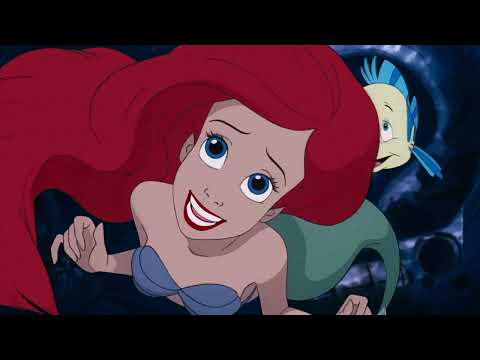
Ariel retreats to her grotto, a private museum of human objects collected in secret. She tries to explain the artifacts to herself and to her friend, using playful placeholder terms when she does not know the real names. As the catalog grows, her tone shifts from amused to restless. The song crescendos into a clear desire: she wants to leave the sea, live among humans, ask questions, learn how things work, and be taken seriously. The scene ends with her longing still unresolved, which is exactly what the narrative needs to push her toward risky choices.
Song Meaning
At face value it is curiosity about the surface. Under the surface, it is the sound of a young woman learning how to want something without permission. The key is how the song treats knowledge as romance: she is not only attracted to a prince or a place, she is attracted to a way of living where questions are allowed. The emotional arc travels from playful collecting to a kind of adult clarity: wanting more is not greed, it is identity.
Annotations
Look at this stuff, isn't it neat?
That opening is a magician's patter: it invites you to admire the collection, but it also signals how carefully she has been rehearsing this moment in her own head. The "neat" is less about cleanliness and more about relief - proof that her secret world is real.
I wanna be where the people are
This is the pivot from object to community. The song is not about owning things, it is about entering a social world where her curiosity will not make her a problem to be managed.
Ask 'em my questions and get some answers
The line is almost educational policy disguised as show tune. It hints at a worldview clash: her father rules by forbidding contact, while Ariel imagines a life structured around learning.
What's a fire and why does it burn?
A childlike question, but placed late enough in the song that it reads as philosophy. She is asking about transformation: what changes you, what consumes you, what makes you alive.
Genre and rhythm
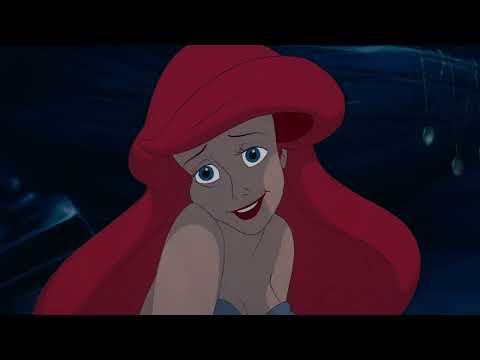
The writing blends Broadway ballad craft with film-score shading. The rhythm feels steady and conversational at first, then intensifies through orchestration rather than percussion: strings brighten, harmony widens, and the last refrain arrives like a door finally opening. That slow ignition is why the song reads as determined rather than merely dreamy.
Symbols and the emotional engine
The grotto is a museum, but also a rehearsal room. Each object is a token of a life she cannot yet enter, and the unknown names matter because they show her position in the world: she is fluent in desire, not in access. That is the heart of the song. It is not a travel brochure for the surface; it is the document of someone outgrowing the categories around her.
Cultural touchpoints
The number helped codify the animated musical's character-defining ballad for the modern era. You can hear its DNA in later Disney heroines, and not only in Disney: the structure is classic theater, but the delivery is intimate enough for film. Time magazine later ranked it among the strongest Disney songs, and you can see why. It is a character blueprint disguised as a melody.
Technical Information
- Artist: Jodi Benson
- Featured: None
- Composer: Alan Menken
- Producer: Alan Menken; Howard Ashman; Robert Kraft
- Release Date: October 13, 1989
- Genre: Musical theatre ballad; film soundtrack
- Instruments: Lead vocal; orchestra (strings, woodwinds, piano emphasis)
- Label: Walt Disney Records
- Mood: Yearning; curious; determined
- Length: 3:16
- Track #: 6 (common soundtrack sequencing)
- Language: English
- Album (if any): The Little Mermaid: Original Motion Picture Soundtrack
- Music style: Broadway-style build with cinematic orchestration
- Poetic meter: Predominantly iambic tendencies with conversational substitutions
Questions and Answers
- Why does the song begin with a tour of objects instead of a direct confession?
- Because the collection is Ariel's alibi. She can talk about forks and trinkets before admitting she wants an entire life. The objects let her ease into honesty.
- What makes it an "I want" song in theater terms?
- It states the protagonist's goal clearly, early, and with enough emotional momentum that the plot can spend the rest of the film testing that desire.
- Is Ariel singing to anyone inside the story?
- Not really. The scene plays like private speech, which is why it lands: you are overhearing a secret, not being sold a message.
- What is the dramatic function of the placeholder vocabulary?
- It shows the gap between fascination and access. She is close enough to touch the human world, but not close enough to name it correctly, and that mismatch fuels the hunger.
- How do the 1989 and 2023 versions differ musically in effect?
- The original favors a gradual theatrical swell with restrained vocal coloring early on. The 2023 performance leans more openly into contemporary vocal runs and a higher-feeling lift, giving the longing a brighter glare.
- Why does the song feel rebellious without sounding angry?
- Because the rebellion is framed as learning. Questions are the insurgency here, and the melody treats curiosity as something noble.
- What is the emotional trick of the final refrain?
- It sounds like arrival even though nothing has changed yet. The harmony opens up and the vocal line rises, giving you the physical sensation of stepping into a new world before the story allows it.
- How has the song endured beyond the film?
- It keeps inviting new singers to test their own identity against it. When a song is about wanting a place to belong, each generation finds a new angle to underline.
- Why do rock and pop versions keep working?
- The melody is strong enough to survive new instrumentation. Strip it down or speed it up, and the core still reads as longing that refuses to stay quiet.
- Is it a love song?
- It is a love song to possibility. Romance enters later, but the first object of affection is the idea of a life where she can choose and learn.
Awards and Chart Positions
The 1989 recording is not remembered as a chart single in the way pop radio tracks are, but its parent film dominated awards season: the Academy of Motion Picture Arts and Sciences honored The Little Mermaid with wins for Best Original Score and Best Original Song (for a different number from the film). The song's long life has been measured less by trophies and more by constant reinvention, including a major live-action release cycle in 2023 and a label-driven rock tribute in 2024.
| Release or version | Year | Notable chart notes |
|---|---|---|
| Halle Bailey (live-action digital single) | 2023 | US Bubbling Under Hot 100 peak: 19; UK Singles Sales peak: 58; New Zealand Hot Singles peak: 12 |
| New Found Glory (A Whole New Sound cover single) | 2024 | Released as a featured single with an official video tied to the compilation rollout |
How to Sing Part of Your World
If you are approaching the original arrangement, treat it like musical theatre first and vocal athletics second. The published range reference is compact enough to tempt you into coasting, but the real challenge is pacing: you have to sound like you are thinking in real time, then expand into a full, ringing finish without flipping the character into a different person.
- Reference key: F major (common edition)
- Reference tempo: Moderately bright feel (often cited around 135)
- Reference range: C4 to C5 (common edition); some performances push higher via transposition and ornament
- Tempo first: Speak the text in rhythm, no singing. Keep it conversational, like you are showing a friend your secret drawer of treasures.
- Diction and consonants: Crisp but not percussive. The opening lives on clarity, because the humor of the made-up object names needs to land.
- Breath mapping: Mark breaths in the verse so you never steal air mid-thought. The song must feel like one continuous confession.
- Flow and dynamic ramp: Start with a narrower tone, then slowly widen resonance as the pre-chorus approaches. Think: the room gets larger, not louder.
- Accents: Highlight the question lines. They are the character's fuel, and the audience hears the future in them.
- Mix and release: On the refrain, aim for a theater mix that can bloom without turning into shouting. Keep the neck loose and the vowels tall.
- Micro-acting: Let small smiles and small doubts appear in the sound. This is not a power ballad about victory; it is a ballad about risk.
- Mic and room: If amplified, back off slightly on the biggest phrase so the note stays free. If unamplified, use forward placement instead of pushing volume.
- Pitfalls: Do not rush the verse, do not over-sing the curiosity, and do not switch personalities for the last refrain. The same Ariel must reach the cliff edge.
Practice material: sing the verse on a neutral vowel to smooth registration, then add text back in. For the final build, do slow crescendos on the refrain melody at half tempo, keeping vibrato natural rather than manufactured.
Additional Info
Two modern moments show how the song continues to travel. In 2023, the live-action release cycle treated the ballad as a headline event, with press coverage framing it as a test of respect for the original while inviting a new vocal identity. In 2024, Disney's pop-punk compilation positioned the melody as a bridge between generations: the hook survives distorted guitars because the underlying desire is still legible. As stated in a Billboard feature, Halle Bailey's version reached the Bubbling Under Hot 100 top 20 range, a neat reminder that a film ballad can still behave like a contemporary release when the spotlight is bright enough.
My favorite detail is how the song keeps resurfacing in theater contexts, not only in the official stage adaptation but also in auditions, syllabi, and recital culture. That is how show writing becomes folk music: passed from voice to voice, each singer treating the melody like a small confession that belongs to them for three minutes.
Key Contributors
| Entity | Type | Relationship | Statement (S-V-O) |
|---|---|---|---|
| Jodi Benson | Person | Original performer (Ariel) | Benson performs the song as Ariel in the 1989 film. |
| Alan Menken | Person | Composer; producer | Menken composes the music and helps produce the recording. |
| Howard Ashman | Person | Lyricist; producer | Ashman writes the lyric and shapes the dramatic intent. |
| Walt Disney Records | Organization | Label | Walt Disney Records releases the soundtrack recording. |
| The Little Mermaid (1989 film) | Work | Source work | The film stages the ballad in Ariel's grotto as a defining character moment. |
| Halle Bailey | Person | Live-action performer | Bailey records a 2023 single version for the live-action adaptation. |
| New Found Glory | MusicGroup | Cover artist | New Found Glory releases a 2024 cover as part of a Disney pop-punk compilation. |
Sources: IMDb soundtrack listing, Academy of Motion Picture Arts and Sciences Oscars archive, Variety best Disney songs feature, Billboard coverage, ABRSM syllabus PDF, Subtitle Cat subtitle timings, Disney press release for A Whole New Sound, Time ranking feature
Music video
Disney: 60 Years of Musical Magic Lyrics: Song List
- Volume One
- A Whole New World (Aladdin)
- Circle of Life (Lion King)
- Beauty and the Beast (Beauty and the Beast)
- Under the Sea (The Little Mermaid)
- Hakuna Matata (Lion King)
- Kiss the Girl (The Little Mermaid)
- I Just Can't Wait to Be King (Lion King)
- Poor Unfortunate Souls (The Little Mermaid)
- Chim Chim Cher-ee (Mary Poppins)
- Jolly Holiday (Mary Poppins)
- A Spoonful of Sugar (Mary Poppins)
- Let's Get Together (The Parent Trap)
- The Monkey's Uncle (The Monkey's Uncle)
- The Ugly Bug Ball (Summer Magic)
- The Spectrum Song (Walt Disney's Wonderful World of Color)
- Colonel Hathi's March (The Jungle Book)
- A Whale of a Tale (20,000 Leagues Under the Sea)
- You Can Fly! You Can Fly! You Can Fly! (Peter Pan)
- The Work Song (Cinderella)
- A Dream is a Wish Your Heart Makes (Cinderella)
- Zip-A-Dee-Doo-Dah (Song of the South)
- Dance of the Reed Flutes (Fantasia)
- Love Is a Song (Bembi)
- Someday My Prince Will Come (Snow White and the Seven Dwarfs)
- Minnie's Yoo Hoo! (Mickey's Follies)
- Volume Two
- Be Our Guest (Beauty & The Beast)
- Can You Feel the Love Tonight (The Lion King)
- Part of Your World (The Little Mermaid)
- One Jump Ahead (Alladin)
- Gaston (Beauty And the Beast)
- Something There (Beauty And the Beast)
- Supercalifragilisticexpialidocious (Mary Poppins)
- Candle on the Water (Pete's Dragon)
- Main Street Electrical Parade (Disneyland)
- The Age of Not Believing (Bedknobs and Broomsticks)
- The Bare Necessities (The Jungle Book)
- Feed the Birds (Mary Poppins)
- Best of Friends (The Fox and the Hound)
- Let's Go Fly a Kite (Mary Poppins)
- It's a Small World (Disneyland)
- The Tiki, Tiki, Tiki Room (Disneyland)
- Mickey Mouse Club March (Mickey Mouse Club)
- On the Front Porch (Summer Magic)
- The Second Star to the Right (Peter Pan)
- Ev'rybody Has a Laughing Place (Song of the South)
- Bibbidi-Bobbidi-Boo (Cinderella)
- So This is Love (Cinderella)
- When You Wish Upon a Star (Pinocchio)
- Heigh-Ho (Snowwhite & the 7 Dwarfs)
- Who's Afraid of the Big Bad Wolf (The 3 Little Pigs)
- Volume Three
- Colors of the Wind (Pocahontas)
- You've Got a Friend in Me (Toy Story)
- Be Prepared (The Lion King)
- Out There (The Hunchback of Notre Dame)
- Family (James & The Giant Peach)
- Les Poissons (The Little Mermaid)
- Mine, Mine, Mine (Pocahontas)
- Jack's Lament (The Nightmare Before Christmas)
- My Name Is James (Jame & The Giant Peach)
- Heffalumps and Woozles (Winnie the Pooh and the Blustery Day)
- The Mob Song (Beauty & The Beast)
- Portobello Road (Bedknobs and Broomsticks)
- Stay Awake (Mary Poppins)
- I Wan'na Be Like You (The Jungle Book)
- Oo-De-Lally (Robin Hood)
- Are We Dancing (The Happiest Millionaire)
- Once Upon a Dream (Sleeping Beauty)
- Bella Notte (Lady and the Tramp)
- Following the Leader (Peter Pan)
- Trust in Me (The Jungle Book)
- The Ballad of Davy Crockett (Davy Crockett)
- I'm Professor Ludwig Von Drake (Walt Disney's Wonderful World of Color)
- Pink Elephants on Parade (Dumbo)
- Little April Shower (Bambi)
- The Silly Song (Snow White & the 7 Dwarfs)
- Volume Four
- One Last Hope (Hercules)
- A Guy Like You (The Hunchback of Norte Dame)
- On the Open Road (A Goofy Movie)
- Just Around the Riverbend (Pocahontas)
- Home (Beauty & the Beast (Broadway Musical))
- Fantasmic! (Disneyland)
- Oogie Boogie's Song (The Nightmare Before Christmas)
- I Will Go Sailing No More (Toy Story)
- Substitutiary Locomotion (Bedknobs and Broomsticks)
- Stop, Look, and Listen/I'm No Fool (Mickey Mouse Club)
- Love (Robin Hood)
- Thomas O'Malley Cat (The Aristocats)
- That's What Friends Are For (The Jungle Book)
- Winnie the Pooh
- Femininity (Summer Magic)
- Ten Feet Off the Ground (The One and Only, Genuine, Original Family Band)
- The Siamese Cat Song (Lady and the Tramp)
- Enjoy It! (In Search of the Castaways (film))
- Give a Little Whistle (Pinocchio)
- Oh, Sing Sweet Nightingale (Cinderella)
- I Wonder (Sleeping Beauty)
- Looking for Romance / I Bring You A Song (Bambi)
- Baby Mine (Dumbo)
- I'm Wishing/One Song (Snow White & the 7 Dwarfs)
- Volume Five
- I'll Make a Man Out of You (Mulan)
- I Won't Say / I'm in Love (Hercules)
- God Help the Outcasts (The Hunchback of Notre Dame)
- If I Can't Love Her (Beauty and the Beast)
- Steady As The Beating Drum (Pocahontas)
- Belle (Beauty & the Beast)
- Strange Things (Toy Story)
- Cruella De Vil (101 Dalmatians)
- Eating the Peach (James and the Giant Peach)
- Seize the Day (Newsies)
- What's This? (The Nightmare Before Christmas)
- Lavender Blue / Dilly Dilly (So Dear to My Heart)
- The Rain Rain Rain Came Down Down Down (Winnie the Pooh and the Blustery Day)
- A Step in the Right Direction (Bedknobs and Broomsticks)
- Boo Bop Bopbop Bop (Pete's Dragon)
- Yo Ho / A Pirate's Life for Me (Disneyland)
- My Own Home (The Jungle Book)
- Ev'rybody Wants to Be a Cat (The Aristocats)
- In a World of My Own (Alice in Wonderland)
- You Belong to My Heart (The 3 Caballeros)
- Humphrey Hop (In the Bag)
- He's a Tramp (Lady and the Tramp)
- How Do You Do? (Song of the South)
- When I See an Elephant Fly (Dumbo)
- I've Got No Strings (Pinocchio)