He's a Tramp (Lady and the Tramp) Lyrics — Disney: 60 Years of Musical Magic
He's a Tramp (Lady and the Tramp) Lyrics
But they love him
Breaks a new heart
Ev'ry day
He's a tramp
They adore him
And I only hope
He'll stay that way
He's a tramp
He's a scoundrel
He's a rounder
He's a cad
He's a tramp
But I love him
Yes, even I
Have got it pretty bad
You can never tell
When he'll show up
He gives you
Plenty of trouble
I
guess he's just a
No 'count pup
But I wish that he
Were double
He's a tramp
He's a rover
And there's nothing
More to say
If he's a tramp
He's a good one
And I wish that I
Could travel his way(x3)
Song Overview
Review and Highlights
Quick summary
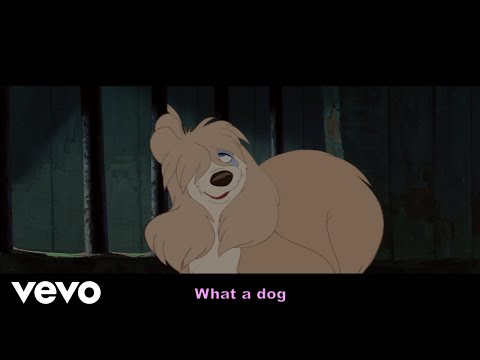
- Film origin: written for Disney's Lady and the Tramp (1955), voiced and sung by Peggy Lee as Peg in the dog-pound sequence.
- Songcraft: swing-jazz phrasing with a conversational lyric that sounds like gossip over a backbeat.
- Recording trail: Lee cut commercial Decca versions around the film era, separate from the shorter movie performance.
- Modern echo: the 2019 live-action remake features a new performance by Janelle Monae, credited on Disney's official music credits site.
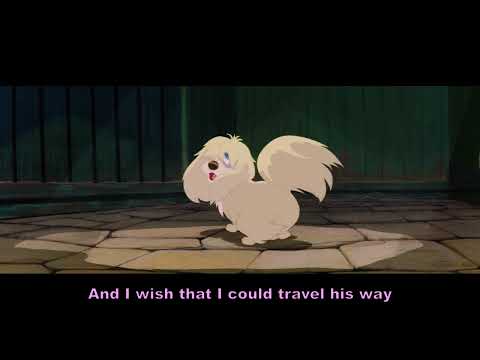
Lady and the Tramp (1955) - film - diegetic. Dog-pound scene (mid-film): Peg leads a pack of inmates through a streetwise portrait of the Tramp while Lady listens, half shocked, half curious. Why it matters: it is character exposition delivered as a nightclub number, the kind of scene that turns a plot beat into a social world you can almost smell.
Musically, it is a lesson in controlled looseness. The rhythm lopes, the melody glides, and the lyric never tries to be "pretty" - it tries to be persuasive. Peggy Lee knew exactly what she was doing: sing it like a confession that also doubles as sales copy. You can hear the grin in the phrasing.
Key takeaways
- Hook: a repeating title figure that lands like a punchline and resets the groove.
- Vocal approach: talk-singing that still stays on pitch, with crisp consonants and relaxed vowels.
- Arrangement: cartoon-era orchestration, but with real jazz attitude in the pocket.
- Scene function: it builds the Tramp's legend while revealing Peg as the film's sharpest commentator.
Creation History
The track sits at the crossroads of animation and pop professionalism. Wikipedia notes that Peggy Lee co-wrote the film's original songs with Sonny Burke and also voiced multiple characters in Lady and the Tramp, which helps explain why the number feels tailor-made for the story instead of pasted on top. The Peggy Lee Discography documents Decca sessions and the odd detail that Decca issued different single variants tied to two recording dates, a reminder that "the" version is often a myth - especially for mid-century film songs chasing both screen timing and radio play.
Song Meaning and Annotations
Plot
In the pound, Peg sizes up the Tramp for Lady. The other dogs chime in as a rough-and-ready chorus, treating the Tramp like a local celebrity with a complicated dating record. The scene is partly warning, partly fascination: Lady hears about a world where love is casual, survival is a skill, and reputation travels faster than a dogcatcher.
Song Meaning
The lyric is a portrait with a wink: the Tramp is framed as trouble, but the singer admits the attraction anyway. That is the heart of it - not romance as purity, but romance as appetite. The swing rhythm does the heavy lifting here: it makes risk feel playful, and it makes confession feel stylish. According to Variety, the 2019 remake rethought some of the film's musical material for modern audiences, yet it kept this number recognizable because its persona is the point, not just the tune.
Annotations
-
"He's a tramp, but I love him."
Eight words, two angles. The first half is judgment, the second half is surrender. In performance, the trick is to make the pivot sound inevitable, like the thought arrived before the singer could stop it.
-
"Breaks a new heart every day."
Hyperbole that behaves like street reporting. It is not a literal statistic, it is reputation-as-fact, the way a neighborhood turns one messy story into a legend by lunchtime.
-
"They adore him."
This line shifts the blame away from the Tramp and onto the crowd. The song is quietly saying: do not pretend he is the only one making choices.
Genre and driving rhythm
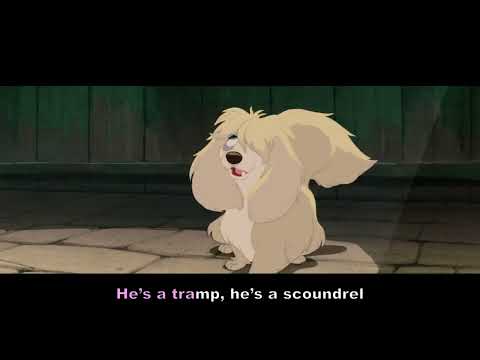
At base, it is swing with a cabaret bite. The beat walks, not sprints. That "walking" feel is why the lyric can keep tossing details without sounding hurried. The chorus responses (those howls and comments) turn the groove into a social space - you are not listening to one narrator, you are listening to a room.
Emotional arc
The song starts as a warning label and ends as an admission. The humor masks vulnerability, but it does not erase it. Lee performs like Peg has seen enough to be cynical, yet still gets pulled by charisma. That push-pull is the drama, served with a smile.
Touchpoints and context
Mid-1950s Disney rarely let a female character sing with this much worldly edge. Peg is animated, but her voice carries nightclub DNA. I hear echoes of jazz storytelling standards where the singer plays both narrator and accomplice, and that is why the number has been covered so often across pop and jazz circles.
Technical Information
- Artist: Peggy Lee (as Peg)
- Featured: The Mellomen (group vocal responses on soundtrack releases)
- Composer: Sonny Burke, Peggy Lee
- Producer: Walt Disney Productions (film); Decca session production varies by issue
- Release Date: February 1955 (Decca single pairing noted in discography listings); June 22, 1955 (soundtrack album date shown by major music services)
- Genre: swing; film song; jazz-pop
- Instruments: vocal; studio orchestra with brass, reeds, rhythm section, and animated-style accent hits
- Label: Decca (commercial single); Walt Disney Records and later Disney catalog issues (soundtrack releases)
- Mood: sly, playful, streetwise
- Length: about 1:39 (film-style soundtrack cut as listed by Apple Music); other commercial versions run longer
- Track #: varies by edition and compilation
- Language: English
- Album (if any): Lady and the Tramp (Original Motion Picture Soundtrack) and later Legacy Collection editions
- Music style: cartoon-era orchestral swing with cabaret phrasing
- Poetic meter: conversational, with syncopated stresses that lean trochaic in the title refrain
Questions and Answers
- Who is singing in the original movie?
- Peg sings it in the pound, voiced and performed by Peggy Lee.
- Did Peggy Lee also write the song?
- Yes. Major reference sources credit Burke and Lee as the songwriting team for the film's songs.
- Why does it feel like jazz, not a typical animated number?
- The phrasing is built on swing speech-rhythm, more cabaret than choir, with the lyric delivered like commentary from the sidelines.
- Is the song diegetic in the film?
- Yes. The dogs are shown performing it as part of the pound's social life, with chorus reactions baked into the scene.
- What is the central idea of the lyric?
- Attraction to trouble, admitted without apology. The singer warns you, then proves she is not immune.
- Why do the background voices matter?
- They turn the song into a community verdict. It is a chorus of lived experience, not a solo fantasy.
- What is the best way to perform it without overdoing comedy?
- Play it straight. Treat the lines like real gossip and let the rhythm carry the humor.
- What changed in the 2019 remake?
- The performance credit shifts to Janelle Monae, with production and vocal credits listed in Disney's official music documentation for the live-action soundtrack.
- Are there multiple Peggy Lee recordings?
- Yes. Discography notes describe different Decca single variants tied to separate recording dates, and the movie performance is shorter than some commercial releases.
- Why is the song still referenced in film-song lists?
- It is a clean character sketch that doubles as a catchy swing vehicle, and it made the AFI nominee list for movie songs.
Awards and Chart Positions
The song did not arrive as an awards campaign number, but it has a long tail in movie-song culture. The American Film Institute included it among the official nominees list for its 100 Years...100 Songs project, placing the tune in the same conversation as live-action standards from the classic studio era. That kind of institutional nod matters: it treats an animated character song as part of the broader American film-song tradition, not a kiddie sidebar.
| Year | List or milestone | What happened |
|---|---|---|
| 2004 | AFI 100 Years...100 Songs | Included on the nominees list (the published nominees PDF lists it under the letter H section). |
| 2019 | Live-action remake soundtrack credits | Disney music credits list a new performance by Janelle Monae for the remake soundtrack. |
How to Sing He's a Tramp
This number rewards restraint. Think smoky club storyteller rather than belt-it-to-the-back-row. Track metadata commonly lists the soundtrack cut around 107 BPM, while some practice tracks and arrangements run slower. Keys vary widely by edition: some sheet music publishes it in E-flat major, while soundtrack metadata is often tagged in G major. In other words, pick a key that lets you speak the lyric without strain.
Tempo: start near 104 to 108 BPM, then adjust until the lyric feels like natural speech on beat two and four.
Diction: keep consonants clean but not sharp. The attitude is confident, not aggressive.
Breathing: plan quick breaths before the title figure and before longer descriptive runs. Do not inhale like you are preparing for opera.
Flow and rhythm: ride the swing. Let some syllables land slightly behind the beat, then snap back for the hook.
Accents: punch the character words (scoundrel, rounder, cad) with timing, not volume.
Vocal range: many singer guides place it around C4 to E5 in common arrangements. If the top feels tight, transpose down and keep the bite.
Ensemble and doubles: if you add a chorus response, keep it tight and percussive. The joke is the group reacting like a peanut gallery.
Mic: sing closer on the quieter confessional lines and pull back slightly on the big title moments to avoid barking.
Pitfalls: do not turn it into a novelty voice. The humor comes from sincerity mixed with savvy.
Additional Info
Peggy Lee's Disney work is often summarized as "she sang a few songs," but the documentation paints a bigger picture: she co-wrote the film's tunes with Sonny Burke and voiced multiple roles, including Peg. That kind of creative footprint inside a major studio feature was not typical, and it helps explain why the song feels authored from inside the narrative. Meanwhile, the remake era proved the tune could be recast without losing its spine: Pitchfork and other music outlets covered Janelle Monae's 2019 release as part of the Disney-plus launch wave, framing it as a faithful swing-forward update rather than a radical rewrite.
Key Contributors
| Entity | Type | Relation | S-V-O statement |
|---|---|---|---|
| Peggy Lee | Person | writer, performer, voice actor | Peggy Lee co-wrote the song and performs it as Peg in the film. |
| Sonny Burke | Person | composer | Sonny Burke co-wrote the song with Peggy Lee. |
| The Mellomen | MusicGroup | featured ensemble | The Mellomen provide the group vocal responses on soundtrack releases. |
| Oliver Wallace | Person | film music lead | Oliver Wallace led the film's score environment that frames the number in the soundtrack program. |
| Walt Disney Productions | Organization | film producer | Walt Disney Productions produced the feature that introduced the song. |
| Janelle Monae | Person | remake performer | Janelle Monae performs the 2019 remake version credited on Disney music credits. |
| Nate Rocket Wonder | Person | producer | Nate Rocket Wonder is credited as a producer for the 2019 remake track. |
| Roman GianArthur | Person | producer | Roman GianArthur is credited as a producer for the 2019 remake track. |
Sources: Lady and the Tramp (Wikipedia entry); Peggy Lee (Wikipedia entry); Walt Disney Music Credits - Lady and the Tramp (Live Action); Peggy Lee Discography - Decca Years (1952-1956); Peggy Lee 78 and 45 Index; AFI 100 Years...100 Songs nominees PDF; Pitchfork news item on Janelle Monae cover; Variety music feature on the remake soundtrack approach; Apple Music track listing for He's a Tramp (Lady and the Tramp); Musicstax tempo and key snippet for What a Dog / He's a Tramp; Singing Carrots vocal range listing
Music video
Disney: 60 Years of Musical Magic Lyrics: Song List
- Volume One
- A Whole New World (Aladdin)
- Circle of Life (Lion King)
- Beauty and the Beast (Beauty and the Beast)
- Under the Sea (The Little Mermaid)
- Hakuna Matata (Lion King)
- Kiss the Girl (The Little Mermaid)
- I Just Can't Wait to Be King (Lion King)
- Poor Unfortunate Souls (The Little Mermaid)
- Chim Chim Cher-ee (Mary Poppins)
- Jolly Holiday (Mary Poppins)
- A Spoonful of Sugar (Mary Poppins)
- Let's Get Together (The Parent Trap)
- The Monkey's Uncle (The Monkey's Uncle)
- The Ugly Bug Ball (Summer Magic)
- The Spectrum Song (Walt Disney's Wonderful World of Color)
- Colonel Hathi's March (The Jungle Book)
- A Whale of a Tale (20,000 Leagues Under the Sea)
- You Can Fly! You Can Fly! You Can Fly! (Peter Pan)
- The Work Song (Cinderella)
- A Dream is a Wish Your Heart Makes (Cinderella)
- Zip-A-Dee-Doo-Dah (Song of the South)
- Dance of the Reed Flutes (Fantasia)
- Love Is a Song (Bembi)
- Someday My Prince Will Come (Snow White and the Seven Dwarfs)
- Minnie's Yoo Hoo! (Mickey's Follies)
- Volume Two
- Be Our Guest (Beauty & The Beast)
- Can You Feel the Love Tonight (The Lion King)
- Part of Your World (The Little Mermaid)
- One Jump Ahead (Alladin)
- Gaston (Beauty And the Beast)
- Something There (Beauty And the Beast)
- Supercalifragilisticexpialidocious (Mary Poppins)
- Candle on the Water (Pete's Dragon)
- Main Street Electrical Parade (Disneyland)
- The Age of Not Believing (Bedknobs and Broomsticks)
- The Bare Necessities (The Jungle Book)
- Feed the Birds (Mary Poppins)
- Best of Friends (The Fox and the Hound)
- Let's Go Fly a Kite (Mary Poppins)
- It's a Small World (Disneyland)
- The Tiki, Tiki, Tiki Room (Disneyland)
- Mickey Mouse Club March (Mickey Mouse Club)
- On the Front Porch (Summer Magic)
- The Second Star to the Right (Peter Pan)
- Ev'rybody Has a Laughing Place (Song of the South)
- Bibbidi-Bobbidi-Boo (Cinderella)
- So This is Love (Cinderella)
- When You Wish Upon a Star (Pinocchio)
- Heigh-Ho (Snowwhite & the 7 Dwarfs)
- Who's Afraid of the Big Bad Wolf (The 3 Little Pigs)
- Volume Three
- Colors of the Wind (Pocahontas)
- You've Got a Friend in Me (Toy Story)
- Be Prepared (The Lion King)
- Out There (The Hunchback of Notre Dame)
- Family (James & The Giant Peach)
- Les Poissons (The Little Mermaid)
- Mine, Mine, Mine (Pocahontas)
- Jack's Lament (The Nightmare Before Christmas)
- My Name Is James (Jame & The Giant Peach)
- Heffalumps and Woozles (Winnie the Pooh and the Blustery Day)
- The Mob Song (Beauty & The Beast)
- Portobello Road (Bedknobs and Broomsticks)
- Stay Awake (Mary Poppins)
- I Wan'na Be Like You (The Jungle Book)
- Oo-De-Lally (Robin Hood)
- Are We Dancing (The Happiest Millionaire)
- Once Upon a Dream (Sleeping Beauty)
- Bella Notte (Lady and the Tramp)
- Following the Leader (Peter Pan)
- Trust in Me (The Jungle Book)
- The Ballad of Davy Crockett (Davy Crockett)
- I'm Professor Ludwig Von Drake (Walt Disney's Wonderful World of Color)
- Pink Elephants on Parade (Dumbo)
- Little April Shower (Bambi)
- The Silly Song (Snow White & the 7 Dwarfs)
- Volume Four
- One Last Hope (Hercules)
- A Guy Like You (The Hunchback of Norte Dame)
- On the Open Road (A Goofy Movie)
- Just Around the Riverbend (Pocahontas)
- Home (Beauty & the Beast (Broadway Musical))
- Fantasmic! (Disneyland)
- Oogie Boogie's Song (The Nightmare Before Christmas)
- I Will Go Sailing No More (Toy Story)
- Substitutiary Locomotion (Bedknobs and Broomsticks)
- Stop, Look, and Listen/I'm No Fool (Mickey Mouse Club)
- Love (Robin Hood)
- Thomas O'Malley Cat (The Aristocats)
- That's What Friends Are For (The Jungle Book)
- Winnie the Pooh
- Femininity (Summer Magic)
- Ten Feet Off the Ground (The One and Only, Genuine, Original Family Band)
- The Siamese Cat Song (Lady and the Tramp)
- Enjoy It! (In Search of the Castaways (film))
- Give a Little Whistle (Pinocchio)
- Oh, Sing Sweet Nightingale (Cinderella)
- I Wonder (Sleeping Beauty)
- Looking for Romance / I Bring You A Song (Bambi)
- Baby Mine (Dumbo)
- I'm Wishing/One Song (Snow White & the 7 Dwarfs)
- Volume Five
- I'll Make a Man Out of You (Mulan)
- I Won't Say / I'm in Love (Hercules)
- God Help the Outcasts (The Hunchback of Notre Dame)
- If I Can't Love Her (Beauty and the Beast)
- Steady As The Beating Drum (Pocahontas)
- Belle (Beauty & the Beast)
- Strange Things (Toy Story)
- Cruella De Vil (101 Dalmatians)
- Eating the Peach (James and the Giant Peach)
- Seize the Day (Newsies)
- What's This? (The Nightmare Before Christmas)
- Lavender Blue / Dilly Dilly (So Dear to My Heart)
- The Rain Rain Rain Came Down Down Down (Winnie the Pooh and the Blustery Day)
- A Step in the Right Direction (Bedknobs and Broomsticks)
- Boo Bop Bopbop Bop (Pete's Dragon)
- Yo Ho / A Pirate's Life for Me (Disneyland)
- My Own Home (The Jungle Book)
- Ev'rybody Wants to Be a Cat (The Aristocats)
- In a World of My Own (Alice in Wonderland)
- You Belong to My Heart (The 3 Caballeros)
- Humphrey Hop (In the Bag)
- He's a Tramp (Lady and the Tramp)
- How Do You Do? (Song of the South)
- When I See an Elephant Fly (Dumbo)
- I've Got No Strings (Pinocchio)