Jerry Springer: the Opera Lyrics – All Songs from the Musical
Jerry Springer: the Opera Lyrics: Song List
- Act 1
- Overtly-Ture Full Company
- Audience Very Plainsong
- Ladies & Gentlemen / Have Yourselves A Good Time
- Bigger Than Oprah Winfrey
- Foursome Guests
- I've Been Seeing Someone Else
- Chick With A Dick / Talk To The Hand
- Adverts 1
- Intro To Diaper Man
- Diaper Man / Montel Cums Dirty
- This Is My Jerry Springer Moment
- Mama Gimmee Smack On The A**Hole
- I Wanna Sing Something Beautiful
- Adverts 2
- First Time I Saw Jerry
- Backstage Scene
- Poledancer
- I Just Wanna Dance
- It Has No Name
- Some Are Decended From Angels
-
Jerrycam / Klan Entrance
- Act 2
- Eat Excrete
- Gloomy Nurses / Purgatory Dawning / The Haunting
-
Him Am the Devil / Every Last Mother Fucker Should Go Down
- Grilled & Roasted
- Transition Music
- Act 3
- Once In Happy Realms Of Light
-
Fuck You Talk
-
Satan & Jesus Spat
-
Adam & Eve & Mary
- Where Were You?
- Behold God
- Marriage of Heaven & Hell
- This is My Cheesey
- Jerry it is Finished
- Jerry Eleison
- Please Don't Die
- Take Care
- Martin's Richard-esque Finale de Grand Fromage
- Play Out
About the "Jerry Springer: the Opera" Stage Show
This musical did not hit the Broadway. Its opening was scheduled for 2004, but was soon canceled. Still, it was well known in London, where the histrionics not only officially was staged in the West End, but also on the National Theatre’s stage from April, 2003, giving 33 performances and in November 2003 in the Cambridge Theatre with exactly the same number of exhibitions. British Sky Broadcasting took staging on the West End in July 2004. The main role took the well-known David Soul, replacing the actor, who performed the role of Jerry in previous runs – M. Brandon. All in the same National Theatre, performances were up to the beginning of a tour in the UK, up to February, 2005. By September, seven months after the closure of the show in the West End, it has been announced that the show will go on tour in another 21 regions.Among other US productions, it was played in Las Vegas at the MGM Grand Hotel and Casino. The musical also traveled to Australia, Canada and Ireland. Production has collected a lot of awards, as well as for Best Musical, not leaving unnoticed actors, performing main roles. As the best actor, David Bedella won several awards. He had the only role that did not require the execution of musical parties. Technically, the actor only spoke, being the narrator of this theatrical, perfectly coping with it.
Release date: 2004
"Jerry Springer: The Opera" – The Musical Guide & Song Meanings
Review
How do you turn a daytime shouting match into something that can carry an aria without collapsing into a novelty act? “Jerry Springer: The Opera” pulls it off by treating trash TV as ritual. Act I is the studio circus: guests, reveals, humiliation, and the audience as a howling Greek chorus. Then it yanks the rug. The protagonist is not “the show” but Springer himself, pushed into a moral audit that the format never allows on air.
The lyric writing is blunt on purpose. It mimics talk-show language, then suddenly widens into hymn, chant, and operatic recitative. That friction is the point: high style forced to escort low behavior, like a tuxedo worn to a brawl. The show’s structure leans on repetition and refrains because tabloid culture is repetitive. The score answers with musical recurrence, little hooks that boomerang back as judgment. Even the controversy becomes part of the dramaturgy: the piece keeps asking who benefits from outrage, and who gets crushed under it.
How It Was Made
The origin story is less “commissioned masterpiece” and more “mad experiment that refused to die.” Richard Thomas first presented an early version as a short “scratch” performance at Battersea Arts Centre in early 2001, and it grew through further public workshop iterations before bigger institutions stepped in. The growth pattern matters because you can feel the workshop DNA in the finished piece: sharp scene-to-song pivots, a rhythm of interruption, and an ensemble that behaves like both audience and accomplice.
By 2002 it had reached Edinburgh in concert form, and Jerry Springer himself reportedly saw it and gave a blessing that sounds like the only endorsement that could be both sincere and comedic. From there it landed at the National Theatre in 2003, then moved to the West End. Later, a 2018 New York run involved revisions that nudged the grooves and adjusted language choices, a reminder that shock ages fast but structure lasts.
Key Tracks & Scenes
"Overtly-Ture" (Company)
- The Scene:
- House lights snap down. The “show” begins before the show begins, with the company behaving like a studio crowd that has been caffeinated, coached, and weaponised. The stage language is TV grammar: entrances, applause cues, and the sense that everyone is both performer and spectator.
- Lyrical Meaning:
- The title is the joke and the warning. We are in a world where overtures are branding, and branding is a form of theology. The lyric tone announces the show’s method: sacred forms, profane content, no apology.
"This Is My Jerry Springer Moment" (Montel and Company)
- The Scene:
- A guest confession lands like a punchline, then keeps going until it stops being funny. Jerry’s machinery runs: cue cards, security, the Warm-Up Man, the crowd’s appetite for escalation.
- Lyrical Meaning:
- The phrase becomes a miniature manifesto about attention economics. The lyric treats “my moment” as both empowerment and trap. Everyone wants a spotlight, and the spotlight burns.
"I Wanna Sing Something Beautiful" (Jerry)
- The Scene:
- Backstage, away from the bleachers and bleep buttons, Springer is alone enough to admit a desire that the format cannot monetize. In many productions, the lighting tightens into something less fluorescent and more confessional, as if the set itself is embarrassed.
- Lyrical Meaning:
- This is the show’s emotional hinge. The lyric is almost simple, which is why it hurts. It reframes Jerry as a compromised human instead of a ringmaster, and it sets up the later metaphysical trial: you cannot crave “beautiful” and keep selling cruelty without consequences.
"I Just Wanna Dance" (Shawntel)
- The Scene:
- In Act I’s final guest segment, Shawntel’s fantasy becomes a performance inside a performance. The number plays like a nightclub eruption under TV lighting, with the sense that liberation is being staged for an audience that will not pay for it unless it can sneer.
- Lyrical Meaning:
- The lyric is about agency, but the show keeps undercutting it with context. Wanting to dance reads as wanting to choose a life. The tragedy is that the room hears it as content.
"It Has No Name" (Chucky / Company)
- The Scene:
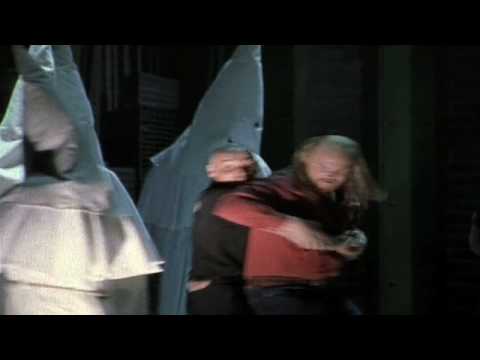
- The revelations sharpen. The secret-camera logic of tabloid TV becomes a plot engine, and the atmosphere turns uglier, faster than the audience expects. The act is building toward the gunshot and the Klan grotesquerie.
- Lyrical Meaning:
- The lyric treats denial as a character trait and a cultural habit. “No name” is how people launder responsibility. The show’s satire becomes indictment.
"Him Am the Devil" (Warm-Up Man / Satan)
- The Scene:
- Act II shifts to Purgatory, often staged as a fog-blank wilderness where familiar guests reappear as ghosts. The Warm-Up Man’s reveal lands with theatrical relish: the hype-man was always a demonic job title.
- Lyrical Meaning:
- It’s comic, then uncomfortably coherent. The lyric argues that the show’s cruelty is not a glitch but a system. Satan isn’t an intruder; he’s a producer.
"Where Were You?" (Company)
- The Scene:
- In Hell, the talk-show set returns as a charred parody of itself, and the questions become cosmic. Accusations fly across a stage picture that often resembles a tribunal wrapped in studio architecture.
- Lyrical Meaning:
- The lyric flips the interrogations of daytime TV into theological cross-examination. It’s no longer “who cheated?” but “who watched, who laughed, who enabled?” The audience is implicated without being directly scolded, which is a harder trick.
"It Ain't Easy Being Me" (Satan)
- The Scene:
- Satan pleads his case like a guest demanding airtime, part seduction, part grievance. Productions tend to play the number with a slickness that feels unearned, because that is what temptation is: polish over rot.
- Lyrical Meaning:
- The lyric is self-pity weaponised. It uses the talk-show vocabulary of victimhood to justify abuse. The satire lands because it sounds like real rhetoric, just sung better.
Live Updates
Information current as of 28 January 2026. In practical terms, “Jerry Springer: The Opera” is behaving like a cult title rather than a franchise property: talked about, sampled, revived in bursts, then quiet again. Major, widely ticketed listings are not consistently active right now. Ticketing aggregators can show stale copy even when there are no dates, so the cleanest signal is blunt: some platforms currently display “No Upcoming Shows.”
What is active is the afterlife. The album remains widely streamable, and the filmed version has rotated through streaming platforms in the past, with physical media also circulating. For audiences who want the text, the show’s enduring availability has been less about constant touring and more about recordings, clips, and the stubborn meme-quality of certain numbers that refuse to behave.
Notes & Trivia
- It started as a tiny scratch performance at Battersea Arts Centre in early 2001 before scaling through workshops and festivals.
- Jerry Springer reportedly saw an early version and offered a now-famous endorsement that doubles as a punchline.
- The BBC broadcast on 8 January 2005 drew a massive wave of complaints, with different tallies reported depending on timing and counting methods.
- Myth-check: tabloid swear counts were often inflated by counting simultaneous chorus utterances as separate instances.
- A live recording was captured during the National Theatre run in July 2003, which helps explain why the album feels like a whole evening rather than a highlights reel.
- Later revisions (notably around 2018) adjusted musical textures and language choices, a sign the creators understood what had aged poorly and what had not.
- The piece won major UK awards including multiple Oliviers, which remains the funniest possible résumé line for a show featuring a studio audience baying for blood.
Reception
The critical split has never been “good taste versus bad taste.” The more interesting divide is between critics who treat the profanity as the headline and critics who notice the show’s formal precision. When it works, it works because it refuses to be only a prank. It is a morality play in a cheap suit.
“Still feels surprisingly relevant.”
“From London to New York in remarkably good shape.”
“The sheer daring… makes [it] such outrageous fun.”
Quick Facts
- Title: Jerry Springer: The Opera
- Year (album era): 2004 (widely listed release year for the Original Cast Recording)
- Form: Sung-through stage musical with operatic structure and pop-inflected rhythms
- Music: Richard Thomas
- Book and lyrics: Stewart Lee and Richard Thomas (with credited variations by production)
- Notable structure: Act I TV studio; Act II Purgatory; Act III Hell-as-studio plus theological showdown
- Album: “Jerry Springer: The Opera (Original Cast Recording)” (49 tracks on major streaming services)
- Label / rights (album): Sony Music CMG (copyright and phonographic notices appear in major databases)
- Live capture note: A well-known “Live” recording was recorded at the National Theatre in July 2003
Frequently Asked Questions
- Is “Jerry Springer: The Opera” based on true episodes?
- Not directly. It borrows the format, the crowd psychology, and the escalation engine. The guests are inventions designed to compress tabloid archetypes into operatic conflict.
- Why does the show go to Hell in Act III?
- The piece treats the talk-show studio as a moral machine. Hell is not a random shock; it is the logical extension of a public ritual built on humiliation, then dressed up as “entertainment.”
- What song explains Jerry’s inner conflict best?
- “I Wanna Sing Something Beautiful.” It is the closest the show gets to quiet sincerity, and it reframes Jerry as a man trapped inside his own brand.
- Was the BBC broadcast really one of the most complained-about programs?
- Yes. Complaint totals vary by report and timing, but it generated an unusually large volume of formal complaints around the January 2005 broadcast.
- Is there an official recording of the whole score?
- Yes, and that is part of the show’s staying power. The cast recording is expansive, and there is also a filmed version that has circulated via physical media and streaming windows.
- Did the creators revise the show later?
- There have been revisions around later productions, including adjustments to musical feel and language, reflecting shifting norms and different cultural contexts.
Key Contributors
| Name | Role | Contribution |
|---|---|---|
| Richard Thomas | Composer, co-writer | Score, lyrics (shared), and the musical architecture that turns tabloid pacing into sung-through propulsion. |
| Stewart Lee | Co-writer | Book and lyric writing that weaponizes TV language, then exposes its moral costs. |
| Avalon | Producer (notable UK history) | Key producing presence in the show’s commercial life and its wider cultural footprint. |
| Sony Music CMG | Label (recording) | Release and distribution of the major cast recording editions across markets. |
Sources: Playbill, The Guardian, Variety, AllMusic, Spotify, MusicBrainz, Discogs, CBS News, WhatsOnStage, Ticketmaster UK, Stewart Lee (official site archives), academic and industry PDFs documenting development history.