
Across the Universe Lyrics
Across the Universe
Words are flowing out likeendless rain into a paper cup
They slither while they pass
They slip away across the universe
Pools of sorrow waves of joy
are drifting through my open mind
Possessing and caressing me
Jai guru deva om
Nothing's gonna change my world
Nothing's gonna change my world
Images of broken light which
dance before me like a million eyes
That call me on and on across the universe
Thoughts meander like a
restless wind inside a letter box
they tumble blindly as they make their way
across the universe
Nothing's gonna change my world
Nothing's gonna change my world
Nothing's gonna change my world
Nothing's gonna change my world
Nothing's gonna change my world
Nothing's gonna change my world
Nothing's gonna change my world
Nothing's gonna change my world
Jai guru deva (om)
Jai guru deva (om)
Jai guru deva (om)
Song Overview
Review and Highlights
Quick summary
- Across the Universe (2007) gives the title song to Jude (Jim Sturgess) and threads it directly into the film's loudest rupture.
- The sequence is interwoven with Sadie's "Helter Skelter (Reprise)", turning a lullaby into counterpoint, not comfort.
- On the standard soundtrack release, the Jim Sturgess recording runs 3:29 and sits mid-album, surrounded by the activist-office fallout cues.
- As stated in The New York Times review of the film, the picture thrives when it lets images and music argue in the same breath, and this cue is a prime exhibit.
Across the Universe (2007) - film - not cleanly diegetic. Jude sings while the film cross-cuts into Sadie's stage performance, with "Helter Skelter (Reprise)" colliding against his hush. The placement matters because the story is splitting in two directions at once: private devotion and public chaos.
Julie Taymor plays a cunning trick here: she makes quiet feel aggressive. The melody arrives like a held breath, then the edit throws it against a scream. Instead of letting the song float as spiritual wallpaper, she uses it as an anchor line. The camera keeps returning to Jude's face, and the vocal sits steady enough to sound stubborn. That steadiness reads as resistance, a refusal to be swept along by someone else's tempo.
Musically, the arrangement leans into a gentle pulse rather than rock swagger. That choice reframes the lyric. In many covers, the tune becomes a dreamy souvenir from late-1960s radio. Here, it becomes a coping mechanism in real time. The refrain is not offered to the audience as a slogan; it is what the character clings to while the film dares him to let go.
Creation History
The original Beatles recording was written by John Lennon and credited to Lennon-McCartney, first released in late 1969 on a charity compilation and later reworked for the 1970 Let It Be album. Taymor's film borrows the song as its conceptual seed and then gives it a new job: instead of studio mysticism, it becomes narrative glue, stitched into cross-cutting that links activism, performance, and romance. The soundtrack release, compiled and produced by T Bone Burnett, Elliot Goldenthal, and Matthias Gohl, presents the cast version as a standalone track with the same calm center the film uses as its hinge.
Song Meaning and Annotations
Plot
By the time the title song arrives in the film, relationships are strained and political certainty has started to harden into theater. Jude is moving through a crisis point while the film cross-cuts to Sadie's performance, creating a double-stage: one public, one internal. The interwoven structure makes the cue less like a number you applaud and more like an argument staged in parallel.
Song Meaning
The lyric treats language as something that cannot be controlled. Words pour out, slide away, and leave the speaker chasing meaning after it has already moved on. In Taymor's hands, that becomes a character portrait. Jude is not delivering a manifesto. He is trying to keep his inner weather steady while the world insists on storms. The mantra line functions like a handrail: a repeated phrase that keeps the singer upright even as the edit tries to knock him sideways.
Annotations
"Words are flowing out like endless rain"
The image is domestic and unshowy, which is exactly why it works. The film is packed with spectacle elsewhere; this line makes language sound like plumbing that will not stop. Jude does not sound delighted by it. He sounds occupied by it.
"Nothing's gonna change my world"
In a crowd scene, that line could read as denial. The intercutting makes it sharper. "My world" becomes personal territory: love, art, and the right to choose a private rhythm even while politics demands a march beat.
"Jai guru deva om"
It lands as ritual rather than decoration. The film treats it like a reset button - a way to re-center when the senses are overloaded. It also connects the song to late-1960s spiritual fashion without turning it into parody.
Style fusion and driving rhythm
The tune sits in a gentle psychedelic-folk space, but the film surrounds it with harder rock and staged chaos. That collision is the point. The calm vocal line becomes the rhythm that refuses to be bullied. Even at a modest tempo, the performance presses forward with a quiet insistence.
Symbols and staging cues
The title song has always carried a cosmic scale in its imagery - universe, drifting, endlessness. Taymor grounds that scale in bodies and spaces. The face remains central, and the song becomes less astronomy and more survival tactic: how a person stays themselves when every room is telling them who to be.
Technical Information (Quick Facts)
- Artist: Jim Sturgess
- Featured: none
- Composer: John Lennon; Paul McCartney
- Producer: T Bone Burnett; Elliot Goldenthal; Matthias Gohl
- Release Date: September 14, 2007 (standard soundtrack)
- Genre: film soundtrack; psychedelic folk cover
- Instruments: lead vocal; guitar-led ensemble
- Label: Interscope
- Mood: meditative; steady under pressure
- Length: 3:29
- Track #: Standard edition Track 11; Deluxe physical Disc 2 Track 22
- Language: English
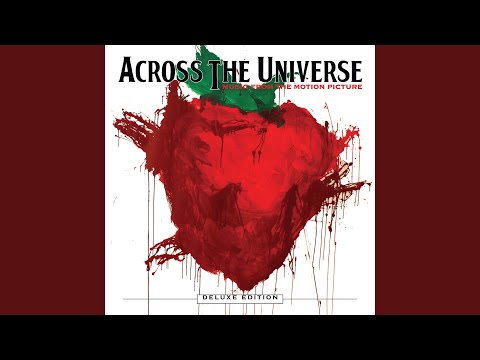
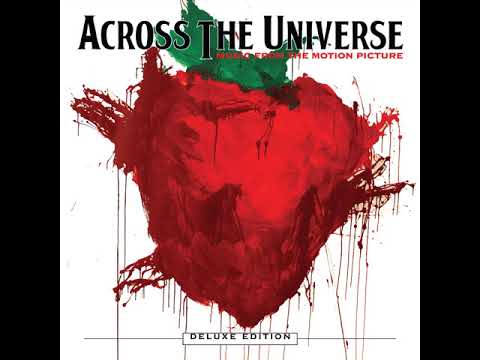
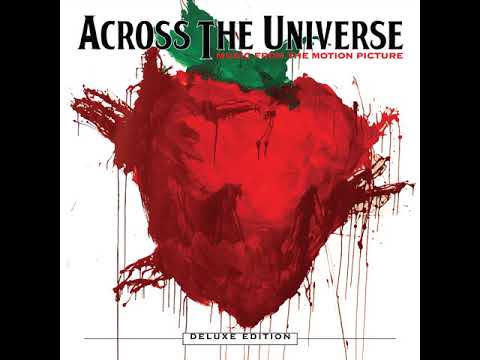
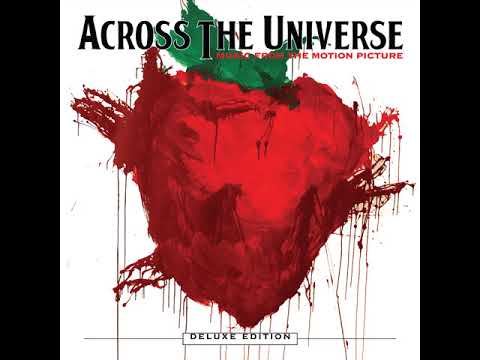
- Album (if any): Across the Universe (Music from the Motion Picture)
- Music style: soft-focus vocal delivery set against cross-cutting spectacle
- Poetic meter: free stress patterns aligned to speech
Frequently Asked Questions
- Who sings the title song in the film?
- Jude performs it, and the soundtrack credit is Jim Sturgess.
- Is it staged like a live performance?
- Not in the usual sense. The film uses it as a cross-cut interior cue, interwoven with Sadie's stage material, so it reads as thought and action at once.
- Why does the sequence cut against "Helter Skelter"?
- Because the story is splitting. One track holds stillness; the other is centrifugal. Taymor lets the audience feel the fracture rather than explaining it.
- What does the repeated mantra line do dramatically?
- It functions like grounding. The lyric becomes a ritual phrase the character returns to when the surrounding world gets too loud.
- Is the cast recording on the standard soundtrack?
- Yes. The standard release includes the Jim Sturgess track, and the deluxe configurations expand the full song program and score.
- How does this version differ from the Beatles recording?
- The film take is smoother and more intimate in vocal focus, while the original is built as studio psychedelia with a distinct late-1960s production signature.
- What is the most useful tempo target for practice?
- Published sheet-music and music-metric references commonly place it around the mid-70s BPM range, which supports long phrasing and clear diction.
- Does the film treat the song as its thesis?
- Yes, but it treats the thesis as contested. The title suggests cosmic unity, while the plot keeps testing whether unity can survive politics and ego.
Awards and Chart Positions
The title song does not carry separate chart history as a cast single, but the soundtrack around it did serious business. The standard album and its deluxe editions charted, and the project earned a nomination for Best Compilation Soundtrack Album for Motion Picture, Television or Other Visual Media at the 50th Grammy Awards cycle. The film itself also drew awards attention for categories outside music, including major nominations for costume work.
| Item | Result | Notes |
|---|---|---|
| Soundtrack - US Billboard 200 peak | 36 | Peak position during the 2007 run. |
| Soundtrack - US Top Soundtracks peak | 12 | Billboard soundtrack chart peak. |
| Grammy nomination | Nominee | Compilation soundtrack category at the 50th ceremony. |
| Certification | United States - Platinum | RIAA certification listed for the album. |
How to Sing Across the Universe
This song looks easy on paper and then asks for two hard things: sustained breath and honest stillness. The line sits best when you resist the urge to decorate it. According to Musicnotes listing data, many published arrangements place the vocal range around D4 to E5 in D major, with a moderate metronome marking near the high 70s. Use that as a practical starting map, not a cage.
- Tempo - Start around 75 to 78 BPM. Speak the text in rhythm first, then sing it with the same conversational timing.
- Diction - Treat consonants as gentle hinges. "Words" and "slither" can blur if you over-soften. Keep clarity without popping.
- Breath - Mark the long phrases and plan silent renewals. A low, quiet inhale is more useful than a dramatic one.
- Flow and rhythm - Keep the pulse steady even when the melody floats. The song wants a calm center, not rubato collapse.
- Accents - Save emphasis for meaning words, not every noun. A single lean on "endless" or "world" can say more than ten pushes.
- Ensemble and doubles - If you are singing with harmony, keep the lead line straight and let the harmony provide color, not volume.
- Mic and proximity - A close mic favors intimacy. Back off slightly on higher notes so the tone stays even and the vowel does not widen.
- Pitfalls - The biggest trap is trying to sound mystical. Sing it like a person thinking carefully, and the mysticism arrives on its own.
Additional Info
There is a backstage pleasure in how Taymor uses the title song: she refuses to let it be a mission statement sung at the camera. She makes it part of the machinery of cross-cutting, like a leitmotif that has wandered into a rock concert and is trying not to get trampled. According to RogerEbert.com, the film often feels like a music video in the best and worst senses. In this cue, the music-video grammar helps - it lets one voice travel through multiple spaces without having to pretend it is a literal performance.
It is also worth noting how the title song sits in the Beatles timeline. The original first appeared on a charity compilation and later in altered form on Let It Be, a history that mirrors the film's own approach: a piece can keep changing shape and still keep its center. Taymor's version is not trying to outdo the source. It is trying to re-stage the feeling of holding onto a private line while public life demands noise.
Key Contributors
| Entity | Type | Relationship (S-V-O) |
|---|---|---|
| Jim Sturgess | Person | Sturgess - performs - the film and soundtrack version as Jude. |
| Julie Taymor | Person | Taymor - directs - the film and interweaves the cue with stage performance. |
| John Lennon | Person | Lennon - writes - the original composition (co-credit). |
| Paul McCartney | Person | McCartney - writes - the original composition (co-credit). |
| Dana Fuchs | Person | Fuchs - performs - Sadie material interwoven in the sequence. |
| T Bone Burnett | Person | Burnett - produces - the soundtrack compilation. |
| Elliot Goldenthal | Person | Goldenthal - produces - soundtrack compilation and composes the film score. |
| Matthias Gohl | Person | Gohl - produces - the soundtrack compilation. |
| Interscope Records | Organization | Interscope Records - releases - the soundtrack editions in 2007. |
| Grammy Awards | Organization | Grammy Awards - nominates - the soundtrack in the compilation category. |
| Billboard | Organization | Billboard - charts - the soundtrack on Billboard 200 and Top Soundtracks. |
Sources
Sources: The Beatles official song page, Wikipedia: song background and release history, Wikipedia: film musical numbers list, Wikipedia: soundtrack track listing and charts, IMDb soundtrack credits page, GRAMMY.com nominee listing for Elliot Goldenthal, Billboard chart page (week of November 3, 2007), Musicnotes arrangement data (range and metronome), RogerEbert.com review, The New York Times review