
Lucy In The Sky With Diamonds Lyrics
Lucy In The Sky With Diamonds
Picture yourself in a boat on a river,With tangerine trees and marmalade skies
Somebody calls you, you answer quite slowly,
A girl with kaleidoscope eyes.
Cellophane flowers of yellow and green,
Towering over your head.
Look for the girl with the sun in her eyes,
And she's gone.
{REFRAIN}
Lucy in the sky with diamonds
Lucy in the sky with diamonds
Lucy in the sky with diamonds
Ah... Ah...
{VERSE 2}
Follow her down to a bridge by a fountain
Where rocking horse people eat marshmallow pies,
Everyone smiles as you drift past the flowers,
That grow so incredibly high.
Newspaper taxis appear on the shore,
Waiting to take you away.
Climb in the back with your head in the clouds,
And you're gone.
{REFRAIN}
Picture yourself on a train in a station,
With plasticine porters with looking glass ties,
Suddenly someone is there at the turnstile,
The girl with kaleidoscope eyes.
{REFRAIN REPEATED AND FADED}
Song Overview
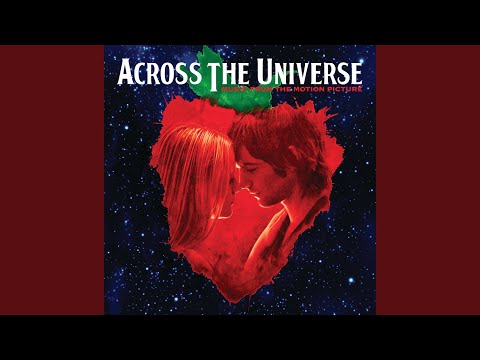
Review and Highlights
Quick summary
- Across the Universe (2007) places the cover in the end credits, sung off-screen rather than staged as a scene.
- The soundtrack lists the performance as Bono with The Edge, running 4:24 on the album.
- It closes the film with a deliberate shift from character story to cultural echo, like the city lights refusing to dim.
- The arrangement plays it as late-night psychedelia, not period cosplay: reverbed space, patient pulse, and a vocal line that leans into wonder and warning at once.
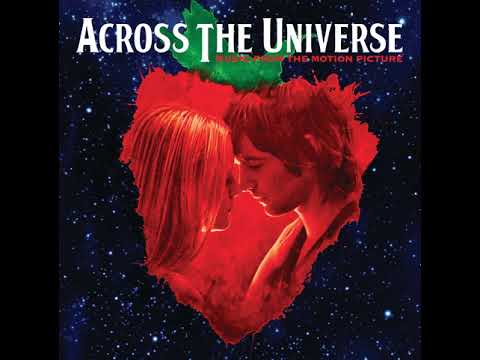
Across the Universe (2007) - film - end credits, not diegetic. The vocal is off-screen and arrives after the story has resolved its final rooftop argument. It matters because the film uses the track as a curtain call in reverse: instead of actors taking bows, the era takes the bow, and it is complicated.
Julie Taymor has spent the whole movie turning Beatles titles into character action. Then she stops doing that. This is the pivot: the credits roll, and the music stops being a device for dialogue and becomes a commentary track for the audience's walk back to reality. I like the audacity of that move. It admits that the film is a collage, and collages sometimes end by showing you the glue.
The performance choice is pointed. Bono is a singer with a public voice, a voice that carries history and spectacle whether he wants it to or not. That quality makes the ending feel less like a lullaby and more like a wake-up call wrapped in velvet. As stated in IMDb's soundtrack credits, the movie foregrounds this as a special end-credits performance, not a cast moment, and that separation gives it authority.
Creation History
The Beatles released the original in 1967 on Sgt. Pepper's Lonely Hearts Club Band, written primarily by John Lennon and credited to Lennon-McCartney. According to The Beatles official site, the song is tied to the album's psychedelic world-building and its dream-logic imagery. The film does not restage that imagery with costumes or sets here. It lets the voice and the mix do the work, and the credits placement turns the number into a final lens rather than a final scene.
Song Meaning and Annotations
Plot
Because this is end credits, the plot function is indirect. The story has already carried Jude and Lucy through migration, war, activism, betrayal, and reunion. The credits track takes what remains - the era's textures, the promises, the damage - and swirls them into a final atmosphere. The film stops speaking through characters and starts speaking through mood.
Song Meaning
Inside this film, the meaning shifts from a private hallucination to a public haze. The song becomes an epilogue about perception: what you thought you saw, what the decade sold you, what it cost. The dream images are seductive, but the repetition and the slow burn insist that seduction has consequences. In Taymor's framework, it is the sound of a generation trying to keep its imagination intact while history keeps grabbing at its sleeve.
Annotations
"The title has long been associated with a debated acronym reading."
That debate matters less as a gotcha and more as a clue to how the song works: it is built to invite projection. The film understands this and positions the track after the story, letting the audience project their own meaning onto the decade's closing glow.
"The origin story involves a child drawing that inspired the phrase."
That detail sharpens the tragedy and the tenderness. A childlike image becomes a cultural Rorschach test. Placing the cover in the credits makes that transformation feel complete: what began as a small picture ends as public mythology.
"The composition shifts feel and meter between sections."
Those internal pivots are the engine of its dream logic. In performance, the trick is not smoothing the changes, but making them feel inevitable, like turning a corner and finding the street has changed names.
Driving rhythm and section changes
The verses often sit in a waltz-like sway, then the chorus lands with steadier footing. That is not just musical cleverness. It is narrative architecture: drift, then declaration. The end-credits cover leans into that architecture, letting the chorus feel like a signpost you cannot ignore.
Images, metaphors, and stagecraft in sound
Rocking-horse figures, kaleidoscope eyes, paper taxis: the images are theatrical props made of language. Here, without staging, the mix becomes the stage. Reverb and spacing function like lighting cues, and the vocal becomes a spotlight that keeps shifting focus. This is the kind of moment where film musical craft meets headphone theater.
Technical Information (Quick Facts)
- Artist: Bono with The Edge
- Featured: The Edge (guitar)
- Composer: John Lennon; Paul McCartney
- Producer: T Bone Burnett; Elliot Goldenthal; Matthias Gohl (soundtrack compilation credits)
- Release Date: September 14, 2007
- Genre: film soundtrack; psychedelic rock cover
- Instruments: lead vocal; electric guitar; rock band backing
- Label: Interscope
- Mood: dreamy; nocturnal; unsettled
- Length: 4:24
- Track #: Standard edition Track 16
- Language: English
- Album (if any): Across the Universe (Music from the Motion Picture)
- Music style: spacious mix, guitar color, vocal-forward phrasing
- Poetic meter: mixed pop prosody with section-based stress shifts
Frequently Asked Questions
- Who performs the version used in the film
- The end-credits cover is credited to Bono with The Edge on the soundtrack listing.
- Is it an on-screen musical number
- No. It plays over the end credits rather than being staged as a scene.
- Why place it in the credits instead of the story
- Because it works as an epilogue: the film stops speaking through characters and lets atmosphere carry the last statement.
- Does the film treat the track as a psychedelic reference
- It allows the associations to hover, but the placement makes it feel like reflection after the fact, not a direct depiction.
- Is the original a Lennon-McCartney song
- Yes. It is credited to Lennon-McCartney and is widely described as written primarily by John Lennon.
- What should a singer listen for in the structure
- The section changes. The verses sway, then the chorus plants its feet, and the contrast is the song's dramatic engine.
- How long is the soundtrack track
- The standard soundtrack lists it at 4 minutes and 24 seconds.
- Do I need to sing it like the Beatles recording
- No. The essential task is clarity through the dream images and commitment through the chorus, whatever the arrangement style.
- Is it connected to a famous acronym debate
- Yes, but the song functions even if you ignore that debate. The imagery is built to invite multiple readings.
Awards and Chart Positions
This cover is not documented as a standalone charting single from the film project, so the measurable story sits at the album level. The soundtrack charted on major US album lists, and it was nominated for Best Compilation Soundtrack Album at the 50th Grammy Awards cycle. According to Grammy.com, that category was won by Love, with the film soundtrack among the nominees in the same field.
| Item | Result | Notes |
|---|---|---|
| Across the Universe soundtrack album | US Billboard 200 peak 36 | Album-level weekly peak during the 2007-2008 run |
| Across the Universe soundtrack album | US Top Soundtracks peak 12 | Album-level soundtrack chart peak |
| Across the Universe soundtrack album | Grammy nominee | Best Compilation Soundtrack Album category (50th ceremony cycle) |
How to Sing Lucy in the Sky with Diamonds
This song is half lullaby, half street theater. It asks for precise diction in surreal images, then demands conviction when the chorus repeats. A practical anchor comes from published leadsheet data: Musicnotes lists an original published key of A major, a voice range around E4 to A5, and a metronome marking of h. equals 52. Treat that metronome value as a feel marker, not a cage, because arrangements often change the groove and the section lengths.
- Tempo - Rehearse the verse sway first, then rehearse the chorus as steadier drive. Practice the transition as its own exercise.
- Diction - Make the image-words clean and readable. Dream imagery only works when the audience can hear the nouns.
- Breathing - Plan quiet inhales before longer verse sentences. Avoid gulping in the middle of an image.
- Flow and rhythm - Let the verse float without dragging. Then let the chorus land like a signpost: same vowel, same pitch center, every time.
- Accents - Pick one stress word per line. Too many accents makes the verse feel busy, not vivid.
- Color and register - Keep the verse lighter and more curious, then add firmness on the chorus. Contrast sells the structure.
- Ensemble or backing - If you have harmonies, keep them simple in the verse and thicker in the chorus, matching the song's natural widening.
- Mic technique - Stay close for the verse, then back off slightly in the chorus to prevent hard peaks on repeated phrases.
- Pitfalls - Do not treat it as novelty. The images are strange, but the emotional stance must be steady.
Additional Info
The end-credits placement is the real dramaturgy here. Most jukebox movies spend the credits calming you down. Taymor does the opposite: she sends you out with a hallucinatory mirror, as if to say the 1960s were not a museum exhibit. They are a set of ideas that still flicker, still distort, still tempt.
There is also a quiet meta-joke in using Bono and The Edge. The film is already about transatlantic identity, Liverpool myth colliding with American reinvention. Ending with a voice from U2 makes that collision explicit. It is not a cameo for its own sake, it is a baton pass: one era's psychedelic pop reframed by a later era's stadium poetry.
Key Contributors
| Entity | Type | Relationship (S-V-O) |
|---|---|---|
| Bono | Person | Bono - performs - the end-credits vocal cover for the film soundtrack. |
| The Edge | Person | The Edge - performs - featured guitar for the soundtrack cover. |
| Julie Taymor | Person | Taymor - directs - the film and places the track in the end credits. |
| John Lennon | Person | Lennon - writes - the source song (credited Lennon-McCartney). |
| Paul McCartney | Person | McCartney - co-writes - the source song (credited Lennon-McCartney). |
| George Martin | Person | Martin - produces - the original Beatles recording era associated with the song. |
| T Bone Burnett | Person | Burnett - produces - the soundtrack compilation. |
| Elliot Goldenthal | Person | Goldenthal - produces - the soundtrack compilation and composes the film score. |
| Matthias Gohl | Person | Gohl - produces - the soundtrack compilation. |
| Interscope Records | Organization | Interscope Records - releases - the soundtrack album. |
| The Beatles | Organization | The Beatles - record - the 1967 album version on Sgt. Pepper's Lonely Hearts Club Band. |
Sources
Sources: The Beatles official site song page, Wikipedia: Across the Universe (film) musical numbers list, Wikipedia: Across the Universe (soundtrack) track listing, IMDb soundtrack credits page, Wikipedia: Lucy in the Sky with Diamonds background, Musicnotes leadsheet listing data, Spotify track metadata for the soundtrack cut, Grammy.com 50th ceremony category clip and nominee context, TheaterMania nominees report