
All You Need Is Love Lyrics
All You Need Is Love
There's nothing you can do that can't be done.Nothing you can sing that can't be sung.
Nothing you can say, but you can learn how to play the game.
It's easy...
There's nothing you can't make that can't be made.
No one you can save that can't be saved.
Nothing you can do, but you can learn how to be you in time.
It's easy...
All you need is love.
All you need is love.
All you need is love, love.
Love is all you need.
There's nothing you can know that can't be known.
Nothing you can see that isn't shown.
No where you can be that isn't where you're meant to be.
It's easy...
All you need is love.
All you need is love.
All you need is love, love.
Love is all you need.
All you need is love.
All you need is love.
All you need is love, love.
Love is all you need.
All you need is love.
All you need is love.
All you need is love, love.
Love is all you need.
Love is all you need.
Love is all you need.
Love is all you need.
Love is all you need.
Love is all you need.
Love is all you need.
Love is all you need.
She loves you yeah, yeah, yeah.
She loves you yeah, yeah, yeah.
All you need is love, love.
Love is all you need.
Song Overview

Review and Highlights
Quick summary
- Across the Universe (2007) uses this as its finale: Jude begins alone on a rooftop, then the others join as the police press in.
- The film credits a group performance (Jude, Sadie, Prudence, Max, Jojo), while the deluxe soundtrack track listing spotlights Dana Fuchs and Jim Sturgess.
- The number is staged as both declaration and rescue, with the chorus functioning like a crowd arriving at the exact second it is needed.
- The cover tightens the shape for film pacing, keeping the hook and the rhythmic lurch that makes the song feel like it is leaning forward.
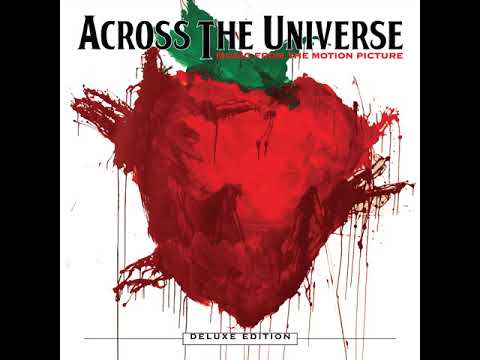
Across the Universe (2007) - film - semi-diegetic. Jude is left on the roof as police move everyone off, then he starts singing into the microphone and the others answer back from below and return to join him. Why it matters: the film makes the song a literal act of reunion, not a slogan, and it lands as the story's last attempt to keep people in the same frame.
Julie Taymor finishes the film with a choice that is both theatrical and a little mischievous: she refuses to end quietly. A rooftop is not a cozy place for closure. It is exposed, public, and one bad moment away from farce. That is why it works. The song becomes a high-wire scene about whether community can form fast enough to matter. You can feel the director counting beats like a stage manager: hold the space, wait for the voices, let the refrain lift.
The arrangement keeps the drive brisk enough to feel like movement, not benediction. The rhythm has that famous unevenness, a subtle stumble that keeps the melody from settling into comfort. It is not there to show off clever meter. It is there to keep the scene honest: love is not a smooth walk, it is a series of decisions, sometimes made in a hurry.
Creation History
John Lennon wrote the source single in 1967 for a global satellite broadcast, and the band first performed it for the Our World telecast. As stated on The Beatles official site, the program reached a mass international audience and positioned the song as a message piece from day one. Taymor repurposes that history into a finale about visibility and risk, then a later Playbill interview has her framing the last song choice as the point reached after the film's emotional battles, which fits the rooftop staging perfectly.
Song Meaning and Annotations
Plot
The story has already detonated friendships and romances with war, jealousy, and politics. The police intervention on the rooftop forces separation into the open, and Jude is briefly left alone. Then he sings, not as showmanship but as a flare. The others hear him and return, and the film closes on connection restored at the exact moment the world tries to scatter it.
Song Meaning
Inside this film, the meaning is less about universal harmony and more about the concrete act of showing up. The lyric becomes an instruction for the characters: stop running, come back, do not let the last word be distance. The chorus works like a roll call. Each added voice is a choice to rejoin the story rather than watch from the sidewalk.
Annotations
"Jude is left alone on the roof and starts singing into the microphone, then the others join."
The staging makes the song a rescue rope. It is not an ending credit gesture, it is a plot action: a sound that gathers people back into the same space.
"The film lists the number as sung by Jude, Sadie, Prudence, Max, and Jojo."
That roster matters. The finale is not only about the central couple. It is the whole chosen family, in harmony because they are finally aligned, not because they suddenly agree on everything.
"The source song has complex meter changes in the verses."
That musical wobble becomes character texture. The scene is not stable ground, and the rhythm mirrors that: forward motion with a slight hitch, like climbing stairs too fast.
Style fusion and driving rhythm
The number sits in pop-rock, but it behaves like theater: call and response, a refrain built for communal breath, and a groove that can be pushed by editing. The film's cover keeps the hook bright, then lets the ensemble sound widen just enough to sell the rooftop as a shared space.
Symbols and key phrases
The roof is the main symbol. It is visibility and vulnerability at once. The key phrase is the title hook, repeated until it stops sounding like a headline and starts sounding like a promise made under pressure.
Technical Information (Quick Facts)
- Artist: Jim Sturgess; Dana Fuchs (soundtrack listing)
- Featured: ensemble (film performance credit context)
- Composer: John Lennon; Paul McCartney
- Producer: T Bone Burnett; Elliot Goldenthal; Matthias Gohl (soundtrack compilation credits)
- Release Date: October 2, 2007 (deluxe soundtrack edition)
- Genre: film soundtrack; pop-rock cover
- Instruments: lead vocals; ensemble vocals; rock band arrangement
- Label: Interscope
- Mood: rallying; urgent; bright
- Length: 3:22 (deluxe soundtrack listing)
- Track #: Deluxe physical disc 2, track 28
- Language: English
- Album (if any): Across the Universe (Music from the Motion Picture) - Deluxe Edition
- Music style: chorus-forward build with rooftop-performance framing
- Poetic meter: pop prosody with irregular verse meter
Frequently Asked Questions
- Who sings the finale in the film
- The film lists it as a group performance led by Jude, with Sadie, Prudence, Max, and Jojo joining.
- Is it staged as a rooftop performance
- Yes. Jude starts alone on the roof, and the others join as the police intervention escalates.
- Why end the film with this title
- Taymor has described it as the final destination after the story's conflicts, which matches the reunion staging and the need for a last, simple statement.
- Is the soundtrack credit the same as the film credit
- Not exactly. The deluxe soundtrack track listing spotlights Jim Sturgess and Dana Fuchs, while film documentation describes an expanded ensemble.
- How long is the deluxe soundtrack version
- About 3 minutes and 22 seconds, as listed in the deluxe track listing.
- Does the song have unusual meter
- Yes. Reference documentation describes irregular verse meter and steadier chorus bars, which can feel like a gentle rhythmic lurch.
- What is the dramatic action of the refrain
- It functions as a signal that gathers characters back together, turning a familiar hook into a reunion device.
- Was the original tied to a major broadcast
- Yes. The Beatles performed it for the Our World satellite broadcast in June 1967, and the single followed soon after.
Awards and Chart Positions
The cover version is primarily an album cue, so its measurable chart footprint is best discussed at the soundtrack level: the album peaked on the US Billboard 200 and the US Top Soundtracks chart, earned a year-end soundtrack placement, and received a US Platinum certification. The source Beatles single, released in July 1967, reached number one in the UK for three weeks and topped the US Hot 100 for a week, with Official Charts and reference documentation agreeing on the headline results.
| Item | Result | Notes |
|---|---|---|
| Across the Universe soundtrack album | US Billboard 200 peak 36 | Album-level weekly peak during 2007-2008 |
| Across the Universe soundtrack album | US Top Soundtracks peak 12 | Album-level soundtrack chart peak |
| Across the Universe soundtrack album | US year-end soundtrack position 22 (2008) | Album-level year-end placement |
| Across the Universe soundtrack album | RIAA Platinum | United States album certification |
| The Beatles single (1967) | UK number one for three weeks | Official Charts summary |
| The Beatles single (1967) | US Hot 100 number one for one week | Reference documentation summary |
How to Sing All You Need Is Love
This one is trickier than it sounds, because the melody invites casual phrasing while the verse meter quietly shifts under your feet. Musicnotes lists a common published key of G major with a voice range around D4 to G5 and metronome markings near q equals 98 to 100 for typical arrangements. Indexing sites for the film soundtrack track often tag it as faster and in a different key, which is a reminder to practice the version you are using, not the myth of the original.
- Tempo - Start around q = 98 to 100 for the standard pop feel, then adjust to your accompaniment and edit timing.
- Diction - Keep the rapid "nothing you can" lines crisp. If consonants smear, the verse turns to mush.
- Breathing - Mark small renewals before long verse sentences. The text is dense and wants air.
- Flow and rhythm - Count the verse carefully. The irregular bar pattern can make singers rush or overcorrect.
- Accents - Stress the verbs, not every syllable. The lyric persuades through clarity, not volume.
- Ensemble - If you have chorus voices, treat the hook like call and response, then blend on the repeated title line.
- Mic - Pull back slightly when the hook repeats in thicker texture, especially on sustained vowels.
- Pitfalls - Avoid turning it into a grin-and-wave anthem. It reads best when it sounds like a decision made in real time.
Additional Info
The finale works because it treats love as action, not vibe. The police move is not subtle, and the film does not pretend it is. That is why the song needs to be sung into a microphone: a public act that can be interrupted. When the others join, the moment becomes a piece of street theater, a chorus stepping into view because someone has finally said the quiet part out loud.
The original single carried a global-telecast backstory, and that history is not just trivia. It explains why the melody can survive huge crowds and still feel direct. The film borrows that public DNA, then aims it at a smaller target: one person across a city gap, a voice traveling farther than the body can.
Key Contributors
| Entity | Type | Relationship (S-V-O) |
|---|---|---|
| Jim Sturgess | Person | Sturgess - performs - the soundtrack version and portrays Jude leading the finale. |
| Dana Fuchs | Person | Fuchs - performs - the deluxe soundtrack track and portrays Sadie joining the rooftop chorus. |
| Joe Anderson | Person | Anderson - appears as - Max, listed among the film's singers for the finale. |
| T. V. Carpio | Person | Carpio - appears as - Prudence, listed among the film's singers for the finale. |
| Martin Luther McCoy | Person | McCoy - appears as - Jojo, listed among the film's singers for the finale. |
| Julie Taymor | Person | Taymor - directs - the film and frames the finale as a rooftop reunion under police pressure. |
| John Lennon | Person | Lennon - writes - the source song and leads its message-first framing. |
| Paul McCartney | Person | McCartney - co-writes - the source song. |
| T Bone Burnett | Person | Burnett - produces - the soundtrack compilation. |
| Elliot Goldenthal | Person | Goldenthal - produces - the soundtrack compilation and composes the film's score. |
| Matthias Gohl | Person | Gohl - produces - the soundtrack compilation. |
| Interscope Records | Organization | Interscope Records - releases - the soundtrack editions. |
Sources
Sources: The Beatles official site (Our World feature and song page), Wikipedia: Across the Universe (film) musical numbers list, Wikipedia: Across the Universe (soundtrack) track listing, charts and certification, IMDb soundtrack page and plot summary, Playbill interview with Julie Taymor, Official Charts song page, Wikipedia: All You Need Is Love composition and chart notes, Musicnotes arrangement details, YouTube official topic audio upload