
Two Sleepy People Lyrics
Two Sleepy People
I`d work for you, I`d even slave for youI`d be a beggar or a knave for you (whatever that is)
And if that isn`t love, it`ll have to do
Until the real thing comes along
I`d gladly move the earth for you
To prove my love, dear, and its worth for you
If that isn`t love, it will have to do (gotta do)
Until the real thing comes along
With all the words, dear, at my command
I just can`t make you understand
I`ll always love you, darling, come what may
My heart is yours, what more can I say?
(You want me to rob a bank? Well I won`t do it)
I`d sigh for you, yes, I`d even cry for you, yes
I`d tear the stars down from the skies for you
If that isn`t love, well skip it, it`ll have to do
Until the real thing comes along
Listen baby
I`d even sigh for you, I`m `bout ready to cry for you
I`d tear the stars down from the skies for you
If that isn`t love, it`ll have to do, baby, yes
Until the real thing comes along
(Here`s the real thing, baby)
Song Overview
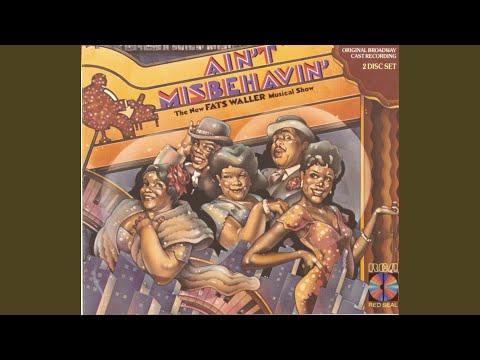
Review and Highlights
Quick summary
- What it is: A 1938 standard by Hoagy Carmichael (music) and Frank Loesser (words), a love song that treats exhaustion as romantic proof.
- How Ain't Misbehavin uses it: As a snippet inside the finale medley, sandwiched among familiar crowd-pleasers, so the evening ends with both sparkle and a soft exhale.
- What the medley choice implies: This is not a separate showcase number - it is a mood-shift, a tiny scene change you feel in the shoulders.
- Why it works: After a revue full of bright talk, this tune briefly lowers the voice and reminds us that intimacy is also showmanship.
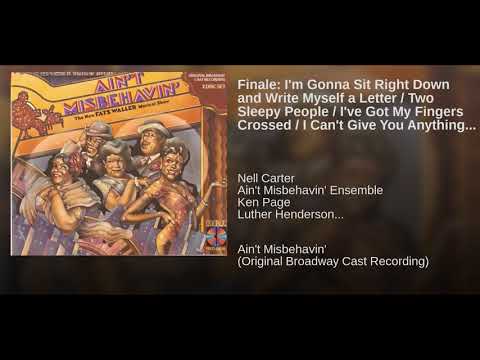
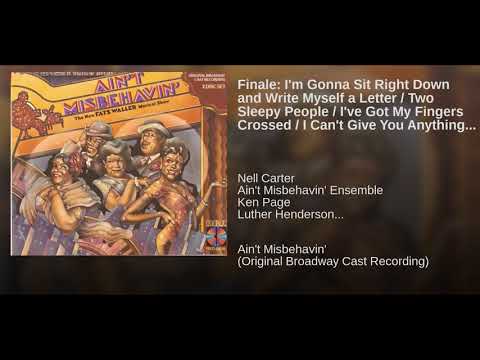
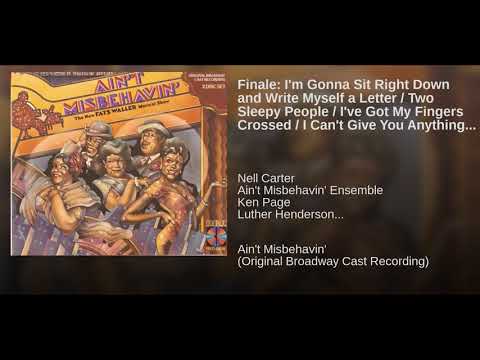
Ain't Misbehavin (1978) - stage revue - non-diegetic (presented as nightclub performance). On the Legacy Recordings 2-CD track list, the finale is literally titled as a string: "I'm Gonna Sit Right Down and Write Myself a Letter / Two Sleepy People / I've Got My Fingers Crossed ..." which tells you exactly how the show thinks - a closing montage rather than a single curtain song.
The charm here is its scale. In a big finale, a smaller song can be a daring move: it asks the audience to lean in for a moment before the last big grin. Carmichael and Loesser wrote a lovers-at-dawn vignette, and in this revue setting it becomes a theatrical breath between bright choruses. The best performances do not sell it as nostalgia. They sell it as behavior - hands still linked, eyes half-lidded, and the stubborn refusal to say goodnight even though the room knows tomorrow is coming.
Key takeaways:
- Play it like a private scene in public: aim the line at one person, let the audience eavesdrop.
- Keep the rhythm steady: it reads as late-night ease, not fatigue.
- In medley context, clarity beats volume: make the words land, then hand the spotlight back to the band.
Creation History
Reference histories date the song to September 10, 1938, with Carmichael and Loesser writing it as a follow-up assignment in the wake of a popular Bob Hope vehicle, and the same sources note that the Fats Waller version became the best-known hit in 1938. Ain't Misbehavin borrows that recognizability, but reframes it as a quick late-night postcard in the finale. According to Masterworks Broadway's album page, the cast recording treats the finale as a medley showcase, and this tune benefits from that framing: it arrives like a soft lamp turned on, then disappears before it can overstay its welcome.
Song Meaning and Annotations
Plot
A couple is out of everything except time and affection. They sit up, they talk, they stall, they hold on, because parting feels worse than staying awake. In Ain't Misbehavin, that tiny story is folded into a montage ending, so it plays like a quick close-up shot inside a larger closing number.
Song Meaning
The meaning is devotion expressed through refusal: refusal to end the night, refusal to admit the party is over, refusal to let tomorrow steal the present. In a revue, that idea doubles as a backstage metaphor. Performers also live in late-night hours, chasing the last laugh, the last chord, the last bit of electricity before the house empties.
Annotations
The song is dated to September 10, 1938, with Carmichael on music and Loesser on words.
That pairing matters for tone. Carmichael brings the melodic warmth; Loesser brings conversational specificity. The tune sounds like a scene, not a declaration.
Legacy Recordings lists it inside the finale medley rather than as a separate track.
That is a staging instruction disguised as catalog copy. You do not build a whole spotlight around it - you let it flicker, then you move on.
Shazam metadata for the cast-recording finale medley lists a pulse near 111 BPM and a release date of July 14, 1987 for that album edition.
The tempo point is practical: even when the lyric is sleepy, the underlying machine keeps turning. In performance, you want the sleepiness in the acting, not in the timekeeping.
Musicnotes listings show common published arrangements with vocal ranges like Bb3 to D5 and a separate arrangement with an original published key listed as C major.
Those ranges explain why the song travels so well. It sits in a comfortable pocket for many singers, which is why it became a standard that can be tailored to the performer.
Style, rhythm, and the emotional arc
The number is a romantic slow-burn, but it is not a ballad that stops the show. In the revue, it lives inside a finale montage, so it behaves like a film dissolve: bright chorus to quiet intimacy, then back to bright chorus. That is why the emotional arc must be quick and clean - warm entrance, one clear image, graceful exit.
Technical Information (Quick Facts)
- Song: Two Sleepy People
- Artist: Original Broadway Cast of Ain't Misbehavin (finale medley context)
- Featured: Nell Carter; Ain't Misbehavin Ensemble; Ken Page; Luther Henderson; Andre DeShields; Armelia McQueen; Charlaine Woodard (finale medley credit line)
- Composer: Hoagy Carmichael
- Lyricist: Frank Loesser
- Release Date (album edition listing): July 14, 1987
- Genre: Standard; swing-era pop adapted for musical theatre revue
- Instruments: Voice; piano; ensemble band
- Label (album edition listing): Masterworks Broadway
- Mood: Tender; late-night; gently amused
- Length: In-medley excerpt (finale track length varies by edition; some listings show about 7:11 for the full finale medley)
- Track #: Disc 2, track 12 (Legacy 2-CD track list, finale medley)
- Language: English
- Album: Ain't Misbehavin (Original Broadway Cast Recording)
- Music style: Standard phrasing inside a Broadway-style closing montage
- Poetic meter: Accentual, speech-forward stresses shaped by swing phrasing
Frequently Asked Questions
- Is this a full stand-alone number in the revue?
- On widely circulated cast-album editions, it is folded into the finale medley rather than presented as a separate track.
- Who wrote it?
- Standard references credit Hoagy Carmichael (music) and Frank Loesser (words), dated to September 10, 1938.
- Why is it associated with Fats Waller in popular memory?
- Reference histories note that a 1938 Fats Waller recording became the most popular hit version, which helped cement the tune as a standard.
- What is the song actually about?
- A couple is too tired to stay up and too in love to say goodnight, so they linger until morning.
- What is the acting job in a medley excerpt?
- Make one clear relationship beat. You need one specific image that reads instantly before the medley moves on.
- Does it need big comedy?
- No. The humor is baked into the situation. Play it sincerely and let the audience smile at the stubbornness.
- What tempo should rehearsal start with for the cast-recording finale feel?
- Metadata for the finale medley lists about 111 BPM, which supports a steady montage rather than a slow ballad tempo.
- Is there a typical vocal range?
- Published sheet-music arrangements vary, but one common listing shows a range like Bb3 to D5, which many voices can inhabit comfortably.
- Why place it near the end of the show?
- It provides contrast: a brief intimate hush inside a big closing sequence, like a close-up shot before the final curtain image.
Awards and Chart Positions
The standard itself is better known for its recording history than for later chart runs. In the revue context, the major competitive milestones belong to Ain't Misbehavin: it won the 1978 Tony Award for Best Musical, a key reason this cast recording - and its finale medley - became a widely circulated reference point for these songs.
| Item | Year | Result |
|---|---|---|
| Tony Awards | 1978 | Best Musical (Ain't Misbehavin) - Won |
How to Sing Two Sleepy People
Because the revue uses an excerpt inside a montage, focus on legibility and intimacy more than on sustained vocal fireworks. For rehearsal anchors, Shazam metadata lists the cast-recording finale medley around 111 BPM, and published sheet-music arrangements list ranges such as Bb3 to D5, with an arrangement that notes an original published key as C major.
- Tempo: Practice the phrase at a steady 111 BPM feel, then adjust to your music director. The goal is montage momentum with sleepy acting, not sleepy time.
- Diction: Place consonants gently. The language should sound like whispered conversation that somehow reaches the back row.
- Breathing: Take small, quiet breaths. Big inhalations contradict the late-night mood.
- Flow and rhythm: Sit in the pocket and let the band carry forward motion. Do not stretch phrases so far they lose the medley handoff.
- Pitch strategy: If your chart sits near the common Bb3 to D5 pocket, keep tone warm and unforced in the middle. If your arrangement is higher, keep vowels narrow so fatigue does not creep into pitch.
- Acting beats: Choose one partner-focus moment and one shared-laughter moment. Two beats is plenty in a medley excerpt.
- Mic: If amplified, trust intimacy. Less volume often reads as more honest.
- Pitfalls: Do not underline cuteness. The sweetness comes from sincerity plus timing.
Additional Info
There is a sly bit of theatre craft in choosing this standard for a finale montage: it lets the revue glance sideways at romance without changing the nightclub frame. And historically, the song sits at an intersection the show loves: popular cinema assignments, standard writing, and bandstand life. Wikipedia summarizes the song's background as a film follow-up commission, while SecondHandSongs catalogs its early recording history and copyright dating. If you want a trusted critical shorthand for why this kind of insertion works, a Masterworks Broadway note about the expanded edition treats the finale as a reason to seek the fuller release - a closing montage that turns a stack of standards into something like a scene.
Key Contributors
| Entity | Type | Relationship (S-V-O) |
|---|---|---|
| Hoagy Carmichael | Person | Carmichael wrote the music credited for the 1938 standard. |
| Frank Loesser | Person | Loesser wrote the words credited for the 1938 standard. |
| Legacy Recordings | Organization | Legacy publishes the 2-CD track list that places the tune inside the finale medley (Disc 2, track 12). |
| Masterworks Broadway | Organization | Masterworks Broadway distributes the cast-recording edition that lists the finale medley and its release date. |
| Luther Henderson | Person | Henderson is credited among the finale medley performers and anchors the revue sound. |
| Original Broadway Cast of Ain't Misbehavin | Organization | The cast performs the tune as part of the finale montage, not as a stand-alone track. |
Sources
Sources: Legacy Recordings track list, Masterworks Broadway album page, Shazam track metadata for the finale medley, Wikipedia background entry for the 1938 standard, SecondHandSongs work page, Musicnotes arrangement listings, YouTube (Masterworks Broadway upload)