
Cant Help Falling in Love Lyrics
Cant Help Falling in Love
Wise men say only fools rush inbut I can't help falling in love with you
Shall I stay
would it be a sin
If I can't help falling in love with you
Like a river flows surely to the sea
Darling so it goes
some things are meant to be
take my hand, take my whole life too
for I can't help falling in love with you
Like a river flows surely to the sea
Darling so it goes
some things are meant to be
take my hand, take my whole life too
for I can't help falling in love with you
for I can't help falling in love with you
Song Overview
Review and Highlights
Quick summary
- What it is: A late-Act I shift from town-wide frenzy to a grown-up kiss that changes the rules of the room.
- Who sings on the 2005 cast album: Sharon Wilkins and Mark Price, joined by featured cast and ensemble voices.
- Where it appears: Act I, as everyone rushes to the abandoned fairgrounds - Jim heads there too, but stops to kiss Sylvia.
- How this version plays: Not a moonlit serenade - a surprise awakening, staged like a door quietly opening in a farce.
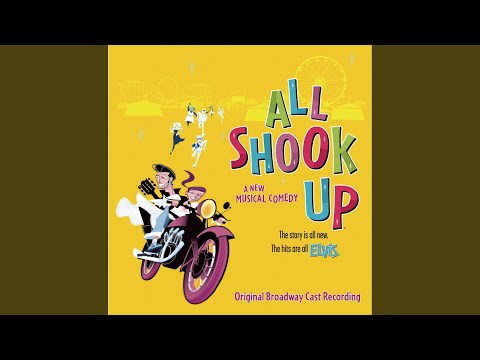
All Shook Up (2005) - musical - non-diegetic. If Act I has been a whirl of teens, disguises, and civic panic, this number suddenly makes you look at the adults and think: oh, they are not just chaperoning the plot. The official synopsis is blunt about the action - Jim is on his way to the fairgrounds, but first he kisses Sylvia, and she discovers a new passion for her old friend. It is a clean theatrical pivot: the show stops chasing the motorbike long enough to reveal a slower, riskier truth.
What I admire is the understatement. In a jukebox score, this tune can easily turn into a concert moment. Here it is written into the gears of the story: Sylvia has spent the act as the capable bar owner with a guarded heart, and the kiss makes that guard wobble. The staging often benefits from restraint - less posing, more listening - because the shock is the point. The audience already knows the melody. The surprise is who gets to mean it.
Key takeaways
- Driving rhythm: A slow, steady pulse that cools the act without draining it.
- Character function: Sylvia steps out of caretaker mode; Jim finally stops performing longing and acts.
- Scene leverage: The number gives the Act II romances adult stakes, not just teen momentum.
Creation History
The song was written by Hugo Peretti, Luigi Creatore, and George David Weiss for Elvis Presley's film Blue Hawaii (released in late 1961 as a single). The melody is linked to the older song "Plaisir d'amour," which helps explain why the line feels almost too elegant for a small-town comedy. As stated in a May 2024 Billboard feature ranking Elvis songs by Hot 100 peak, the recording sits near the very top of his pop legacy, and that cultural weight is exactly what the musical borrows to dignify Sylvia and Jim in one stroke.
Song Meaning and Annotations
Plot
By the time the sun goes down, the town is running on desire like it just discovered electricity. Chad is hiding at the fairgrounds, romances are colliding, and secrets are stacking up. Jim joins the rush, but the show pauses him at the edge of something quieter: Sylvia. The kiss is not a detour. It is a correction. Jim has been chasing the wrong fantasy (Miss Sandra), and Sylvia has been waiting long enough that waiting has become a habit. This moment breaks the habit.
Song Meaning
In the musical, the meaning is not destiny as a slogan. It is recognition with consequences. Sylvia is not a wide-eyed newcomer to love; she is a person who has been managing a room for years and suddenly cannot manage her own face. Jim is not pleading for affection; he is choosing the person who has been beside him all along. The lyric becomes a confession that arrives late - and lands better for arriving late.
Annotations
Jim heads to the fairgrounds, but not before kissing Sylvia, who suddenly discovers a new passion for her old friend.Synopsis cue
This is a textbook example of a jukebox number earning its keep. One action, one reversal, and the adult love story finally stops being subtext.
The cast recording credits a large group of featured voices on this track, led by Sylvia and Dennis performers alongside the ensemble.Recording note
Even if a production stages it as a private beat, the recording reminds you the town is the pressure cooker. Love in this show is rarely allowed to stay private for long.
In the UK, the 1962 single pairing "Cant Help Falling in Love/Rock-A-Hula Baby" reached peak position 1 and stayed on the chart for 20 weeks.Chart note
That long UK run is why the melody hits like a collective memory. The musical uses that memory to make Sylvia and Jim feel inevitable without writing a new ballad.
Harmony and the emotional arc
The arc is built on calm, not fireworks: tentative contact, then acceptance, then a kind of relief you can hear in the sustained phrases. If the performers rush it, the scene turns sugary. If they let the line breathe, the lyric reads as adult bravery. The best versions keep Sylvia's competence present even while she melts a little - she is not changing personalities, she is letting a truth surface.
Technical Information (Quick Facts)
- Song: Cant Help Falling in Love
- Artist: Sharon Wilkins; Mark Price; featured cast; All Shook Up Ensemble
- Featured: Ensemble and principals
- Composer: Hugo Peretti; Luigi Creatore; George David Weiss
- Producer: Jay David Saks (cast recording)
- Release Date: May 31, 2005
- Genre: Musical theatre; pop ballad
- Instruments: Voices; theatre orchestra and band
- Label: Masterworks Broadway
- Mood: Tender; dawning; grounded
- Length: 2:55
- Track #: 16
- Language: English
- Album (if any): All Shook Up - Original Broadway Cast Recording (2005)
- Music style: Act I release valve that turns a side friendship into a romantic choice
- Poetic meter: Slow, even phrasing with long sustained stresses
Frequently Asked Questions
- Who sings this number in the story?
- Sylvia and Jim anchor it in most stagings, with additional voices often used to color the moment.
- Where does it land in the plot?
- Late in Act I, just before everyone converges on the abandoned fairgrounds.
- Why give this song to the adults?
- Because it grants them the same romantic legitimacy the teens get all night, and it reframes Sylvia as a person with stakes, not just a setting.
- Is it staged as a performance inside the town?
- Usually no. It plays as scene music, with the kiss as the dramatic event.
- What is the main acting action for Sylvia?
- Allow. She allows herself to be seen, and that is harder for her than flirting.
- What is the main acting action for Jim?
- Choose. He stops chasing a fantasy and chooses the person who has been there, steady, the whole time.
- Is the tune linked to an older melody?
- Yes. Music histories commonly note its connection to "Plaisir d'amour," which gives it an older-song inevitability.
- How big was the original Elvis single in the UK?
- Official Charts Company lists the 1962 pairing with "Rock-A-Hula Baby" as a UK number 1 with a 20-week run on the singles chart.
- How big was it on the US Hot 100?
- Billboard rankings and chart histories commonly place its Hot 100 peak at No. 2.
- What is the best way to avoid making it syrupy onstage?
- Keep it conversational. Let the lyric feel like a thought spoken aloud, not a recital.
Awards and Chart Positions
The cast recording track functions as story documentation, not a single release. The source song carries the public milestones. In the UK, Official Charts Company lists "Cant Help Falling in Love/Rock-A-Hula Baby" at peak position 1 with a 20-week chart run in 1962. In the United States, Billboard chart summaries rank the recording with a Hot 100 peak at No. 2. A major later-life cover is UB40's "(I Cant Help) Falling in Love with You," which Official Charts Company lists as a UK number 1 in 1993.
| Version | Year | Marker | Notes |
|---|---|---|---|
| Elvis Presley - Cant Help Falling in Love/Rock-A-Hula Baby | 1962 | UK peak 1; 20 weeks on chart | Official UK chart listing for the pairing |
| Elvis Presley - Cant Help Falling in Love | 1962 | US Hot 100 peak 2 | Billboard peak-date summaries and rankings |
| UB40 - (I Cant Help) Falling in Love with You | 1993 | UK peak 1 | Later cover that reintroduced the hook to pop radio |
| All Shook Up cast recording track | 2005 | Track 16; 2:55 | Act I turning point for Sylvia and Jim |
How to Sing Cant Help Falling in Love
For rehearsal, metrics depend on edition and performance key. A common published vocal arrangement lists D major with a vocal range around A3 to C-sharp 5, and tempo references for the Elvis master often sit around 100 BPM. The cast recording database listing for this track reports a slower feel around 88 BPM with a B-flat major center. In theatre, the job is less about the exact numbers and more about line, breath, and intention.
- Tempo: Start around 76 BPM to connect the legato, then move toward the track feel (roughly high-80s to around 100 BPM depending on arrangement) so the phrases do not drag.
- Diction: Keep consonants gentle but present. The lyric lives in plain words, so clarity matters more than volume.
- Breathing: Plan breaths before long climbs. If you inhale late, the line sounds like it is collapsing rather than yielding.
- Flow and rhythm: Think in long arcs. Each phrase should feel like one thought, not a chain of pretty notes.
- Accents: Let the stress fall on the choice words, not on sentiment. This character moment is about deciding, not decorating.
- Partner work: If staged as Sylvia and Jim, sing to a person, not to the balcony. The intimacy is the staging trick.
- Mic: If amplified, do less. A small dynamic shift reads louder than a pushed belt in this style.
- Pitfalls: Over-crooning or over-slowing. Keep the heartbeat steady so the scene stays truthful.
Additional Info
This tune is famous as a closer in Elvis concerts, but the musical uses it differently - not as goodbye, as discovery. That choice is savvy. The song arrives with built-in romance, so the show can spend its time on what matters: Sylvia's surprise at her own desire, and Jim's relief at finding a real answer after chasing a shiny one.
If you want a listener's footnote, the two major public afterlives are easy to trace: the UK chart-topping 1962 pairing, and the UB40 version that turned the melody into early-1990s pop-reggae. Neither cancels the other. They just prove the hook survives costume changes.
Key Contributors
| Entity | Type | Relationship (S-V-O) |
|---|---|---|
| Sharon Wilkins | Person | Wilkins performs the cast recording track as Sylvia. |
| Jonathan Hadary | Person | Hadary originates Jim and is credited among featured voices on the cast recording track. |
| Hugo Peretti | Person | Peretti co-wrote the original song used in the musical. |
| Luigi Creatore | Person | Creatore co-wrote the original song used in the musical. |
| George David Weiss | Person | Weiss co-wrote the original song used in the musical. |
| Jay David Saks | Person | Saks produced the Original Broadway Cast Recording. |
| Masterworks Broadway | Organization | Masterworks Broadway released the cast album and publishes the Act I synopsis cue for the kiss. |
| Official Charts Company | Organization | Official Charts Company documents UK chart history for the Elvis and UB40 versions. |
Sources
Sources: Masterworks Broadway cast album page and Act I synopsis, Masterworks Broadway YouTube audio release, Presto Music album metadata and performer credits, Official Charts Company chart history pages for Elvis Presley and UB40, Billboard May 28, 2024 Elvis top songs feature, Musicnotes sheet music listing for vocal range and key, Tunebat key and BPM listings