
Artus Excalibur Lyrics: Song List
- Act I
- Das Feld der Ehre / The Field of Honor
- Der Heiler / The Healer
- Excalibur
- Fern von dieser Welt / In This World
- Schwert und Stein / Sword and Stone
- Sünden der Väter / Sins of the Fathers
- Ein wahrer Held / A True Hero
- Was macht einen Konig aus / What Makes A King?
- Die ruhmreiche Schlacht / The Glorious Battle
- Was will ich hier / What I Want
- Ein neuer Tag / A New Day
- Heute Nacht fängt es an / It Begins Tonight
- Act II
- Sogar der Regen schweigt still heut Nacht / Even the Rain is Silent Tonight
- Vater und Sohn / Father and Son
- Morgen triffst du den Tod / Tomorrow, You Meet Death
- Die Rose / The Rose
- Wo ging die Liebe hin? / How Do You Make Love Stay?
- Begehren / Desire
- Nur sie allein / Her Alone
- Der Kreis der Menschheit / The Circle of Humanity
- Alles ist vorbei / The End
- Vor langer Zeit / Long Ago
About the "Artus Excalibur" Stage Show
The story follows the legendary King Arthur from his humble beginnings to becoming the ruler of Camelot. After pulling the magical sword Excalibur from the stone, Arthur sets out to unify Britain. Along the way, he encounters various challenges, including the treacherous Mordred, who seeks to overthrow him. Arthur's love for Guinevere and his friendship with Lancelot are central to the plot, leading to dramatic conflicts and emotional turmoil. The musical explores themes of loyalty, power, and destiny, culminating in a climactic battle for the future of Camelot.
Release date of the musical: 2014
"Artus – Excalibur" – The Musical Guide & Song Meanings
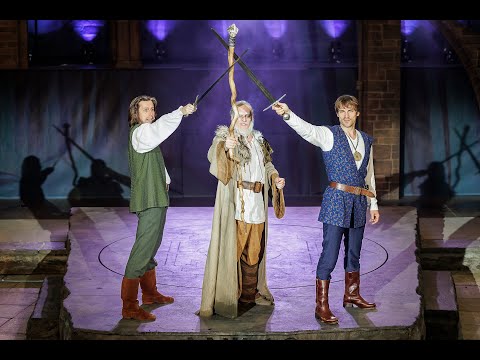
Review: the king is crowned, then the lyric takes the crown away
“Artus – Excalibur” sells a heroic myth, then undercuts it in the very first emotional turn. Pulling the sword is not the triumph. It’s the trap. The lyrics keep insisting that destiny is just another form of pressure, the kind that looks noble from far away and feels like a bruise up close. When Arthur denies the role, the language does something sharp: it reframes refusal as ethics, not weakness. And then it dares him to keep living with that choice.
Robin Lerner’s text (in German translation by Nina Schneider) plays a constant game with “should.” Should a king forgive. Should a friend stay loyal. Should a wife be patient. Should a wizard resist temptation. The score’s hook is that each “should” is performed as a song, which means it’s never neutral. The words push the characters into public promises, then punish them for not being able to inhabit those promises privately.
Musically, Frank Wildhorn leans into modern rock musculature, but he keeps threading in older colors when the story needs authority or ritual. A review of the St. Gallen premiere notes “irish” melodic touches inside the orchestrations and a strong recurring main theme, paired with a quieter, less romance-forward Wildhorn profile than some audiences expect. That matters for lyric reading, because it changes how the love triangle hits. Guinevere and Lancelot do not sound like a glossy fantasy. They sound like people trying to be decent while failing in real time.
How it was made
The most revealing “origin” detail of “Artus – Excalibur” is where it premiered: not Broadway, not the West End, but Theater St. Gallen in Switzerland, with an American creative spine (Wildhorn, Ivan Menchell, Lerner) and a German-language performance identity. That hybrid is the project. It’s a transatlantic Wildhorn musical built for Europe’s repertoire model, where a show can be tuned through productions rather than judged by a single opening night.
In April 2014, Playbill reported that a concept recording tied to the St. Gallen opening hit No. 1 on both German iTunes and Amazon charts. That kind of chart pop for a new musical matters because it tells you what listeners were buying: not just the title, but the sound world. It also signals how this show has often been consumed, as an album-first experience, even by people who have never seen the staging.
There’s a small, nerdy detail that lyric people will appreciate: a German review of the CD presentation notes that the booklet “includes all lyrics.” That’s not glamorous, but it’s a statement. This is a score that expects you to read along. The writing wants scrutiny.
Onstage, the St. Gallen review record also gives you craft clues: a mostly light-wood set architecture, a central round table rising from below, and projections and lighting used to announce scene mood shifts. That design approach matches the lyric strategy: big myth, clear emotional signposts, and characters who confess under changing atmospheres rather than inside elaborate scenery.
Key tracks & scenes
"Excalibur" (Ensemble, Artus, Ector, Lancelot)
- The Scene:
- A crowd gathers at the rock. A priestly promise hangs in the air. Fighters posture. The lighting is public and harsh, like a ceremony that could turn into a riot in one breath.
- Lyrical Meaning:
- This is prophecy as peer pressure. The lyric sets up a world where legitimacy is treated like a party trick: pull the sword, win the crown. The song’s real job is to make Arthur’s later refusal feel like an act of defiance against an entire social machine.
"Fern von dieser Welt" (Merlin)
- The Scene:
- Merlin isolates Arthur from the noise and forces him to look backward. Time becomes a staging device. Past and present share the same air, like a memory you cannot walk out of.
- Lyrical Meaning:
- Merlin sings certainty, but the lyric is also manipulation. “Destiny” becomes a narrative Merlin insists on, and the song makes you wonder whose story this really is: Arthur’s life, or Merlin’s project.
"Schwert und Stein" (Artus)
- The Scene:
- Arthur throws the idea of kingship away like a weapon he did not ask to hold. The stage often empties around him. Wood, steel, breath, shame.
- Lyrical Meaning:
- Refusal becomes a character signature. The lyric is not “I’m scared.” It’s “I won’t be used.” It’s a crucial early statement that makes later jealousy and rage feel like the collapse of a man who once tried to be principled.
"Sünden der Väter" (Morgana)
- The Scene:
- A cloistered space. Punishment dressed up as piety. Morgana pivots from victimhood to strategy, with darkness entering like a second chorus.
- Lyrical Meaning:
- The title alone is the thesis: inherited damage. Morgana’s lyric weaponizes biography. She treats her past as evidence, then uses that evidence to justify revenge as “justice.”
"Was will ich hier" (Artus, Merlin, Morgana)
- The Scene:
- Camelot is still being invented, politically and physically. Morgana arrives with entitlement and pain, demanding a throne as if it’s a debt owed with interest.
- Lyrical Meaning:
- This trio makes “want” into conflict choreography. The lyric stages competing definitions of legitimacy: birthright, merit, prophecy. Nobody is purely lying. That’s why it hurts.
"Sogar der Regen schweigt still heut Nacht" (Lancelot)
- The Scene:
- A wedding celebration rages, and Lancelot slips away from it. The light narrows. The party sound becomes distant. Private longing finally has room to speak.
- Lyrical Meaning:
- It’s the score’s cleanest portrait of self-denial. The lyric frames desire as something that must be managed, muted, and moralized. Even the weather is recruited as a witness.
"Morgen triffst du den Tod" (Company)
- The Scene:
- Armies assemble. Rhetoric becomes fuel. Morgana and Loth treat war as inevitable, while Arthur’s grief hardens into a decision.
- Lyrical Meaning:
- This is threat made singable. The lyric doesn’t romanticize battle. It turns war into a countdown, exposing how quickly “duty” can become permission to destroy.
"Alles ist vorbei" (Artus, Guinevere, Lancelot, Morgana)
- The Scene:
- Morgana plants a vision of betrayal. Arthur runs on impulse and finds what looks like proof. The staging often frames the triangle in diagonals: nobody can stand face-to-face without breaking.
- Lyrical Meaning:
- The lyric is catastrophe language. It shows how jealousy edits reality. “It’s over” becomes a spell Arthur casts on his own life, because it’s easier than uncertainty.
"Vor langer Zeit" (Artus, Guinevere, Ensemble)
- The Scene:
- After bodies and consequences, love returns as something older than the war. Ghosts or memories often frame the moment. The air feels colder, but clearer.
- Lyrical Meaning:
- The lyric does not pretend the damage didn’t happen. It argues for continuation anyway. It’s not innocence regained. It’s two people choosing to live with what they did.
Live updates (2025–2026)
The most concrete near-future booking is in Austria. The Musical Festspiele Schloss Hartberg lists “Artus – Excalibur” for July 2026 as a German-language open-air production, with multiple performance dates and a posted cast lineup (Arthur, Guinevere, Lancelot, Merlin, Morgana) and creative leads. The Hartberg city page also states that ticket sales begin on November 10, 2025. If you care about momentum, that date matters more than any vague “touring” rumor, because it’s the difference between a wish and a schedule.
Beyond Europe, the property’s international life is real but versioned. Reference sources track later productions in Seoul (under the title “Xcalibur”) and Tokyo, which signals a separate adaptation path rather than a simple remount. For lyric readers, that’s a warning and an invitation: the core themes travel, but the text and story emphasis can shift dramatically between markets.
What has not been verified in the sources above is any 2025 Broadway or West End engagement. For now, “Artus – Excalibur” is behaving like a modern Wildhorn repertory title: regionally scalable, album-forward, and periodically reactivated in big outdoor venues.
Notes & trivia
- The musical premiered March 15, 2014 at Theater St. Gallen in Switzerland.
- Playbill reported the concept recording released in early April 2014 hit No. 1 on both German iTunes and Amazon charts.
- A CD review notes the booklet includes the full lyrics, an unusually reader-friendly choice for a cast recording package.
- A St. Gallen review describes a central round table that rises from below stage level, built heavily enough to require a dedicated lift mechanism.
- St. Gallen’s creative team credits include fight choreographer Rick Sordelet and choreographer Eric Sean Fogel, signaling that swordplay is treated as narrative language, not decoration.
- The German Wikipedia plot summary explicitly ties key songs to story turns, including Arthur’s rejection (“Schwert und Stein”) and Morgana’s vow of vengeance (“Sünden der Väter”).
- Hartberg’s 2026 listing frames the production as a German-language staging and publishes a specific ticket on-sale date (Nov 10, 2025).
Reception
Early reception is a familiar Wildhorn pattern: admiration for the sound, skepticism about the structure. A St. Gallen review praises the orchestra and details in orchestration while criticizing the story as too constructed and predictable. That critique is not just about book mechanics. It’s about lyric consequence. When a plot turn feels inevitable, a song can sound like an announcement instead of a decision. The show’s best numbers avoid that trap by writing from a character’s blind spot, not from the outline.
Another strand of reception highlights pure vocal impact. A German magazine write-up singles out “Sünden der Väter” and “Morgen triffst Du den Tod” as vocal peaks, while also noting a dramaturgical frustration around Morgana’s arc. That is a useful lens for the lyrics: Morgana’s songs often feel like climaxes because they are argument songs. She’s the character whose text is built to persuade, accuse, and recruit.
“Eine hervorragende Cast … einnehmende Wildhorn-Melodien … und doch mag der Funke … nicht gänzlich aufs Publikum überspringen.”
“entered the No. 1 slot on Amazon and iTunes in Germany.”
“Songs wie ‘Sünden der Väter’ oder ‘Morgen triffst Du den Tod’ gehören … zu den gesanglichen Höhepunkten.”
Technical info
- Title: Artus – Excalibur (also referenced as “Artus” and, in parts of Asia, “Xcalibur”)
- Year: 2014 (world premiere)
- Type: Through-sung, rock-leaning myth musical (legend cycle adaptation)
- Music: Frank Wildhorn
- Lyrics: Robin Lerner
- Book: Ivan Menchell
- Orchestrations/arrangements; music supervision (St. Gallen): Koen Schoots
- German translation: Nina Schneider
- World premiere: Theater St. Gallen, Switzerland (March 15, 2014)
- Selected notable placements (story-linked song moments): “Schwert und Stein” (Arthur rejects destiny); “Sünden der Väter” (Morgana swears revenge); “Sogar der Regen schweigt still heut Nacht” (Lancelot’s private conflict at the wedding); “Alles ist vorbei” (banishment after Morgana’s vision)
- Album: “Artus Excalibur – Das Musical” (2014), listed as 14 songs / 53 minutes; label credited as HitSquad Records on Apple Music
- Availability / chart notes: Reported No. 1 placement for the concept recording on German Amazon and iTunes at release; available on major streaming platforms
- 2026 staging: Musical Festspiele Schloss Hartberg (open-air, German language), with ticket on-sale date posted for Nov 10, 2025
FAQ
- Can I read the complete lyrics somewhere?
- Authorized full-text lyric publication is usually controlled by rights holders, but at least one CD review notes that the physical booklet included the full lyrics. Otherwise, expect excerpts and translations rather than complete official lyric dumps online.
- Who wrote the lyrics: Robin Lerner or Nina Schneider?
- Robin Lerner is credited for the original lyrics; Nina Schneider is credited for the German-language version.
- Is “Artus – Excalibur” the same show as the Korean “Xcalibur”?
- They are connected as versions of the same property, but reference sources describe meaningful story and adaptation differences across markets. Treat it as a related edition, not a line-by-line identical text.
- Where do the key songs land in the plot?
- Story summaries link “Schwert und Stein” to Arthur rejecting the crown, “Sünden der Väter” to Morgana’s revenge vow, “Sogar der Regen schweigt still heut Nacht” to Lancelot’s wedding-night conflict, and “Alles ist vorbei” to the banishment sequence after Morgana’s manipulation.
- Is it running in 2025 or 2026?
- A documented 2026 open-air production is listed for Musical Festspiele Schloss Hartberg in July 2026, with a posted ticket on-sale date in November 2025. No Broadway or West End run is verified in the sources above.
Key contributors
| Name | Role | Contribution |
|---|---|---|
| Frank Wildhorn | Composer | Wrote the score’s rock-driven propulsion and recurring thematic material. |
| Robin Lerner | Lyricist | Built the show’s language of duty, temptation, and political love. |
| Ivan Menchell | Book writer | Structured a revised Arthurian narrative with strong villain agency for Morgana. |
| Koen Schoots | Orchestrations/arrangements; music supervision | Shaped the sonic identity and led the musical implementation noted in St. Gallen reviews. |
| Nina Schneider | German translation | Created the German-language lyric and dialogue version used in major productions. |
| Francesca Zambello | Director (St. Gallen) | Helmed the world premiere staging cited in production coverage. |
| Eric Sean Fogel | Choreographer (St. Gallen) | Built movement language around knights, crowds, and ritual. |
| Rick Sordelet | Fight choreographer (St. Gallen) | Designed combat storytelling for a sword-and-prophecy musical. |
| Thomas Schleimer | Arthur (Hartberg 2026 listing) | Listed as Arthur for the 2026 open-air Hartberg production. |
| Valentina Ganster | Guinevere (Hartberg 2026 listing) | Listed as Guinevere for the 2026 open-air Hartberg production. |
Sources: Playbill; Musicalzentrale; Konzert und Theater St. Gallen (via coverage); German Wikipedia; Bruxellons (synopsis); Musicalplanet; Musical Festspiele Schloss Hartberg (official site); Hartberg city website; musicals - Das Musicalmagazin; YouTube.