
Zombie Prom Lyrics: Song List
- Act 1
- Enrico Fermi High
- Ain't Goin' Back
- Jonny Don't Go
- Good as It Gets
- The C Word
- Rules, Regulations and Respect
- Blast from the Past
- Thats the Beat for Me
- The Voice in the Ocean
- It's Alive
- Where Do We Go from Here
- Trio (Case Closed)
- Act 2
- Then Came Jonny
- Come Join Us
- How Can I Say Good-Bye
- Easy to Say
- Expose
- Is'nt It?
- Forbidden Love
- Delilah's Confession (It was years ago... )
- The Lids Have Been Blown
- Zombie Prom
About the "Zombie Prom" Stage Show
Music was composed by D. P. Rowe. The libretto and lyrics were written by John Dempsey. Premiere was held in 1993 in the Florida Red Barn Theatre. Production has been developed by a director J. Hawkins. Off-Broadway musical took place in the Variety Arts Theatre from March to April 1996, exhibiting 28 regular performances. Production was carried out by director Philip McKinley and choreographer Tony Stevens. The cast involved R. Roland, K. Murphy, J. S. Wilson, R. Muenz, R. Rich, M. Lovci, J. Skowron, N. Toro, S Stevens & C. Trien. In 2004, British production was held in Hitchens’ Queen Mother Theatre with the participation of Katherine Judkins and Sophie Michaels in the main parts. In 2006, the short film was created based on a plot of this musical. Director of the film was Vince Marcello.
From October to November 2009, production was held at London's Landor Theatre, carried out by director Ian McFarlane and choreographer Grace Harrington. The play had the following cast: Sophie Issacs, Jonathan Vickers, Lucy May Barker & Darren John. In June 2011, the theatrical was presented in London’s Drill Hall. The choreography developed Lisa Donmall. The cast of actors was: Kay Victoria Hindmarsh, David Moss, Laura Beth Mortemore & Lauren Austin. In March 2013, the spectacle was shown in the Mayfield High School Theatre. In the production participated Haley Kirkpatrick, Joel Fisk, Courtney Hiedenreich & Abraham Espana. In November 2013, the play was exhibited in the Ohio State University Theatre, directed by Mandy Fox. Kelly Hogan, Trent Rowland, Liz Light & Ryan Boda were in the cast.
Release date of the musical: 1997
"Zombie Prom" – The Musical Guide & Song Meanings
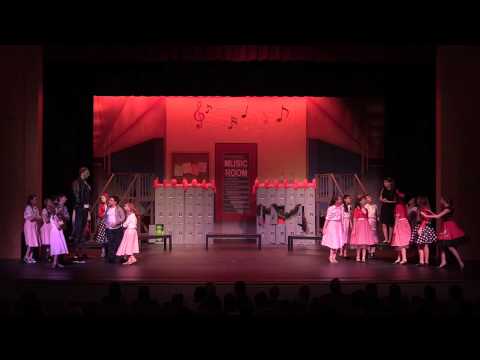
Review
“Zombie Prom” runs on a simple thesis and then keeps poking it with a stick: conformity is funny until it turns cruel. John Dempsey’s lyrics behave like pep-squad slogans that start to glitch, while Dana P. Rowe’s score leans into doo-wop, rock ’n’ roll, and period pastiche as if the atomic age is a dance step you can learn and survive. The best lines are the ones that sound like 1950s cheer but carry a 1990s punchline: teen rules are arbitrary, adult rules are hypocritical, and everybody keeps smiling anyway.
The show’s big lyrical motif is regulation. Not love, not death. Regulation. Enrico Fermi High is policed by language, manners, and a principal who treats “respect” like a weapon. That sets up the central joke: the story’s undead boy is not the scariest thing in the room. The text keeps asking who gets to be “acceptable,” who gets labeled “gross,” and how quickly a crowd will turn when someone stops performing normal.
Listener tip (and it matters onstage, too): track the plot through the “public” songs versus the “private” songs. The school-wide numbers are about social control. The romantic numbers are about denial and stubborn hope. When those two modes collide, the show clicks into place.
How It Was Made
Despite the “1997” tag you’ll see attached to the title in some catalog listings, “Zombie Prom” is a mid-1990s Off-Broadway creature that has lived several lives. The musical began earlier in Florida (Key West, 1993), then reached New York for an Off-Broadway run at the Variety Arts Theatre in 1996. A cast recording arrived later (commonly listed as 1998, though some retailers file it under 1997). The show’s afterlife has been powered by licensing and youth-theatre editions, including “Zombie Prom: Atomic Edition,” which streamlines the material for younger companies while keeping the core engine: love, rules, and fallout.
One origin detail hidden in plain sight is how deliberately the writers position the piece as “nuclear fifties” satire. The licensed “Atomic Edition” materials spell out the locations and tonal reference points: school corridors and classrooms, a tabloid newsroom, a television studio, and Toffee’s bedroom, all treated like stations on a media-and-manners assembly line. That framing explains why the lyrics often feel like announcements, slogans, and public-facing scripts. This is a show about people performing a decade, not just living in it.
There’s also a quiet clue about the writing partnership. In later interviews, Rowe describes his collaboration with Dempsey as fast, direct, and low on “fluff,” which tracks with “Zombie Prom” itself: it is engineered to move, land a joke, and shove the plot into the next musical beat.
Key Tracks & Scenes
"Enrico Fermi High" (Toffee, Jonny, Kids & Miss Strict)
- The Scene:
- Lights up on a home economics class: girls cooking under Miss Strict’s watch, then the boys appear in woodshop. The day is routine, the smiles are compulsory, and the building feels like it was designed to enforce posture.
- Lyrical Meaning:
- This opener sells the school as a machine. The lyric piles up subjects and rules to make teenage life sound busy and safe, which is exactly the point. The show wants “safe” to feel claustrophobic.
"Ain’t No Goin’ Back" (Toffee, Jonny & Kids)
- The Scene:
- An air-raid drill interrupts the day, and the flirtation turns into a decision. The lighting softens, the crowd becomes a chorus, and the romance is born with an alarm still ringing in the air.
- Lyrical Meaning:
- The lyric frames love as a one-way door. It’s a teen anthem on purpose: big vow, small vocabulary, full commitment. In a show obsessed with rules, this is the first real act of defiance.
"Jonny Don’t Go to the Nuclear Plant" (Toffee)
- The Scene:
- Toffee is ordered to break up with him. She tries to keep it polite. The scene collapses into panic as Jonny heads for the place everyone pretends is “fine.”
- Lyrical Meaning:
- This is where the lyric drops the satire and admits fear. The words are direct because the stakes are. It’s the show’s warning label, delivered too late.
"Good As It Gets" (Toffee & Kids)
- The Scene:
- Three weeks later, students decorate for “Our Atomic Prom: An Evening of Miracles and Molecules” while Miss Strict makes announcements over the PA and rumors curdle in the hallway.
- Lyrical Meaning:
- The lyric weaponizes optimism. It’s about moving on, which is presented as healthy, then starts to sound like a demand. That tension is the show’s moral engine.
"Rules, Regulations, and Respect" (Miss Strict & Kids)
- The Scene:
- Toffee slips, says the wrong word, and gets hauled into a public lesson. Miss Strict turns discipline into a musical number. The ensemble becomes her marching band.
- Lyrical Meaning:
- It’s a villain song disguised as school spirit. The lyric lists values that sound reasonable until you hear how they’re used: as permission to punish.
"Blast From the Past" (Jonny & Kids)
- The Scene:
- Jonny’s voice has been haunting Toffee. Then it’s not a voice. He bursts out of a locker, and the hallway becomes a horror-movie punchline with a pep-rally tempo.
- Lyrical Meaning:
- The lyric is a comeback line turned existential. Jonny returns as the thing everybody fears, but what he wants is painfully ordinary: recognition, love, a dance, a diploma.
"That’s the Beat for Me" (Eddie, Josh, Secretaries & Copy Boys)
- The Scene:
- A tabloid newsroom spins up. Typewriters, flashing bulbs, and a reporter who smells a story like blood in the water.
- Lyrical Meaning:
- Media becomes a second school. The lyric treats scandal as rhythm, showing how quickly a community turns a human crisis into entertainment.
"Forbidden Love" (Jonny & Toffee)
- The Scene:
- Prom night: the gym is transformed, the crowd is euphoric, and Toffee finds Jonny in the shadows. They dance like they’re trying to rewrite the rules with their bodies.
- Lyrical Meaning:
- The lyric is romance with a legal problem. It’s love framed as trespassing, which is why it hurts when authority interrupts the music.
"The Lid’s Been Blown" (Company)
- The Scene:
- Eddie corners Miss Strict at the prom and forces a confession spiral. The lighting tightens, and the comedy turns into backstory with consequences.
- Lyrical Meaning:
- This is the plot’s hinge song: hypocrisy is named, then turned into the reason the ending can exist. The lyric argues that rules are often built from somebody’s old shame.
"Zombie Prom" (Company)
- The Scene:
- After revelations, the prom returns, and the whole school tries to pretend the night was always headed here. One last dance. One last joke. A finale that’s happier than the story’s body count suggests.
- Lyrical Meaning:
- The lyric resolves the show’s central question: can a community change without erasing the people it hurt? The ending says yes, but the satire has already made you suspicious, which is why it lingers.
Live Updates
Info current as of February 2026. “Zombie Prom” remains a licensing staple, with Concord Theatricals positioning it as a rock ’n’ roll comedy for schools and smaller companies, and “Zombie Prom: Atomic Edition” explicitly marketed as a youth-theatre adaptation (with adapter credit and story attribution spelled out in licensing materials). The title also appears on the Educational Theatre Association’s approved material list (a practical signal that the show is actively in circulation for student performers).
Evidence of 2025–2026 life is mostly grassroots, which is fitting for a cult-friendly show. Schools and local companies continue to announce productions and share full performance captures. The original cast recording has also been repackaged for modern listening habits: the album appears as an official “Topic” playlist upload dated 2025 on YouTube Music, alongside its long-running presence on Spotify and Apple Music.
Film chatter still haunts the property. There is a documented short film adaptation (2006) with RuPaul as Miss Strict, and Playbill has reported on feature-film development attempts. As of the most recent public reporting, the feature remains a “maybe,” which, in a story about the undead, feels oddly appropriate.
Notes & Trivia
- The “Atomic Edition” materials explicitly label the setting as the “nuclear fifties” and list the show’s core locations, including a tabloid newsroom and a TV studio.
- The licensing packet notes early production history: Key West (1993), a Florida follow-up in the same year, and then the New York Off-Broadway path.
- Miss Strict’s persona is written as a comic tyrant with a “bruised heart,” which sets up the show’s late-game pivot into her backstory.
- Concord’s song list is unusually helpful for lyric study because it tags who sings what, making it easier to track the show’s point-of-view shifts.
- Collectors will see multiple “years” attached to the cast recording: Apple Music and Spotify present it as a 1998 release, while at least one major retailer catalogs it as 1997.
- The 2006 short film adaptation is repeatedly described as a festival player and is associated with awards mentions in production study guides.
Reception
Critics in 1996 agreed on one thing: the concept is a great elevator pitch. They disagreed on whether the show delivered enough bite to justify the undead hook. That split still defines “Zombie Prom’s” reputation today. Some productions play it as pure camp, fast and bright. Others lean into the cruelty under the pastel, treating the jokes as camouflage for social punishment.
“Zombie Prom” proves yet again that camp without edge is like a zombie without rot, no guts.
“But for a musical whose hero is a gangrenous corpse, it is also exceptionally bland.”
“So what do you get when you marry Grease with the Rocky Horror Picture Show, and add in a little nuclear action?”
Awards
- Screen adaptation note: The 2006 short film version is described in study-guide material as receiving festival recognition, including a “Best Short Film” mention at the Palm Beach International Film Festival.
- Industry milestone: The Off-Broadway cast recording’s digital release milestones have been covered by Playbill, including its arrival on iTunes.
Quick Facts
- Title: Zombie Prom
- Year commonly associated: 1996 (Off-Broadway), with some catalogs tagging 1997 for the cast album
- Book & Lyrics: John Dempsey
- Music: Dana P. Rowe
- Story credit (Atomic Edition materials): John Dempsey and Hugh M. Murphy
- Setting: “Nuclear fifties” at Enrico Fermi High, near a nuclear power plant
- Off-Broadway venue: Variety Arts Theatre, New York City
- Licensed editions: Standard version and Zombie Prom: Atomic Edition (youth-theatre adaptation)
- Cast recording: Available on Apple Music, Spotify, and as an official YouTube Music “Topic” playlist upload
- Selected notable placements: “Enrico Fermi High” (school introduction); “Rules, Regulations, and Respect” (discipline anthem); “Blast From the Past” (locker reveal); “That’s the Beat for Me” (tabloid spin); “Forbidden Love” (prom dance)
Frequently Asked Questions
- Who wrote the lyrics for “Zombie Prom”?
- John Dempsey is credited with the book and lyrics, with Dana P. Rowe credited for the music.
- What is “Zombie Prom: Atomic Edition”?
- It’s a youth-theatre adaptation licensed through Concord Theatricals, adapted by Marc Tumminelli, based on a story credited to Dempsey and Hugh M. Murphy.
- Where do the songs sit in the story?
- The opening (“Enrico Fermi High”) establishes the school’s rule-obsessed culture. The love song (“Ain’t No Goin’ Back”) arrives during an air-raid drill. The breakup-and-disaster section leads to “Jonny Don’t Go.” The locker reveal is “Blast From the Past,” and the tabloid machinery starts in “That’s the Beat for Me.” Prom-night romance is “Forbidden Love,” and the finale lands in “Zombie Prom.”
- Is there a movie version?
- There is a short film adaptation (2006) credited to director Vince Marcello, with RuPaul playing Miss Strict. Feature-film development has been reported, but no widely verified release has followed.
- Why does the show feel like both parody and sincerity?
- Because the lyric strategy uses 1950s-style “public” language to mock social rules, then lets private songs admit what the public won’t say. The joke and the heartbreak share the same chord changes.
- What should I listen to first if I want the show’s whole argument quickly?
- Start with “Rules, Regulations, and Respect,” then jump to “Blast From the Past,” then “Forbidden Love.” Those three show you the system, the disruption, and the emotional cost.
Key Contributors
| Name | Role | Contribution |
|---|---|---|
| John Dempsey | Book & Lyrics | Builds the show’s central weapon: cheerful language used to enforce cruelty, then unravel it. |
| Dana P. Rowe | Composer | Writes period-flavored hooks that let satire land without slowing the plot. |
| Hugh M. Murphy | Story (credit in Atomic Edition materials) | Co-credited story basis for licensed youth-theatre adaptation documentation. |
| Marc Tumminelli | Adapter | Adapted “Zombie Prom: Atomic Edition” for youth-theatre licensing. |
| Philip William McKinley | Director (original Off-Broadway production) | Staged the original Off-Broadway version referenced in major production summaries. |
| Vince Marcello | Director (short film) | Directed the 2006 short film adaptation that keeps the title circulating beyond theatre. |
| RuPaul | Performer (short film) | Played Principal Strict in the short film adaptation, a casting gag with real star power. |
| Concord Theatricals | Licensing | Current licensing home; publishes song list, synopsis, and the Atomic Edition pathway. |
References & Verification: Concord Theatricals show page and Atomic Edition listing (song list, edition credits, synopsis); “Zombie Prom: Atomic Edition” licensed PDF packet (time/setting, scene and song cues, production history); Apple Music and Spotify album listings for cast recording metadata; Playbill coverage for digital cast recording availability and film-development reporting; Variety review for original critical framing; Londonist and WhatsOnStage for the 2009 UK premiere context; Wikipedia for consolidated production timeline and the embedded Brantley excerpt where the original article is access-restricted.