
Civil War, The Lyrics: Song List
- Act 1
- A House Divided
- Freedom's Child
- By The Sword/Sons Of Dixie
- Tell My Father
- The Peculiar Institution
- If Prayin' Were Horses
- Greenback
- Missing You (My Bill)
- Judgment Day
- Father, How Long?
- Someday
- I'll Never Pass This Way Again
- How Many Devils?
- Act 2
- Virginia
- Candle in the Window
- Oh! Be Joyful!
- Five Boys
- The Hospital
- If Prayin' Were Horses (reprise)
- River Jordan
- Sarah
- The Honor of Your Name
- Greenback (reprise)
- Northbound Train
- Last Waltz for Dixie
- The Glory
About the "Civil War, The" Stage Show
The premiere of the musical took place in 1998 in Houston, Texas, as a pre-Broadway run. Production came on Broadway in 1999, opening at St. James Theatre. Gregory Boyd was the director, George Faison was responsible for the music and Nick Corley was an art director. The composition of cast was: L. Eder, K. B. Kirk, B. Leavel, J. Lenat, C. Jenkins, M. Bogart & M. Lanning.
Recording of songs from the musical has been performed a year later, in 1999, and reached 48th place in the national charts of albums. Hootie & the Blowfish participated in recording of songs for a full collection that was on 2 CDs.
April 1999 – June 1999 was a period of musical play on Broadway, which showed 61 final regular performances & 35 preliminary. Jerry Zaks was the director, Luis Perez choreographed. Original cast in the Broadway were: M. Bell, M. Bogart, L. Burmester, G. Chiasson, L. Clayton, D. Clemmons, M. Eldred, D. M. Felty, C. Freeman, A. Galde, H. Harris, C. Jenkins, K. B. Kirk, M. Lanning, B. Leavel, D. M. Lutken, M. Midgette, G. Miller, I. Molloy, W. W. Pretlow, J. Price, R. Reed, R. Ruffin, J. Sawyer, R. Sharpe, B. Shatto, R. Weber & C. White.
US tour came after pretty fast, opening in 2000. Of the original 28 actors, only 15 took part on the roadshow, nearly halving the number. It had played so that the same actor might display several characters on the stage. The director was Stephen Rayne.
Washington, D. C. received a musical in 2009, from March to May in the renovated Ford's Theatre, with director Jeff Calhoun, a fairly big-name director of musicals, which has very, very long list of awards and nominations – Outer Critics Circle Award, Craig Noel Award, Drama League Circle Award, Helen Hayes Award, Ovation & LA Drama, Critics Circle Award, San Diego Theatre Critics, LA Weekly Theater Award, Ovation Award, Los Angeles Drama Critics Circle Award, Tony, BackStage West Garland Award, Drama Desk.
Release date of the musical: 1998
"The Civil War" – The Musical Guide & Song Meanings
Review
Can a civil war be sung without turning it into a costume pageant. The Civil War tries. It calls itself a “dramatic theatrical concert,” and it behaves like one: voices step forward, deliver testimony, and vanish back into the group. The lyric writing leans on letters, speeches, and public language, which creates an honest bluntness. It also creates distance. You do not always get a character so much as a position, a wound, a prayer, a slogan.
That distance is the show’s argument. Rather than pin the war on a single hero’s arc, it keeps returning to the same pressure points: honor as inheritance, freedom as unfinished business, faith as a last resort when policy fails. The book’s structure favors montage and juxtaposition. A recruiting frenzy can sit beside an auction scene. A private’s last message can be followed by a uniformed vow that sounds brave until you hear the exhaustion underneath it.
Musically, Wildhorn writes in American vernacular forms on purpose: gospel lift for collective survival, country phrasing for homesickness, rock pulse for marching certainty. The score is less about period authenticity than about modern emotional readability. When the harmonies open up, it is usually because a singer has stopped arguing and started admitting need. When the chorus hits hard, it is often because the show is trying to make you feel how quickly individual grief becomes national math.
How It Was Made
The project started as a commissioned idea in the mid-1990s, tied to the Alley Theatre’s anniversary and to the creative team’s shared history with that Houston stage. Boyd and Wildhorn pursued a nontraditional format, closer to a song-cycle and concert event than a scene-by-scene narrative. Murphy’s lyric approach was shaped by documentary material and public texts, which let the show borrow the cadences of proclamation, sermon, and letter-writing without pretending those were casual conversations.
Before Broadway, the piece was pushed outward into the music industry. A star-heavy concept recording was planned and rolled out with Atlantic Records, treating the score like an American pop anthology. The 1998 Playbill reporting reads like a casting call for radio: multiple major artists, a “complete work” double-disc, and even narration by film and cultural figures. That decision still defines the show’s afterlife. Many people meet The Civil War first as tracks, not scenes.
After the Broadway run, the material continued to be reshaped for different production contexts. A notable reworking in Gettysburg reframed the evening around place and memory, with an intentionally stripped theatrical vocabulary and projections doing historical heavy lifting. The show has always been slightly restless about what it is: not quite musical, not quite cantata, not quite play, but always chasing the sound of a divided room.
Key Tracks & Scenes
"Brother, My Brother" (Lochran / Company)
- The Scene:
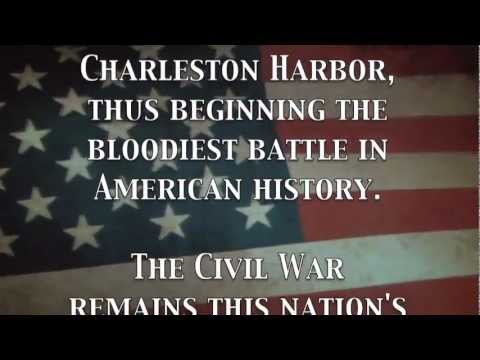
- A lone singer with a guitar stands before an oversized, war-torn American flag. Mid-song, the flag lifts away and the company appears in tableau, as Lincoln’s words hover over the room.
- Lyrical Meaning:
- The hook is simple, almost folk-prayer direct, and that is the point. The lyric sets “brother” as both family and enemy, establishing the show’s core obsession: intimacy turned into target practice.
"By the Sword / Sons of Dixie" (Recruits / Ensemble)
- The Scene:
- The tableau breaks. Young recruits from North and South flood the stage, shouting slogans, mocking each other, and imagining the glory they have not earned yet.
- Lyrical Meaning:
- The lyric weaponizes certainty. It sells war as identity and rhythm, with crowd language doing what it does best: turning fear into chant so nobody has to be alone with it.
"Freedom's Child" (Frederick Douglass)
- The Scene:
- Douglass steps forward and rejects the polite framing of the conflict. The speech-song insists that slavery is not a side issue, it is the engine.
- Lyrical Meaning:
- The lyric’s force comes from accusation and definition. It narrows the war’s meaning until it becomes morally legible, then dares the audience to stop hiding behind abstract unity.
"Tell My Father" (Union Soldier)
- The Scene:
- A montage of letters from the front collapses into one voice. A wounded soldier, near death, writes home and asks his mother to pass along a final message of courage.
- Lyrical Meaning:
- The lyric is a last will disguised as a bedtime confession. It frames honor as something you beg to be believed, which makes the song devastating when it is sung cleanly, without vocal heroics.
"Candle in the Window" (Harriet / Ensemble)
- The Scene:
- Lincoln sits alone in the White House in winter, candlelight visible from a window. Harriet watches from elsewhere, imagining his thoughts and measuring hope by a small flame.
- Lyrical Meaning:
- The lyric turns government into silhouette. The candle is a symbol of distant authority, but also a fragile promise. It is a song about waiting for decisions made by strangers.
"Sarah" (Bill)
- The Scene:
- On the battlefield, Bill writes to his wife, describing how memory keeps him alive. The transition is cruelly immediate: a black-bordered telegram arrives. He is gone.
- Lyrical Meaning:
- These lyrics treat love as a location. The chorus is built like a return address, the voice trying to mail itself home before the body fails.
"The Honor of Your Name" (Sarah)
- The Scene:
- Grief is not staged as collapse. Sarah makes a vow to raise their son, survive, and carry a dead man’s name forward as duty and memory.
- Lyrical Meaning:
- The lyric turns mourning into a contract. “Honor” becomes a daily verb, not a statue word. It is a song about what patriotism looks like when the parade never comes.
"The Glory" (Lochran / Pierce / Company)
- The Scene:
- Gettysburg, July 2, 1863. Mist, fog, and a wall of waiting. Union guns aim at a hidden line. Leaders call their men forward, and the stage fills with smoke, flags, bayonets, then fallen bodies.
- Lyrical Meaning:
- The title is bitter. “Glory” is sung like a drug and then exposed as a price tag. The lyric’s power comes from repetition that starts as rallying and ends as reckoning.
Live Updates
As of January 23, 2026, The Civil War is primarily active as a licensed title rather than a Broadway property, with MTI continuing to represent the show for productions. Recent listings and announcements point to ongoing regional and community interest, including 2025 performances marketed as “The Musical Story Of Us” at the Smoky Mountain Center for the Performing Arts and a related 2025 event listing in North Carolina. At the same time, individual songs remain in circulation outside the full show: “Tell My Father,” in particular, continues to surface in choral concerts and school performances, functioning as a stand-alone narrative ballad with a long tail.
If you are tracking the piece for programming, the current pattern is clear: producers mount it when they want a large-cast, vocally driven evening with flexible staging options. The show’s “concert plus projections” DNA makes it adaptable for venues that cannot or do not want to stage literal battles, while still aiming for scale through chorus and light.
Notes & Trivia
- The MTI synopsis frames the opening image “circa 1862,” then steers the evening toward Gettysburg, dated in the text as July 2, 1863.
- A 1998 Playbill report lists an all-star concept recording approach, including narration by James Garner as Lincoln and Danny Glover as Frederick Douglass, with additional narrators credited.
- That same 1998 report describes two CD configurations: a full-score double-disc and a separate “radio friendly mixes” edition.
- Apple Music lists “The Civil War: The Complete Work” as a 1999 release, with Atlantic Recording Corp. credited and later Rhino marketing noted in the metadata.
- The Broadway production opened April 22, 1999 and closed June 13, 1999, according to IBDB.
- A Gettysburg revision titled “For the Glory” was built to feel closer to the earlier Alley version and emphasized projections and a lean theatrical approach.
- The show’s core storytelling method is explicitly documentary-adjacent: letters, diaries, firsthand accounts, and the words of Lincoln, Douglass, and Whitman are baked into its premise.
Reception
Critical response has long been split between respect for the ambition and frustration with the form. When reviewers wanted a conventional plot, they heard a compilation. When they wanted psychological specificity, they got emblem and chorus. The most common critique is that the show’s emotional aims are broad, and that its stylistic variety can read as musical channel-switching rather than dramatic progression.
“There’s not a complex emotion or idea ... to be found.”
“With the opening of The Civil War, [Wildhorn] has three shows simultaneously dumbing down Broadway.”
“Generic...without plot and essentially without character.”
Quick Facts
- Title: The Civil War (also billed as The Civil War: An American Musical)
- Year: 1998 (Houston premiere); 1999 (Broadway)
- Type: Dramatic theatrical concert / thematic revue
- Book: Gregory Boyd; Frank Wildhorn (Broadway version crediting varies by source)
- Music: Frank Wildhorn
- Lyrics: Jack Murphy (with additional lyric credit listed by MTI for the Broadway version)
- Orchestrations: Kim Scharnberg
- Selected notable placements: Opening flag-and-tableau prologue; auction sequence; Lincoln candlelight scene; Gettysburg fog battle sequence
- Broadway run: Opened April 22, 1999; closed June 13, 1999
- Key recordings: 1998 concept recording campaign reported by Playbill; “The Civil War: The Complete Work” listed as 1999 on Apple Music
- Label / album status: Atlantic Recording Corp. (Apple Music metadata also notes Rhino marketing)
- Availability: Licensed for stage productions through MTI
Frequently Asked Questions
- Is The Civil War a traditional book musical?
- No. It is structured as vignettes and musical testimony, with characters often functioning as representative voices rather than fully tracked arcs.
- Who wrote the lyrics?
- Jack Murphy is credited as lyricist across major references, with MTI also listing additional lyric credit alongside the Broadway version’s authoring credits.
- What is the best entry point if I only know one song?
- “Tell My Father.” It contains the show’s essential conflict: private grief trying to speak the language of public honor.
- Is there an official album?
- Yes. A major “complete work” release is listed on Apple Music as “The Civil War: The Complete Work,” and the score also circulated through a high-profile concept recording strategy reported in 1998.
- What time period does the show cover?
- The MTI synopsis frames the opening around 1862 and builds toward Gettysburg, dated July 2, 1863, then narrates the aftermath through surrender, inauguration, and assassination.
- Is the show still being performed in 2025 and 2026?
- It continues to appear through licensed and community presentations, with documented 2025 event listings and ongoing concert life for individual songs, especially in choral settings.
Key Contributors
| Name | Role | Contribution |
|---|---|---|
| Frank Wildhorn | Composer; book contributor (credited on Broadway sources) | Wrote the score and helped shape the show’s concert-first format and pop-to-choral palette. |
| Jack Murphy | Lyricist; book contributor (credited by MTI) | Lyric writing grounded in public texts, letters, and rhetorical cadences. |
| Gregory Boyd | Book; early director/development leader | Co-created the nontraditional structure and shepherded early production history tied to Houston. |
| Kim Scharnberg | Orchestrations | Built the orchestral and band hybrid that lets the show move between folk, gospel, and rock idioms. |
| Jerry Zaks | Broadway director | Staged the Broadway version at the St. James Theatre with a large ensemble and projection-forward vocabulary. |
| James Garner | Narration (concept recording) | Credited by Playbill as narrator on the 1998 concept recording plan, as Abraham Lincoln. |
| Danny Glover | Narration (concept recording) | Credited by Playbill as narrator on the 1998 concept recording plan, as Frederick Douglass. |
| Linda Eder | Featured vocalist (recording history) | Listed by Playbill among prominent concept-recording performers and long associated with Wildhorn’s catalogue. |
Sources: Music Theatre International (MTI), Playbill, IBDB, Apple Music, SFGate, New York Magazine, Wikipedia, Hal Leonard, Smoky Mountain Center for the Performing Arts listings, Clay County Chamber calendar.