
Mr. Saturday Night Lyrics: Song List
- Act 1
-
We’re Live

- A Little Joy
- There's A Chance
- I Still Got It
-
At Farber's
-
Buddy's First Act
- Until Now
-
Timing
- What If I Said?
- Unbelievable
- Act 2
- What's Playin' at the Movies
- Maybe It Starts With Me
- Tahiti
- My Wonderful Pain In The Ass
- Broken
- Any Man But Me
- Stick Around
About the "Mr. Saturday Night" Stage Show
Mr. Saturday Night Summary
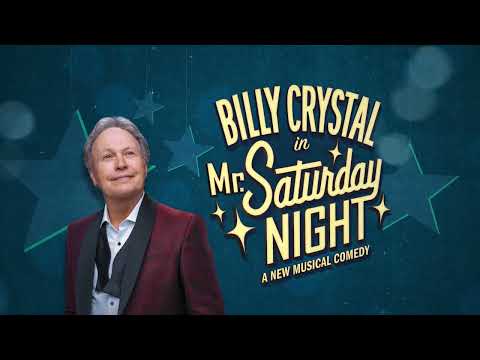
Billy Crystal returns to the role of Buddy Young Jr. in Mr. Saturday Night on Broadway!
Mr. Saturday Night is the story of Buddy Young, Jr., an outrageous and outspoken comedian who found fame in the early days of television! Now, some 40 years after he hit the top, Buddy will take one last shot at reclaiming the spotlight – and his family - one hilarious step at a time. Mr. Saturday Night is the brand new musical comedy about being a funny man, a family man, and getting a second chance at both.
Written by Billy Crystal, Lowell Ganz & Babaloo Mandel, based on an original concept by Billy Crystal, Mr. Saturday Night features music by three-time Tony winner Jason Robert Brown, lyrics by Tony Award® nominee Amanda Green, choreography by Ellenore Scott (Funny Girl) and direction by Tony Award winner John Rando.
Release date of the musical: 2022
"Mr. Saturday Night" – The Musical Guide & Song Meanings
Review: What the lyrics are really doing
If “Mr. Saturday Night” has a secret, it’s that the score is less interested in punch lines than in the hangover after them. The book sells you Buddy Young Jr. as a human rimshot: fast, loud, and allergic to sincerity. Jason Robert Brown and Amanda Green answer by writing lyrics that keep slipping past the joke to the cost of the joke, especially when Buddy tries to narrate his own legend in real time.
The show’s language is family-first even when Buddy isn’t. The lyrics sit in a very specific Jewish-showbiz cadence, not as a museum piece, but as a coping mechanism. When Buddy performs, the words are weapons. When Susan or Stan sing, the words become receipts. That tension is the engine: comedy as control vs. comedy as avoidance. Even the breezier numbers tend to land like a smile with a bruise underneath.
Musically, Brown writes with a deliberate “then vs. now” split: a brassy, traditional musical-comedy swing for Buddy’s older world, and a more contemporary framing when the story is stuck in the 1990s present. The point isn’t range for its own sake. It’s to make Buddy sound comfortable only in eras where he can pretend he still owns the room.
How it was made
The project’s timeline is longer than Buddy’s patience. In the Broadway Direct transcript, Amanda Green traces her involvement back to 2016, when Marc Shaiman first brought her in; Shaiman later bowed out, and Green asked Jason Robert Brown to collaborate, starting in 2017. The songwriting process they describe is almost sitcom-perfect: Brown throws down a quick musical idea at the piano, then leaves so Green can write alone, literally needing a door between them. That division of labor matters, because it matches the show’s theme: closeness, negotiated.
Brown also frames the sound as intentionally “golden age” adjacent, aiming for a traditional musical-comedy kick, then asking how that language bends when scenes jump into the 1990s. In other words, the score is engineered to feel like Buddy’s comfort food, until it isn’t.
Development-wise, “Mr. Saturday Night” premiered at Barrington Stage Company in October 2021 before moving to Broadway in spring 2022. After the Broadway run ended, a filmed performance was released for streaming, turning the show into something you can watch like a late-night rerun, which is thematically on-brand in a way Buddy would hate to admit.
Key tracks & scenes
"We’re Live" (Bobby, Joey, Lorraine)
- The Scene:
- Bright studio light, pre-show bustle, bodies moving like stagehands are a rhythm section. The number feels like a control room talking in song while Buddy’s legend is being queued up.
- Lyrical Meaning:
- The lyric is a thesis statement in disguise: Buddy’s life only makes sense when someone is counting him down. It sets up the show’s obsession with performance as oxygen.
"A Little Joy" (Buddy Young Jr.)
- The Scene:
- Buddy plays a nursing home or retirement-room gig, working the crowd like it’s 1952 and the room is still his. The lighting is practical, unglamorous, and that’s the joke.
- Lyrical Meaning:
- It’s Buddy’s self-justification: if he can “bring joy,” he can excuse the collateral damage. The lyric tries to rebrand ego as service.
"There’s a Chance" (Susan Young)
- The Scene:
- A daughter who has learned to speak in show-business terms sees an opening and pitches it. The staging tends to sharpen here: less nostalgia, more negotiation.
- Lyrical Meaning:
- Susan’s lyric is ambition with an emotional subtext: she wants the comeback, but she also wants leverage over the family story that Buddy has hogged for decades.
"I Still Got It" (Buddy Young Jr., Stan Yankleman)
- The Scene:
- Buddy and Stan share the sugar-rush of possibility. The movement is buoyant, almost too buoyant, as if the choreography is politely pretending time didn’t pass.
- Lyrical Meaning:
- Two brothers sing the oldest lie in show business: “this time will be different.” The lyric is funny because it is familiar, and bleak because it is accurate.
"Tahiti" (Elaine Young)
- The Scene:
- Elaine lets herself fantasize. Softer light, warmer palette, a small private dream inside a marriage that has been run like a tour schedule.
- Lyrical Meaning:
- The lyric is escape as self-preservation. Elaine doesn’t sing to win, she sings to survive living next to Buddy’s constant performance.
"My Wonderful Pain in the Ass" (Elaine Young, Buddy Young Jr.)
- The Scene:
- A domestic scene played like a seasoned vaudeville act, except the laugh lines keep turning into truth. The two of them know exactly where the other person is going to land.
- Lyrical Meaning:
- The title says “affection,” the lyric says “terms.” It’s a love song written in the language of complaint, which is, frankly, a recognizable marriage dialect.
"Broken" (Stan Yankleman)
- The Scene:
- Stan finally gets the room. Fewer jokes, more silence. The staging narrows, as if the set itself is tired of Buddy’s noise.
- Lyrical Meaning:
- Stan’s lyric is the show’s moral accounting. It’s about loyalty that curdled into obligation, and the grief of being the responsible one in a family that rewards the loudest person.
"Stick Around" (Susan, Elaine, Buddy, Annie, Company)
- The Scene:
- Reconciliation is staged as a group decision, not a solo revelation. The light opens up. The show stops sprinting for applause and lets a quieter warmth settle in.
- Lyrical Meaning:
- The lyric is the closest the show gets to a cure: not forgiveness as a grand gesture, but presence as a practice. Buddy doesn’t get to “win.” He gets to stay.
Live updates (2025/2026)
There is no current Broadway run to chase. The Nederlander Theatre production opened April 27, 2022 and played its final performance September 4, 2022. If you want the closest thing to “seeing it now,” the official filmed capture is the key update: it was recorded during the Broadway run (filmed August 31, 2022) and debuted on BroadwayHD on December 1, 2022. BroadwayHD also offers access via an Amazon Channel in some regions, which has made this title more durable than its short onstage life.
On the audio side, the Original Broadway Cast Recording (17 tracks) is widely available on major streaming platforms. For lyric-focused listeners, that album is the cleanest way to hear how Green writes character: Susan’s material is sharper, Stan’s is more compressed, and Buddy’s is built to sound like a man who thinks rhythm is the same thing as love.
Notes & trivia
- Amanda Green says the project began for her in 2016, and that Marc Shaiman initially brought her into the adaptation before he bowed out; Green then invited Jason Robert Brown to collaborate in 2017.
- Brown describes a workflow where he would throw down a quick musical idea at the piano and then leave so Green could write alone, needing literal separation to work.
- Brown cites a “traditional musical comedy” sound, with a brass-and-swing vocabulary, then asks how that language shifts when the story lands in the 1990s.
- IBDB lists the setting as New York City in 1994 and in the late 1940s/early 1950s, matching the show’s flashback structure.
- The BroadwayHD capture was filmed on August 31, 2022 and began streaming December 1, 2022.
- The cast recording was released June 10, 2022 by Craft Recordings / Concord Theatricals, with Jeffrey Lesser and Brown producing, and Sean Patrick Flahaven co-producing.
- The cast album received a Grammy nomination for Best Musical Theater Album (2023).
Reception
The critical story was consistent: reviewers tended to praise Crystal’s live-wire charm, while debating whether the score and structure were sturdy enough to carry him, rather than simply frame him. Some found the show pleasantly old-fashioned. Others heard the seams where a film comedy becomes a stage musical, and wished for either sharper songs or fewer of them.
“By Broadway standards, Mr. Saturday is a modest little show. But it delivers exactly what it promises: Crystal, completely in his element.”
“This production… takes some time to get going but is well worth the wait.”
“We’ve captured the feeling of being in the theatre in the best ‘House Seats’ possible.”
Quick facts
- Title: Mr. Saturday Night
- Year: 2022 (Broadway); development premiere 2021 (Barrington Stage Company)
- Type: Original stage musical adapted from the 1992 film
- Music: Jason Robert Brown
- Lyrics: Amanda Green
- Book: Billy Crystal, Lowell Ganz, Babaloo Mandel
- Director: John Rando
- Choreography: Ellenore Scott
- Notable placements (story-world): TV studio framing; Catskills-era flashbacks; nursing-home gigs; family home and industry rooms
- Cast album: Mr. Saturday Night (Original Broadway Cast Recording), 17 tracks, released June 10, 2022
- Label / distribution: Craft Recordings / Concord Theatricals (distributed by Concord)
- Screen capture: Filmed live on Broadway (Aug 31, 2022); streaming on BroadwayHD from Dec 1, 2022
- Awards notes: Five Tony nominations (2022); Grammy nomination for Best Musical Theater Album (2023)
Frequently asked questions
- Is there a proshot or official filmed version?
- Yes. A filmed performance was recorded during the Broadway run and released on BroadwayHD starting December 1, 2022.
- Who wrote the songs?
- Jason Robert Brown wrote the music and Amanda Green wrote the lyrics. Billy Crystal, Lowell Ganz, and Babaloo Mandel wrote the book.
- What time period does the story take place in?
- The show moves between New York City in 1994 and earlier decades (late 1940s/early 1950s), using flashbacks to explain how Buddy’s career and family fractured.
- What’s the best “entry point” song if I’m new to the score?
- Start with “A Little Joy” to understand Buddy’s persona, then “There’s a Chance” and “Broken” to hear how the family argues back.
- Is the cast recording the same as what was performed on Broadway?
- It captures the Broadway company and the show’s core musical numbers in a 17-track album released in June 2022.
Key contributors
| Name | Role | Contribution |
|---|---|---|
| Billy Crystal | Star; Book writer | Plays Buddy Young Jr.; co-wrote the stage book adapting the film. |
| Jason Robert Brown | Composer; Orchestrations/Arrangements | Wrote the score and shaped the show’s era-specific musical language. |
| Amanda Green | Lyricist | Wrote lyrics keyed to character voice and family dynamics. |
| Lowell Ganz | Book writer | Co-wrote the stage book; also co-wrote the original film screenplay. |
| Babaloo Mandel | Book writer | Co-wrote the stage book; also co-wrote the original film screenplay. |
| John Rando | Director | Staged the Broadway production with an intentionally old-fashioned frame. |
| Ellenore Scott | Choreographer | Created movement that supports a comedy-first show without overpowering it. |
| David O | Music Director | Led the musical performance and maintained the score’s tonal balance. |
| Scott Pask | Scenic Designer | Designed the physical environments: studio, clubs, home, and memory spaces. |
| Paul Tazewell; Sky Switser | Costume Designers | Costumed multiple eras, supporting the show’s time-jump storytelling. |
| Kenneth Posner | Lighting Designer | Built the contrast between performance glare and private-family shadow. |
| Jeff Sugg | Video and Projection Designer | Provided period textures and screen language that reinforces the TV frame. |
| Kai Harada | Sound Designer | Balanced stand-up immediacy with musical clarity in a dialogue-heavy show. |
Sources: Playbill, IBDB, Broadway Direct (Stage Door Sessions transcript), Concord (press release), Broadway News, TheaterMania, Barrington Stage Company, Time Out New York, The Guardian.