
By Jeeves Lyrics: Song List
- Some Introductory Chat
- The Code of the Woosters
-
Wooster Will Entertain You

- The Plot Thickens
- Travel Hopefully, Pt. 1
- A Curious Hedgehog Incident
- Travel Hopefully, Pt. 2
- In Which My Character Is Tested
- That Was Nearly Us
- Days of Jam and Mazes
- Love's Maze
- Wooster Thinks on His Feet
- The Hallo Song
- An Identity Crisis (Or Two)
- By Jeeves
- Wooster Nobly Intercedes
- When Love Arrives
- What Have You Got to Say, Jeeves?
- I Answer the Call of the Code
- Half a Moment
- I Risk My Neck to Save the Bacon
- It's a Pig!
- A Satisfactory Outcome
- Banjo Boy
- Wizard Rainbow Banjo Mix
About the "By Jeeves" Stage Show
Tim Rice & Andrew Lloyd Webber – the creators of this musical. In Britain, the writer P. G. Wodehouse is popular with his stories about the sharp-witted servant named Jeeves and Tim Rice wanted to make a musical based on them. After a couple of years of study, during which Tim Rice was excluded from the creators and then was restored again, the musical became ready.
Its original length was just epic – 4 hours and 45 minutes. Furthermore, it held 35 minutes of time till the first female character appeared on the stage, which was occupied entirely by men. One of the most important stories for the musical that tells the protagonist lies in the fact that he once met with three stupid girls from high society and their relationships dragged into a tight knot that threatened him with a scandal. But his savvy butler Jeeves unwrapped a bundle, but so deftly, as if cut the Gordian knot.
It has been decided to shorten the length of the musical, which attempts met resistance of the main actors.
David Cullen wrote the music together with Andrew Lloyd Webber, with the participation of several others.
The show originally opened in London in 1975, with the actors: B. Marsden, D. Hemmings, D. Wood, M. Aldridge, B. Wallis, G. Drake, J. Turner, D. Bowen, A. Easterling & G. Clyde. E. Thompson, who was director of the show was changed to D. Ayckbourn before the start of the musical, and the choreographer was C. Bruce. The show lasted only 38 plays and has been closed because of the negative reviews from spectators. Record of songs from the musical, however, was published and a few copies were even sold before Lloyd Webber has withdrawn it from circulation, wanting to use the songs in his future musicals. Therefore, the original album is valued at the market very high.
Release date of the musical: 1996
"By Jeeves" - The Musical Guide & Song Meanings
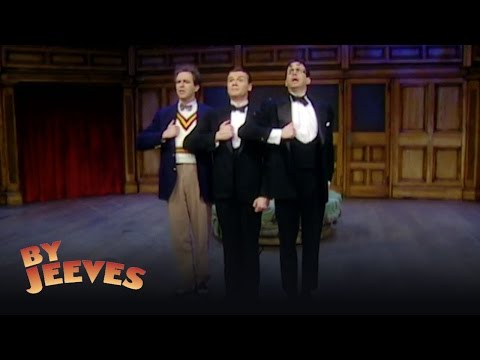
Review
Can a musical be both a rescue mission and a confession? That is the tension inside By Jeeves. It exists because an earlier version, Jeeves (1975), crashed loudly, then got rebuilt almost from the foundation up in the mid-1990s. You can feel that history in the lyrics: they are engineered to keep the air moving. Alan Ayckbourn writes like a stage manager with opinions. He gives Bertie lines that bounce, dodge, repeat, and then escape the scene before anyone can interrogate them. It is comedy by momentum, and the score follows suit. Andrew Lloyd Webber stays in “bright craft” mode here, tailoring tunes to character motion rather than to grand emotional argument. The best numbers do not pretend Bertie is deep. They let him be quick, and let the audience be quicker.
The lyrical spine is the framing device: a missing banjo at a charity concert becomes an excuse to narrate a tangle of romantic disasters. That structure makes the songs feel like demonstrations, not diary entries. When the text lands, it lands as social choreography. Love becomes a maze, names become disguises, and etiquette becomes a weapon. The “Englishness” is not nostalgia. It is a pressure system. Everyone is polite. Everyone is cornered. And the funniest lyrics are often the ones that show how little language can protect you once the plot begins to tighten.
How It Was Made
Before Ayckbourn wrote the lyrics, there was a different plan. Archival reporting around the show’s early development describes a Lloyd Webber and Tim Rice draft in progress before Ayckbourn joined, and quotes Rice criticizing his own lyric attempts, stepping away, and leaving the project to be reconfigured. The same archival account describes an ambitious scale and mounting production pressure in the 1970s, with creative decisions moving faster than the show could be solved. Decades later, that failure became material. By Jeeves is the revision that tries to make the premise playable: a small cast, a compact band, and a plot that treats theatrical improvisation as the point, not a problem.
Ayckbourn has also spoken bluntly about the original collapse, describing an overlong first attempt and a process that did not get a proper run-through, with the production literally running out of time and stamina. That bruised origin matters to the 1996 rewrite because it explains the tone. By Jeeves often sounds like creators who refuse to trust stillness. The joke is always one beat away. The lyric is always one rhyme away. It is survival instinct turned into style.
Key Tracks & Scenes
"Banjo Boy" (Bertie)
- The Scene:
- A church hall. Folding chairs. Volunteer helpers. Bertie is meant to play a charity concert, but the evening starts with the wrong prop in his hands and the right instrument missing. Lights stay workmanlike, almost rehearsal-bright, because the premise is “real time.”
- Lyrical Meaning:
- Bertie’s self-mythology arrives before the plot does. The lyric makes him a performer even when he is failing to perform. That contradiction is the show’s engine: charm as camouflage, rhythm as avoidance.
"Wooster Will Entertain You" (Bertie)
- The Scene:
- Still in the church hall, Bertie pivots from panic into patter. He faces the audience like a host forced to invent an evening while the kettle boils. A spot finds him, not as a hero, but as a man cornered into charisma.
- Lyrical Meaning:
- This is the contract song. The lyric reassures the crowd that chaos is part of the service. It also frames Bertie as unreliable narrator, which gives the later romantic mess permission to be heightened and a little artificial.
"Travel Hopefully" (Bertie, Jeeves, Bingo)
- The Scene:
- A story begins inside the story. The staging often plays as minimal furniture plus actor precision: steering wheels implied, countryside suggested, dialogue snapping over an upbeat pulse. The lighting shifts to “daylight on the move.”
- Lyrical Meaning:
- The lyric is about optimism as a driving technique. It is funny because Bertie’s hope is not philosophy, it is denial with good manners. Jeeves’ interjections sharpen the joke: competence watching recklessness, then tidying the edges.
"That Was Nearly Us Back There" (Honoria, Bertie)
- The Scene:
- On the road to Totleigh Towers, Honoria turns a car ride into a proposal without asking. The world outside the vehicle becomes soft focus. Inside, the tension gets specific. A romantic tableau keeps appearing and disappearing as she narrates what “almost happened.”
- Lyrical Meaning:
- This is Ayckbourn at his most incisive: nostalgia weaponized. Honoria uses lyric as leverage, reframing “nearly” as destiny. Bertie replies with jokes because jokes are his only exits.
"Love’s Maze" (Stiffy, Bertie, Company)
- The Scene:
- Totleigh Towers, or at least the idea of it. Servants, guests, and social rules funnel characters into corridors. The maze is both literal and social. Lighting becomes more theatrical here, with patterned shadows that suggest hedges and traps.
- Lyrical Meaning:
- The lyric makes love sound like architecture: ornate, confusing, expensive. Stiffy is sincere, which makes her dangerous in this world. The ensemble lines widen the joke into a thesis: romance is a group activity, and everyone gets lost together.
"When Love Arrives" (Bertie, Madeline)
- The Scene:
- A quieter pocket inside the farce. Madeline and Bertie share a space that feels briefly private. The lighting drops warmer, as if the show is trying out tenderness to see if it fits.
- Lyrical Meaning:
- The lyric is one of the rare moments that does not sprint. It lets Lloyd Webber write a clean melodic line and lets Ayckbourn soften the comedy without abandoning it. Love, here, is not mature. It is surprising. That is enough.
"Half a Moment" (Harold, Stiffy)
- The Scene:
- Two characters step out of the machinery and admit they have hearts. It plays best under simple, honest lighting. No tricks. Just faces.
- Lyrical Meaning:
- The lyric is a modest plea for time, which is poignant in a show built on speed. “Half a moment” becomes a tiny rebellion against the constant resetting of the plot.
"It’s a Pig!" (Honoria, Madeline, Bertie, Bassett, Gussie)
- The Scene:
- Bedroom doors. Accusations. A pig mask. The farce hits full volume. Lighting becomes harder and more exposed, as if the show is daring you to watch the embarrassment in detail. Characters chase and misread each other in overlapping rhythms.
- Lyrical Meaning:
- This is the thesis in slapstick form: identity is costume. The lyric piles on labels, panic, and moral outrage, then reveals how shallow each judgment is. It is funny because everyone is sincere and everyone is wrong.
Live Updates
As of the most recent publicly available listings and rights-holders’ pages, By Jeeves is not positioned as a standing commercial tour. Its “life” is licensing-driven: a small cast, a flexible band, and a built-in theatrical framing device that suits schools, amateur societies, and concert-style presentations. A recent example of that afterlife is the 2024 concert/cabaret listing at Lakewood Theatre Company’s Lost Treasures series, framing the score as a rediscovery item rather than a repertory staple. The show also remains visible through the filmed performance that circulates online and through clipped song uploads, which keeps key numbers in the algorithm even when the stage production is dormant.
If you are tracking ticket trends, the honest read is this: By Jeeves does not generate market heat the way Lloyd Webber’s flagship titles do. What it generates is periodic affection and curiosity, plus a steady trickle of productions that like a compact comedy with a famous composer attached. The “current status” is therefore not about a star cast. It is about availability, rights, and discoverability.
Notes & Trivia
- The 1996 rewrite reframed the whole evening as a church-hall entertainment after Bertie’s banjo goes missing, turning the audience into part of the premise.
- Multiple sources note that only a small portion of the 1975 material survived lyrically into the 1996 version, with most of the book and score replaced.
- The show’s core setting is explicitly theatrical: a church hall that can transform into a London flat and the grounds of Totleigh Towers within the same “evening” frame.
- The Broadway run in 2001 was brief, with the production opening and closing within the same year at the Helen Hayes Theatre.
- A filmed performance preserves the show’s meta-theatrical device, including reaction shots from the in-hall “audience” used as extras in the recording.
- The 2024 concert-style programming of By Jeeves is often marketed as a “rare” or “obscure” Lloyd Webber title, signaling how it is currently curated for audiences.
Reception
Critics have rarely agreed on what By Jeeves is trying to be. When it works for reviewers, it is a slight, daft, politely engineered comedy with a few genuinely pretty songs. When it fails, it is seen as overlong, narratively messy, and too self-aware about its own contrivance. What has changed over time is the frame. In 2001, the Broadway question was “Why this now?” In the streaming era, the question became “What does this teach us about how theatre misfires?”
“It’s not necessarily news that By Jeeves is disappointing.”
“The appeal of Jeeves & Co. ... is by no means universal.”
“It was doomed from the start.”
Technical Info
- Title: By Jeeves
- Year: Reworked version premiered 1996 (original version titled Jeeves premiered 1975)
- Type: Musical comedy, adaptation of P.G. Wodehouse’s Jeeves and Wooster stories
- Music: Andrew Lloyd Webber
- Book & Lyrics: Alan Ayckbourn
- Framing device: A church-hall charity “concert” that becomes a staged retelling after the banjo disappears
- Selected notable placements (productions): Scarborough (Stephen Joseph Theatre) 1996; London (Duke of York’s, then Lyric) 1996-1997; Goodspeed Opera House (US premiere) 1996; Broadway (Helen Hayes Theatre) 2001
- Orchestra / band size: Often licensed for a small combo
- Album: Original London Cast Recording (1996), with later track-list variants documented for early releases
- Availability: Licensing handled via the rights-holders and major theatrical licensors; filmed performance also exists as a separate release
FAQ
- Is “By Jeeves” the same show as “Jeeves” (1975)?
- They are related, but not the same experience. By Jeeves is the heavily revised 1996 rewrite, with a new framing device, a reduced scale, and only a small portion of the earlier lyric material retained.
- Where do the songs sit in the story?
- The show begins in a church hall at a charity “concert.” After the banjo disappears, Bertie and Jeeves launch into a narrated farce that moves through a London flat and the grounds of Totleigh Towers, with the key songs attached to travel, romantic pressure, and the big disguise set pieces.
- What should I listen to first if I only have 15 minutes?
- Try “Travel Hopefully” for the show’s comic momentum, “That Was Nearly Us Back There” for character pressure disguised as romance, and “It’s a Pig!” for the full farce payoff.
- Is there a movie or filmed version?
- Yes. A filmed performance exists that captures the show’s theatrical framing, including the in-hall audience reaction device.
- Is “By Jeeves” running in 2025 or 2026?
- It is not commonly positioned as a long commercial run in that window. The more typical pattern is licensed productions and occasional concert-style programming, plus continued circulation of clips and the filmed performance.
Key Contributors
| Name | Role | Contribution |
|---|---|---|
| Andrew Lloyd Webber | Composer | Score that pivots between patter-driven comedy and compact romantic ballads. |
| Alan Ayckbourn | Book & Lyricist | Framing device, farce structure, and lyric voice built for speed and stage mechanics. |
| Kate Young | Musical Director (1996 London production) | Helped shape the revised version’s performance identity in its key West End run. |
| Steven Pacey | Originating Bertie (1996 London) | Anchored the rewrite’s comic tone in the production that established the title’s post-1975 reputation. |
| Malcolm Sinclair | Originating Jeeves (1996 London) | Played the calm counterweight that makes Bertie’s lyrical panic readable. |
| Martin Jarvis | Jeeves (2001 Broadway / filmed version) | Front-facing screen record of Jeeves’ “stage manager” energy for later viewers. |
Sources: Andrew Lloyd Webber Show Licensing, Concord Theatricals, IBDB, Playbill, The Guardian, Variety, Vulture, Around Ayckbourn (Ayckbourn Archivist), Lakewood Center for the Arts, Discogs, Spotify, YouTube.