
Beautiful Game, The Lyrics: Song List
- Act 1
- The Beautiful Game
- Clean The Kit
- Don't Like You
- God's Own Country
- God's Own Country (Protestant March)
- Let Us Love In Peace
- The Final (A Game Of Two Halves)
- Off To The Party
- The Craic
- Don't Like You (Reprise)
- Our Kind Of Love
- Let Us Love In Peace (Reprise)
- Act 2
- The Happiest Day
- To Have And To Hold
- The First Time
- I'd Rather Die On My Feet Than Live On My Knees
- God's Own Country (Reprise)
- The Selection
- Dead Zone
- If This Is What We're Fighting For
- All The Love I Have
- Finale
About the "Beautiful Game, The" Stage Show
Over 11 months this musical continued after its premiere performance in 2000 in London at the Cambridge Theatre. Director was Robert Carsen. A choreographer – Meryl Tankard. Lloyd Webber is the one who wrote the music. Libretto and lyrics were written by Ben Elton. Music admired with everything – because it is the Maestro himself, who always creates something majestic and magically beautiful. But the rest – that was done by Ben Elton – was defied mercilessly by criticism and only one person really liked the book and the words as bold and delicious. In contrast to him, the rest of the critics simply festered Ben, saying that he wrote the predictable story, not thoughtful and openly scoffed at the results of his labor.
The show never made it to Broadway, but was able to get to Australia and in 2016 it is already known that in August, the Western Australian Academy of Performing Arts will be taken the staging of the musical, directed by Meryl Tankard, which will also be responsible for the choreography.
In 2009 in Winnipeg, Canada, musical, reworked, reinterpreted and re-named as The Boys in the Photograph, was played from April till September of the same year. After – it moved to Toronto, Canada. The rethought version was more vivid and life-affirming in the finale.
The following actors took part in the Canadian version of the musical: D. Hurwitz, T. LePage, J. Stadnyk, R. Harte, E. Peck, K. Peace, R. McMillan, A. Hughes, A. Pagano, C. Adamson, L. Olafson, K. Ballantine, C. Nattrass, M. Bradley, M. Murray, C. Cosman, J. Giles, S. Meunier, T. Covelli, A. Merrell, T. Dawson, B. McGibbon, T. D. Bello, C. S. Lancaster, K. Fletcher, J. Keats & J. French.
Also, the show was played in 2012, from February to May, in Northern Ireland.
Release date of the musical: 2000
"The Beautiful Game" – The Musical Guide & Song Meanings
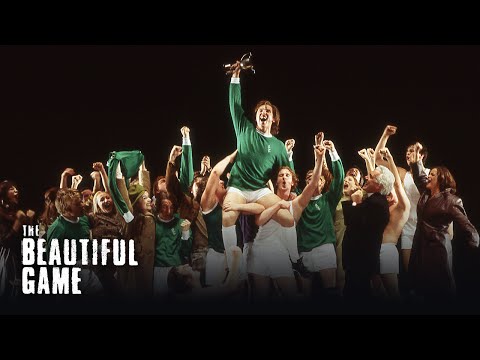
Review
What do you call a musical that opens like a terrace chant, then asks you to watch a community fracture in real time? Andrew Lloyd Webber and Ben Elton’s 2000 West End piece sets its love songs, jokes, and anthems against Belfast as the Troubles harden from background noise into lived policy. The hook is deceptively simple: a local church football team. The twist is cruel: the same tribal instincts that make a crowd sing in unison can also make a street decide who belongs.
Elton’s lyric-writing is blunt by design. People talk, tease, flirt, and posture like teenagers. Then the language curdles, because the world demands slogans. The score keeps switching masks, too. The opening number treats football as calendar and religion, fast and communal, with the rhythm of bodies moving together. The show’s best writing understands that group identity is musical. Harmonies sound like safety until they start sounding like a mob. The perusal script even stages the opener as a whirl of flirting, fighting, and football play while news cues can cut in like a cold broadcast, an audible reminder that politics does not wait backstage.
“God’s Own Country” is the thesis in miniature: two girls claim the same land with incompatible certainties, their costumes and allegiance split by a jersey swap. It’s not subtle. It doesn’t need to be. Billington singled it out as one of the score’s most poignant moments, because it turns patriotism into a duet that cannot resolve. Later, the show becomes harder and less graceful, and even supporters have noted how the romance can buckle under the weight of the violence. That tension is the point. When this musical works, it is because the text refuses to let “private life” stay private.
How it was made
The origin story begins, fittingly, with a near-miss. In 1998 Lloyd Webber invited Elton to discuss rewriting Starlight Express. Elton declined, then argued that too many musicals leaned on pre-sold material and pitched an original story instead. They landed on Belfast during the Troubles and built a new piece around a football team coached by a priest. It premiered at the Cambridge Theatre on 26 September 2000 and closed 1 September 2001, a run of just under a year that still felt like a statement for a producer-composer better known for longevity.
After the West End, the show’s second life became part of its text. Lloyd Webber and Elton revised it into The Boys in the Photograph, aiming for a more uplifting ending in later versions, and workshop and Canadian productions followed. One song, “Our Kind of Love”, escaped the show entirely: it had begun life as “The Heart Is Slow to Learn” (written for Kiri Te Kanawa), then became the most portable ballad from The Beautiful Game, and was later repurposed as the title track for Love Never Dies. If you want the most revealing behind-the-scenes detail, it’s this: the melody survived by changing its job.
Key tracks & scenes
"The Beautiful Game" (Company)
- The Scene:
- A surge of bodies and noise. The company assembles as working-class Belfast teens flirt, scrap, and kick a ball, while optional news announcements can slice in with reports of riots and the British Army’s shifting role. It’s public life arriving inside the overture.
- Lyrical Meaning:
- The lyric frames football as timekeeping, faith, and escape. The trick is that the same chant structure that makes it joyous also makes it dangerous: once you can sing together, you can also decide together.
"Clean the Kit" (John)
- The Scene:
- After training, John is left alone with the dirty gear, still fuming at Father O’Donnell’s punishment. The stage picture is small: one boy, one task, a private rant turning into a song.
- Lyrical Meaning:
- It’s an adolescent manifesto disguised as comic complaint. John’s dream is not ideology, it’s upward mobility: the fancy car, the mansion, the myth of being “picked.” That’s why what happens later lands so hard. The lyric plants a future the plot will deny.
"Don't Like You" (Mary and John)
- The Scene:
- Mary and John verbally spar in close quarters, each refusing to admit attraction. The script treats their courtship as an awkward, shifting tableau, time passing as the tone tilts from insult to gravity.
- Lyrical Meaning:
- This is Elton at his most effective: love as competitive banter. The repeated “don’t like you” becomes a protective spell. In a city where labels can get you hurt, even romance starts as denial.
"God's Own Country" (Mary and the Other Girl)
- The Scene:
- Two young women claim the same country. A kitbag becomes a prop of identity when the other girl pulls out an orange jersey and the argument turns musical. The number is confrontation, not confession.
- Lyrical Meaning:
- National pride is written as a mirror. Both sides use religious certainty and inheritance language, so the song exposes how symmetrical the rhetoric can be. The lyric is less about “who is right” than about how righteousness sounds.
"Let Us Love in Peace" (Bernadette and Ginger)
- The Scene:
- A dance begins almost shyly, a groove forming before voices join. The lyric imagines silence where bombs used to be, and the reprise later gathers multiple characters into a shared plea.
- Lyrical Meaning:
- This is the score’s fragile centre: peace as a domestic fantasy. The lyric is intentionally plain, because peace is not an argument here. It’s a longing, and it sounds like people trying not to jinx themselves.
"The First Time" (Mary and John)
- The Scene:
- A newlywed bedroom scene played for nerves and comedy. They joke, stall, and finally admit fear as the number begins, then the staging turns intimate and direct.
- Lyrical Meaning:
- The show risks humour because it wants you to like these people before history rearranges them. The lyric also quietly underlines Catholic guilt and social policing, making private life another battleground with rules and consequences.
"I'd Rather Die On My Feet Than Live On My Knees" (Thomas and John)
- The Scene:
- A confrontation that feels like a friendship snapping. Thomas argues for hardness and certainty; John pushes back. The number is structured like a debate, but it plays like a goodbye.
- Lyrical Meaning:
- Elton weaponises aphorisms. Thomas’s lines are built to be repeated in rooms where dissent is dangerous. The lyric shows how slogans recruit: they simplify, they flatter, and they dare you to object.
"The Selection" (John and Company)
- The Scene:
- The stage fills with exuberant footballing youths at trials for Everton, watched by officials taking notes. It’s a bright, kinetic sequence that briefly resembles a conventional sports musical.
- Lyrical Meaning:
- This is the musical’s cruelest irony. The lyric centres merit and recognition, the fantasy of escape by talent. The show positions that fantasy directly beside forces that do not care how good your first touch is.
"If This Is What We're Fighting For" (Mary)
- The Scene:
- After the violence hits home, Mary is left to name what the men have done in the language they claim to serve. The song lands as a moral reckoning, not a comfort.
- Lyrical Meaning:
- Mary’s lyric rejects victory as a meaningful metric. It’s one of the rare moments where the show’s political argument becomes explicit: the means have contaminated the cause, and “winning” is exposed as a hollow word.
One extra track matters for the soundtrack album even when certain later versions omit it: “Our Kind of Love.” It became the score’s breakout ballad, then migrated into Lloyd Webber’s later work. On record, it plays like an answer to the show’s darkness: a melody that insists tenderness is not naive, even when the plot is.
Live updates
The Beautiful Game is not currently a permanent commercial fixture, but it is actively licensed and periodically reappears through youth groups, amateur societies, and smaller revivals. The official licensing portal maintains a downloadable perusal script (updated to match post-Union production workshop changes) and lists the show’s resources and worldwide licensing contacts, which is the clearest indicator that the title remains production-ready. In North America, Concord Theatricals also continues to represent the work for licensing.
Recent public footprints lean smaller and more local than West End scale. A Belfast youth production by Belvoir Theatre Academy ran in July 2023, with published performance dates and pricing, and NYMT’s 2025 season materials reference The Beautiful Game within a history-spanning platform presentation at The Other Palace. The pattern is consistent: the show survives where young performers can play characters their own age, and where a theatre can afford a story that doesn’t end in neat uplift.
If you are searching by title because of Netflix’s 2024 film The Beautiful Game, note the mismatch: that film is a separate football drama unrelated to Lloyd Webber and Elton’s musical. The shared title is coincidence, not adaptation.
Notes & trivia
- The West End premiere opened 26 September 2000 at the Cambridge Theatre and closed 1 September 2001, a run of just under a year.
- The show was later revised as The Boys in the Photograph, including a reshaped, more uplifting ending in subsequent productions.
- “Our Kind of Love” began life as “The Heart Is Slow to Learn” for Kiri Te Kanawa, was removed from the 2008 rework, and later became the title track of Love Never Dies.
- “Let Us Love in Peace” was performed by Shonagh Daly at a memorial service for families of the September 11 attacks in October 2001.
- A selection of songs from the musical were performed for President-elect George W. Bush and UK Prime Minister Tony Blair at a Washington reception in January 2001.
- The show won Best Musical at the Critics’ Circle Theatre Awards (2000).
- The currently circulated licensing perusal script is marked as updated (Feb 2015) to reflect post-Union production workshop changes.
Reception
In 2000, critics largely agreed on the paradox: strong craft, uneasy fit. Michael Billington praised the attempt to tell the story “through words as well as song” while also noting where the writing “turn[s] to mush” when romance tries to paper over brutality. A year later, as the closing was announced, he argued the material was simply too close to reality for audiences seeking escape, even while admiring the score’s honesty and a standout ballad.
With distance and revision, the conversation softened. Fringe and youth revivals have been judged less as “a new Lloyd Webber blockbuster” and more as an imperfect political chamber piece with flashes of bite, comedy, and tenderness. Reviews of the NYMT revival explicitly describe a work that benefits from performers playing their own age, with Elton’s camaraderie writing and Lloyd Webber’s youthful energy reading more clearly in a smaller space.
“Even if The Beautiful Game … isn’t the greatest musical you’ll ever see, it has the signal virtue of telling its story through words as well as song.”
“Lyrics and music turn to mush as we’re told: ‘There’s only one love in the end.’”
“BYMT delivers a cracking rendition of a highly-flawed musical.”
Technical info
- Title: The Beautiful Game
- Year: 2000 (West End premiere; often indexed as 2000 even when referenced in 2004-era lyric searches)
- Type: Through-sung, pop-operatic drama with folk and rock colouring
- Music: Andrew Lloyd Webber
- Book & Lyrics: Ben Elton
- Original West End venue: Cambridge Theatre, London
- Original director / choreographer: Robert Carsen / Meryl Tankard
- Licensed perusal script: PDF available via ALW Show Licensing (script marked updated Feb 2015)
- Selected notable placements (story): Opening football chant; “God’s Own Country” identity duet; “The Selection” Everton trials; “If This Is What We’re Fighting For” moral reckoning
- Original cast recording release context: 23-track album released 27 November 2000 (digital releases include later remaster listings)
- Label / rights notes (recording): Telstar (UK CD listings) and LW Entertainment Limited credits on digital platforms
- Producers / musical supervision (recording credits commonly listed): Produced by Andrew Lloyd Webber and Nigel Wright; musical supervision and conducting credits commonly list Simon Lee
- Availability: Widely available on major streaming services under Original 2000 London Cast listings
FAQ
- Is The Beautiful Game based on a true story?
- Not a single documented incident. It’s a fictional story set against real historical conditions in Belfast during the early Troubles, using a football team as the social unit that gets pulled apart.
- Why is football so central to the lyrics?
- Because the terrace chant is already a kind of choir. The show uses football language to show how belonging works, then shows how easily that belonging can become exclusion.
- Is “Our Kind of Love” actually in the show?
- It was a key ballad of the original score and is on the soundtrack album, but it was removed in the 2008 reworked version (The Boys in the Photograph) and later repurposed by Lloyd Webber for Love Never Dies.
- What’s the difference between The Beautiful Game and The Boys in the Photograph?
- The Boys in the Photograph is a revised incarnation with structural changes and a more uplifting ending, developed through workshops and later productions after the initial West End run.
- Is the Netflix film The Beautiful Game connected to this musical?
- No. The 2024 film is a separate football drama with no adaptation link to the Lloyd Webber and Elton stage work.
Key contributors
| Name | Role | Contribution |
|---|---|---|
| Andrew Lloyd Webber | Composer | Score blending football-anthem drive with Irish folk hues and pop-operatic balladry. |
| Ben Elton | Book & lyricist | Text built from teen banter and political rhetoric, designed to show how language recruits and hardens. |
| Robert Carsen | Director (original West End) | Original staging at the Cambridge Theatre; a stripped-back approach noted by early critics. |
| Meryl Tankard | Choreographer (original West End) | Movement language that turns football physicality into theatrical grammar. |
| Simon Lee | Musical supervision / conductor (recording credits commonly listed) | Orchestra leadership associated with the original cast recording’s credited personnel listings. |
| Nigel Wright | Producer (original cast recording) | Co-produced the original cast recording with Lloyd Webber, per widely circulated album credit listings. |
Sources: ALW Show Licensing (perusal script & licensing page), Concord Theatricals, The Guardian, Musical Theatre Review, Playbill, Wikipedia, Apple Music, Discogs (catalog/credit listings), Belvoir Players (Belfast programme/events), NYMT season page.