Apple Tree, The Lyrics – All Songs from the Musical
Apple Tree, The Lyrics: Song List
- Act 1 The Diary of Adam and Eve
- Eden Prelude
- Here In Eden
- Feelings
- Eve
- Friends
- The Apple Tree (Forbidden Fruit)
- Beautiful, Beautiful World
- It's A Fish
- Go To Sleep, Whatever You Are
- What Makes Me Love Him?
- Act 2 The Lady or the Tiger?
- The Lady Or The Tiger?
- I'll Tell You A Truth
- Make Way
- Forbidden Love (In Gaul)
- The Apple Tree (Reprise)
- I've Got What You Want
- Tiger, Tiger
- Make Way (Reprise)/Which Door?
- Act 3 Passionella
-
Passionella Prelude
- Oh, To Be A Movie Star
- Gorgeous
- (Who, Who, Who, Who,) Who Is She?
- I Know
- Wealth
- You Are Not Real
- Passionella Postlude/Finale
About the "Apple Tree, The" Stage Show
This musical opened on Broadway back in 1966 and until 1967, more than 450 performances were given, in the Shubert Theatre. Actors, who have played in, are: B. Harris, A. Alda & L. Blyden. Director is Mike Nichols, and the producer is Stuart Ostrow.Harris received a Tony award for participating in this production, and so the musical was nominated for several other Tony awards in various categories.
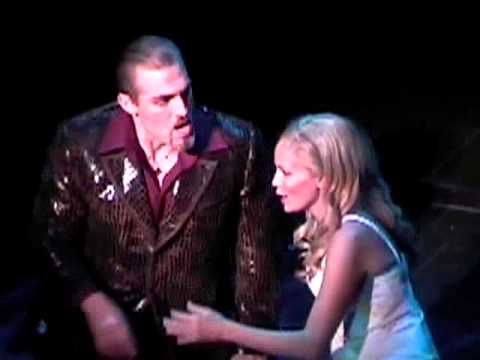
Kristin Chenoweth is an actress of many musicals and fairly well known personality on the stage largely due to her phenomenally clear voice, participated in a production that was performed eleven years ago – in 2005, together with M. Cerveris & M. Gets. After the change of actors and locations of playing of this musical (Roundabout Theatre) in 2006 – 2007, Chenoweth played with B. James & M. Kudisch as Blyden. Only Chenoweth’s game was marked as high acting of this musical, while all the other actors seemed unconvincing and the music critics never gave to anyone their closer attention. Before closing in 2007, the musical lasted for another 117 plays.
Because of the simplicity and narrativeness of stories of the musical show, their simple display by the actors, as well as because of the depth of the philosophical content, this musical is often made by students of theater colleges. In addition, the audience is already familiar with the biblical content and concepts of good and evil, so there will be no difficulties with the understanding of this.
Release date: 1966
"The Apple Tree" – The Musical Guide & Song Meanings
Review: the paradox of “small” stories that land huge
How does a musical made of three one-acts feel more emotionally complete than plenty of two-and-a-half-hour epics? That question is the secret engine of The Apple Tree (1966). Jerry Bock and Sheldon Harnick write as if they’re building miniature clocks: compact, legible, and designed to reveal the same idea from three angles. “Be careful what you wish for” is the show’s advertising-friendly summary, but the sharper truth is this: the lyrics keep proving that language is never neutral. Naming is power. Desire is a script you inherit. And the moment you ask for “more,” you start negotiating what you’re willing to lose.
The first act, The Diary of Adam and Eve, begins like a comedy about incompatibility. It ends as a quiet elegy about the terrifying beauty of needing another person. Harnick’s text makes the fall from Eden less theological than domestic. One character names the world like a filing system. The other names it like poetry. The lyric craft is in the friction between those approaches, and how that friction becomes love.
The second act, The Lady or the Tiger?, flips the frame into a public spectacle. The lyrics here are bolder, more performative, more “court” than “home.” Jealousy is dramatized as a moral puzzle with stadium lighting. The famous two doors are not just plot. They’re the show’s cleanest metaphor for lyric writing itself: a song forces a character to choose a version of the truth, and the audience knows something is always left behind another door.
Then Passionella drags the whole evening into modernity: television hours, manufactured glamour, love that wants to be real inside a world that sells “realness” as a product. Bock’s music brightens into pop pastiche and Harnick answers with pointed, efficient lines that sound breezy until you notice how often the lyrics turn on time limits, contracts, and images. When the show is at its best, it doesn’t mock longing. It exposes who profits from it.
How it was made
The Apple Tree arrived on Broadway in a specific moment: Bock and Harnick were coming off Fiddler on the Roof, and the industry expected another big “statement.” Instead, they wrote a triptych. Even the early working title, “Come Back! Go Away! I Love You!”, reads like a lyric for the whole piece: intimacy as a tug-of-war you can’t quite stop playing.
One production decision became a visual thesis. In the tryout period, director Mike Nichols reportedly abandoned an ornate Garden of Eden set very late in the process, replacing it with a simpler, stylized apple tree. That choice matters for the lyric reading. Strip the scenery, and the words have nowhere to hide. The show becomes what it always wanted to be: a storybook where language does the heavy lifting.
Another behind-the-scenes note plays like Broadway folklore with a sting: Nichols and producer Stuart Ostrow considered Dustin Hoffman at one stage, but he didn’t meet the vocal demands for the role that went to Alan Alda. The footnote becomes history when Nichols later cast Hoffman in The Graduate. It’s a reminder that a musical’s lyric needs are not ornamental. They are casting requirements. You cannot fake this kind of verbal rhythm.
And in retrospect, it’s difficult to talk about the show without talking about what its star was allowed to mean. Peter Filichia, looking back on the original, frames Barbara Harris’s Eve as unusually “smart” in relation to the men around her, pushing the piece into early feminist territory for mainstream Broadway comedy. That reading survives because it is built into the structure: each act repeats the same cautionary premise, but each time the woman is the character forced to pay the largest price for wanting knowledge, choice, or transformation.
For the creators’ own perspective, Sheldon Harnick later discussed the show’s genesis in an American Theatre Wing “Downstage Center” interview timed to the first Broadway revival, placing the piece inside his longer philosophy of storytelling in song. That context is useful because The Apple Tree is not “about” one plot. It is about the lyricist’s relationship to narrative itself: a belief that a song can compress a whole moral argument into a conversational beat.
Key tracks & scenes
"Here in Eden" (Eve)
- The Scene:
- Morning in Eden. The stage is uncluttered. A new world that hasn’t learned cynicism yet. Eve arrives with an almost childlike certainty that everything deserves a name and a reason. Adam watches like a man who preferred the silence.
- Lyrical Meaning:
- This number defines Eve’s worldview: attention as devotion. The lyric stakes are not “I want love” but “I want language.” Harnick uses wonder as a rhetorical weapon. The subtext is that naming creates ownership, and ownership creates conflict.
"Feelings" (Adam & Eve)
- The Scene:
- Early domestic negotiation. The comedy is in the mismatch: two people describing the same emotion with different vocabularies. The light tightens. The air changes from pastoral to personal.
- Lyrical Meaning:
- On paper, “feelings” is soft. In this show, it’s dangerous. The lyric keeps catching itself mid-thought, as if the characters are embarrassed by self-knowledge. That embarrassment is the point. The song shows intimacy as a skill you learn, not a miracle you receive.
"The Apple Tree (Forbidden Fruit)" (The Snake)
- The Scene:
- The Snake appears like a cabaret host in the middle of scripture. The mood becomes seductive and slightly cynical. Eve stands close enough to temptation to feel its heat.
- Lyrical Meaning:
- “Forbidden fruit” is usually about sin. Here it’s about persuasion. The lyric is crafted as a sales pitch. It flatters, it explains, it reframes. The brilliance is how ordinary it sounds. Temptation doesn’t speak in thunder. It speaks in “Listen closely.”
"Beautiful, Beautiful World" (Adam)
- The Scene:
- After the rupture. The stage feels larger because the characters feel smaller. The music opens into something almost hymn-like, but the delivery is still human-scale.
- Lyrical Meaning:
- This is the show’s emotional hinge. The lyric isn’t praising Eden. It’s mourning the illusion of control. It turns “beautiful” into repetition, as if saying it enough times might repair what’s broken. That’s the heartbreak. It doesn’t.
"I've Got What You Want" (Princess Barbára)
- The Scene:
- A semi-barbaric kingdom, an arena-sized idea of justice, and a princess who realizes that information is a weapon. The lighting goes theatrical, more “show” than “life.”
- Lyrical Meaning:
- The lyric is pure leverage. It’s a song about bargaining, not romance. The princess doesn’t sing to express herself. She sings to get an answer. Harnick makes the seduction transactional on purpose, because jealousy is a market.
"Which Door?" (Company)
- The Scene:
- The crowd becomes its own character. The arena is a metaphor factory: two doors, one decision, no clean outcome. The suspense is staged as ritual.
- Lyrical Meaning:
- What makes this number last is its refusal to resolve the question. The lyric turns the audience into accomplices, because the only person who can’t escape the choice is the person who loves. It’s a song about how power forces intimacy into public spectacle.
"Gorgeous" (Passionella)
- The Scene:
- Transformation by wish. The tone is comic, but the image is a little brutal: a working-class woman remade on command. Bright light. “Camera-ready” energy.
- Lyrical Meaning:
- The lyric is a fast, funny avalanche of self-description, and that’s the warning. When the character starts listing her beauty like inventory, the song reveals how easily a wish becomes a contract with the gaze of strangers.
"You Are Not Real" (Flip)
- The Scene:
- Late-night intimacy collapses under the weight of performance. The glamour dims. The edges of the fantasy show through. Flip refuses the myth in front of him.
- Lyrical Meaning:
- This is the act’s moral pivot. The lyric stings because it’s half-true and fully cruel. The show asks whether “real” is something you are, or something you’re allowed to be when the spotlight turns off.
Live updates (2025–2026)
As of early 2026, The Apple Tree is not in an open-ended Broadway run, but it remains active in the ecosystem the way many smart, modular titles do: readings, short-run presentations, and selective act-focused concerts. That modularity is built into the licensing and marketing language as well. Music Theatre International explicitly positions the piece as three “musical miniatures” that can be presented separately or combined.
In February 2025, “Neglected Musicals” presented The Apple Tree in association with Hayes Theatre Co in Sydney, with listings describing a tightly scheduled presentation format (scripts in hand; piano accompaniment; minimal rehearsal), and TodayTix listed performances running February 5–7, 2025. That kind of event is a natural home for the show: it rewards sharp text and clear storytelling over spectacle.
For 2026 dates, the Jewish Theatre of Oklahoma announced a concert staging focused specifically on Act I (The Diary of Adam and Eve), scheduled for January 24–25 at Oklahoma Shakespeare in the Paseo. That announcement is revealing: companies keep returning to the Eden act because it plays like a complete chamber musical on its own, and because its lyric comedy is still legible even when you strip everything else away.
If you’re tracking tickets, the most practical “trend” is not pricing. It’s format. The title appears most often as short-run, curated programming rather than long commercial engagements, and that fact shapes how performers approach it: a showcase of precision, quick character-switching, and lyric clarity rather than vocal maximalism.
Notes & trivia
- The original Broadway production opened October 18, 1966 at the Shubert Theatre and ran 463 performances, according to IBDB.
- IBDB lists the settings with unusually specific contrast: Part I “Eden. Saturday, June 1st.” Part II “A Semi-Barbaric Kingdom. A Long Time Ago.” Part III “Here. Now.” It’s a thematic map disguised as a playbill detail.
- The show’s early working title was “Come Back! Go Away! I Love You!”, a phrase that reads like the emotional algorithm of all three one-acts.
- Director Mike Nichols reportedly scrapped an elaborate Eden set during the tryout period and replaced it with a simpler stylized apple tree, shifting the production’s emphasis toward performers and text.
- A bit of casting lore: Nichols and Stuart Ostrow considered Dustin Hoffman early on, but the role went to Alan Alda due to vocal demands. Nichols then cast Hoffman in The Graduate.
- In a recording-history footnote, Overture notes the cast album includes a longer version of “Beautiful, Beautiful World” than what was being heard in the production by opening time.
- Recent presentations underline the show’s afterlife: a February 2025 Sydney run under “Neglected Musicals” and a January 2026 Oklahoma concert staging focused on Act I.
Reception
The critical story of The Apple Tree has always been two stories. One is about the writing: a clever structure, a literate score, and a Broadway team willing to risk a triptych when the market loves a single, brandable plot. The other is about the performer at the center. The show has repeatedly been described as a vehicle in the best and worst senses: demanding, virtuosic, and sometimes overly dependent on star electricity.
“three of the most charming and witty musicals imaginable … The songs … are extraordinary musically and lyrically … novelty of the year.”
“The Broadway season will be hard put … to come up with another musical comedy to equal The Apple Tree in fresh imagination …”
“has nothing musically to rival their previous ‘Fiddler on the Roof’ …”
That last quote, from a later revival-era review, hints at why the title remains a critic’s Rorschach test. If you arrive wanting another Fiddler, you may hear the score as slight. If you arrive listening for wit, architecture, and the emotional intelligence of compression, you may find it unusually modern. The show’s best lyric trick is also its risk: it can look effortless, which makes some people underestimate how controlled it is.
Technical info
- Title: The Apple Tree
- Year: 1966
- Type: Musical comedy in three one-act playlets
- Music: Jerry Bock
- Lyrics: Sheldon Harnick
- Book: Jerry Bock, Sheldon Harnick; additional book material by Jerome Coopersmith
- Source material: Mark Twain (The Diaries of Adam and Eve), Frank R. Stockton (“The Lady, or the Tiger?”), Jules Feiffer (Passionella)
- Original Broadway opening: October 18, 1966 (Shubert Theatre); closing November 25, 1967
- Settings (as listed by IBDB): Eden (Saturday, June 1st); a semi-barbaric kingdom (a long time ago); “Here. Now.”
- Notable revival context: A concert revival at NYC Center Encores! in May 2005; a Roundabout revival at Studio 54 (Dec 2006–Mar 2007)
- Cast album: Original Broadway Cast Recording was recorded October 23, 1966; widely available on major streaming services
- Label / album status: Original LP releases are documented under Columbia Masterworks; later digital/curated reissues appear under Masterworks Broadway branding
- Availability: Streaming on Spotify/Apple Music; playlisted uploads of the original cast recording also circulate on YouTube
FAQ
- Are the lyrics available to read in full online?
- Full lyric reproductions are typically controlled by rights holders, so you’ll usually find only excerpts, synopses, and track lists in official places. For the complete text, look to licensed scripts or authorized publications, and use the cast album to study how the lyric scans.
- Do you have to perform all three acts?
- No. The show is frequently described and licensed as three musical miniatures that can be presented separately or in combination, which is why it often appears in concert formats.
- What’s the single best “starter” song to understand the show’s voice?
- “The Apple Tree (Forbidden Fruit).” It captures the show’s comic intelligence: temptation as a smooth argument, not a melodrama.
- Why does Act II end without telling us what’s behind the door?
- Because the point is not the answer. The point is the psychology of choice under power. The act ends where certainty usually begins, forcing the audience to sit with jealousy instead of solving it.
- Is there a movie version?
- There is no major studio film adaptation that functions as a definitive “movie of the musical.” The show is best known through stage productions, recordings, and archival/unauthorized circulating videos rather than a canonical film.
Key contributors
| Name | Role | Contribution |
|---|---|---|
| Jerry Bock | Composer / Co-book | Wrote the score; co-shaped the triptych structure for musical storytelling. |
| Sheldon Harnick | Lyricist / Co-book | Lyrics built around persuasion, naming, and the cost of desire; co-authored book framework. |
| Jerome Coopersmith | Additional book material | Contributed book material (notably associated with Act I’s adaptation work). |
| Mike Nichols | Director (original production) | Directed the 1966 Broadway original; key visual simplifications shaped how text lands. |
| Stuart Ostrow | Producer (original Broadway) | Produced the original Broadway run and helped position a three-playlet musical as commercial Broadway. |
| Barbara Harris | Original leading performer | Created the central multi-role performance; won the Tony for Best Actress in a Musical. |
Sources: IBDB; Music Theatre International (MTI); TheaterMania; Playbill; TodayTix; Masterworks Broadway; Overture (cast recording database); WorldRadioHistory (BMI Magazine archive); Spotify; Apple Music; YouTube.