Because Lyrics — Across the Universe
Because Lyrics
Because the world is round, ah
Because the wind is high, it blows my mind
Because the wind is high, ah
Love is old, love is new
Love is all, love is you
Because the sky is blue, it makes me cry
Because the sky is blue, ah, ah, ah, ah
Song Overview
Review and Highlights
Quick summary
- Film performers: Evan Rachel Wood, Jim Sturgess, Joe Anderson, Dana Fuchs, T.V. Carpio, Martin Luther McCoy.
- Original writers: John Lennon and Paul McCartney; first released by The Beatles on Abbey Road (1969).
- Screen placement: after "Being for the Benefit of Mr. Kite!" and before "Something".
- Diegetic status: yes. The characters sing together on screen.
- Scene note: the film frames it as a group hush - bodies, breath, and harmony - then cuts into an underwater montage.
Across the Universe (2007) - film musical number - diegetic. Timestamp: about 1:13:00. The characters lie together in a field and sing in close harmony, then the film drifts into an underwater montage. It is a rare moment where Taymor stops cutting for punch lines and lets a chord do the acting.
As a theater person, I always watch for the number that quietly changes the air in the room. This is that number. Not a showstopper, not a plot bulletin, not even a big vocal showcase. It is ensemble craft: hold still, listen harder than you sing, and let the blend turn the scene into one shared thought. The Beatles original is already built on stacked vocals. Taymor treats that structure like blocking.
There is also a sly dramaturgical move. The film has been tossing its lovers and friends through spectacle - circus, protest, recruitment, riot. Here, the spectacle is a chord that refuses to hurry. As stated in an Oxford University Press chapter on the film, the shot of the group singing a cappella in close harmony functions as a performative statement, not just a pretty interlude. That reads right to me: in the middle of a decade screaming, a choir can be an argument.
Key Takeaways
- The arrangement plays to blend and breath, with no room for star ego.
- Harmony is the narrative engine: tension and release arrive as voicings, not events.
- The camera treats the group as one unit, making intimacy feel political.
Creation History
The Beatles recorded the original in 1969 with triple-tracked harmonies that make the lyric feel suspended in midair. Across the Universe keeps the a cappella core, then places it inside the Dr. Robert trip corridor, where image and memory start trading places. According to IMDb soundtrack credits, the film version is performed by the six principal cast singers named above, and the same credit set appears on major streaming track listings. The choice fits Taymor's method: when the film needs a collective heartbeat, it reaches for a song that is already built like a choir.
Song Meaning and Annotations
Plot
The story is deep in its psychedelic stretch. Mr. Kite has just sold the audience a carnival nightmare, and the film needs a pivot into quieter intimacy before the lovers fracture again. "Because" supplies that pivot. It is placed between the ringmaster fever and Jude's "Something" sketching scene, so the film can glide from group trance to private obsession without snapping the tone.
Song Meaning
The lyric is almost childlike in its logic: the world is round, the sky is blue, and therefore the singer feels turned on, shaken, and moved to tears. In the film, those simple causes become a manifesto of sensation. The characters are not debating politics in this moment; they are insisting that perception matters. When a group sings this together, the message shifts from diary entry to shared creed: love is old, love is new, love is all, love is you - sung not as a pickup line, but as a chorus of witnesses.
Annotations
-
Because the world is round, it turns me on
As a line, it flirts with nonsense. As a sung harmony, it becomes a vow: meaning does not have to be argued into existence, it can be felt into existence. The film stages it like a group deciding, for one breath, to agree on wonder.
-
Because the wind is high, it blows my mind
The phrase rides on sound more than semantics, which is why the a cappella setting works. Without instruments, the wind is the breath itself, and the "mind" being blown is the chord widening as each voice enters.
-
Love is old, love is new
This is Taymor's favorite kind of Beatles line: compact, reversible, and staged as truth even when the characters are about to contradict it. In context, it plays like temporary clarity, the kind you get mid-trip and only half trust the next morning.
-
Because the sky is blue, it makes me cry
In another movie, this might read as precious. Here, it lands as fatigue and tenderness at the same time. A blue sky can be comfort, and it can be accusation, depending on what is happening on the ground.
Genre and rhythmic engine
Call it pop, call it chamber rock, call it vocal writing with a rock band's instincts. The film leans into the song's classical trick: make the harmony do the heavy lifting. Track-metric listings for the soundtrack version often tag it around D major and 167 BPM, though the feel in the scene reads closer to half-time. The important part is not the number, it is the steadiness of the internal pulse as voices stack.
Emotional arc
It starts as quiet seduction, moves into a brief swell of awe, and settles into something like acceptance. The emotional climb is tiny, almost stubbornly small, which is why it hits. In a film packed with banners and spotlights, a small climb can feel radical.
Production and voicing
The arrangement is about spacing. You can hear the lead line pass forward, then retreat into blend, like a person stepping up to confess and then remembering they are not alone. The camera reinforces that idea by treating the group as one body. When the underwater montage arrives, the voices have already done the work of loosening gravity.
Technical Information (Quick Facts)
- Artist: Across the Universe cast (Evan Rachel Wood; Jim Sturgess; Joe Anderson; Dana Fuchs; T.V. Carpio; Martin Luther McCoy)
- Featured: None
- Composer: John Lennon; Paul McCartney
- Producer: Teese Gohl; T Bone Burnett; Elliot Goldenthal; Matthias Gohl
- Release Date: October 2, 2007
- Genre: Film soundtrack; a cappella pop-rock
- Instruments: Voices (lead and harmony)
- Label: Interscope
- Mood: Lush; suspended; intimate
- Length: 2:29
- Track #: 3 (commonly listed on the deluxe sequencing)
- Language: English
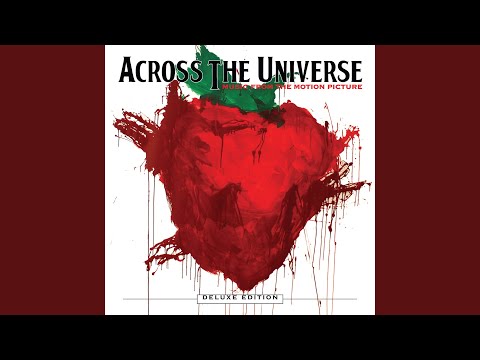
- Album (if any): Across the Universe (Music from the Motion Picture) - Deluxe Edition
- Music style: Close-harmony a cappella with pop phrasing
- Poetic meter: Free stress, shaped by repeated causal clauses
Frequently Asked Questions
- Who sings the number in the film?
- IMDb soundtrack credits list Evan Rachel Wood, Jim Sturgess, Joe Anderson, Dana Fuchs, T.V. Carpio, and Martin Luther McCoy as the performers.
- Where does it appear in the film?
- It is placed after "Being for the Benefit of Mr. Kite!" and before "Something" in the film's published musical-number order.
- Is the performance diegetic?
- Yes. The characters sing together on screen as part of the scene.
- What is the scene context?
- A soundtrack timestamp guide places it around 1:13:00, with the group lying in a field and the film cutting into an underwater montage.
- Why use an a cappella texture here?
- It forces intimacy. Without instruments, the audience cannot hide behind rhythm or volume; blend becomes the drama.
- Who wrote the song originally?
- It is credited to Lennon and McCartney and first appeared on The Beatles' Abbey Road.
- What makes the harmony special?
- The writing stacks simple lines into a slow-moving chord machine. You hear the same idea from multiple angles at once.
- What key and tempo are commonly listed for the soundtrack track?
- Some track-metric databases list D major and 167 BPM, though many listeners feel it in half-time due to the a cappella phrasing.
- Does the soundtrack album have awards recognition?
- Yes. The official soundtrack was nominated for a Grammy in the compilation soundtrack category, and it charted on Billboard lists.
- Is this the same as The Beatles recording?
- No. It is a film cast recording with its own arrangement choices and vocal blend, used for a specific scene beat.
Awards and Chart Positions
The number itself was not promoted as a stand-alone single, but the soundtrack around it had a documented run. Wikipedia's soundtrack entry lists Billboard peaks and a Grammy nomination for the compilation soundtrack category.
| Item | Result | Notes |
|---|---|---|
| Grammy Awards | Nominated - Best Compilation Soundtrack Album for Motion Picture, Television or Other Visual Media | Nomination for the soundtrack album. |
| US Billboard 200 (soundtrack album) | Peak: 36 | Weekly peak listed in the soundtrack chart table. |
| US Top Soundtracks (Billboard) | Peak: 12 | Category chart peak listed in the soundtrack chart table. |
| US Soundtrack Albums (Billboard) year-end | Position: 22 (2008) | Year-end placement listed in the soundtrack year-end table. |
How to Sing Because
Two data points help you plan rehearsal: track-metric listings for the film recording often tag D major and 167 BPM, and common sheet listings for the song show upper harmony lines reaching into soprano territory (often notated up to B5 in leadsheet formats). The catch is feel. Many singers experience the film track as half-time, so do not let a number bully you into rushing.
- Tempo: Rehearse the blend at about 84 BPM first (half-time), then check whether your group wants a quicker internal subdivision. Keep the pulse steady.
- Diction: Match vowel shapes across voices. The lyric is simple; the drama is in alignment.
- Breathing: Stagger breaths. A cappella harmony collapses when everyone inhales at the same spot.
- Flow and rhythm: Treat the repeated "because" clauses like waves, not separate sentences. Each entry should feel inevitable.
- Accents: Keep consonants light on "round" and "blue" so the chord stays warm, not percussive.
- Harmony tuning: Tune major thirds a touch low and fifths clean. Hold the chord like a string quartet.
- Ensemble roles: Decide who carries the line and who supports. Swap roles in rehearsal so the blend does not lean on one singer.
- Mic technique: If amplified, place the lead line slightly forward and keep harmony mics a bit softer. Let the chord bloom, not shout.
- Pitfalls: Vibrato that is too wide, early cutoffs, and bright vowels that make the chord brittle.
- Practice materials: Sing the chords on "oo" for two minutes, then add text without changing vowel focus. Record and check whether the word "love" lands as one sound, not six.
Additional Info
One reason this song keeps getting stolen by arrangers is that it behaves like a chorale wearing pop clothes. Beatles Bible notes its famous inspiration hook: John Lennon reportedly built it after hearing Yoko Ono play Beethoven's Moonlight Sonata, then flipped the chord sequence. That origin story fits the film use. A song born from classical gravity becomes, in Taymor's hands, a floating argument for togetherness.
If you want a director's-eye reading, look at the staging choice the film makes and refuses to apologize for: bodies close, voices closer, and a camera that treats the group as a single organism. The Oxford study calls attention to the a cappella close harmonies as a performative statement tied to the characters' stance. Translation: this is not just a love song, it is a way of standing in a room.
Key Contributors
| Subject | Verb | Object |
|---|---|---|
| Julie Taymor | directs | Across the Universe and stages the a cappella ensemble number |
| Evan Rachel Wood | performs | the film and soundtrack vocal part as Lucy |
| Jim Sturgess | performs | the film and soundtrack vocal part as Jude |
| Joe Anderson | performs | the film and soundtrack vocal part as Max |
| Dana Fuchs | performs | the film and soundtrack vocal part as Sadie |
| T.V. Carpio | performs | the film and soundtrack vocal part as Prudence |
| Martin Luther McCoy | performs | the film and soundtrack vocal part as Jojo |
| John Lennon | writes | the composition and lyric under Lennon-McCartney credit |
| Paul McCartney | co-writes | the composition and lyric under Lennon-McCartney credit |
| Interscope | releases | the soundtrack and deluxe edition |
Sources
Sources: Wikipedia - Across the Universe (film) musical numbers list, IMDb soundtrack credits page for Across the Universe (2007), Soundtrackradar song list with timestamps, Apple Music album listing for the deluxe soundtrack, Shazam track credits for the soundtrack recording, Musicstax track metrics for the soundtrack cut, Musicnotes sheet listing for vocal ranges, Beatles Bible song history note, Oxford University Press chapter on Julie Taymor's jukebox musical analysis
Music video
Across the Universe Lyrics: Song List
- Girl
- Helter Skelter
- Hold MeTight
- All My Loving
- I Wanna Hold Your Hand
- With A Little Help From My Friends
- It Won't Be Long
- I've Just Seen A Face
- Let It Be
- Come Together
- Why Don't We Do It In The Road?
- If I Fell
- I Want You / She's So Heavy
- Dear Prudence
- Flying
- Blue Jay Way
- I Am The Walrus
- Being for the Benefit of Mr. Kite!
- Because
- Something
- Oh, Darling
- Strawberry Fields
- Revolution
- While My Guitar Gently Weeps
- Across the Universe
- Helter Skelter (Reprise)
- And I Love Her
- Happiness Is A Warm Gun
- A Day in the Life
- Blackbird
- Hey Jude
- Don't Let Me Down
- All You Need Is Love
- Lucy In The Sky With Diamonds