
Falsettos Lyrics: Song List
- Act 1
- Four Jews in a Room Bitching
- A Tight Knit Family
- Love is Blind
- Thrill of First Love
- Marvin at the Psychiatrist (A Three-Part Mini-Opera)
- Everyone Tells Jason to See a Psychiatrist
- This Had Better Come to a Stop
- I'm Breaking Down
- Jason's Therapy
- A Marriage Proposal
- Trina's Song
- March of the Falsettos
- Trina's Song (Reprise)
- The Chess Game
- Making a Home
- The Games I Play
- Marvin Goes Crazy
- I Never Wanted to Love You
- Father to Son
- Act 2
- Welcome to Falsettoland
- The Year of the Child
- Miracle of Judaism
- The Baseball Game
- A Day in Falsettoland
- The Fight/Everyone Hates His Parents
- What More Can I Say
- Something Bad Is Happening
- Holding to the Ground
- Days Like This
- Cancelling the Bar Mitzvah
- Unlikely Lovers
- Another Miracle of Judaism
- You Gotta Die Sometime
- Jason's Bar Mitzvah
- What Would I Do?
About the "Falsettos" Stage Show
Falsettos is the story of a large, eccentric, and dysfunctional -- but loving -- Jewish family in New York at the end of the 1970s. Initially, Marvin seems blessed with the perfect family. He has a caring wife, Trina and a young son, Jason. Nevertheless, the family is soon broken apart, when bisexual Marvin leaves Trina for a man called Whizzer. Trina, meanwhile, ends up romantically involved with the family psychiatrist, Mendel. All the while, their son, Jason, is stuck in the middle. Included in the mix are a lesbian, Dr. Charlotte and Cordelia. When Marvin's lover, Whizzer, is diagnosed with AIDS, the entire family -- non-traditional as it may be -- must put aside their issues and come together.
Release date of the musical: 2016
"Falsettos" – The Musical Guide & Song Meanings
Review
Why does a musical that starts with complaining feel like a love story by the end? Falsettos answers with a specific kind of lyric pressure. William Finn writes people who cannot stop thinking out loud, and the songs keep the nervous talk musical without sanding off the edges. The text is quick, argumentative, intimate. It turns domestic mess into structure, then turns structure into a punchline that lands one beat too late.
In the 2016 revival, that writing sits inside a visual idea that clarifies the theme: adults behaving like kids while a kid tries to behave like an adult. The skyline becomes blocks. Furniture becomes a cube that rearranges like a toy, then traps the characters when the games stop being cute. Finn’s language follows the same rule. In Act One, masculinity is a dare. In Act Two, masculinity is a responsibility, and the words suddenly have consequences the characters did not plan for. You can hear the hinge in the way jokes thin out and questions get simpler. Finn does not give the characters clean speeches. He gives them patterns, repeated phrases, internal rhymes, and overlapping arguments that sound like family because they are interruptions, not monologues.
Musically, Falsettos lives in a talk-sung sprint with bursts of ensemble math. Lines stack and collide. Couples sing different truths at the same time. A chorus can sound like community and surveillance in the same bar. That is why the lyrics matter more than plot summary. Falsettos is almost entirely sung, so character is language, and language becomes fate.
How It Was Made
Falsettos is a stitched-together evening with a history you can feel. Finn started the world with In Trousers, then wrote March of the Falsettos (1981) and later Falsettoland (1990). James Lapine joined as collaborator and director, and the two one-acts eventually fused into the 1992 Broadway version. That timeline explains the show’s emotional acceleration. The first half comes from a period when the characters could still treat life as a debate club. The second half arrives from a different decade, when the culture changed and the show had to name what was happening without having stable language for it yet.
Finn’s craft habit also shows in the score’s shape. He has described needing the first line before a song can exist. That explains why so many numbers feel like a sentence that starts as a joke and ends as a confession. Even the origin trivia carries lyric meaning. Finn has said the show’s original title matched its opening number, which is an unusually honest mission statement: begin with griping, then expose what the griping is protecting.
The 2016 revival, directed again by Lapine, treated the piece as living material. It was not presented as museum work. The production was filmed live in January 2017 for PBS, and reporting around that filming notes that some explicit language was adjusted for the capture. That detail matters because Finn’s lyrics are specific about shame and politeness, and any softening changes the temperature of a scene.
Key Tracks & Scenes
"Four Jews in a Room Bitching" (Marvin, Mendel, Whizzer, Jason)
- The Scene:
- A black-lit jolt into the world. The men cluster like a band that cannot agree on the first chord. The blocks loom. The energy is sharp, almost fluorescent.
- Lyrical Meaning:
- The lyric frames complaint as inheritance. Everyone is performing intelligence, and the performance becomes its own trap. Finn makes the opening funny, then uses it to set up the show’s core question: who gets to be a man, and at what cost?
"A Tight-Knit Family" (Company)
- The Scene:
- The cube of furniture shifts into “home.” Marvin tries to declare order into existence. People orbit him, resisting, negotiating, rolling their eyes in rhythm.
- Lyrical Meaning:
- The phrase is aspiration and control. Finn writes the words like a slogan Marvin repeats to drown out the chaos he caused. The chorus is communal, but it does not sound safe.
"I'm Breaking Down" (Trina)
- The Scene:
- Kitchen panic under bright light. Trina moves too fast, chopping and spiraling, jokes firing like alarms. The room feels cramped even on a wide stage.
- Lyrical Meaning:
- Finn gives Trina comedy as a weapon and a symptom. The lyric is a list of grievances that keeps trying to become a diagnosis. When the song tips into high-wire bravura, it sounds like survival performing itself.
"The Thrill of First Love" (Marvin & Whizzer)
- The Scene:
- A private bubble inside public mess. The skyline blocks look soft for a moment. The men circle each other with attraction and distrust, like they are reading terms and conditions.
- Lyrical Meaning:
- The lyric treats romance as both discovery and competition. Finn makes tenderness feel risky. The words insist on pleasure while the subtext keeps warning that Marvin will try to own it.
"March of the Falsettos" (Marvin, Mendel, Whizzer)
- The Scene:
- A stylized nightmare, often staged with eerie light and toy-like architecture. The men sing high, matching Jason’s pre-adolescent sound, as if adulthood is a costume that does not fit.
- Lyrical Meaning:
- The falsetto choice is the metaphor in the title. Finn writes masculinity as performance, not biology. The lyric mocks immaturity while admitting how comforting immaturity can be.
"The Baseball Game" (Ensemble)
- The Scene:
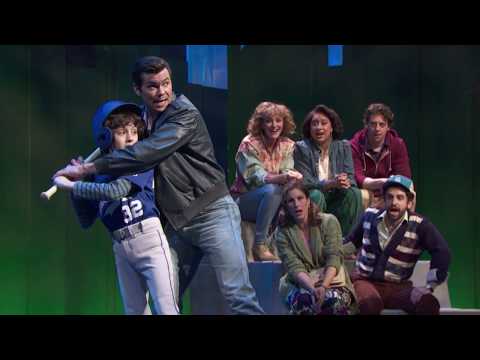
- Daylight play with a scorecard under it. Jason at bat. Adults on the sidelines turning sport into gossip, jealousy, and care. Movement feels choreographed but casual.
- Lyrical Meaning:
- Finn uses commentary to show who is watching whom. The lyric turns community into a chorus that can celebrate and judge in the same breath, which is why the later hospital scenes feel so stark.
"Something Bad Is Happening" (Charlotte & Cordelia)
- The Scene:
- Clinical lighting. Charlotte’s medical focus clashes with Cordelia’s emotional insistence. The room narrows to language, the moment where the show’s jokes start losing oxygen.
- Lyrical Meaning:
- The power is the bluntness. The lyric refuses poetry because the characters do not have the terms yet. Finn writes dread as an unfinished sentence that keeps returning.
"You Gotta Die Sometime" (Whizzer)
- The Scene:
- Hospital space, isolated even when others are near. Whizzer’s bravado cracks and reforms. The lighting often holds him in a lonely pool.
- Lyrical Meaning:
- Finn lets anger and humor coexist with fear. The lyric avoids saintliness. It gives Whizzer agency in a moment designed to strip it away.
"What Would I Do?" (Marvin & Whizzer)
- The Scene:
- Afterward. The room is quieter than the audience expects. Marvin speaks as if the questions might rearrange time the way the blocks rearrange rooms.
- Lyrical Meaning:
- The song is grief that cannot negotiate. Finn writes love as dependency without shame, and the lyric’s simplicity lands because the show spent so long avoiding simplicity.
Live Updates
In 2025 and 2026, Falsettos is thriving as a regional “event” title rather than a touring juggernaut. A clear example is Philadelphia’s Arden Theatre Company, which opened its 2025–26 season with Falsettos in a fall 2025 run. Washington, D.C.’s Keegan Theatre mounted the show in May to June 2025, timed to a high-visibility civic moment, and Montreal’s Segal Centre lists Falsettos for March 7–15, 2026. Those choices track with how the piece is programmed now: theatres position it as both comedy and memory work, often building talkbacks and community partnerships around the story’s AIDS-era setting.
Licensing remains a practical driver of that momentum. Concord Theatricals represents the title and lists band parts and rental options, and at least one music prep resource notes that the licensed version reflects the 2016 Broadway revival. That means new productions are often inheriting a sound world and pacing shaped by Lapine’s return to the material, plus the revival’s orchestration approach.
The other “current” factor is the writer’s legacy. William Finn died in April 2025, and the show’s 2025 productions have often been described as tributes. That grief changes how audiences hear the comedy. The jokes still land. They land with a longer echo.
Notes & Trivia
- The 2016 Broadway revival began previews September 29, 2016, opened October 27, and closed January 8, 2017 at the Walter Kerr Theatre.
- The production was filmed live on January 3–4, 2017 for PBS’s Live From Lincoln Center, with broadcast on October 27, 2017.
- Reporting around the filming notes that some explicit language was altered for the capture.
- Finn has said the original title of the show matched its opening number, “Four Jews in a Room Bitching.”
- The 2016 set concept used a cube and rearrangeable blocks, turning Manhattan into a childlike construction set.
- The 2016 Broadway cast recording was released December 16, 2016; Ghostlight’s edition includes a substantial booklet with complete lyrics and production photos.
- Music prep notes for the licensed materials explicitly reference the 2016 revival as the baseline version.
Reception
Falsettos has always been praised for doing two jobs at once: documenting a specific community and building a universal family argument. Early major reviews pushed back against reducing it to “a gay musical,” stressing its larger comic architecture and emotional reach. The 2016 revival reopened a second debate: how much sweetness is earned, and how much is theatrical reflex. Some critics celebrated the revival as newly piercing, and others argued the show leans too hard on self-awareness. What stays consistent is the language. Finn’s lyrics attract strong reactions because they do not behave politely. They interrupt. They rhyme where you do not expect them to rhyme. They let a character be selfish in public, then make you mourn that character anyway.
“To call ‘Falsettos’ a musical about gay life … is also to shortchange its tremendous appeal.”
“Few musicals have the range, idiosyncrasy and emotional punch of this profoundly unconventional and personal work.”
“Finn grabs at a rhyme as if it were the last canapé on a tray.”
Quick Facts
- Title: Falsettos
- Year: 2016 (Broadway revival; original Broadway debut 1992)
- Type: Sung-through musical
- Book: William Finn, James Lapine
- Music & Lyrics: William Finn
- 2016 Revival Venue: Walter Kerr Theatre (Broadway)
- 2016 Revival Dates: Previews September 29, 2016; opened October 27; closed January 8, 2017
- Director (2016): James Lapine
- Choreography (2016): Spencer Liff
- Orchestrations (2016 credit): Michael Starobin
- Selected notable scene placements: “Four Jews in a Room Bitching” as tonal thesis; “The Baseball Game” as community hinge; “Something Bad Is Happening” as crisis ignition; “What Would I Do?” as final reckoning
- Filmed capture: Walter Kerr Theatre performances filmed January 3–4, 2017 for PBS
- Cast album (revival): Falsettos (2016 Broadway Cast Recording), released December 16, 2016
- Label / release context: Digital and physical release via Ghostlight; platform metadata credits Sh-K-Boom and Lincoln Center Theater
- Album availability: Streaming on major platforms; Ghostlight product page notes complete lyrics in the booklet
Frequently Asked Questions
- Is Falsettos a revival in 2016 or a new musical?
- The 2016 Broadway production is a revival of the 1992 Broadway musical, created from earlier one-act works that premiered Off-Broadway.
- Who wrote the lyrics?
- William Finn wrote the music and lyrics. He co-wrote the book with James Lapine.
- Why does the show use falsetto as an idea?
- It links the adult men to Jason’s pre-adolescent voice, turning “being a man” into something performed, contested, and often avoided.
- Is the filmed version from the 2016 revival?
- Yes. The production was filmed live at the Walter Kerr Theatre in January 2017 for Live From Lincoln Center and later aired on PBS.
- Is there a complete cast recording of the 2016 revival?
- Yes. The 2016 Broadway cast recording was released in December 2016.
- Where is Falsettos being staged in 2025 and 2026?
- Recent listings include productions in Washington, D.C. in May–June 2025, Philadelphia in fall 2025, and Montreal in March 2026.
Key Contributors
| Name | Role | Contribution |
|---|---|---|
| William Finn | Composer-Lyricist; Co-Book | Wrote the score’s rapid-fire language and built the two-act arc from domestic comedy into AIDS-era grief. |
| James Lapine | Co-Book; Director (2016 revival) | Shaped the material across decades and returned to direct the revival with a brisk, contemporary tempo. |
| Christian Borle | Actor (2016 revival) | Played Marvin with a volatility that keeps Finn’s sharpest lines from turning charming. |
| Andrew Rannells | Actor (2016 revival) | Played Whizzer with ease that sharpens the late songs when ease disappears. |
| Stephanie J. Block | Actor (2016 revival) | Played Trina; “I’m Breaking Down” becomes a comic set piece that still reads as pain. |
| Brandon Uranowitz | Actor (2016 revival) | Played Mendel, the therapist-narrator figure who keeps trying to rationalize desire. |
| Michael Starobin | Orchestrator (2016 credit) | Orchestration credit on the 2016 Broadway production. |
| Spencer Liff | Choreographer (2016 revival) | Built movement that turns banter into physical argument, especially in ensemble sequences. |
Sources: IBDB; Playbill; Lincoln Center Theater; Concord Theatricals; Time Out New York; Vulture (New York Magazine); Variety; PBS SoCal; Ghostlight Records; Apple Music; Keegan Theatre; Arden Theatre Company; Segal Centre for Performing Arts; Legacy.com.