
Elegies: A Song Cycle Lyrics: Song List
- Looking Up Quintet
- Mister Choi & Madame G
- Mark's All-Male Thanksgiving
- Only One
- Joe Papp
- Peggy Hewitt and Mystery del Gior
- Passover
- Infinite Joy
- Ballad of Jack Eric Williams
-
Fred

-
Dear Reader
- Monica & Mark
- Anytime (I Am There)
- My Dogs
- Venice
- 14 Dwight Ave., Natick, Massachusetts
- When the Earth Stopped Turning
- Goodbye/Boom Boom
- Looking Up
About the "Elegies: A Song Cycle" Stage Show
Due to the simplicity of the format of spectacle (a collection of songs rather than classic musical), it's easy to play it on almost every stage, with any level of professionalism of the actors and the entire production team. Most of its notable shows were made in:
– November 2004, in the UK, with such actors: L. Ward, P. Caulfield, S. Fellows, R. Shell & J. Barrowman;
– May 2004, Boston: L. Barrett, M. Mendiola, W. McGarrahan, J. Delgado & K. Dowling;
– March of 2007, Toronto: M. Strathmore, T. Allison, E.–J. Scott, S. Gallagher & B. Barsky;
– 2010, August, New York: K. O'Malley, D. de Haas, A. Milazzo, J. Forbach & M. B. Dunn.
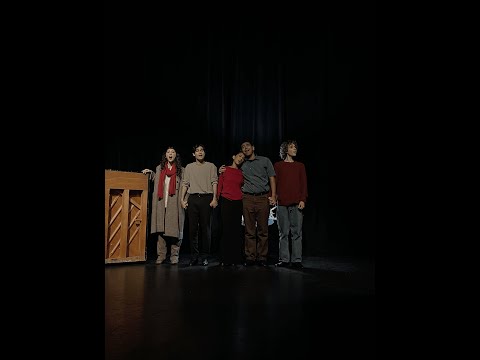
As for non-professional performances, they were more than a hundred, in various versions, including the execution of separate songs at some events, as in the example in "Video" section, where the first song is performed in some restaurant.
Release date of the musical: 2003
"Elegies: A Song Cycle" – The Musical Guide & Song Meanings
Review
What do you call a show that refuses to pretend grief is polite. “Elegies” answers by singing names out loud. William Finn writes each number like a small room you step into, and the air changes. Some rooms are funny. Some are blunt. Some are unbearably domestic, which is exactly the point.
The lyric engine is memory under pressure. Finn does not generalize loss, he particularizes it. A deli counter, a holiday table, a mother’s address, a run of dead dogs, a producer’s swagger. The jokes are not decoration. They are defense mechanisms that keep the evening from turning into a vigil that only whispers.
Musically, the cycle moves in Finn’s familiar lanes: speech-rhythms that feel like thought, melodies that can turn conversational and then suddenly lift, as if a private recollection has reached the ceiling. The biggest structural choice is also the bravest one. The work saves its explicit 9/11 response for the conclusion, after you have been trained to care about individual lives first.
How It Was Made
“Elegies” premiered at Lincoln Center Theater’s Mitzi E. Newhouse Theater in March 2003, staged by Graciela Daniele with a five-performer cast. The material is personal by design. Concord’s licensing summary is unusually specific about who is being honored, from Joe Papp and performers Peggy Hewitt and Jack Eric Williams to the Korean family who ran a deli Finn frequented, plus relatives, friends, pets, and a sequence centered on Finn’s mother. The same summary notes a three-song conclusion that offers a tribute to the victims of 9/11.
The most revealing origin detail is not a cute rehearsal anecdote. It is intent. A Playbill album essay describes many of the songs as private outpourings that were not written to “work” theatrically, and then explains how they became an evening anyway, after years of Finn’s limited output and Lincoln Center’s long relationship with him. That tension is audible in the lyrics. They are not performing grief. They are reporting it, sometimes with a grin that hurts.
Key Tracks & Scenes
"Looking Up Quintet" (Company)
- The Scene:
- The opening feels like a community forming in real time. A bare stage, close light, performers facing front as if they are checking whether the audience can handle what’s coming.
- Lyrical Meaning:
- Finn starts with insistence. The words push upward, not because loss is over, but because the only way through the night is to keep talking and keep looking.
"Mister Choi & Madame G" (Ensemble)
- The Scene:
- A corner-store memory. Fluorescent lighting in the imagination, a counter that becomes sacred simply because it was routine.
- Lyrical Meaning:
- The lyric treats everyday caretaking as a form of love. The song honors working people without flattening them into symbols, which is rarer than it should be.
"Mark’s All-Male Thanksgiving" (Solo)
- The Scene:
- A party story told like a toast that keeps slipping into elegy. Warm light, quick tempo, laughter that lands a half-beat late.
- Lyrical Meaning:
- The lyric refuses to separate queerness from community. It mourns a person by remembering how he hosted, how he gathered others, how he made tradition out of friends.
"Joe Papp" (Ensemble)
- The Scene:
- The stage becomes a downtown theatre hallway. Posters in your mind. Someone moving too fast, talking too loud, making a city feel possible.
- Lyrical Meaning:
- Finn writes tribute as portrait. The lyric catches ambition and generosity in the same breath, which is exactly how producers can feel to artists who owe them something real.
"The Ballad of Jack Eric Williams (and other 3-named composers)" (Ensemble)
- The Scene:
- A cabaret turn with an edge. The light sharpens. The rhythm tightens. The number plays like an inside joke that keeps widening into something sadder.
- Lyrical Meaning:
- The lyric uses wit to guard a bruise. It honors an artist while also acknowledging how quickly artists can be filed away, even by the people who loved them.
"Anytime (I Am There)" (Solo)
- The Scene:
- A bedside promise that does not ask for certainty. A single voice, soft light, the sense that the room is holding its breath.
- Lyrical Meaning:
- The lyric is structured like a vow. It offers presence instead of explanation. That choice is why the song lands with audiences who have no connection to the specific person being remembered.
"My Dogs" (Solo)
- The Scene:
- A comic monologue that keeps turning. The performer lets the audience laugh, then lets the laughter curdle, because that’s how grief sneaks in.
- Lyrical Meaning:
- The lyric dares you to admit you mourn animals, too. It turns a list into a confession: love is not ranked. Loss does not ask permission.
"14 Dwight Ave., Natick, Massachusetts" (Solo)
- The Scene:
- An address spoken like an incantation. The light narrows. Everything onstage feels smaller, the way childhood homes feel when you try to carry them as an adult.
- Lyrical Meaning:
- The lyric does not “sum up” a mother. It circles her, concrete detail by concrete detail, until the portrait emerges. A Playbill album essay calls this one incredibly powerful, and it earns that reputation by staying specific.
"When the Earth Stopped Turning" (Solo)
- The Scene:
- The room goes still. The singer stands as if bracing for impact that has already happened. The final moments often play with very little movement, because the song already contains the motion.
- Lyrical Meaning:
- Finn writes the feeling of time breaking. The lyric frames death as a shift in physics: the world continues, but your internal world has changed laws.
Live Updates 2025–2026
In 2025, “Elegies” keeps turning up in training programs and festivals, where the show’s format fits both budget and mission. The Elder Conservatorium of Music Theatre at the University of Adelaide scheduled “Elegies: A Song Cycle” for October 16–19, 2025 at the Little Theatre, with ticketed listings that include pricing. Ohio University’s theatre season also lists “Elegies: a Song Cycle” for October 8–12, 2025, directed by Steven Strafford at Kantner Hall 308.
In Toronto, Opera 5 programmed “Elegies: A Song Cycle” at Factory Theatre as part of its 2025 Toronto Opera Festival, with performances listed across June 15, 17, and 20 and a stated run time of about 70 minutes with no intermission. That kind of programming is telling. Companies are increasingly treating Finn’s cycle as repertory, not novelty, and pairing it with community talkbacks and festival framing.
Looking into 2026, Los Angeles company Chromolume Theatre has publicly placed “Elegies” in June 2026 as part of the Hollywood Fringe Festival, with both BroadwayWorld coverage and the company’s own season history listing the title and month. The cycle’s afterlife continues to look like this: short runs, close rooms, and audiences who show up because they have lost someone, not because they have heard of the show.
Notes & Trivia
- The Lincoln Center run is documented as March 2 to April 19, 2003 at the Mitzi E. Newhouse Theater.
- Concord’s licensing summary describes a three-song conclusion that explicitly honors the victims of 9/11.
- The musical numbers list includes several items marked as not featured on the Original Off-Broadway cast recording, which is one reason different listening experiences can feel slightly incomplete.
- The cast recording release date is widely listed as June 24, 2003, with recording dated April 28, 2003 at Clinton Recording Studios in New York.
- Finn’s subjects include public figures (like Joe Papp) and intensely private figures (like Finn’s mother), and the tonal whiplash is intentional.
- Recent critics still emphasize the work’s balance of humor and mourning, especially in productions that keep staging minimal and storytelling direct.
Reception
Early responses framed “Elegies” as an unusual Lincoln Center offering, a song cycle presented on dark nights, closer to a special event than a conventional run. Over time, the reputation has shifted toward repertory value. Reviews of later productions often praise the writing’s swing between comedy and sorrow, and the way Finn refuses to sand down either edge.
“William Finn celebrates lost lives in this collection of songs being presented on dark nights at the Mitzi Newhouse...”
“Finn writes not for his living, but for his life.”
“In 2003, [he] premiered ‘Elegies’ ... written as a response to the Sept. 11, 2001, terrorist attacks.”
Quick Facts
- Title: Elegies: A Song Cycle
- Year: 2003
- Type: Song cycle / musical revue
- Music and lyrics: William Finn
- Premiere: Mitzi E. Newhouse Theater, Lincoln Center (March 2003)
- Original staging: Directed by Graciela Daniele
- Original cast (Lincoln Center): Christian Borle; Betty Buckley; Carolee Carmello; Keith Byron Kirk; Michael Rupert
- Album: “Elegies: A Song Cycle (2003 Off-Broadway Cast Recording)”
- Cast recording date/location: April 28, 2003; Clinton Recording Studios, New York
- Release context: Recorded nearly complete; released on CD via Fynsworth Alley with distribution noted via Varèse Sarabande in show history; currently available on major streaming platforms under Concord metadata
- Selected notable placements within the cycle: “Mister Choi & Madame G” (the deli family tribute); “Joe Papp” (producer portrait); “My Dogs” (comic grief); “14 Dwight Ave., Natick, Massachusetts” (mother memorial); “When the Earth Stopped Turning” (maternal grief); concluding sequence honoring 9/11 victims
Frequently Asked Questions
- Is “Elegies” a traditional book musical?
- No. It is a song cycle. The continuity comes from theme and memory, not a single plotline.
- Who wrote the lyrics?
- William Finn wrote both music and lyrics.
- Is the show connected to 9/11?
- Yes. Multiple sources describe it as a response to the September 11 attacks, and Concord’s licensing summary notes a concluding tribute sequence for the victims.
- Which songs are the emotional center of the piece?
- Many productions build their spine around “Anytime (I Am There),” “14 Dwight Ave., Natick, Massachusetts,” and “When the Earth Stopped Turning,” with comic counterweights like “My Dogs.”
- Is there an official cast album?
- Yes. The 2003 Off-Broadway cast recording is widely listed with a June 24, 2003 release date and is available on major streaming services.
- Is “Elegies” being performed in 2025 and 2026?
- Yes. Listings include October 2025 university productions in Adelaide and Ohio, a June 2025 Opera 5 festival run in Toronto, and a June 2026 placement announced by Chromolume Theatre for the Hollywood Fringe Festival.
Key Contributors
| Name | Role | Contribution |
|---|---|---|
| William Finn | Composer; Lyricist | Wrote music and lyrics; shaped the cycle’s tone shifts between comedy, portraiture, and direct mourning. |
| Graciela Daniele | Director (original Lincoln Center staging) | Staged the 2003 Lincoln Center presentation that established the five-performer concert-theatre template. |
| Lincoln Center Theater | Presenting organization | Hosted the premiere at the Mitzi E. Newhouse Theater and documented cast/production history. |
| Concord Theatricals | Licensing / catalog | Provides licensing materials and a synopsis that identifies subjects honored and the 9/11 conclusion. |
| Steven Suskin | Critic / historian | Authored a detailed album essay highlighting the songs’ private origins and naming key numbers. |
Sources: Concord Theatricals; Lincoln Center Theater; Playbill; Variety; The Washington Post; Wikipedia; Opera 5; Factory Theatre; University of Adelaide (Elder Conservatorium / student events listings); Ohio University theatre season; BroadwayWorld (Los Angeles); Chromolume Theatre.