
Children Of Eden Lyrics: Song List
- Act 1
- Let There Be
- Perfect (Part 1)
- Tree of Knowledge
- Naming
- Grateful Children
- Father's Day
- Perfect (Part 2)
- Spark of Creation
- In Pursuit of Excellence
- End of a Perfect Day
- Childhood's End
- World Without You
- Explusion
- Wasteland
- Spark of Creation (Reprise 1)
- Lost in the Wilderness
- Lost in the Wilderness (Reprise)
- Close to Home
- Ring of Stones
- Clash of the Generations
- Death of Abel
- Mark of Cain
- Children of Eden
- Act 2
- Generations
- Gathering Storm
- Piece of Eight
- Blind Obedience/Return of the Animals
- Noah's Lullaby
- Stranger to the Rain
- In Whatever Time We Have
- Flood
- What Is He Waiting For?
- Sailor of the Skies
- Spark of Creation (Reprise 2)
- Hardest Part of Love
- Words of Doom
- Hour of Darkness
- Ain't It Good?
- Precious Children
- In the Beginning
About the "Children Of Eden" Stage Show
Initial production was in 1986 and was called Family Tree, which united the two hits from the biblical story about the first people and their children & about Noah and the great flood. This play was initially performed by religious school in Illinois, but then a man named Stephen Schwartz has adapted it for the musical format and renamed to today’s call.
Royal Shakespeare Company has developed the play and picked actors with director John Caird. It was full of such actors: E. Bentley, R. Henshall, K. Page, H. Itoh, R. Lloyd-King, R. Shell, M. Smith, C. Pinder, S. Powell, A. Barclay, A . Beaumont, F. Ruffelle & K. Colson. In 1991, the show opened and closed after 3 months since ticket sales have been weak, and the world had fever in general this year – there were many wars, disasters, and some hardened empires were disintegrated.
The musical was never released in the West End nor on Broadway, because of the negative responses to the musical and its rapid closing. It might have no such plans in future with rapid shutdown, so they have been forgotten. Recordings of songs that came out on CD, were not too popular, and went out of circulation very quickly. But due to technical problems with the release on CD, most of the drives were unable to read these CDs, so normal, readable discs with this recording now are quite rare and thus, are popular in the market of connoisseurs and lovers of the theater. Records of the original musical is now in so small quantity that practically the only reliable verified owners of concept recording on a CD or in another electronic form are only the director Stephen Schwartz and a man named Michael Kohl.
In 1990th, the show was altered and done by the actors at various levels, both amateurs and professionals. There were many versions performed that differ from each other as in a set of songs and also in scenes and dialogues, and even in the characters of protagonists. New Jersey has seen this musical staged in 1997, which became one of the most established versions of this musical, recognized as the most successful one, and it is played in the United States mostly. According to one of the magazines from music critics, Children of Eden is in the top 20 of musicals that are played often on different scenes & this is not typical for a musical that never made it to Broadway and did not even have off-Broadway's viewings.
Release date of the musical: 1991
"Children of Eden" – The Musical Guide & Song Meanings
Review and lyric themes
“Children of Eden” is a Bible musical that keeps pulling its punches toward the human. The stories are Genesis, but the subject is family management: how love becomes control, how control becomes fear, and how fear becomes a commandment. Stephen Schwartz writes lyrics that sound simple until you hear what they are doing. They keep returning to choice. A parent can forbid. A child can obey. Then both realize obedience does not create peace. It only delays consequence.
The show’s most persistent lyrical move is the argument inside tenderness. Father calls his children “perfect,” then watches them prove they are not. Eve sings curiosity as appetite, not sin. Cain sings ambition as loneliness, not evil. Act II repeats the pattern with Noah, but the writing gets harsher. If Act I is about leaving home, Act II is about building a home that becomes a fortress. The language turns into rules, lists, and exclusions, then breaks apart when the flood arrives and the rules fail.
Musically, Schwartz treats style like character psychology. “The Spark of Creation” is a solo that swells like a private discovery. “In Pursuit of Excellence” flirts with jazz-as-temptation, a seduction number that smiles while it sharpens its teeth. Then the score opens into anthem territory, because this show is built for choral mass. The larger the ensemble, the more the lyric thesis lands: families are never just two people. They are ecosystems, and the weather changes fast.
How it was made
The origin story is unusually concrete. Schwartz has said the piece began as “Family Tree,” created for Youth Sing Praise at the National Shrine of Our Lady of the Snows in Illinois, essentially an oratorio with about eleven songs. Several titles survived into the final musical in altered form, including “In the Beginning,” “Lost in the Wilderness,” and “In Pursuit of Excellence.” That first-life as a youth-driven religious commission explains the show’s DNA: large ensemble writing, direct moral language, and emotional clarity built for performers who need the words to carry. Schwartz also notes an early development workshop at the Guildhall School, part of the process that shaped the version people license today.
John Caird entered the story as the structural fixer and co-creator. Schwartz describes calling Caird after seeing “Nicholas Nickleby,” and Caird ultimately became the book writer. That matters because “Children of Eden” is two acts that mirror each other across a thousand years. The show needs a director-brain and a storyteller’s hand. It also needed rewrites. Schwartz has openly described learning from productions, then rewriting for clarity, calling the later version “vastly superior” in execution to the London run.
The 1991 West End production opened at the Prince Edward Theatre on January 8, 1991, directed by Caird. It closed quickly, and the work’s mainstream trajectory stalled. But the musical did something rarer: it became a grassroots show. It lives through licensing, schools, churches, community theatres, and concert events, where the choir can become the heartbeat of the night.
Key tracks and scenes
"Let There Be" (Father)
- The Scene:
- Nothing, then light. Father speaks creation into being with the Storytellers acting as the world’s first witnesses. Many productions treat it like a ritual, clean stage pictures and a sense of a universe assembling itself in public.
- Lyrical Meaning:
- The lyric frames creation as an act of will and a desire for relationship. Father is not building a planet. He is trying to build a family that will love him back, and the neediness is already there.
"The Spark of Creation" (Eve)
- The Scene:
- Eve steps away from the group and discovers her own hunger. The world feels newly touchable. Curiosity becomes physical, almost like gravity pulling her toward a choice.
- Lyrical Meaning:
- This is not “temptation” as a villain plot. It is selfhood arriving. Eve’s words make knowledge sound like pleasure and necessity at the same time, which is why Father’s rules feel suddenly small.
"In Pursuit of Excellence" (Snake, Eve)
- The Scene:
- The Snake enters like confidence with a pulse. The number often plays as a sly lounge act inside Eden’s innocence, shifting the room’s energy from wonder to persuasion.
- Lyrical Meaning:
- The lyric sells improvement as morality. “Excellence” becomes a trap word: it sounds noble, but it is really a way to make Eve ashamed of limits. The song teaches her how to desire what will cost her.
"Lost in the Wilderness" (Cain)
- The Scene:
- Cain convinces Abel to leave home and seek a future beyond their parents’ fear. It is a travel song with a bruise under it, a boy trying to outrun the story he was born into.
- Lyrical Meaning:
- Cain’s lyric is ambition as abandonment anxiety. He wants a destiny, but what he is really asking for is proof that he matters without Father’s approval. The rhyme schemes tighten like a fist.
"Children of Eden" (Eve)
- The Scene:
- Eve looks at her children and realizes Eden was never a garden. It was a phase. The staging often pulls focus to the family unit, with Storytellers surrounding them like memory and judgment.
- Lyrical Meaning:
- This lyric is parenting as surrender. Eve stops bargaining with the past and starts blessing the future. The title becomes a definition: Eden is not a place behind them, it is the people in front of her.
"Generations" (Storytellers)
- The Scene:
- Act II turns the page. The Storytellers map lineage and multiplication, a human tide that has moved far from the first family. The stage can feel crowded on purpose, history pressing in.
- Lyrical Meaning:
- The lyric makes time itself a character. It is a reminder that family conflict scales. One household pattern becomes a world pattern, and the cost multiplies.
"Stranger to the Rain" (Yonah)
- The Scene:
- Yonah is left outside the ark because she carries the mark of Cain. She prepares to face the storm alone, while the family’s safety becomes a bright, sealed-off image behind her.
- Lyrical Meaning:
- It is a song about exclusion that refuses bitterness as a personality. The lyric accepts reality, then insists on dignity anyway. Yonah becomes the show’s moral center by refusing to become cruel.
"In Whatever Time We Have" (Japheth, Yonah)
- The Scene:
- Japheth chooses Yonah over the rules and pulls her into the ark as Father watches. It is romance staged as emergency, two people making a vow with disaster already in the air.
- Lyrical Meaning:
- The lyric is love without guarantees. It rejects the fantasy of safety and replaces it with presence. In a show obsessed with obedience, this duet is chosen disobedience that sounds like truth.
Live updates 2025/2026
The most current “headline” for the show is not a Broadway run. It is streaming and concerts. A filmed concert performance from Chicago’s Cadillac Palace Theatre is scheduled to stream April 23 to April 26, 2026, a rare case of “Children of Eden” getting a defined digital window with a major cast attached. That keeps the score in circulation in a way the show rarely enjoys.
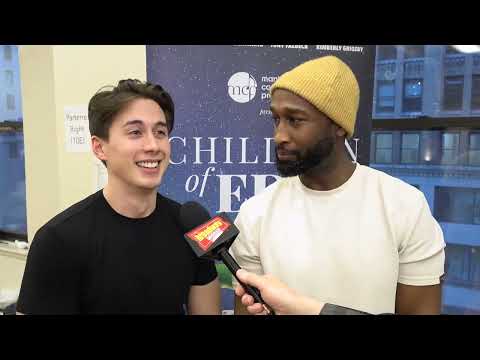
In New York, Manhattan Concert Productions mounted “Children of Eden in Concert” at Lincoln Center’s David Geffen Hall on February 18, 2024, with a star cast including Norm Lewis, Auli?i Cravalho, and Nikki Renée Daniels. Even though that date is in the past, it matters in 2026 because it signals how the piece is being positioned: as an event score with choral scale, not as a fragile book musical waiting for permission.
On the licensing side, MTI continues to present the show as a large-cast, faith-friendly epic that can be scaled, and its UK callboard has listed school and conservatoire productions in 2025. That is the real “tour.” The musical travels through local stages, where “Lost in the Wilderness” and “Stranger to the Rain” act like calling cards for young singers who want material with spine.
Notes and trivia
- The musical began life as “Family Tree,” written for Youth Sing Praise at the National Shrine of Our Lady of the Snows in Illinois, before becoming “Children of Eden.”
- Schwartz has said several “Family Tree” songs survive in altered form, including “Lost in the Wilderness” and “In Pursuit of Excellence.”
- Schwartz has confirmed the show was workshopped at the Guildhall School during early development.
- Schwartz has said Yonah is an invented character and not found in the Bible, a deliberate signal that the show is not a literal retelling.
- The West End premiere opened January 8, 1991 at the Prince Edward Theatre, directed by John Caird.
- The best-known full recording is the Paper Mill Playhouse based “American Premiere Recording,” released in 1998, with both a complete set and a highlights edition.
- A major Chicago concert was filmed and later scheduled for a limited streaming window in April 2026.
Reception then vs. now
Critics tend to split on the same fault line. The score is admired for its melodic generosity and solo material. The book is often called literal, sometimes plodding, and occasionally too eager to announce its message. That complaint is persistent because the show’s central voice is Father, and making a divine parent dramatically interesting is hard work. When it fails, Father feels like a rulebook with a microphone. When it works, he feels like a parent panicking in public.
“Beautiful melodies abound … but a very literal and plodding book undermines the pleasures.”
“Save for a handful of numbers … the score is unexciting.”
“Dates have finally emerged for the streaming run … April 23–26, 2026.”
Over time, “Children of Eden” has gained a different kind of reputation: a performer’s show. In concert form, and in community spaces where the choir becomes the community, the message feels less like instruction and more like testimony from the people singing it. The lyrics land because the room is part of the lyric.
Quick facts
- Title: Children of Eden
- Year: 1991 (West End premiere)
- Type: Musical (large-ensemble biblical drama)
- Music and lyrics: Stephen Schwartz
- Book: John Caird
- Concept: Charles Lisanby
- Structure: Act I (Adam, Eve, Cain, Abel); Act II (Noah and the flood)
- Notable lyric set-pieces: “The Spark of Creation,” “Lost in the Wilderness,” “Stranger to the Rain,” “In Whatever Time We Have”
- Cast recording anchor: Paper Mill Playhouse based “American Premiere Recording” (1998 release; recording dates listed January 12–14, 1998; produced by Stephen Schwartz and Danny Kosarin)
- Current availability: Licensed by MTI; recordings on major streaming platforms; filmed Chicago concert scheduled to stream April 23–26, 2026
Frequently asked questions
- Is “Children of Eden” a literal Bible retelling?
- No. Schwartz has explicitly noted that the show is not a literal retelling, and the character Yonah is an invention created for the story’s generational themes.
- What is “Lost in the Wilderness” about in the plot?
- Cain convinces Abel to leave home and seek a future beyond their parents’ world, a turning point where restlessness becomes destiny.
- Why does Act II feel harsher than Act I?
- Act II is about survival logic. Noah’s rules are built to save a family, but they also create exclusion. The lyrics move from curiosity and longing to policy and consequence.
- What is the central message of the show?
- The lyric line the show keeps earning is that “the hardest part of love is letting go.” It lands differently depending on whether you hear it as Father’s lesson, Eve’s lesson, or Noah’s lesson.
- Is there an official filmed version?
- A Chicago concert performance filmed at the Cadillac Palace Theatre has announced streaming dates in April 2026. A fully staged commercial film release is not standard for this title.
- What album should I start with?
- The 1998 “American Premiere Recording” documents the commonly licensed American version, and it is the easiest full score entry point on streaming.
Key contributors
| Name | Role | Contribution |
|---|---|---|
| Stephen Schwartz | Composer, lyricist | Wrote music and lyrics; documented the show’s early “Family Tree” origin and later rewrite process. |
| John Caird | Book writer, original director | Shaped the two-act mirror structure and directed the 1991 West End premiere. |
| Charles Lisanby | Concept | Conceived the project framework that became the musical. |
| Danny Kosarin | Producer, music supervision (recording) | Co-produced the 1998 recording with Schwartz, helping lock the “American version” into an accessible document. |
| Manhattan Concert Productions | Presenter | Mounted the Lincoln Center concert event in 2024 with choral scale and star casting. |
| Tony Yazbeck | Director (concert) | Directed the 2024 Lincoln Center concert performance. |
Sources: StephenSchwartz.com (official PDF archive), MTI Shows (US and UK), Playbill, Lincoln Center, JohnCaird.com, AllMusic, Masterworks Broadway, The Stage, ArtsATL, MusicalSchwartz.com, YouTube.