
Charlie and the Chocolate Factory Lyrics: Song List
- Act 1
- Opening / Almost Nearly Perfect
- The Amazing Fantastical History Of Mr. Willy Wonka
- A Letter from Charlie Bucket
- News of Augustus / More of Him to Love
- News of Veruca / When Veruca Says
- News of Violet / The Double Bubble Duchess
- News of Mike / Its Teavee Time!
- If Your Mother Were Here
- Don't Ya Pinch Me, Charlie
- It Must Be Believed to Be Seen
- Act 2
- Strike That! Reverse It!
- The Chocolate Room / Simply Second Nature
- Augustus' Downfall / Auf Weidersehen Augustus Gloop
- Gum! / Juicy!
- Veruca's Nutcracker Sweet
- Vidiots
- Pure Imagination
- A Little Me
- It Must Be Believed to Be Seen (Reprise)
About the "Charlie and the Chocolate Factory" Stage Show
When Charlie wins a golden ticket to the weird and wonderful Wonka Chocolate Factory, it's the chance of a lifetime to feast on the sweets he's always dreamed of. But beyond the gates astonishment awaits, as down the sugary corridors and amongst the incredible edible delights, the five lucky winners discover not everything is as sweet as it seems.
Featuring ingenious stagecraft, the wonder of the original story that has captivated the world for almost 50 years is brought to life with music by Marc Shaiman, and lyrics by Scott Wittman and Marc Shaiman, a book by award-winning playwright and adaptor David Greig, set and costume designs by Mark Thompson and choreography by Peter Darling.
A chocolate garden, an army of squirrels and the curiously peculiar Oompa-Loompas must be believed to be seen in this gigantic new musical that is choc-full of fantastical treats to dazzle your senses.
Release date of the musical: 2013
"Charlie and the Chocolate Factory" – The Musical Guide & Song Meanings
Review and lyric themes
The trick with “Charlie and the Chocolate Factory” (2013) is that it asks you to wait. The first act sits with poverty, routine, and the humiliations of being kind in a loud world. Wonka is the promise of escape, but Sam Mendes’ staging keeps him at a distance. Critics noticed the same structural gamble: a long runway before the plane lifts.
That delay shapes how Marc Shaiman and Scott Wittman write lyrics. Outside the factory, words tend to behave like labels. Countries become musical jokes. Families become types. In one early stretch, the text gets swallowed by pastiche, with the score imitating national “flavors” so aggressively that character detail can blur. Once the doors finally open, the show changes gears and the lyric writing gets sharper, more theatrical, and more predatory. In the factory scenes, people do not sing to communicate. They sing to control the room.
Shaiman’s musical language is built on contrast: warm, old-fashioned heart for Charlie and the Buckets, and a cooler, snap-to-attention energy for Wonka. The most telling motif is not a melody, it’s a cadence. Wonka’s language keeps turning into commands, slogans, and rules. Even when the words are playful, the rhythm implies a system. That is why the show’s “moral” songs do not land as sermons. They land as consequences.
How it was made
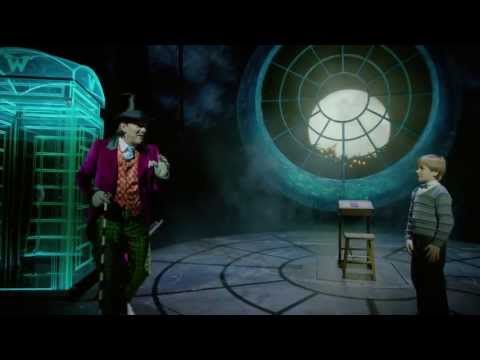
This musical was engineered like a major film release, then treated like a living draft. A first-act reading happened in 2010. By 2012, the West End production was formally confirmed, with Mendes directing and David Greig writing the book. Previews in 2013 were delayed because a piece of stage engineering arrived late. The detail sounds mundane until you remember what the show is. This version depends on machinery: screens, lifts, traps, projections, and optical tricks. Its “magic” is partly logistics.
The lyric and music brief was also tricky. The story comes with famous songs in the public ear, especially “Pure Imagination.” The creative solution, in London, was selective borrowing and heavy original writing. Later, the Broadway rework leaned further into the film catalogue for American audiences, but the 2013 London album captures the first big idea: write new material that can sit next to classic Wonka without apologizing for itself.
One behind-the-scenes line that explains the writers’ approach comes from Shaiman discussing style references for the later Broadway reimagining: he floated a pop-history “what if” that frames Wonka as a studio experiment, a band trying on textures and eras. That mind-set is audible in the score’s constant costume changes, even in 2013. It is not subtle. It is the point.
Key tracks and scenes
"Almost Nearly Perfect" (Charlie Bucket)
- The Scene:
- Early, in the Bucket home. The lighting is intentionally spare, the kind of grey that makes every warm note feel earned. Charlie’s voice sits inside the room, not above it.
- Lyrical Meaning:
- The lyric sells decency as a daily practice, not a personality trait. Charlie is not “special” because he wants chocolate. He is special because he can stay gentle while hungry.
"A Letter from Charlie Bucket" (Charlie, Bucket family)
- The Scene:
- A family moment staged like a ritual. The grandparents are part of the furniture, bedridden but watchful, while Charlie tries to sound brave on their behalf.
- Lyrical Meaning:
- This is the show’s first real argument with itself: Charlie speaks in hope, but the lyric is full of practical details that expose how little he owns. Hope, here, is work.
"More of Him to Love" (Mrs. Gloop, Augustus, Mr. Gloop)
- The Scene:
- One of the “broadcast” reveals, often framed as a TV event. The staging leans loud and glossy, a bright box inside the darker town world.
- Lyrical Meaning:
- Wittman and Shaiman write greed as parental affection gone rancid. The lyric is funny because it is sincere. Nobody thinks they are the villain when the punchline lands.
"When Veruca Says" (Mr. Salt, Veruca Salt)
- The Scene:
- Another reveal with status lighting and crisp edges. Veruca is framed like a product launch, with her father as the exhausted PR department.
- Lyrical Meaning:
- The lyric is built out of conditional love. “When she says” is the trap. The song shows how a child learns that demand is a language that works.
"It Must Be Believed to Be Seen" (Willy Wonka, ticket winners, ensemble)
- The Scene:
- The threshold number. Wonka finally arrives, and the factory starts to behave like an architectural hallucination: projections and shadowed depth, a space that feels carved rather than built.
- Lyrical Meaning:
- Wonka sells faith as a brand. The lyric is a contract disguised as wonder: accept my rules, suspend your doubts, and you get admitted to the spectacle.
"Strike That! Reverse It!" (Willy Wonka)
- The Scene:
- Mid-factory, after the first shocks. The light tightens, timing becomes snappier, and Wonka’s authority sharpens. This is where “whimsy” reveals its teeth.
- Lyrical Meaning:
- The phrase is comic in the film, but onstage it becomes a worldview. The lyric turns correction into pleasure. Wonka is happiest when he can edit reality.
"Pure Imagination" (Willy Wonka)
- The Scene:
- Inside the factory, with Wonka at his most direct. Reviews noted moments where he plays to the audience, even rising from the orchestra pit like a conjurer stepping through the floor.
- Lyrical Meaning:
- In this production, the song’s gentleness reads as a tactic. It calms the room so the system can keep running. The lyric promises freedom while the plot proves the opposite.
"The View From Here" (Willy Wonka, Charlie)
- The Scene:
- The Great Glass Elevator sequence, added during the London preview period and now central to the show’s exit strategy. The stage often shifts to open sky colors, a rare breath after the factory’s darker chambers.
- Lyrical Meaning:
- This is inheritance as seduction. The lyric makes succession sound like friendship, but the real question underneath is simple: what is Charlie being recruited into?
Live updates 2025/2026
As of 2025 and January 2026, this title is in a new phase: less anchored to one landmark production, more built for export. MTI has made the full show available for worldwide licensing (with materials rolling out after early 2024), and it also released a one-act TYA edition in 2025. If you are tracking “who is playing Wonka right now,” the answer is not one city. It depends on the licensed production and the touring package.
A world tour launched in Asia on 23 October 2025 at the Dongguan International Arts Festival, with Daniel Plimpton billed as Willy Wonka and Steve McCoy returning as Grandpa Joe from the U.S. touring run. Separately, Royal Caribbean announced the musical as a headline entertainment title for its ship “Legend of the Seas,” positioning Wonka as a family tentpole onboard programming in 2026.
Ticket trend context still matters for SEO even when a show is no longer in the West End: the 2013 London production was a box office beast, repeatedly setting West End weekly gross records, including a reported £1,080,260 week (week commencing 30 December 2013). The brand is strong. The material is now designed to travel.
Notes and trivia
- The West End production opened 25 June 2013 at Theatre Royal Drury Lane and ran until 7 January 2017.
- Previews in 2013 were delayed by five days because of a late delivery of stage engineering.
- The show won Olivier Awards for Best Costume Design and Best Lighting Design (London production).
- Reviews described the first act’s “golden ticket” reveals as a garish TV spectacle, a deliberate contrast to Charlie’s home life.
- Factory design notes from reviews highlight projections that suggest cavernous depth and rooms with distinct visual identities, including puppet squirrels in the Nut Room.
- The Original London Cast Recording was released in October 2013 and recorded at Angel Studios in London (July 2013 session date is listed in release documentation).
- MTI’s licensing announcement explicitly calls out the Great Glass Elevator alongside chocolate waterfalls and squirrels, treating those visuals as core promises.
Reception then vs. now
In 2013, the critical conversation kept circling the same tension: design versus drama. Even mixed notices tended to concede that the production’s visual thinking was high-level, while questioning whether the new songs had the emotional bite to match the spectacle. The lyrics took some early hits for getting lost inside stylistic parody. Others praised the show once it “reached the factory” and stopped explaining itself.
“the lyrics … initially get swallowed up in the parody of national musical styles.”
“tuneful and wholly unmemorable.”
“set the West End record for the highest weekly gross sales.”
Now, the show’s reputation is more practical than heated. The score is judged by what it enables: a clear Charlie, a playable Wonka, and a sequence of stageable set-pieces with built-in audience recognition. The cast recording matters here. It preserves the 2013 architecture, including the long approach, the threshold songs, and the late arrival of “Pure Imagination” as a structural release valve.
Quick facts
- Title: Charlie and the Chocolate Factory
- Year: 2013 (West End premiere)
- Type: Stage musical
- Book: David Greig
- Music: Marc Shaiman
- Lyrics: Marc Shaiman, Scott Wittman
- Director (original London): Sam Mendes
- Set & costumes: Mark Thompson
- Lighting: Paul Pyant
- Choreography: Peter Darling
- Projection design: Jon Driscoll
- Selected notable placements: First-act ticket winners staged as TV spectacle; factory rooms realized with projections and puppetry; Great Glass Elevator sequence added during London preview development
- Original London Cast Recording: Released October 2013 (WaterTower Music; licensed distribution details vary by territory)
- Availability: Streaming platforms list the London album; MTI licenses full show and a TYA one-act edition
Frequently asked questions
- Are the 2013 West End and 2017 Broadway scores the same?
- They share core DNA, but Broadway was reworked, with more film songs integrated and multiple numbers cut or replaced. The 2013 London cast album is the clearest document of the original London structure.
- When does “Pure Imagination” happen in the stage version?
- In the West End staging, it arrives after the factory reveal, as Wonka’s big sincerity moment once the audience is inside his world, not while we are still waiting outside the gates.
- Who wrote the lyrics for the new songs?
- Marc Shaiman and Scott Wittman wrote the new lyrical material, with Shaiman also composing the original score and David Greig writing the book.
- Is the show licensable for schools and community theatres?
- Yes. MTI has made the full musical available for licensing, and it has also released a one-act TYA edition designed for younger performers and shorter running times.
- What is the Great Glass Elevator doing in the stage show?
- It functions as a finale engine and a promise of “what happens next,” giving the stage version a cinematic exit and a literal rise out of the factory’s rule-bound spaces.
- What are the most lyric-driven character songs?
- Charlie’s early songs define decency under pressure, while the parents’ and children’s reveal numbers turn vanity and appetite into punchlines. Wonka’s key songs turn language into policy.
Key contributors
| Name | Role | Contribution |
|---|---|---|
| David Greig | Book writer | Stage adaptation structure, including the show’s long first-act approach and factory payoff |
| Marc Shaiman | Composer, lyricist | Original score and co-lyric writing; tonal split between Charlie’s warmth and Wonka’s control |
| Scott Wittman | Lyricist | Co-lyric writing with a focus on satire, patter, and character-as-brand language |
| Sam Mendes | Director (West End) | Staging language: delayed Wonka reveal, TV framing for ticket winners, design-forward factory storytelling |
| Mark Thompson | Set and costume designer | Town-to-factory visual shift, plus distinct identities for each “room” |
| Paul Pyant | Lighting designer | Contrast between the Bucket home’s austerity and the factory’s heightened theatrical glow |
| Peter Darling | Choreographer | Physical comedy and precision movement for Oompa-Loompas and “room” sequences |
| Jon Driscoll | Projection designer | Depth illusions and shifting environments inside the factory |
| Douglas Hodge | Original London cast | Originated Willy Wonka in the West End production; anchored “Pure Imagination” as a sincerity play |
Sources: The Guardian, The Independent, Playbill, WhatsOnStage, Music Theatre International (MTI), Neal Street Productions, Discogs, Apple Music, Royal Caribbean Press Center, Wikipedia.