
Shucked Lyrics: Song List
About the "Shucked" Stage Show
Release date of the musical: 2023
"Shucked" – The Musical Guide & Song Meanings
Review
What do you do when your punchlines are louder than your plot? You write songs that pretend to be simple, then sneak in the grown-up theme: isolation is comforting until it becomes expensive. “Shucked” runs on a country-radio chassis: clean verse-chorus architecture, sturdy hooks, and enough harmonic lift to make sincerity feel like a choice, not a lecture. The best lyrics understand that comedy needs a spine. The show’s big idea is not corn. It’s the way a closed community turns “tradition” into a security blanket, then panics when the outside world tugs it away.
The lyric-writing is at its sharpest when it weaponizes plain language. Short phrases. Hard rhymes. Punchline buttons. The score keeps returning to “walls,” “windows,” and “owned” as emotional shorthand: boundaries, permeability, agency. When the show is working, the songs do plot work in public. They explain motives, move people across the map, and reframe jokes as character tells. When it’s not working, the lyric density dips into pleasant filler, the kind that feels engineered to get you from one barn-door gag to the next.
Musically, the “Broadway-country” blend matters because it changes how characters argue. In classic musical-comedy writing, characters debate with wit. Here, they debate with hook logic: a repeated line becomes a moral stance. That’s why the standout numbers hit so hard; they don’t just entertain. They declare jurisdiction over the story.
How it was made
The show’s origin story is a long rewrite disguised as a corn joke. It began as a project tied to “Hee Haw,” then morphed through a Dallas world premiere as “Moonshine,” and later rebuilt around a more contemporary question: what happens when a town confuses “safe” with “sealed”? A key creative pivot was scrapping a large chunk of earlier material and writing new songs with more heart and less point-and-laugh caricature. That’s a lyric note, not a marketing note. The tone shift is audible: fewer winks about rural people, more empathy for why they cling to the familiar.
One practical tip for first-timers: listen to “Corn,” “Walls,” and “Travelin’ Song” before you go. Those three numbers lay out the show’s rules, its central metaphor, and its travel mechanics. Once you clock those, you can relax and let the jokes do their job.
Viewer tip for the room: if you want to catch the narrators’ physical comedy and the show’s quick visual punchlines, aim for center orchestra rather than extreme sides. The staging uses lateral business and sign-like reveals that read cleanest head-on.
Key tracks & scenes
"Corn" (Storytellers/Ensemble)
- The Scene:
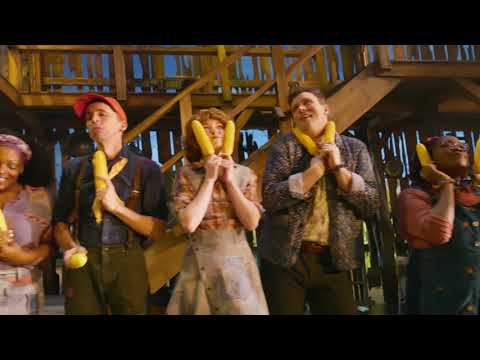
- A barnlike stage world establishes the town as a self-contained myth. The opening plays like a grin with choreography: community shapes, quick turns, and a “we’re in on it” narrator framing.
- Lyrical Meaning:
- This is the show’s mission statement. The lyrics make corn a civic religion: identity, economy, and belonging fused into one mascot. It’s funny, but it’s also the first warning sign.
"Walls" (Maizy)
- The Scene:
- Private resolve after public crisis. The town wants to retreat inward; she decides to leave anyway. The lighting tightens, isolating her choice inside a big communal space.
- Lyrical Meaning:
- The lyric’s “build” language turns politics into personal psychology. The song frames openness as courage, not rebellion. It sets up the show’s central conflict without pretending it’s complicated.
"Travelin’ Song" (Maizy/Storytellers/Ensemble)
- The Scene:
- Arrival as spectacle. “TAMPA” signage and color-shifting light cues make the city feel like a neon punchline. The costume language pops, too: the satire is bright on purpose.
- Lyrical Meaning:
- This number turns geography into temptation. The lyric doesn’t just say “new place.” It says “new rules,” which is why the con man can slide in so easily.
"Bad" (Gordy/Ensemble)
- The Scene:
- A patter-forward confession with showman swagger. The character sells himself even while admitting he’s a mess, which is exactly how he survives.
- Lyrical Meaning:
- The lyric makes “bad” sound like a family trade, then exposes it as insecurity. It’s a charm offensive built out of self-owning.
"Somebody Will" (Beau)
- The Scene:
- A bruised ballad after the relationship fractures. He’s no longer the golden retriever fiancé. He’s a person with a limit, standing in the aftermath of a choice he didn’t make.
- Lyrical Meaning:
- This is country writing doing Broadway character work. The lyric takes a generic romantic premise and turns it into a boundary: affection is not consent to be taken for granted.
"Independently Owned" (Lulu)
- The Scene:
- A whiskey-distillery domain where the character controls the terms. The staging is designed for eruption: a vocal runway, audience-facing punctuation, and a performance that dares you not to clap mid-phrase.
- Lyrical Meaning:
- The lyric is commerce-as-selfhood. “Owned” becomes personal sovereignty, not a transaction. It’s also the show’s cleanest thesis: community is lovely, but autonomy is non-negotiable.
"Maybe Love" (Maizy)
- The Scene:
- A softer pocket where the show briefly stops mugging and lets longing breathe. The orchestration leans into tenderness instead of punchlines.
- Lyrical Meaning:
- The lyric is cautious romance, not fireworks. “Maybe” is the tell: uncertainty becomes the honest language of someone who just detonated her own stability.
"The Best Man Wins" (Ensemble)
- The Scene:
- A big, athletic group number with line formations and lighting shifts that underline the choreography’s “showtime” attitude. It’s the closest the show gets to old-school musical-comedy spectacle.
- Lyrical Meaning:
- The lyric parodies competition while indulging it. The joke is the premise, but the subtext is community pressure: love, here, is treated like a contest the town can adjudicate.
Live updates
Information current as of February 2026. The Broadway run ended in January 2024, but “Shucked” is very much alive as a touring property. The official site lists multiple 2026 stops (including Greensboro and Norfolk in early February), and industry databases track the tour’s launch in October 2024 with bookings extending into 2026.
Tour casting has rotated, but the second-year company announcement (late 2025) highlights continuity for several principal roles while refreshing the lineup. There is also a reported touring change that replaces the Broadway song “We Love Jesus” with “Ballad of the Rocks,” a tweak that signals the tour is sanding down some of the Broadway-specific edges in favor of broader regional playability.
One notable “what’s next” signal: the show has moved into licensing, meaning schools and regional theaters are being positioned as the next long tail for the material. That matters for lyric longevity. The jokes will date. The core “open the town” idea probably won’t.
Notes & trivia
- The cast recording released digitally first (May 2023) with a later CD release (June 2023), under a major Broadway label imprint.
- The project’s earlier life included an iteration tied to “Hee Haw,” then a Dallas world premiere as “Moonshine,” before being rebuilt into “Shucked.”
- A key rewrite philosophy was to stop treating rural life as the punchline and start treating isolation as the problem.
- “Independently Owned” functions as a structural pivot: it’s character definition, thematic banner, and applause engine in one.
- The tour has featured at least one song substitution (“We Love Jesus” replaced by “Ballad of the Rocks”).
- The show’s typical runtime on the road is about 2 hours and 15 minutes including intermission (venue listings vary slightly by presenter).
- The title’s central joke is also the show’s craft trick: corn as both prop and metaphor, used to keep big ideas from sounding sanctimonious.
Reception
Critical response has been consistent about one thing: the comedy is the engine, and the lyrics are the steering wheel when the plot threatens to skid. Early Broadway reviews often praised the joke density and singled out the show’s breakout solo as the moment where the songwriting stops being pleasantly competent and becomes genuinely commanding. Later tour reviews, especially in major presenting houses, tend to echo the same pattern: a strong first act, a softer second, and at least one number that triggers a roar regardless of venue.
“A show whose often disparate parts are held together only by tough, silky fibres of sometimes indigestible corn.”
“The standout by far is ‘Independently Owned,’ a showstopper by Maizy’s best friend Lulu (Alex Newell).”
“It ends up feeling like a fleeting curiosity rather than a ‘Little Shop of Horrors’-style camp classic.”
Quick facts
- Title: Shucked
- Broadway opening year: 2023
- Type: Original musical comedy
- Book: Robert Horn
- Music & lyrics: Brandy Clark, Shane McAnally
- Director: Jack O’Brien
- Music supervision / orchestrations: Jason Howland (credits vary by listing)
- Scenic design (notable look): Barn-slat architecture with sliding corn imagery
- Cast album: Original Broadway Cast Recording (digital-first release; later CD)
- Label: Masterworks Broadway / Sony Masterworks (as credited on release announcements)
- Selected notable placements: “Travelin’ Song” (Tampa reveal), “Independently Owned” (distillery showstopper)
- Tour status: North American tour launched 2024; dates extend into 2026
Frequently asked questions
- Is there a cast recording?
- Yes. The Original Broadway Cast Recording released digitally in May 2023, with a CD release in June 2023. It is widely available on major streaming platforms and retailers.
- What kind of music is it?
- Country-forward pop musical theatre: big choruses, clear storytelling, and lyric punchlines that function like stand-up tags.
- Which song should I start with if I only sample one?
- “Independently Owned.” It’s the show’s clearest blend of character, theme, and vocal spectacle.
- Is “Shucked” touring in 2025–2026?
- Yes. The official site and major tour listings show bookings through early 2026 and beyond, depending on city routing.
- Did the tour change anything from Broadway?
- At least one musical number has been replaced on tour (“We Love Jesus” swapped for “Ballad of the Rocks”), and some presenters report minor text trims in various markets.
- Is the humor family-friendly?
- It’s broadly accessible but not squeaky clean. Many venues recommend it for around age 10+ due to innuendo and occasional adult language.
Key contributors
| Name | Role | Contribution |
|---|---|---|
| Robert Horn | Book | High-density joke writing; narrators-as-hosts structure that keeps exposition fast. |
| Brandy Clark | Music & Lyrics | Country songwriting craft adapted for character-forward musical storytelling. |
| Shane McAnally | Music & Lyrics | Hook-first construction and comic timing in lyrical buttons. |
| Jack O’Brien | Director | Musical-comedy pacing; stage pictures that support punchline rhythm. |
| Jason Howland | Music supervision / Orchestrations (credited) | Orchestral framing that keeps country-pop textures readable in a theatre mix. |
| Masterworks Broadway / Sony Masterworks | Label | Original Broadway Cast Recording release and distribution. |
Sources: Official show site, Playbill, Broadway.com, Masterworks Broadway, American Songwriter, CBS News, Entertainment Weekly, The New Yorker, The Washington Post, IBDB, Broadway.org, venue presenter listings.