
Marry Me a Little Lyrics
Marry Me a Little
[BOBBIE, spoken]Jamie! You know what we should do?
[JAMIE, spoken]
What's that?
[BOBBIE, spoken] We should get married
You said it before, we're... we're just alike. Why don't we, Jamie?
[JAMIE, spoken]
Why don't we? Bobbie?
[FRIENDS]
Bobbie
Bobbie
Bobbie, baby
Bobbie, bubbi
Bobbie
[BOBBIE, spoken]
Marry me! And everybody will leave us alone
[FRIENDS]
Bobbie
Bobbie
Bobbie, how have you been?
Stop by on your way home
Bobbie, we've been thinking of you...
[JAMIE, spoken]
Thank you, Bobbie. It's just that you have to want to marry somebody, not just some body
[FRIENDS]
Bobbie come on over for dinner, we'll be so glad to see you
Bobbie come on over for dinner, it'll just be the three of us
Only the three of us!
We loooove you!
[BOBBIE]
Marry me a little
Love me just enough
Cry, but not too often
Play, but not too rough
Keep a tender distance
So we'll both be free
That's the way it ought to be
I'm ready!
Marry me a little
Do it with a will
Make a few demands
I'm able to fulfill
Want me more than others
Not exclusively
That's the way it ought to be
I'm ready!
I'm ready now!
You can be my best friend
I can be your right arm
We'll go through a fight or two -
No harm, no harm
We'll look not too deep
We'll go not too far
We won't have to give up a thing
We'll stay who we are
Right?
Okay, then
I'm ready!
I'm ready now!
Someone -
Marry me a little
Love me just enough
Warm and sweet and easy
Just the simple stuff
Keep a tender distance
So we'll both be free
That's the way it ought to be
I'm ready!
Marry me a little
Body, heart, and soul
Passionate as hell
But always in control
Want me first and foremost
Keep me company
That's the way it ought to be
I'm ready!
I'm ready now!
Oh, how gently we'll talk
Oh, how softly we'll tread
All the stings
The ugly things
We'll keep unsaid
We'll build a cocoon
Of love and respect
You promise whatever you like
I'll never collect
Right?
Okay, then
I'm ready
I'm ready now
Someone -
I'm ready!
I'm ready
I'm ready
I'm -
I'm -
[FRIENDS]
Bobbie
Bobbie
Bobbie baby
Bobbie bubbi
Bobbie
Bobbie
Bobbie baby
Bobbie bubbi
Song Overview
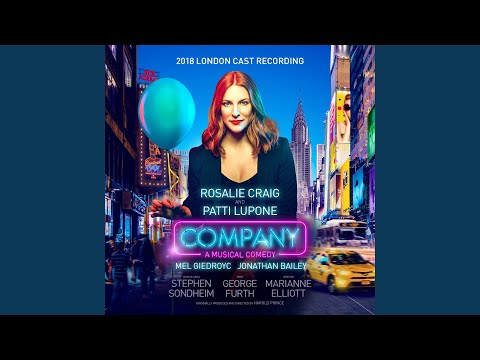
In Marianne Elliott's 2018 West End reimagining of Stephen Sondheim and George Furth's Company, the character Bobbie - now a woman, played by Rosalie Craig - claims the late Act 1 spotlight with "Marry Me a Little." Long known as one of Sondheim's great almost-finales, the song returns here as a cool-headed plea for safe intimacy: partnership with the rough edges filed down. Recorded in London in early November 2018 and released digitally on February 1, 2019, this track distills the revival's thesis in four and a half arresting minutes - witty, guarded, and quietly aching.
Review and Highlights
Quick summary
- Song by Stephen Sondheim from Company; restored to close Act 1 in select revivals and used here to frame Bobbie's guarded worldview.
- 2018 London cast performance centers Rosalie Craig's Bobbie; album produced by Nigel Wright and released digitally on February 1, 2019.
- Tempo sits in a brisk lyric ballad pocket; this recording lands around the low 140s BPM in D major, with subtle dynamic swells.
- The lyric outlines a compromise romance: intimacy without surrender, tenderness at arm's length.
- Historically, the number was cut from the 1970 Broadway production and later repurposed in the revue Marry Me a Little.
Creation History
Sondheim conceived "Marry Me a Little" during Company's development as an alternate end to Act 1, but it was removed before opening and replaced in the original run's dramatic architecture. The lyric's posture - a sophisticated bachelor bargaining for love on his own terms - was deemed, in early accounts, too knowing for Bobby at that moment. Over time, the song found new life: first in concert and revue contexts, then in revivals that sensed its dramatic sting as Act 1's final note. In 2018, Elliott's London revival - with genders switched for the protagonist and one couple - uses it as a laser-accurate character reveal for Bobbie. The musical language is classic Sondheim: clean treble figures, well-placed harmonic sidesteps, and conversational phrasing that keeps the argument moving.
The album was recorded in London across two days in early November 2018 and released digitally February 1, 2019, later on CD. Producer Nigel Wright and musical supervisor Joel Fram keep the band translucent; Craig's vocal rides close to the microphone, conversational more than declamatory. That choice fits the lyric's negotiating table mood - a private contract proposal rather than a balcony serenade.
As for the video's companion stills, what you hear is a pristine label upload rather than a staged clip. That suits the track: the drama is in the prosody, the way "Keep a tender distance" lands with a smile that does not reach the eyes.
Highlights and key takeaways
- Contract language, romantic subject: The lyric reads like terms and conditions for companionship - "Keep a tender distance" - revealing a modern discomfort with need.
- Gender perspective shift: Heard from Bobbie, the bargaining takes on a different social pressure: a woman navigating expectations at 35, deflecting pity and prescription.
- Groove as subtext: A gently insistent pulse propels the verses; not quite a torch song, not quite a patter song - an urbane in-between that mirrors the character's hedging.
- Act break purpose: Placed before intermission, it leaves us suspended in Bobbie's half-step toward intimacy, unsure if self-protection is wisdom or fear.
Song Meaning and Annotations
Plot
Within Company, Bobbie spends Act 1 shuttling through friends' apartments, parties, and unsolicited advice, all orbiting one question: why not settle down. "Marry Me a Little" arrives as a self-authored answer. She proposes a version of marriage that keeps her safely intact: love without upheaval, a tight perimeter around the self. It's a proposal to nobody and everybody - an offer made to the air, half in hope, half in defense.
Song Meaning
The song argues for controlled intimacy. Bobbie imagines a relationship calibrated like a dimmer switch: enough warmth to soothe, not enough heat to scorch. The bargains she lists - "Cry, but not too often; play, but not too rough" - reveal not cruelty but fear. She wants connection that leaves identity undisturbed. The melancholy is in the refrain's insistence: "I'm ready now." Repetition tries to convince the singer as much as any imagined partner.
Annotations
"Keep a tender distance - so we'll both be free."
A paradox at the core of the character: freedom as the goal, tenderness as the means, distance as the guardrail. The triad points to modern urban romance, where careers, apartments, and chosen solitude complicate the old scripts.
"You promise whatever you like - I'll never collect."
That line is a razor. It signals Bobbie's refusal to be owed, and therefore her refusal to be disappointed. It's relationship as risk management, the same logic that makes the final Act 2 number land like a revelation when it arrives.
"Want me first and foremost - keep me company."
Wordplay meets thesis. The title word collapses companionship and the show's title into one ask: do not fix me, just stay with me. The musical backs this with a steady, almost walking tempo - forward motion without vertigo.
Genre and style
Call it a lyric ballad with modern jazz inflections: supple meter, conversational entrances, and harmonies that take a sidestep just when you expect a straight cadence. The rhythm section maintains a measured push; the number breathes like chamber pop scored for pit orchestra. That fusion - show tune craft with cool jazz restraint - underscores the lyric's contained longing.
Emotional arc
We start in control and end in fray. "I'm ready now" begins as mantra and ends as a plea. Craig shades the vowels so the gloss thins with each repetition; consonants soften, breath lengthens, and the last "I'm -" clips off as if Bobbie cannot finish the sentence without admitting she wants more than she allowed.
Context and touchpoints
The song's afterlife is a story in itself. It left the original 1970 production and resurfaced in Sondheim revues, notably one that took its title from the number. Later revivals of Company restored it at the Act 1 hinge, recognizing how perfectly it encapsulates a character suspended between appetite and anxiety. In the London revival, with Bobbie as a woman and Amy rewritten as Jamie to form a same-sex couple, the lyric glances off contemporary expectations about marriage without changing a word. It is as if the song had been waiting for this staging all along.
Idioms, metaphors, and symbols
- Contract imagery: Demands, promises, collecting - the diction of agreements stands in for domestic vows.
- Cocoon image: "We'll build a cocoon of love and respect" wraps protection around intimacy, a soft fortress against chaos.
- Distance as tenderness: The oxymoron frames the thesis: care without friction, closeness with space.
Key Facts
- Artist: 2018 London Cast of Company; vocal by Rosalie Craig
- Featured: Rosalie Craig
- Composer: Stephen Sondheim
- Producer: Nigel Wright
- Release Date: February 1, 2019
- Genre: Stage and Screen; Cast Recording
- Instruments: Pit orchestra with rhythm section; woodwinds and brass in light textures; piano-led accompaniment
- Label: Warner Classics / Arts Music
- Mood: Wry, guarded, quietly yearning
- Length: Approx. 4:55
- Track #: 10 on the cast album
- Language: English
- Album: Company (2018 London Cast Recording)
- Music style: Lyric ballad with jazz inflections; conversational prosody
- Poetic meter: Mixed, conversational iambic patterns shaped by speech rhythm
Canonical Entities & Relations
- Stephen Sondheim - wrote - music and lyrics for "Marry Me a Little".
- Rosalie Craig - performed - lead vocal as Bobbie on the 2018 London cast recording.
- Nigel Wright - produced - Company (2018 London Cast Recording).
- Marianne Elliott - directed - the 2018 West End revival of Company.
- Elliott & Harper Productions - produced - the 2018 West End revival.
- Arts Music / Warner Classics - released - the 2019 digital and CD cast album.
- George Furth - wrote - book of Company.
- Jonathan Bailey - portrayed - Jamie in the 2018 production.
- Patti LuPone - portrayed - Joanne in the 2018 production.
Questions and Answers
- Who produced "Marry Me a Little" on the 2018 London cast album?
- Nigel Wright produced the cast recording.
- When was this recording released?
- It was released digitally on February 1, 2019, with a later CD issue that spring.
- Who wrote the song?
- Stephen Sondheim wrote both music and lyrics.
- Where does the song sit in the show?
- It appears at the end of Act 1 in this revival, a strategic placement that crystallizes Bobbie's guarded views on partnership.
- Was "Marry Me a Little" always part of Company?
- No. It was cut from the original 1970 production and later restored in various revivals and revues.
- What tempo and key are used in this recording?
- This performance sits around the low 140s BPM in D major, with a measured 4/4 feel.
- What makes Rosalie Craig's interpretation distinctive?
- She leans into conversational phrasing, letting the consonants do the arguing and the vowels carry the doubt - a cool, persuasive reading that fits the revival's modern lens.
- How does the song align with the revival's gender updates?
- The lyric's negotiation of boundaries reads freshly when voiced by Bobbie; without changing text, the social pressures around marriage and independence feel newly pointed.
- Does the number reference other Sondheim works?
- Formally it does, in the way Sondheim uses tight internal rhymes and harmonic feints; historically, it later titled a separate revue built from songs cut from multiple Sondheim shows.
Awards and Chart Positions
The track itself is a cast-album cut and not a charting single, but the 2018 London revival of Company earned significant honors that frame its cultural moment. The production won Best Musical Revival at the 2019 Olivier Awards, with Patti LuPone and Jonathan Bailey taking supporting performance prizes and Marianne Elliott cited among the night's winners. Press tallies called out the four-win night and nine nominations, reflecting how decisively the revival landed. In coverage, critics emphasized how the gender updates sharpened the show's themes - a context in which "Marry Me a Little" feels especially targeted.
| Award | Category | Recipient | Result | Date |
|---|---|---|---|---|
| Laurence Olivier Awards | Best Musical Revival | Company - 2018 West End revival | Won | April 7, 2019 |
| Laurence Olivier Awards | Best Actress in a Supporting Role in a Musical | Patti LuPone | Won | April 7, 2019 |
| Laurence Olivier Awards | Best Actor in a Supporting Role in a Musical | Jonathan Bailey | Won | April 7, 2019 |
How to Sing Marry Me a Little
This is a thinking singer's piece: conversational yet rhythmically exact, intimate yet aerated. For this 2018 London cast version, expect D major at roughly 140 BPM, though orchestrations keep the feel supple.
Vocal range and placement
- Suggested range for this arrangement: roughly A3 to D5 for a female-presenting Bobbie, sitting in mid-voice with a few supported peaks. Historic sources list older male keys around B or Bb; this cut is transposed higher to suit Craig's color.
- Register strategy: speech-mix on the verses; light head-mix for the "I'm ready" ascents to preserve ease and keep the text in focus.
Tempo and key
- Tempo: around 130-142 BPM in common time; think steady walk with forward lean.
- Key: D major for the 2018 London track.
Step-by-step HowTo
- Tempo: Practice with a click at 70 BPM half-time, speaking the lyric in rhythm. Then double to performance tempo to preserve clarity under speed.
- Diction: Consonants carry argument. Over-articulate K, T, and B in phrases like "Keep a tender distance" during drills, then back to naturalness.
- Breathing: Mark silent commas after each micro-condition ("Cry, but not too often") to avoid rush. Low, quiet inhalations maintain the confiding tone.
- Flow and rhythm: Treat the accompaniment as a moving sidewalk. Lay the syllables just ahead of the bar line on the bargains, then sit back a hair on the "I'm ready" refrains to show ambivalence.
- Accents: Stress the verbs of control - "Keep," "Make," "Want" - but never shout. The power is in restraint.
- Ensemble and doubles: If background voices echo "Bobbie," keep them airy and off the chest. They should feel like friends pressing in from the apartment hallway.
- Mic technique: Work close to the capsule for intimacy; step back slightly on "Passionate as hell" to avoid compression artifacts.
- Pitfalls: Do not flatten the emotional arc. The mantra "I'm ready" should evolve from performance to confession. Avoid over-legato; the line is speech set to pitch.
Additional Info
Notable performances of "Marry Me a Little" populate the Sondheim ecosystem: Michael Rupert's recordings, Raul Esparza's revival rendition, and numerous concert takes that highlight the lyric's quicksilver wit. The title also anchors a compact Sondheim revue, whose concept stitches together songs cut from larger shows. As stated in NME magazine in a retrospective on West End cast albums, the late 2010s saw a quiet boom in London cast recordings that traveled globally via digital platforms; this album fits that pattern, landing on streaming services the day of release. And as a 2024 Rolling Stone's study of cast recordings suggested, the most resonant tracks tend to be character soliloquies that double as cultural weather reports. "Marry Me a Little" qualifies: it is both plot and pulse check.
To place the number historically: Sondheim's collaborators and critics have long noted that early drafts of Company experimented with several Act 1 endgames, with "Marry Me a Little" among them. This iteration - cool, poised, and just a touch bruised - reads like the production's thesis in miniature: love is a social construct, but longing is stubbornly private. The recording lets the argument sit cleanly in the air, no scenery required.
Sources: Official cast-album listings and reviews; London theatre press releases; awards coverage from major news outlets; streaming platform metadata; music key/tempo analyzers.