
How's Chances? Lyrics
How's Chances?
[1st VERSE:]The nickels and dimes I got
Have bought me an awful lot
A great big box of bonds and stocks
A hundred frocks, a car and a yacht
But having so much and more
Is getting to be a bore
It's not much fun when day is done
Without someone to love and adore
[REFRAIN:]
How's chances, say, how are the chances
Of making you love me the way I love you
I'd give up the things I'm possessing
To be caressing someone like you
How's chances for one of those glances
A glimpse of the heaven I'm longing to see
How's chances to end all your romances
And start taking your chances with me
[2nd VERSE:]
My tailor's the best but he
Is dear as a man can be
My shoes and spats, my opera hats
And my cravats are made just for me
I like an expensive car
And when at my favorite bar
I think it's fine to order wine
And when I dine, I love caviar
[alternate VERSE, from sheet music:]
When I want to see the boys
I know where to find the boys
I don't go through a club or two
I just find you and there are the boys
To get you alone I strive
You ask me to tea at five
I find you then with other men
And wonder when my chance will arrive
[alternate bridge:]
My castle will need some restoring
Ceiling and flooring, furniture, too
[another alternate bridge:]
How many young men must I fight with
To be in right with, in right with you
Song Overview
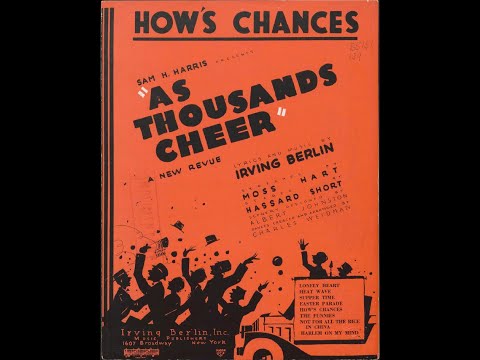
Review and Highlights
Quick summary
- Work: As Thousands Cheer (1933), a Broadway revue built around newspaper headlines, with sketches by Moss Hart and songs by Irving Berlin.
- Introduced by: Marilyn Miller and Clifton Webb in the original production.
- Scene frame: A tabloid-style celebrity breakup headline sketch (Joan Crawford and Douglas Fairbanks Jr. as characters, per production documentation).
- Later touchstone: The 1998 New York revival cast recording puts the song back in circulation for modern listeners.
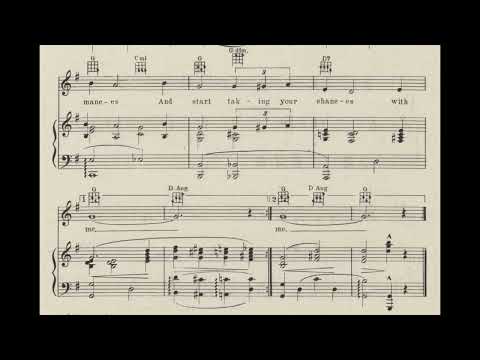
As Thousands Cheer (1933) - stage revue - non-diegetic. The song lands inside a sketch sparked by a newspaper headline about a Hollywood split, with performers playing public figures rather than fully invented characters. It matters because it shows the revue's trick at full strength: real-world gossip becomes a theatrical situation, then a song that feels like a private aside delivered under bright lights.
Musically, it is Berlin in his sly courtship mode: conversational, lightly syncopated, and engineered to sound easy while the rhyme scheme does quiet heavy lifting. The hook is the speaker's mix of confidence and self-protective joking. He wants the romance, but he wants plausible deniability, too. That tension is why it sticks. If you have ever watched someone flirt while pretending they are not flirting, you already get the rhythm of the lyric.
- Key takeaways:
- The melody keeps the mood buoyant while the lyric admits uncertainty.
- It works best when sung like dialogue - the punch lines are in the phrasing, not volume.
- It is built to sit inside a scene, yet it traveled well into recordings and covers.
Creation History
As Thousands Cheer opened on Broadway in 1933 at the Music Box Theatre, pairing Berlin's songs with Hart's headline-based sketches. "How's Chances?" was written for that framework and is documented in published sheet music and archival listings as a 1933 Berlin composition tied to the show. From there it moved quickly into the wider popular-song ecosystem: band-era and vocal records appeared in the same year, and later interpreters kept picking it up, from traditional pop to cast-album revivals.
Song Meaning and Annotations
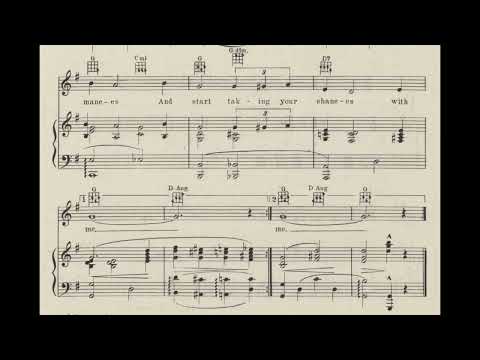
Plot
Within the revue, the number sits in a celebrity-divorce sketch. The singers trade charm and uncertainty while the headline context hovers in the background like a camera flash. The scene is not about tragedy. It is about image and desire in a world where romance is already public property.
Song Meaning
The lyric is a flirtation that keeps glancing at the exit. The speaker wants to be loved, but he frames it as a probability question - "how are the chances" - because asking directly would feel too exposed. That little dodge gives the song its bite. It is sweet, but it is also defensive. Berlin lets the melody smile while the words hedge.
Annotations
"Introduced by Marilyn Miller and Clifton Webb."
Song reference summary
This introduction detail shapes how the song reads onstage: it was made for performers who could sell sophistication and comedy in the same breath. The best performances keep the surface polished while letting the insecurity flicker underneath.
"Used in a sketch based on the headline 'Joan Crawford to Divorce Douglas Fairbanks, Jr.'"
Production note and song description
That headline setup turns the lyric into a quiet joke. The characters are surrounded by public scandal, so a simple question about love starts sounding like a risky bet placed in front of the whole world.
There is also a style fusion worth calling out. It is theatre writing, but it shares DNA with the early-1930s pop ballad and dance-band sensibility: clean melody, steady pulse, and room for a singer to lean into consonants. That is part of why so many band and vocal versions appeared, and why later songbook interpreters were happy to treat it as a standard.
Emotional arc and phrasing
The feeling moves in small steps: tease, soften, test the water, retreat, try again. One bar can sound like a grin, the next like a nervous cough. The trick is to keep the tempo light so the self-doubt does not sink the scene.
Technical Information (Quick Facts)
- Song: How's Chances?
- Artist: As Thousands Cheer cast and interpreters (originally staged; later recorded by multiple artists)
- Featured: Typically two featured singers within the sketch, plus supporting stage ensemble as needed
- Composer: Irving Berlin
- Producer: Bruce Kimmel (1998 revival cast recording production credit)
- Release Date: September 30, 1933 (Broadway opening date context); 1933 (sheet music publication); January 1, 1998 (1998 cast album metadata date)
- Genre: Musical theatre, traditional pop standard
- Instruments: Theatre orchestra or dance-band arrangement (varies by version)
- Label: Concord Theatricals (1998 cast recording metadata); other labels vary for historical recordings
- Mood: Playful, cautious, romantic
- Length: About 2:50 (1998 cast recording track length, platform metadata)
- Track #: Varies by release
- Language: English
- Album (if any): As Thousands Cheer (1998 Off-Broadway Cast Recording)
- Music style: Dialogue-forward theatre song with pop-standard flexibility
- Poetic meter: Accentual, speech-led phrasing with regular refrain anchoring
Frequently Asked Questions
- Who sings it in the original show?
- It was introduced on Broadway by Marilyn Miller and Clifton Webb.
- What is happening in the scene when the song appears?
- The revue places it inside a headline sketch about a Hollywood divorce, using celebrity personas as the scene's frame.
- Is it a love song or a comedy song?
- Both. The melody keeps it light, but the lyric is a flirtation with a nervous edge, which plays as comedy when staged in a gossip-driven sketch.
- Why did it become a standard outside the theatre?
- Berlin wrote it in a pop-friendly shape: clear melody, flexible tempo, and lyrics that singers can play like dialogue.
- Are there notable early recordings?
- Yes. Several 1933 dance-band and orchestra versions circulate, including credited recordings tied to that year in collector documentation and uploads.
- Is there a modern cast recording that includes it?
- Yes. The 1998 New York revival cast recording includes the song and is available on major platforms.
- Did it chart as a pop hit?
- Reliable, consistent chart documentation for a 1933 chart run is not commonly presented in mainstream chart databases. The song's footprint is stronger in theatre history, sheet music, and recorded covers.
- What is the best performance approach?
- Keep the voice conversational. Let the punch lines live in crisp diction and timing, then soften the tone on the more vulnerable lines.
- Is it used in film or television soundtracks?
- No widely cited, consistent film or television placement appears in standard soundtrack listings for the song. Most references treat it as a stage and recording standard.
Additional Info
Two details give the song extra texture. First, theatre paperwork and reference write-ups tie it to a very specific headline sketch, which makes the lyric's uncertainty funnier: the characters are trapped in a publicity storm, so even a gentle romantic question comes out sounding like a calculated move. Second, the cover trail is long. SecondHandSongs lists a wide set of recorded interpretations across decades, and Universal Music Publishing's song entry also points to multiple credited versions in its catalog view. According to Wikipedia's song page, the original staging paired Miller and Webb, which tracks with how the number plays: part glamour, part teasing, part self-defense.
Key Contributors
| Entity | Type | Relationship (S - V - O) |
|---|---|---|
| Irving Berlin | Person | Berlin wrote the music and lyrics for the song. |
| Moss Hart | Person | Hart wrote the revue sketches that frame the headline scenes. |
| Marilyn Miller | Person | Miller introduced the song in the original Broadway production. |
| Clifton Webb | Person | Webb introduced the song in the original Broadway production. |
| Music Box Theatre | Venue | The theatre hosted the Broadway premiere of As Thousands Cheer in 1933. |
| Concord Theatricals | Organization | The licensor lists the show and associated songs for production use. |
| 1998 New York revival cast | Organization | The cast recorded the song for the 1998 cast album release. |
Sources
Sources: IBDB production page for As Thousands Cheer, Concord Theatricals show page, Wikipedia song entry for How's Chances?, University of Maine Digital Commons sheet music record, SecondHandSongs work page, Universal Music Publishing catalog entry, Apple Music and Spotify release metadata for the 1998 cast recording, selected historical recordings and uploads credited to 1933 performers and orchestras.