It's De-Lovely Lyrics — Anything Goes
It's De-Lovely Lyrics
The night is young, the skies are clear
So if you want to go walking, dear,
It's delightful, it's delicious, it's de-lovely.
I understand the reason why
You're sentimental, 'cause so am I,
It's delightful, it's delicious, it's de-lovely.
You can tell at a glance
What a swell night this is for romance,
You can hear dear Mother Nature
Murmuring low,
"Let yourself go!"
So please be sweet, my chickadee,
And when I kiss you, just say to me,
"It's delightful, it's delicious,
It's delectable, it's delirious,
It's dilemma, it's delimit, it's deluxe,
It's de-lovely".
[HOPE]
I feel a sudden urge to sing
The kind of ditty that invokes the spring.
[BILLY]
I'll control my desire to curse
While you crucify the verse.
[HOPE]
This verse I started seems to me
The Tin-Pantithesis of a melody,
[BILLY]
So spare us all the pain,
Just skip the darn thing and sing the refrain...
[HOPE]
Mi, mi, mi, mi,
Re, re, re, re,
Do, sol, mi, do, la, si.
The night is young, the skies are clear
So if you want to go walking, dear,
It's delightful, it's delicious, it's de-lovely.
I understand the reason why
You're sentimental, 'cause so am I,
It's delightful, it's delicious, it's de-lovely.
You can tell at a glance
What a swell night this is for romance,
You can hear dear Mother Nature
Murmuring low,
"Let yourself go!"
[BILLY]
So please be sweet, my chickadee,
And when I kiss you, just say to me,
"It's delightful, it's delicious,
It's...It's de-lovely".
Song Overview
Review and Highlights
Quick summary
- Origin: Written by Cole Porter for Red, Hot and Blue (1936), introduced on Broadway by Ethel Merman and Bob Hope.
- Anything Goes connection: Not part of the 1934 opening-night score, but later folded into major editions and productions.
- Onstage job: A Billy-and-Hope courting moment that plays like a grin you can dance to.
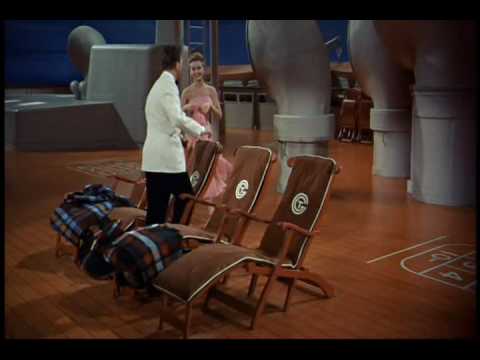
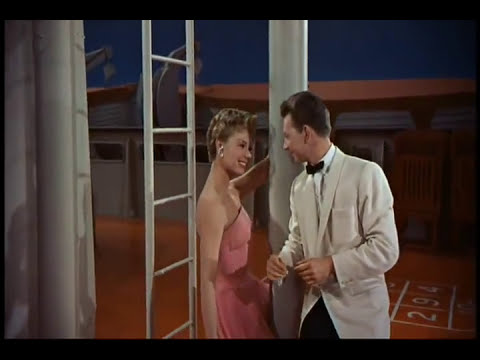
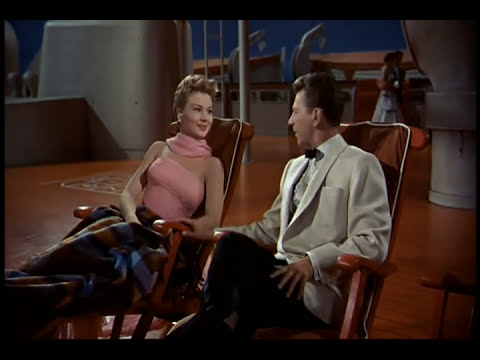
- Big screen stamp: The 1956 Anything Goes film uses it as a featured duet-and-dance for Donald O'Connor and Mitzi Gaynor.
Anything Goes (1934) - stage musical - non-diegetic (in later stage editions). If you were expecting this number in the 1934 Broadway lineup, you are not misremembering the title, you are bumping into revision history. The tune is Porter at his most playful: he takes a tiny verbal gimmick and spins it into something that feels both clever and strangely natural, like a private joke that still works in a crowded room.
What I hear, every time, is how fast the song earns trust. The words are light, almost teasing. The harmony is not. It keeps nudging the melody forward, giving performers a runway for charm. A good production treats it as a short scene with movement baked in: flirt, pivot, land the refrain, let the dancers punctuate the punchlines.
Creation History
The paper trail starts outside Anything Goes. Reference summaries place the song in Red, Hot and Blue (1936), introduced by Merman and Hope. Later, it migrates into Anything Goes through screen and stage revisions: the 1956 film uses it as a prominent duet, and the 1987 Broadway revival lists it as a Billy Crocker and Hope Harcourt number. Masterworks Broadway has written about how later versions of Anything Goes imported well-known Porter songs from other shows, with this one singled out as a Billy-and-Hope courting piece.
Song Meaning and Annotations
Plot
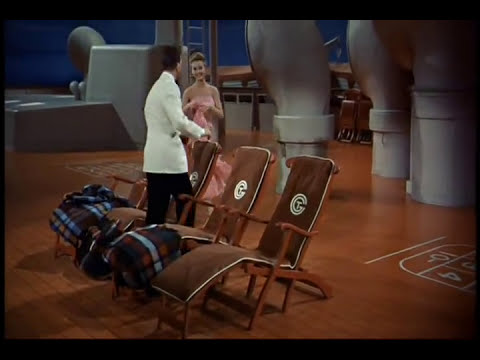
In Anything Goes, Billy Crocker chases Hope Harcourt across an ocean liner packed with disguise, money, and comic danger. When the score makes room for a straight romantic beat, it has to be fast and clean, because the farce machinery is always waiting to restart. In later editions, this song becomes that beat: a moment where the couple can stop strategizing and simply enjoy the fact that they like each other.
In the 1956 film, the plot engine is different, but the function is similar. The number becomes a set piece. Movement does the storytelling, and the lyric becomes a soundtrack for mutual show-off energy.
Song Meaning
The meaning is almost aggressively simple: tonight is good, you are good, and the feeling is so pleasant the singer has to invent a new adjective. The joke is the "de-" chain, but the subtext is confidence. Nobody is begging. Nobody is bargaining. The singer is already sure the mood will land.
Annotations
Originally written for Red, Hot and Blue (1936) and introduced by Ethel Merman and Bob Hope.
That origin explains the tone. It is Broadway wit with a crowd-pleaser grin, built for two big personalities trading lines and letting the audience in on the joke.
Later used in Anything Goes, including the 1956 film where it is performed by Donald O'Connor and Mitzi Gaynor.
Film turns it into a dance-first statement. When O'Connor and Gaynor take over, the song becomes athletic flirting. The lyric stays light, but the staging makes it feel like a victory lap.
IBDB lists the number in the 1987 Broadway revival as a Billy Crocker and Hope Harcourt duet.
This is the stage logic: give the central couple a courting tune with snap, then roll straight into bigger ensemble business. It is romance that does not slow the ship down.
Rhythm and texture
Most arrangements sit in easy swing. The groove should feel conversational, not heavy. When performers push too hard, the wordplay starts to sound like homework. When they relax, the prefix joke turns into a warm tick.
Key phrases and comic engineering
The lyric keeps piling "de-" words, but the real punch is that it never admits it is working. It is a magic trick that pretends it is not a trick.
Technical Information (Quick Facts)
- Song: It's De-Lovely
- Artist: Cole Porter
- Featured: N/A
- Composer: Cole Porter
- Producer: Recording-dependent
- Release Date: October 29, 1936 (Broadway opening context for Red, Hot and Blue)
- Genre: Musical theatre; jazz standard
- Instruments: Voice; orchestra or jazz ensemble
- Label: Recording-dependent
- Mood: Flirty, bright, lightly swinging
- Length: Recording-dependent
- Track #: Varies by album
- Language: English
- Album (if any): Cast recordings of Red, Hot and Blue; later Anything Goes editions; many jazz vocal albums
- Music style: American Songbook swing with Broadway wordplay
- Poetic meter: Accentual, speech-forward phrasing
Frequently Asked Questions
- Was this song in the original 1934 Broadway version of Anything Goes?
- No. It is documented as a Porter song from Red, Hot and Blue (1936) that was added to Anything Goes in later versions and productions.
- Who introduced it on Broadway?
- Reference summaries credit Ethel Merman and Bob Hope with introducing it in the 1936 show.
- When did it first appear in Anything Goes on screen?
- Sources describe the 1956 film adaptation as the first Anything Goes usage, performed by Donald O'Connor and Mitzi Gaynor.
- Who sings it in the 1987 Broadway revival edition?
- IBDB lists it as a duet for Billy Crocker and Hope Harcourt.
- Why does it work so well for dance?
- The lyric is rhythmic and repetitive in a good way, and most arrangements sit in an easy swing pocket that invites footwork without fighting the melody.
- Is it considered a jazz standard?
- Yes. The song has long circulated outside theatre through jazz and pop recordings, including major vocal interpretations.
- What key and range do singers most often see in published editions?
- Common published data points include F major and a listed voice range around C4 to F5, though keys are frequently transposed for performers.
- Is there a modern film association beyond Anything Goes?
- Yes. It is highlighted in the 2004 biographical film De-Lovely, with a performance by Robbie Williams discussed in the artist timeline and film references.
Additional Info
There is a fun irony in how this tune ends up filed under Anything Goes by many listeners. The song was born in a different Porter show, then got adopted by later Anything Goes editions because it fits the shipboard romance like it had always lived there. Masterworks Broadway has described this exact kind of import process: later versions grabbed familiar Porter hits from other projects and reassigned them to characters who needed a moment.
If you want a quick map of its three most visible lives, it goes like this: 1936 Broadway duet in Red, Hot and Blue; 1956 screen showcase in Anything Goes with O'Connor and Gaynor; 2004 film spotlight in De-Lovely with Robbie Williams. According to Oxford University Press scholarship on Porter musicals, the song is often singled out for its effervescent melodic motion, which explains why it still sounds fresh even when the lyric is basically a running gag.
Key Contributors
| Entity | Type | Relationship statement |
|---|---|---|
| Cole Porter | Person | Cole Porter wrote the music and words. |
| Red, Hot and Blue | Work | Red, Hot and Blue is the 1936 Broadway show where the song debuted. |
| Ethel Merman | Person | Ethel Merman introduced the song on Broadway as part of the 1936 cast. |
| Bob Hope | Person | Bob Hope introduced the song on Broadway as part of the 1936 cast. |
| Anything Goes | Work | Anything Goes later adopted the song in revised editions and screen adaptations. |
| Donald O'Connor | Person | Donald O'Connor performed the song in the 1956 Anything Goes film. |
| Mitzi Gaynor | Person | Mitzi Gaynor performed the song in the 1956 Anything Goes film. |
| Robbie Williams | Person | Robbie Williams performed the song in the 2004 film De-Lovely. |
| The Broadway League (IBDB) | Organization | IBDB documents the song placement and singer assignment in Broadway editions. |
How to Sing It's De-Lovely
Most singers meet the song through published keys and audition books, not through one fixed "official" tempo. Still, the paperwork gives practical anchors. A common Musicnotes piano-vocal edition lists F major and an easy swing around quarter note 110, with a typical printed range C4 to F5. ABRSM also lists it in F with the same C4 to F5 range for a musical theatre syllabus entry.
- Tempo: Start in easy swing. If the lyric starts to blur, slow slightly. If it starts to drag, lift the pulse with lighter consonants rather than rushing.
- Diction: The "de-" chain is the hook. Make the prefix crisp, but do not punch it like a joke drum. Let it sparkle.
- Breathing: Plan breaths after shorter thought units, not mid-gag. The line should feel like it is spilling out because the mood is good.
- Flow and rhythm: Keep the verse conversational, then settle into the refrain with steadier time. The refrain is where the room relaxes.
- Accents: Stress meaning words, not filler. If every syllable gets the same weight, the charm flattens.
- Key choice: If F makes the top feel tight, transpose. The whole premise is ease, so the sound has to match the claim.
- Style choice: For theatre, aim for character-first phrasing. For jazz, let the backbeat breathe and vary the line endings.
- Pitfalls: Do not over-smile every line. The best reads are half-sincere, half-winking, like you are trying not to laugh at your own compliment.
Sources
Sources: IBDB Broadway revival song lists, Masterworks Broadway version history article, Red, Hot and Blue reference summary, It's De-Lovely reference summary, Musicnotes arrangement metadata, ABRSM musical theatre syllabus PDF, YouTube upload of the 1956 film number, Robbie Williams official timeline note
Music video
Anything Goes Lyrics: Song List
- Act 1
- Overture
- I Get a Kick Out of You
- There's No Cure Like Travel
- Bon Voyage
- All Through the Night
- Easy to Love
- I Want to Row on the Crew
- You're the Top
- Sailor's Chantey
- Freindship
- It's De-Lovely
- Anything Goes
- Act 2
- Entr'acte
- Public Enemy Number One
- Blow, Gabriel, Blow
- Goodbye Little Dream, Goodbye
- Be Like the Bluebird
- Gypsy in Me
- Buddie, Beware
- I Get a Kick Out of You (Reprise)
- Anything Goes (Reprise)
- Take Me Back To Manhattan