All Through the Night Lyrics — Anything Goes
All Through the Night Lyrics
All through the night I delight in your love.
All through the night you're so close to me.
All through the night from a height far above,
You and your love bring me ecstasy.
When dawn comes to waken me,
You're never there at all,
I know you've forsaken me
Till the shadows fall,
But then once again I can dream I've the right
To be close to you all through the night.
[HOPE]
All through the night I delight in your love.
All through the night you're so close to me.
[BILLY, HOPE & CREW]
All through the night from a height far above,
You and your love bring me ecstasy.
When dawn comes to waken me,
You're never there at all,
I know you've forsaken me
Till the shadows fall,
And then once again I can dream I've the right
[BILLY]
Staying close to you all through the night,
[CREW]
Through the night.
Song Overview
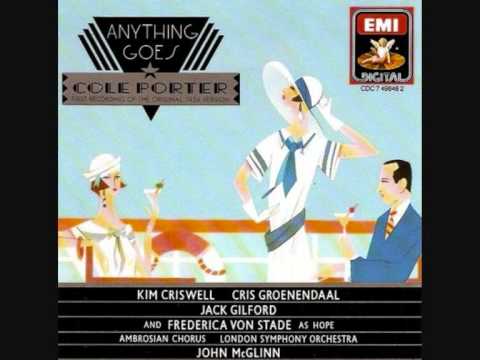
Review and Highlights
Quick summary
- Work: Anything Goes (opened November 21, 1934).
- Original stage placement: A deck-side romantic beat for Billy Crocker and Hope Harcourt.
- Why it stands out: Porter writes a lullaby that still thinks in jazz harmony, then slips in a signature descending chromatic line.
- Afterlife: It jumped from theatre into early dance-band recordings, later turning up in the 1936 film, the 1956 film, and modern cast albums.
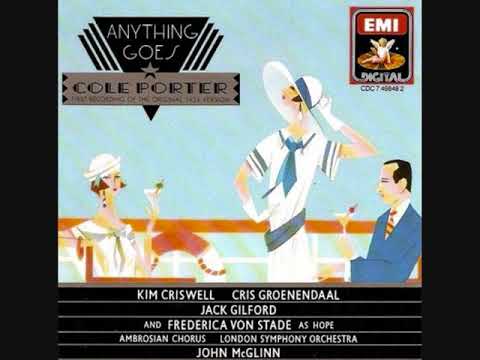
Anything Goes (1934) - stage musical - non-diegetic. The surrounding show runs on disguises and wisecracks, but this number gives the story a brief quiet corridor. Porter does not change the world outside the ship. He changes the lighting inside the characters. The melody moves with that familiar Porter elegance, yet it keeps a slight ache under the polish, like the band is smiling while the lyric admits it cannot quite relax.
Key takeaways: (1) The verse sets loneliness plainly, then the chorus turns intimacy into a kind of refuge. (2) The tune is built for phrasing freedom - you can lean into swing, or float it straight. (3) The harmonic descent is the hook, even when the arrangement is minimal.
Creation History
In official Broadway documentation for the original production, the song is listed for Hope Harcourt and Billy Crocker in Act I. In print, the piece circulated quickly as 1934 vocal score sheet music from Harms, Inc., which helped it travel beyond the theatre. Not long after, dance-band and orchestra recordings began to appear: Paul Whiteman recorded it in New York on October 26, 1934 for RCA Victor, with a vocal refrain credited to Bob Lawrence. The speed of that timeline says a lot. Porter wrote for a stage, but the wider music world heard a standard being born and rushed to claim it.
Song Meaning and Annotations
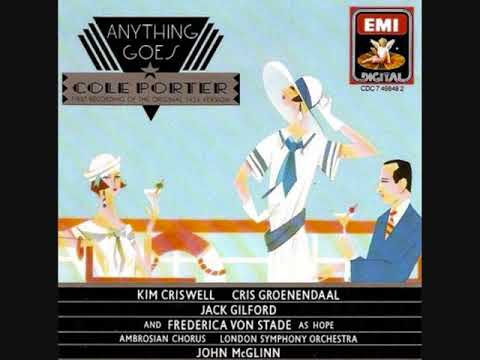
Plot
Anything Goes puts Billy Crocker on an ocean liner chasing Hope Harcourt, while Reno Sweeney and a gallery of con artists and social climbers stir the pot. In that busy stew, this duet is a pause button. It is the moment where the chase stops looking like a game and starts sounding like need. The ocean setting matters: away from land, away from routine, the characters can admit what daytime manners keep hidden.
Song Meaning
The central idea is not complicated, which is part of its charm. Daytime equals isolation, performance, and self-control. Nighttime equals closeness, and the courage to speak softly. The lyric frames the day as an adversary and the night as an ally, then uses that contrast to make romance feel like shelter rather than fireworks. I hear it as Porter doing intimacy without melting into syrup, like he is letting the characters tell the truth, but only in a voice quiet enough to survive the next joke.
Annotations
"The day is my enemy."
That line is a blunt emotional thesis. It is also a staging instruction in disguise: daytime is the world of hustle and schemes, nighttime is where the mask slips.
The melody leans on a descending chromatic figure.
This is classic Porter craft. The descent can sound like a sigh, a slow exhale, or even a sleepy grin, depending on tempo. One idea, many moods.
Official production records list it for Hope Harcourt and Billy Crocker in the original Broadway run.
That matters because it keeps the song tied to a specific relationship, even after decades of recordings turned it into a free-floating standard.
It appears among the musical numbers credited to Porter in the 1936 film adaptation.
Film versions reshuffle plots, but certain tunes survive because they do a job Hollywood still needs: instant romance, instant atmosphere, no extra explanation.
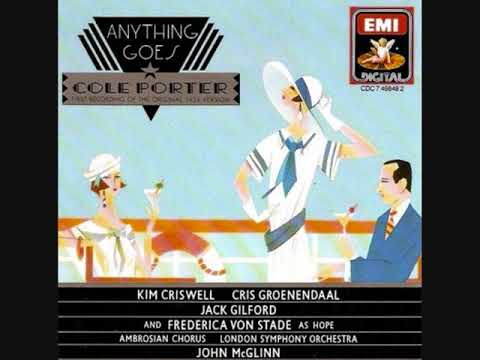
Style and sound
Onstage it plays like a late-night ballad. In band versions it often turns into soft swing, with the rhythm section barely nudging the pulse forward. The song can take lush strings, a small jazz trio, or a Broadway pit. It rarely breaks, because the core idea is strong enough to hold any outfit.
Emotional arc
The lyric starts in solitude, then finds comfort. It is not a big conversion. It is a shift of posture. That is why it feels believable inside a comedy: nobody is rewriting their whole identity, they are just admitting they do not want to be alone.
Technical Information (Quick Facts)
- Song: All Through the Night
- Artist: Cole Porter
- Featured: N/A
- Composer: Cole Porter
- Producer: Recording-dependent
- Release Date: November 21, 1934 (Broadway premiere context for Anything Goes)
- Genre: Musical theatre; jazz standard
- Instruments: Voice and orchestra or jazz ensemble
- Label: Harms, Inc. (1934 sheet music publication); later recordings vary
- Mood: Tender, reflective, lightly swinging
- Length: Recording-dependent
- Track #: Varies by album
- Language: English
- Album (if any): Cast recordings of Anything Goes; major jazz vocal collections
- Music style: Swing-era ballad writing with Porter harmony
- Poetic meter: Accentual, conversational lyric pacing
Frequently Asked Questions
- Who sings it in the original Broadway production?
- IBDB lists it for Hope Harcourt and Billy Crocker in Act I of the original Broadway production record.
- Is it a solo or a duet?
- In the 1934 stage context it is presented as a duet, though many recordings treat it as a solo standard.
- Was it published in 1934 as sheet music?
- Yes. Archival catalog records describe a 1934 Harms, Inc. vocal score publication.
- How quickly did bands record it?
- Very quickly. Discography documentation lists a Paul Whiteman session in New York on October 26, 1934 with Bob Lawrence on vocal refrain.
- Is it in the 1936 film version?
- Reference documentation of the 1936 film musical numbers includes it among the Porter songs used.
- Why does it feel different from the big comic hits in the show?
- It is written as a night-scene pause. The humor in Anything Goes is still nearby, but this number lets romance speak in a lower voice.
- Is it connected to modern pop culture?
- Yes. Sampling documentation notes that The Prodigy used elements from an Ella Fitzgerald recording of the tune in 2015 for "The Day Is My Enemy."
- Do revivals move it around in the show?
- Yes. Song placement shifts across editions and revivals, which is one reason cast recordings can present different dramatic contexts for the same tune.
Additional Info
The song has a second life that is almost a biography of 20th-century listening habits. First it is a Broadway romance beat, then it becomes a bandstand item, then it turns into a jazz-vocal calling card. By 1956, Ella Fitzgerald opens her Cole Porter songbook project with it, which is a quiet compliment: start here, because this is Porter as melody-maker, dramatist, and harmonist in one package. Later, the tune even leaks into electronic culture. Sampling documentation and album notes around The Prodigy point back to Fitzgerald's recording as an inspiration source, turning a 1930s night scene into a 2015 statement about insomnia and pressure.
Key Contributors
| Entity | Type | Relationship statement |
|---|---|---|
| Cole Porter | Person | Cole Porter wrote the music and lyrics for Anything Goes, including this number. |
| Hope Harcourt | Fictional character | Hope Harcourt is listed in production records as a singer of the song in Act I. |
| Billy Crocker | Fictional character | Billy Crocker is listed in production records as a singer of the song in Act I. |
| The Broadway League (IBDB) | Organization | IBDB documents the original Broadway production song list and singer assignments. |
| Harms, Inc. | Organization | Harms, Inc. published the 1934 vocal score sheet music. |
| The Morgan Library and Museum | Organization | The Morgan catalog describes a first edition 1934 sheet music item for the song. |
| Paul Whiteman and His Orchestra | MusicGroup | Paul Whiteman recorded an early commercial version in New York on October 26, 1934. |
| Ella Fitzgerald | Person | Ella Fitzgerald recorded it in 1956 for her Cole Porter songbook album. |
| The Prodigy | MusicGroup | The Prodigy incorporated elements of an Ella Fitzgerald recording for the 2015 track "The Day Is My Enemy." |
Sources
Sources: IBDB production record, The Morgan Library and Museum catalog, Paul Whiteman orchestra discography listings, UCSB Discography of American Historical Recordings entry, Sondheim Guide page on the 1936 film musical numbers, Ella Fitzgerald album track listing, WhoSampled entry for The Prodigy sampling
Music video
Anything Goes Lyrics: Song List
- Act 1
- Overture
- I Get a Kick Out of You
- There's No Cure Like Travel
- Bon Voyage
- All Through the Night
- Easy to Love
- I Want to Row on the Crew
- You're the Top
- Sailor's Chantey
- Freindship
- It's De-Lovely
- Anything Goes
- Act 2
- Entr'acte
- Public Enemy Number One
- Blow, Gabriel, Blow
- Goodbye Little Dream, Goodbye
- Be Like the Bluebird
- Gypsy in Me
- Buddie, Beware
- I Get a Kick Out of You (Reprise)
- Anything Goes (Reprise)
- Take Me Back To Manhattan