
I Got Lost in His Arms Lyrics
I Got Lost in His Arms
ANNIE OAKLEY:Don't ask me just how it happens,
I wish I knew.
I can't believe that it's happened,
And still it's true.
I got lost in his arms
And I had to stay;
It was dark in his arms
And I lost my way.
From the dark came a voice
And it seemed to say,
There you go,
There you go.
How I felt as I fell
I just can't recall.
But his arms held me fast
And it broke the fall.
And I said to my heart,
As it foolishly kept jumping
All around,
I got lost,
But look what I've found.
CHORUS:
There you go
There you go
ANNIE OAKLEY:
How I felt as I fell
I just can't recall.
But his arms held me fast
As it broke the fall.
And I said to my heart,
As it foolishly kept jumping
All around,
I got lost,
But look what I've found.
Song Overview
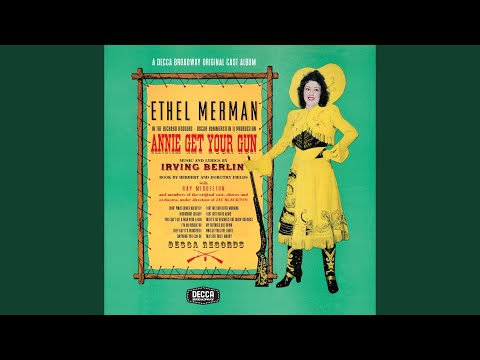
"I Got Lost in His Arms" is the moment Annie Get Your Gun stops kidding around and lets Annie Oakley drift into a full-bodied love song. Irving Berlin does not paint romance as destiny here - he paints it as vertigo. Annie is not strategizing, not performing for Buffalo Bill, not trying to outshoot Frank Butler. She is admitting that the toughest person in the room can still misplace her footing.
Review and Highlights
Quick summary
- Work: Annie Get Your Gun (opened on Broadway May 16, 1946) - stage musical
- Where it appears: Act II, as Annie longs for Frank after the company returns to New York
- Usual singer: Annie Oakley
- Stage job: a quiet reset that makes the later comedy and competition sting more sharply
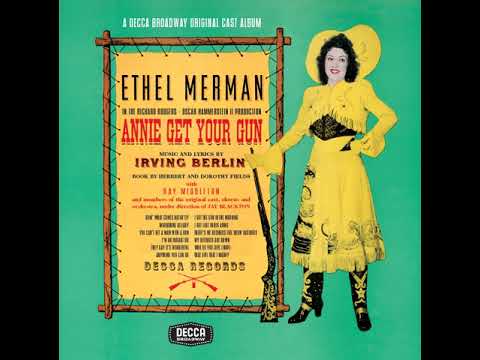
Annie Get Your Gun (1946) - stage musical - not diegetic. Annie is not entertaining a crowd inside the plot. She is alone with the thought of Frank, and Berlin lets the melody do what the book cannot do: show Annie unarmed. That matters because the show spends so much time watching her aim. Here she misses, and the miss is the romance.
The writing is deceptively plain. Berlin uses repetition like a hand on a shoulder, steadying a character who does not want to admit she needs steadying. According to Oxford University Press writer Ethan Mordden, the song has a notable reliance on repeated notes - which, onstage, can feel like Annie circling the same memory until it finally breaks open.
Key takeaways
- Character lens: Annie is newly refined on the surface, but emotionally unchanged - still direct, still hungry for Frank.
- Musical shape: torch-song ballad logic, with repetition used as insistence rather than decoration.
- Story effect: it makes the merger plot and the final competition feel personal, not only professional.
Creation History
Berlin wrote the number for the 1946 Broadway score, introduced by Ethel Merman. The original cast album includes it as a dedicated track, and later revivals kept returning to it because it supplies a missing ingredient: Annie is not only funny and fierce, she is capable of longing. As stated in Playbill, the original cast album has been reissued in remastered form, keeping this track in circulation for listeners who meet the show through recordings first.
Song Meaning and Annotations
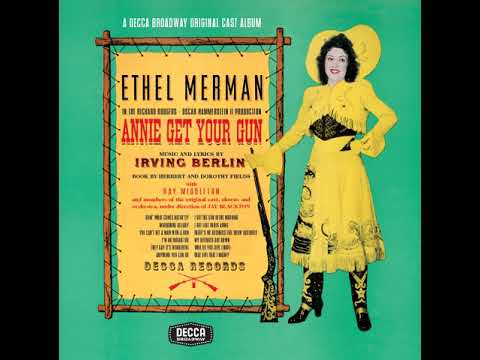
Plot
After a European tour, the company returns to New York and discovers the financial picture is bleak. Annie has the polish of travel and success, but the personal wound remains: Frank walked out, and her pride will not pretend that did not matter. The song lands as Annie watches the business machine keep turning while she stays stuck on one human absence.
Song Meaning
Annie describes love as losing orientation. The title phrase is not about weakness so much as surrender. She is a character trained to be accurate: aim, breathe, hit. Falling for Frank is the first time that training does not help. The lyric turns romance into physical memory - arms, closeness, a sense of being carried somewhere she did not plan to go.
Annotations
The ballad arrives in Act II when Annie, now more refined and worldly, still longs for Frank.Scene placement, rewritten
This contrast is the dramatic hook. If Annie were still the same outwardly, longing would read like habit. Instead, the show puts a dressed-up Annie in the same emotional spot, and the audience gets the point: success did not solve her private life.
The song is often described as a torch song and is shaped by repeated notes.Musical observation, rewritten
Repetition is the engine here. It can sound like obsession if played too heavy, or like tenderness if played as quiet insistence. The performer decides whether Annie is pleading or simply telling the truth with no decorations.
Film documentation around the 1950 adaptation is mixed: some soundtrack listings credit Betty Hutton with the title, while other reference summaries say it was cut from the final film.Adaptation record, rewritten
This is the kind of archival contradiction that follows movie musicals. A song can be rehearsed, recorded, even listed, and still disappear from the released cut. For stage performers, the practical takeaway is simpler: the song is part of the stage story, and it is one of Annie's clearest inner monologues.
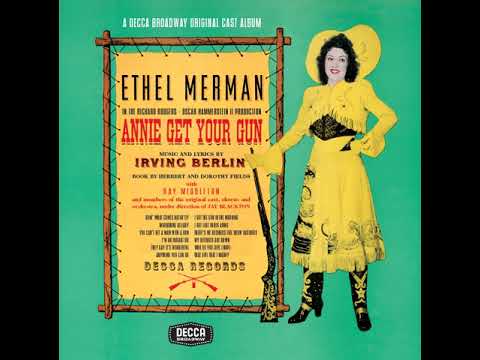
Technical Information (Quick Facts)
- Song: I Got Lost in His Arms
- Artist: Annie Oakley (cast recordings vary)
- Featured: Annie Oakley
- Composer: Irving Berlin
- Producer: varies by recording/label
- Release Date: written for the 1946 stage premiere; issued on original cast recording releases in 1946
- Genre: musical theater; torch-song ballad
- Instruments: voice and orchestra (often piano-led in recital settings)
- Label: varies (original cast releases associated with Decca; revival recordings vary)
- Mood: yearning, reflective, quietly undone
- Length: about 2 minutes 46 seconds on a commonly listed 1946 cast release track timing (varies by edition)
- Language: English
- Album (if any): Annie Get Your Gun (Original Broadway Cast Recording); Annie Get Your Gun (1986 London Cast Recording); revival cast albums
- Music style: ballad built on sustained lines and repeated-note emphasis
- Poetic meter: accentual, speech-shaped ballad cadence
Frequently Asked Questions
- Who sings "I Got Lost in His Arms" in the stage musical?
- Annie Oakley sings it as her Act II ballad about Frank Butler.
- Where does it fall in the plot?
- In Act II after the company returns to New York and the show is in financial trouble, while Annie still longs for Frank.
- Is it a show-within-the-show performance?
- No. It plays as private confession rather than an in-story attraction.
- What is the dramatic purpose of the song?
- It reveals Annie as vulnerable and keeps the romance central while the plot shifts into mergers, money, and reputation.
- Why do critics call it a torch-song style number?
- Because it centers longing, uses sustained lines, and treats love as a lingering ache rather than a cute flirtation.
- Was it in the 1950 film adaptation?
- Some soundtrack listings credit it to Betty Hutton, but other reference summaries state it was cut from the released film.
- Which later performer is linked to a notable single release?
- Suzi Quatro, who played Annie in the 1986 West End production, released the song as a UK single paired with "You Can't Get a Man with a Gun."
- What is the biggest acting note for Annie?
- Keep the honesty plain. Annie is not trying to be elegant here; she is trying to say what happened to her.
Additional Info
The song has a useful afterlife outside Broadway because it behaves like a standalone standard. Julie London recorded it in the late 1950s, and later vocalists have used it as a measuring stick for quiet authority: can you hold the room without tricks. It also took an unexpected turn in 1986, when Suzi Quatro led a UK revival and released a single of the number. That release is a reminder that this show is not only "classic Broadway" in a museum case - it has been re-voiced by performers with very different stage instincts and audiences.
The adaptation footnote is worth keeping straight. The stage score places this as Annie's Act II confession, but film documentation is inconsistent: one prominent soundtrack list credits Betty Hutton with the title, while another widely consulted reference summary for the film lists it among numbers removed from the screen version. That contradiction fits how studio musicals were built: songs were recorded and sometimes discarded late. For theatre people, the safer anchor is the stage logic. Annie needs this ballad, and the show needs Annie to have it.
Key Contributors
| Entity | Type | Relation (S-V-O) |
|---|---|---|
| Irving Berlin | Person | Berlin wrote the music and lyrics for the ballad. |
| Annie Oakley | Person | Annie sings the ballad as her confession of love for Frank. |
| Frank Butler | Person | Frank is the absent focus of Annie's longing in Act II. |
| Ethel Merman | Person | Merman introduced the song on Broadway and recorded it for the original cast album era. |
| Suzi Quatro | Person | Quatro performed the song in the 1986 West End revival and released it as a single. |
| Playbill | Organization | Playbill reported on the CD reissue of the original cast album. |
How to Sing I Got Lost in His Arms
The safest technical baseline comes from widely used sheet-music listings: the standard edition is published in C major with a vocal range of D4 to E5, while an Ethel Merman arrangement is published in Ab major with a range of Bb3 to C5 and a Moderato marking with a metronome around half note equals 96. Translation: this is not about vocal fireworks. It is about line, breath, and text you can trust.
- Tempo: choose a true moderato that lets the lyric breathe. Too slow turns longing into self-pity.
- Diction: keep consonants gentle but exact, especially on the title phrase. The audience should hear the admission without strain.
- Breath plan: mark where you will refill so the long lines do not collapse. Quiet inhales keep the torch-song mood intact.
- Legato: connect phrases like a single thought. The song works when it sounds remembered rather than performed.
- Dynamic shape: begin contained and open only as the memory intensifies. Save your biggest sound for the emotional peak, not the first verse.
- Acting focus: avoid showing the sadness too hard. Annie is describing what happened to her body and balance, and that factual tone is the heartbreak.
- Pitfalls: do not over-color the repeated notes. Let repetition feel inevitable, not fussy.
Sources
Sources: Wikipedia - Annie Get Your Gun (musical), Wikipedia - I Got Lost in His Arms, Playbill (original cast album CD reissue), Musicnotes sheet music listings, Wikipedia - Annie Get Your Gun (film), IMDb soundtrack listing, Discogs (Suzi Quatro single release), YouTube label audio (Universal Music Group)