
I'm an Indian, Too Lyrics
I'm an Indian, Too
ANNIE OAKLEY and INDIAN CHORUS:Ook-a-looka
Gah-hay-la-kinka
La-ha-hoo-way
Hoo-way
ANNIE:
Like the Chippewa,
Iroquois,
Omaha...
Like those Indians
I'm an Indian too
A Sioux
A Sioux
Just like Rising Moon
Falling Pants
Running Nose
Like those Indians
I'm an Indian too
A Sioux
A Sioux
Some Indian drummers they're without a care
I may run away
With Big Chief Sun-of-A-Bear
And I'll have totem poles
Tomahawk
Small papoose
Which will go to prove
I'm an Indian too
A sioux
A sioux
A sioux
Oh, I'm an indian
I'm an Indian
I'm an honest Injun Indian
I'm an Indian, too.
Song Overview
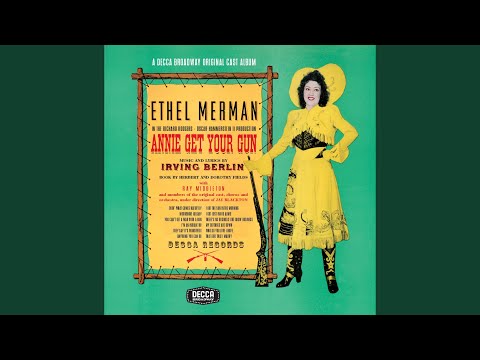
"I'm an Indian, Too" sits at the exact intersection where Annie Get Your Gun is most entertaining and most combustible. Irving Berlin wrote it as a big, boisterous adoption-ceremony showpiece: Annie, newly claimed by Sitting Bull, tries on what she thinks "Indian" identity looks like and sounds like. The number plays as comic mimicry, with punch lines built from misnaming, costume business, and the era's idea of playful stereotype. On a modern stage, that same mechanism can read as a bruise.
Review and Highlights
Quick summary
- Work: Annie Get Your Gun (opened on Broadway May 16, 1946) - stage musical
- Where it appears: Act II, after Sitting Bull adopts Annie into the Sioux tribe
- Usual singers: Annie with dance chorus (adoption-ceremony staging)
- What it does: a comic spectacle number that also spotlights the show’s most dated cultural framing

Annie Get Your Gun (1946) - stage musical - diegetic-adjacent. The number occurs inside the story as a ceremonial performance, so it has permission to be a "number" in the old Broadway sense: big, loud, and choreographic. Some production notes even describe it as a solo in F with a mixed dance chorus, underscoring that it is designed to travel with a full stage picture.
Berlin writes it with relentless forward motion: short phrases, quick rhymes, and a chorus that can pounce. The stage trick is that Annie is sincere in her enthusiasm while the show invites the audience to laugh at her imitation. That mismatch can land as satire of Annie's naivete, or as a lazy joke at the expense of Native identity. The staging chooses which one the audience hears first.
Key takeaways
- Character lens: Annie wants belonging so badly she performs it, and the musical makes comedy out of that need.
- Music and rhythm: brisk, dance-forward writing that rewards crisp diction and sharp cutoffs.
- Modern pressure point: this is a frequent cut, rewrite target, or contextualization challenge in revivals.
Creation History
Berlin wrote the song for the 1946 production, originally performed by Ethel Merman as Annie. Over time, the title became a flashpoint in revision history. Wikipedia’s production account notes that Peter Stone’s 1999 Broadway revival removed "I'm an Indian, Too" along with other references he considered insensitive, with the Berlin heirs granting permission for those changes. That single decision shaped decades of licensing choices and school editions.
Song Meaning and Annotations

Plot
Annie has been folded into Sitting Bull’s community during the show’s broad Western fantasia. The adoption ceremony gives her a new status and a new angle on selfhood, and she responds in the only way she knows: by turning wonder into performance. The song sits as a mid-to-late show spectacle that resets the audience’s energy before the romantic conflict returns to center stage.
Song Meaning
At the story level, the meaning is Annie claiming kinship and safety. At the theatrical level, the meaning is more complicated: the number uses "playing Indian" as an entertainment device. In 1946, that device was mainstream; today, it is often challenged as stereotyping. According to The Independent, some modern directors have framed the song as difficult to present to audiences whose awareness of racism and cultural sensitivity has changed since Berlin’s era.
Annotations
Annie sings this after Sitting Bull adopts her into the Sioux tribe, and the lyric leans on mid-century ideas of what Native identity looks like.Scene description, rewritten
That is the hinge: adoption is the plot excuse, but the lyric is the content. Many audiences can accept the plot beat while rejecting the caricature vocabulary layered on top of it.
The 1999 Broadway revival removed the song as part of a revision that aimed to eliminate insensitive references.Revision history, rewritten
Cutting the number changes the show’s temperature. You lose a dance spectacle, but you also remove a moment that can pull focus away from Annie and Frank’s arc and toward a cultural argument the original authors did not know they were staging.
Genre and staging engine
The song is classic Broadway spectacle writing: lead plus chorus, jokes plus rhythmic drive, choreography as punctuation. It is built for a room that likes "big" and hears nuance as optional. That is why it becomes a test in modern productions: you can stage it with commentary, or you can stage it as if 1946 never ended. Either choice speaks loudly.
Touchpoints and reframing
One modern response has been to repurpose the title ironically rather than present it straight. Wikipedia notes that the Native American comedy group The 1491s used the song in a satirical video, playing with stereotype and self-identification in a very different register than a mid-century Broadway chorus line.
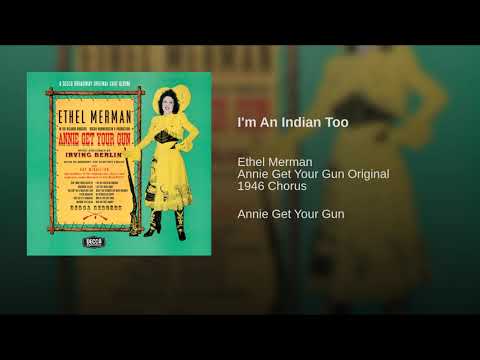
Technical Information (Quick Facts)
- Song: I'm an Indian, Too
- Artist: Annie Get Your Gun cast (varies by recording)
- Featured: Annie Oakley; dance chorus
- Composer: Irving Berlin
- Producer: varies by recording/label
- Release Date: written for the 1946 stage premiere; original cast recording era releases followed in 1946
- Genre: musical theater; show tune with dance-number structure
- Instruments: voice and orchestra
- Label: varies by recording (original cast releases on Decca; later cast albums vary)
- Mood: comic, high-energy, spectacle-forward
- Length: about 2 minutes 42 seconds on common 1946 cast releases; about 3 minutes 10 seconds in the 1950 film performance
- Language: English
- Album (if any): Annie Get Your Gun (Original 1946 Broadway Cast Recording); Annie Get Your Gun (1950 film soundtrack); Annie Get Your Gun (1963 studio recording with Doris Day and Robert Goulet)
- Music style: solo with dance chorus, built for choreography and punch-line phrasing
- Poetic meter: accentual, stress-led comic lyric
Frequently Asked Questions
- Who sings the number in the original stage version?
- Annie sings it after Sitting Bull adopts her, with chorus and dance support in the scene.
- Why is the song controversial today?
- Because its humor relies on cultural stereotypes and "playing Indian" imagery that many audiences consider demeaning.
- Was it removed from the 1999 Broadway revival?
- Yes. Production notes for that revival state it was cut as part of a revision that removed insensitive references.
- Is the song in the 1950 film adaptation?
- Yes. The film includes a staged performance of the number for Annie.
- Did Doris Day record it?
- Yes. It appears on the 1963 studio recording album built around Doris Day and Robert Goulet.
- What is the acting engine for Annie?
- Earnest excitement. Annie wants to belong, and the comedy comes from her confidence, not from winked cruelty.
- Can a production keep the scene without keeping the lyric intact?
- Some productions substitute or rewrite the material, or reframe the staging with explicit commentary, but licensing terms vary by edition.
- What makes the number hard to sing well?
- Speed plus clarity. The lyric wants crisp articulation, and the choreography can steal breath if pacing is sloppy.
- Why does the song persist on recordings even when cut onstage?
- Because it is historically tied to the original score and it remains a reference point in discussions of the show’s revision history.
Awards and Chart Positions
The song itself is primarily documented as a stage and soundtrack title rather than a pop-chart vehicle. Its most visible chart-adjacent afterlife arrives through disco: Don Armando's 1979 single "Deputy of Love" reached No. 1 on Billboard's dance chart, and reference pages list "I'm an Indian, Too" as the flip-side title associated with that release.
| Release | Year | Chart note |
|---|---|---|
| Don Armando - "Deputy of Love" single (flip-side titled with the song) | 1979 | No. 1 on Billboard dance chart (for "Deputy of Love") |
Additional Info
There is a difference between a song being cut and a song being erased. This one keeps reappearing in discourse as a shorthand for the musical’s historical blind spots. Wikipedia’s entry for the show frames it as a common example cited by Native critics, while also noting that some readers interpret it as a mild satire of stereotyping rather than a direct endorsement. Meanwhile, critics and columnists have argued back and forth about whether it can be staged with context or should stay in the archive.
Recording history keeps the material accessible even when licensing editions drop it. The 1946 cast releases credit the chorus and orchestra in ways that are not always precise about whether a studio chorus was involved, and the 1963 studio recording with Doris Day and Robert Goulet preserves the number inside a carefully curated album concept. That is also why the 1950 film performance is often the public's reference point: it is easy to find, and it plays the number with glossy studio confidence.
Key Contributors
| Entity | Type | Relation (S-V-O) |
|---|---|---|
| Irving Berlin | Person | Berlin wrote the music and lyrics for the number. |
| Annie Oakley | Person | Annie sings the number after Sitting Bull adopts her into the tribe in the story. |
| Sitting Bull | Person | Sitting Bull adopts Annie, motivating the adoption-ceremony scene. |
| Ethel Merman | Person | Merman introduced the song on Broadway as Annie. |
| Peter Stone | Person | Stone revised the 1999 Broadway version and removed the song. |
| The 1491s | Organization | The 1491s repurposed the song title in a satirical video context. |
| Don Armando's Second Avenue Rhumba Band | MusicGroup | The group released a disco flip-side titled with the song, linked to the 1979 single. |
How to Sing I'm an Indian, Too
Reliable published vocal-tech specifics for the original stage key and range are scattered across editions, but performance resources describe the number as a solo in F with a mixed dance chorus, and commercial backing-track listings present it as an up-tempo cut near 120 bpm in a male-friendly key area. Those hints point you toward the real task: breath management under movement.
- Tempo: rehearse it at speed early. If the number is danced, practice the lyric while marking choreography so your breath plan matches the staging.
- Diction: prioritize consonants on proper nouns and list phrases. The jokes land through clarity, not volume.
- Breathing: map quiet refills before punch lines. A late breath turns a punch line into a scramble.
- Rhythm: keep patter-like sections locked to the groove. Rushing makes the text unintelligible; dragging kills the dance engine.
- Style: aim for musical-comedy brightness, but keep Annie’s sincerity present. The scene reads best when she believes her own enthusiasm.
- Movement: if choreographed heavily, choose where to sing still. One planted moment can save an entire phrase.
- Ensemble coordination: rehearse cutoffs with the chorus. A clean ensemble release is the difference between tight spectacle and noisy clutter.
- Pitfalls: do not try to "sell" the number by pushing. Pushing stiffens diction and makes the humor feel forced.
Sources
Sources: Wikipedia - Annie Get Your Gun (musical), Wikipedia - I'm an Indian Too, The Independent column on Annie Get Your Gun revisions, Masterworks Broadway - Annie Get Your Gun (1963 studio recording), Wikipedia - Deputy of Love, Danishcharts listing for Don Armando single, YouTube label audio (Ethel Merman), YouTube film clip (1950), Musical Notes Revisited staging note, Theatre Music Shop backing-track listing