
Fun Home Lyrics: Song List
- It All Comes Back (Opening)
- Sometimes My Father Appeared To Enjoy Having Children
- Welcome to Our House on Maple Avenue
- Not Too Bad
- Just Had A Good Talk With Dad
- Come To The Fun Home
- Helen’s Etude
- Thanks For The Care Package
- Al for Short
- Changing My Major
- I Leapt Out Of The Closet
- Maps
- Read A Book
- Raincoat of Love
- I Need More Coffee
- Ring of Keys
- Let Me Introduce You To My Gay Dad
- Shortly After We Were Married
- Days and Days
- You Ready To Go For That Drive?
- Telephone Wire
- It Was Great To Have You Home
- Edges of the World
- This Is What I Have Of You
- Flying Away (Finale)
About the "Fun Home" Stage Show
Development of the plot has been done by producers for 4 years, starting from 2009, when there were usual workshops, and then, after 2 years, the first readings held. A year later, subsequent studies were continued and only two actors from the initial team joined the production on Broadway. Continued changing the story, histrionics gained the new format in 2012 and in 2013 in it acted such ones: D. H. Pierce, J. Kuhn & M. Gyllenhaal, as a part of the pre-Broadway run in May. This play had such serious constant recycles that during 2011 – 2013 the play was literally changed every week and eventually became completely different from its original version, sometimes causing the displeasure of the actors that they had to read the new changes in it every night.
Finally, the official off-Broadway’s premiere took place in 2013 at The Public Theater and was closed at the beginning of the next year. Sam Gold was director, D. Zinn & B. Stanton were responsible for the lighting and costumes, respectively, and D. Mefford & J. Findlay were responsible for choreography and projections, respectively.
In 2015, there was another show at Circle in the Square Theatre, with the same director, with almost the same set of actors (except of three) and this version after 2/3 of the year of staying on stage, fully paid for costs and began to generate profits to producers. By the way, this histrionics’ cost has been relatively small, since the composition of actors and orchestra was not too big. In the fall of 2016, a cities tour must begin and the international production will be started from the capital of Philippines in 2016, where it is planned to use one of the leading Filipino actresses, Lea Salonga.
Release date of the musical: 2015
"Fun Home" – The Musical Guide & Song Meanings
Review: why the lyrics hit so hard
How do you turn a graphic memoir about memory and loss into a musical without forcing it into a neat moral? Lisa Kron’s lyrics answer by refusing to “wrap” anything. They sound like thought in motion. Half-confession, half stage direction. When Adult Alison narrates, she is not providing comfort. She is trying to get the scene to stay still long enough to be drawn.
The show’s central trick is also its emotional trap: three Alisons share the same story while disagreeing on its meaning. Kron writes each Alison with a different relationship to language. Small Alison names feelings by describing objects. Medium Alison intellectualizes until desire breaks the sentence. Adult Alison uses precision as a defense, then lets the defenses fail in public. Jeanine Tesori’s score supports that split by returning to small musical fingerprints, little turns that reappear like an unwanted memory that also happens to be true.
“Fun Home” is often praised for representation, and it earned that praise. What lasts, though, is craft. This is a one-act, no-intermission piece, so the lyrics have to do double duty: character psychology and propulsion. Even the jokes feel like a survival tactic. The writing understands that a funny family can still be a dangerous family. It also understands that a parent can be both adored and unlivable.
Viewer tip for staging: the original Broadway production played in-the-round at Circle in the Square, which matters because Adult Alison is constantly watching her own past. In a more traditional proscenium, choose seats that keep the drawing table and memory scenes in your sightline at the same time. The show lives in that overlap.
How it was made
Kron and Tesori had a built-in adaptation problem: Alison Bechdel’s memoir already has narration, meta-commentary, and visual framing devices. The musical keeps the framing, then adds a second frame: Adult Alison as cartoonist, literally trying to compose the past. In interviews, the collaborators describe a long development period where structure was the hardest fight, because memory does not behave like plot.
One practical, underrated decision: the cast album exists in two major forms. PS Classics released the Public Theater cast album in February 2014, then issued an updated Broadway version on May 19, 2015 with added dialogue and recorded changes that reflect the Broadway script. For lyric readers, that means the “album” is not just a souvenir. It is a document of revision, with beats clarified so listeners can follow the time-jumps at home.
Origin detail that explains the writing style: critics noticed how Sondheim-aware the score feels, not as imitation, but as an interest in unresolved emotions. That matters because “Fun Home” is allergic to clean closure. It keeps circling a moment until the act of circling becomes the point.
Key tracks & scenes
"It All Comes Back (Opening)" (Small Alison, Bruce, Adult Alison)
- The Scene:
- Adult Alison at her drawing table. The lights carve out two worlds at once: the present where she draws, and the past where the Bechdel kids play inside a funeral home. Memory arrives like a page turning itself.
- Lyrical Meaning:
- The opening lyric treats recollection as a physical force. Alison is not reminiscing. She is being pulled. The language is full of retrieval attempts, as if naming details could stop them from disappearing.
"Welcome to Our House on Maple Avenue" (Helen, Bruce, Small Alison, Christian, John)
- The Scene:
- A restored house that feels more like a project than a home. Bright, tidy lighting that turns obsessive. The family sings over each other in a choreography of chores and corrections.
- Lyrical Meaning:
- Kron uses domestic language as a control system. The lyric is about hospitality on the surface, and about performance underneath. Everyone is selling normal because someone in the room needs normal to survive.
"Ring of Keys" (Small Alison, Adult Alison)
- The Scene:
- A luncheonette with Bruce. A delivery woman enters. The staging usually isolates Small Alison in a tight pool of light while the rest of the world keeps moving, indifferent and loud.
- Lyrical Meaning:
- This is identity recognition without vocabulary. The lyric doesn’t announce discovery. It describes clothing, posture, keys, and the shock of seeing a future self in someone else’s walk. Adult Alison’s presence turns the moment into both joy and grief: she knows what it will cost.
"Changing My Major" (Medium Alison)
- The Scene:
- Oberlin. A dorm room that feels both safe and overwhelming. Medium Alison paces, half dancing, half spiraling, as language tries to catch up with desire.
- Lyrical Meaning:
- The lyric captures a common coming-out truth: the “big decision” is often a string of small admissions. Kron makes the comedy nervous on purpose. Medium Alison is terrified of being seen and equally terrified of going back.
"Days and Days" (Helen)
- The Scene:
- Medium Alison is home on vacation with her girlfriend. Helen finally speaks without the family’s usual charming noise. The lighting flattens into something honest, almost rehearsal-room plain.
- Lyrical Meaning:
- Helen’s lyric is a ledger of self-betrayal and endurance. Kron writes her without sainthood. The song is not a plea for sympathy. It is the sound of someone noticing, too late, how long she has been disappearing.
"Telephone Wire" (Adult Alison, Bruce)
- The Scene:
- A car ride that breaks the show’s rules. Adult Alison gets in the car with her father, crossing time as if it were a thin curtain. Outside the windows: telephone wires, fading light, ordinary Pennsylvania details that feel like a countdown.
- Lyrical Meaning:
- The lyric is a fight against the finality of silence. Alison begs for one moment of mutual recognition, one sentence that proves her father can see her. Bruce talks around the truth, then the scene ends anyway. The song hurts because it dramatizes how close connection can get without arriving.
"Edges of the World" (Bruce)
- The Scene:
- Bruce alone, manic with a new restoration project. The stage often becomes spare here, with light sharpening into hard angles. The world feels too bright, too thin.
- Lyrical Meaning:
- Bruce’s lyric is self-justification collapsing into panic. The metaphors are architectural: rebuilding, fixing, finishing. Underneath is a man admitting he has no language for his own life, only for surfaces.
"Flying Away (Finale)" (Adult Alison, Medium Alison, Small Alison)
- The Scene:
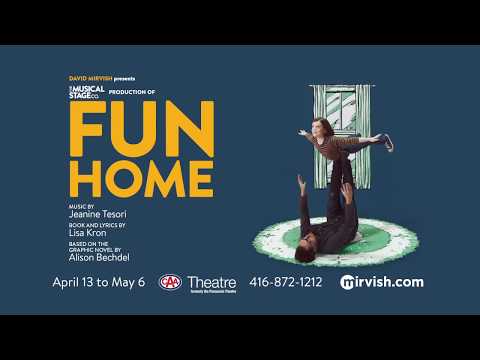
- The show lands on a remembered game: “airplane” with Bruce, a moment of perfect balance that is both real and impossible to keep. The three Alisons share space without fighting for it.
- Lyrical Meaning:
- The finale does not solve the father. It gives the daughter a way to hold complexity without flinching. The lyric chooses a small, bodily memory over a grand explanation. That choice is the reconciliation.
Live updates 2025/2026
Information current as of January 24, 2026. “Fun Home” is not in a single headline Broadway run right now. It is active through major regional programming and licensing, which is how this title keeps renewing its audience.
In the UK, Royal Exchange Theatre in Manchester has announced “Fun Home” for summer 2026 (a July 4 to August 1 run is listed on the venue page), directed by Sarah Frankcom with a disclosed creative team. What’sOnStage also reports the production window as July 3 to August 1, 2026, with casting to be announced. In the US, the Huntington in Boston mounted a production running November 14 to December 14, 2025, with the director noting how changed cultural context shifts the show’s impact.
On screen, a film adaptation has been discussed for years. Public reporting confirms Jake Gyllenhaal’s Nine Stories signed a first-look deal with Amazon MGM Studios in 2024, and trade coverage has treated “Fun Home” as one of several projects associated with that pipeline. That is not the same as a release date or a locked cast. For now, the musical’s most reliable home remains the stage.
Notes & trivia
- Kron and Tesori became the first all-female writing team to win the Tony for Best Original Score.
- The Broadway run opened April 19, 2015 at Circle in the Square and closed September 10, 2016 after 26 previews and 582 regular performances.
- The updated Broadway cast album (PS Classics) was released May 19, 2015 with 27 tracks and added dialogue to clarify story structure.
- PS Classics also released the Public Theater cast album in February 2014, making “Fun Home” a rare case where two official albums document the rewrite.
- Many productions highlight the show’s motif-writing, using recurring musical phrases as memory triggers across the three Alisons.
- “Ring of Keys” became the show’s signature public-facing number after Sydney Lucas performed it on the 2015 Tony Awards broadcast.
- Myth-check: the title is not “fun” in tone. It is literal, the family funeral home, and the word “home” carries the harm.
Reception
Early reviews tended to focus on scale. Critics kept noting how a small, intimate piece could hold a Broadway audience without spectacle. Over time, the conversation has shifted toward technique: how the lyric writing treats queerness as lived reality rather than as plot twist, and how the score repeats and reframes musical ideas the way memory repeats and reframes images.
“The score … is rich and troubled and psychologically nuanced.”
“Ring of Keys … is a wonder.”
“Ring of Keys” is “trenchant.”
Quick facts
- Title: Fun Home
- Year: 2015 (Broadway opening)
- Type: One-act musical (no intermission)
- Music: Jeanine Tesori
- Book & Lyrics: Lisa Kron
- Based on: Alison Bechdel’s graphic memoir “Fun Home”
- Original Broadway venue: Circle in the Square Theatre (in-the-round)
- Selected notable placements (story beats): “Ring of Keys” at a luncheonette; “Telephone Wire” during the boundary-breaking car ride; “Edges of the World” as Bruce unravels; “Flying Away” as the remembered “airplane” moment
- Cast album (2015): “Fun Home (A New Broadway Musical)”
- Label: PS Classics
- Release context: Updated Broadway album released May 19, 2015; Public Theater cast album released Feb. 25, 2014
- Availability: Major streaming services and licensed stage productions via Concord Theatricals
| Cast album version | Release | What changes for lyric readers |
|---|---|---|
| Public Theater cast album | Feb. 25, 2014 | Earlier form of the show; useful for hearing the pre-Broadway shape. |
| Broadway updated album | May 19, 2015 | Added dialogue and recorded revisions that match the Broadway script beats. |
Frequently asked questions
- Is “Fun Home” sung-through?
- No. It uses a tight one-act structure with dialogue, narration, and songs that arrive like memory flashes rather than set-piece numbers.
- Why are there three Alisons?
- Because the show is about interpretation. Small, Medium, and Adult Alison let the same event carry different meanings at different ages.
- What is the emotional point of “Ring of Keys”?
- Recognition. Small Alison sees a butch delivery woman and feels kinship before she has language for it, and Adult Alison watches the moment with adult consequence attached.
- Where does “Telephone Wire” sit in the story?
- Late in the show, during a car ride where Adult Alison crosses into the past to try to get one honest conversation with Bruce before his death.
- Is the 2015 cast album the only official recording?
- No. There is also a 2014 Public Theater cast album. The 2015 release is an updated Broadway version with added dialogue and revisions.
- Is there a film version coming?
- A screen adaptation has been discussed publicly, but there is no confirmed release date. Reporting in 2024 tied the project to Amazon MGM through a first-look deal involving Nine Stories.
Key contributors
| Name | Role | Contribution |
|---|---|---|
| Jeanine Tesori | Composer | Wrote a motif-rich score that repeats musical ideas the way memory repeats images. |
| Lisa Kron | Book & Lyricist | Built lyrics that sound like lived thought, splitting voice across three versions of Alison. |
| Alison Bechdel | Source Author | Wrote the memoir whose visual framing and self-interrogation shaped the musical’s structure. |
| Sam Gold | Director (original stage productions) | Staged the piece as a memory machine, with Adult Alison watching and triggering scenes. |
| John Clancy | Orchestrations | Helped translate intimacy into a theatrical palette that can turn sharp or tender fast. |
| Chris Fenwick | Music Director (original productions) | Shaped pacing and clarity for a score that threads narration through song. |
| PS Classics (Tommy Krasker, Philip Chaffin) | Cast album producers | Released both the 2014 Public Theater album and the updated 2015 Broadway album. |
Sources: IBDB, Playbill, PS Classics, Apple Music, The Guardian, The New Yorker, Variety, American Theatre, Concord Theatricals, What’sOnStage, Royal Exchange Theatre, Boston Globe, Deadline.