Babes In Arms Lyrics – All Songs from the Musical
Babes In Arms Lyrics: Song List
- Act 1
- Where Or When
- Babes In Arms
- I Wish I Were In Love Again
-
Babes in Arms - Reprise
- Way Out West
- My Funny Valentine
- Johnny One-Note
- Ballet: Johnny One-Note
- Act 2
- Imagine
- All At Once
- Peter's Journey: Imagine Reprise 1
- Peter's Journey: Ballet: Peter's Journey
- Peter's Journey: Imagine Reprise 2
- The Lady Is A Tramp
- You Are So Fair
- Finale
About the "Babes In Arms" Stage Show
It is in the spirit of its time. Theatrical production was first made in 1937, it tells about the events of 1921–1930 years, what happens to the family, which is very closely involved in staging of vaudevilles, but technical progress mixes up all of their cards – the invention of sound motion pictures.Richard Rodgers wrote the music, Lorenz Hart was responsible for the words and they co-wrote the book for the play.
The focus of the play – several teenagers who either have to go to a theater show or go to work on the farm, while those who does this very show, seek funding for its continuation. The funding of the theater has sharply been decreased after 1928 – because the whole crowd went to watch at the novelty of technological progress of Mankind – talkies. Then the same audience received several new products in images on the screen – pictures in color, special effects, videotapes and 3D, eventually.
After a few songs, performed in this musical, became literally pop standards, the screens received a film of the same name. It had almost no songs make this musical popular – only two of the original, Babes in Arms & Where or When. Judy Garland was a star of this motion picture.
Since the version of 1939 displayed the very radicalized pre-war moods of the time, in 1959, when the musical came out again, its creator named George Oppenheimer did a very audited, refined version in which there were not a gram of politics of sharp corners. Those version of the musical, which you can watch at the moment (even video records posted on this website), are so refined that people just sing about anything. However, in 1999, the original version was resurrected from oblivion, but still, it was also simplified in order to avoid negative publicity for loud musical script.
Release date: 1989
"Babes in Arms" – The Musical Guide & Song Meanings
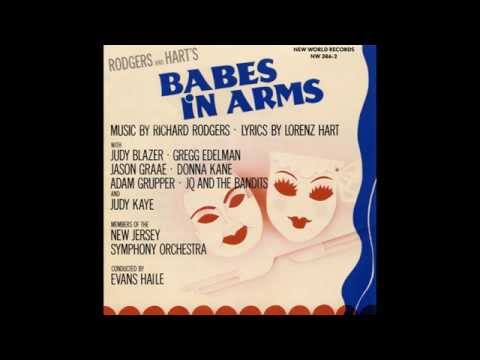
Review
Why does a “let’s put on a show” premise end up asking bigger questions than it needs to? That’s the sly pressure inside Babes in Arms. It is a youth musical that keeps wandering into adult territory: class, power, who gets to work, who gets to dream, and who gets to be seen. Rodgers gives you melodies that glide. Hart gives you words that do not soften the truth.
Listen to the lyric voice across the standards that came out of this score. Hart writes love as a mix of embarrassment and precision. “My Funny Valentine” is affectionate, but it refuses flattery. “I Wish I Were in Love Again” is comedy that admits its own bruise. Even the big crowd moments carry a bite. The kids are not only performing. They are negotiating the terms of being treated as disposable.
The 1989 “year” matters because it reframed the piece as music-first evidence. A pared-down concert at Avery Fisher Hall replaced most dialogue with narration and used a streamlined song list, then that material fed the New World Records album. You hear the architecture of the score. You also hear how the show’s central mood shifts: bright communal energy, then a private corner of confession, then back out into a public number that sounds like freedom.
How It Was Made
Babes in Arms premiered on Broadway in 1937, directed by Robert B. Sinclair with choreography by George Balanchine, and it quickly introduced songs that would escape the show and become standards. The “kids in a barn” story is the sugar. The sharper edge is Hart’s interest in how people justify their choices when money and status are on the line.
Revisions became part of the musical’s afterlife. The 1939 MGM film kept very little of the stage plot and retained only a small slice of the original score, and later stage versions re-threaded the songs with new books. George Oppenheimer’s 1959 revision became a commonly available performance edition for years, and Concord now licenses multiple versions, including the Oppenheimer and Guare versions and a newer book by Douglas Carter Beane that premiered in 2021.
The 1989 concert story is unusually specific and unusually documented. The liner notes trace a line from a 1987 Library of Congress presentation of the original score to the 1989 Avery Fisher Hall concert conducted by Evans Haile and directed by Sara Louise Lazarus, then to the studio recording sessions at Manhattan Center in August 1989. It is a reminder that “revival” can mean many things. Sometimes it is a staging. Sometimes it is a restoration job.
Key Tracks & Scenes
"Where or When" (Valentine LaMar, Billie Smith)
- The Scene:
- Seaport, Long Island. Great Depression. Parents rush off to a long vaudeville tour, leaving the kids behind with almost nothing. Val meets Billie, and their flirtation turns strangely still, as if the room has learned to listen.
- Lyrical Meaning:
- Hart makes romance sound like memory malfunction. The lyric leans into déjà vu, not destiny. It is yearning with a raised eyebrow, which is why it lasts.
"Babes in Arms" (Company)
- The Scene:
- The Sheriff threatens the work farm. Val decides the kids will prove they can care for themselves. A meeting forms. The energy is half rally, half panic, with a barn-show optimism that has to work fast.
- Lyrical Meaning:
- This is the show’s mission statement. Youth frames itself as capability, not innocence. The lyric sells confidence while admitting the stakes are survival.
"I Wish I Were in Love Again" (Gus Fielding, Dolores Reynolds)
- The Scene:
- After the meeting, relationship debris spills onto the floor. Gus and Dolores circle old feelings in front of an audience that can sense the fight coming. The mood is comic, but the temperature is real.
- Lyrical Meaning:
- Hart writes heartbreak as a complaint you cannot stop repeating. The joke is in the phrasing. The pain is in the fact that the joke keeps landing.
"Way Out West" (Baby Rose)
- The Scene:
- A former child star arrives and the kids try to recruit her. The setting tilts toward performance mode: a star entrance, a practiced smile, and a sense that show business is both escape hatch and trapdoor.
- Lyrical Meaning:
- The lyric treats “the West” as myth, then punctures it. It is a travel song that quietly admits nowhere is simple once you have been commodified young.
"My Funny Valentine" (Billie Smith)
- The Scene:
- Billie alone, thinking through what Val wants from her and what she can offer. The light narrows. The show stops selling itself and lets a single person speak plainly.
- Lyrical Meaning:
- Hart’s trick is affectionate honesty without cruelty. He lists flaws as if they are proof of intimacy. Love becomes recognition, not decoration.
"Johnny One-Note" (Baby Rose)
- The Scene:
- The kids’ show is underway. Baby Rose delivers a comic story-song that plays like vaudeville. The rhythm is crisp, the humor is controlled, and the number feels built to get laughs on command.
- Lyrical Meaning:
- The lyric is a character sketch in fast strokes. Under the comedy is a small portrait of limitation and obsession. A “one-note” person is funny, until you realize how common it is.
"Imagine" (Company)
- The Scene:
- Act II opens with the kids exhausted from farm labor. They daydream their way out, singing fantasies like they are building a temporary shelter against reality.
- Lyrical Meaning:
- It is escapism written with intelligence. The lyric stacks luxuries and contradictions. It shows how dreaming can be both self-care and avoidance.
"The Lady Is a Tramp" (Billie Smith)
- The Scene:
- Later on the farm, Billie admits she would rather be free on the road than trapped in a “respectable” cage. The atmosphere turns bold and bright, like she is daring the town to judge her out loud.
- Lyrical Meaning:
- Hart weaponizes labels. The lyric flips moralizing into pride, turning an insult into a self-definition. Freedom arrives as wit.
"All at Once" (Valentine LaMar, Billie Smith)
- The Scene:
- Val receives a letter from his touring parents. He is forced into pragmatism. The number feels like a private calculation in the middle of communal trouble.
- Lyrical Meaning:
- The lyric captures the shock of adulthood arriving early. “All at once” is not romance. It is responsibility landing without warning.
Live Updates
There is no single dominant commercial “touring brand” of Babes in Arms in 2025 or 2026. The show’s real present tense is licensing and versioning. Concord continues to offer multiple scripts, including the long-circulating Oppenheimer version, a Guare version, and the newer Douglas Carter Beane version that premiered in 2021. That matters for lyrics in performance because each book reshapes what the songs are “about” in the room, even when the score stays familiar.
On the audio side, the 1989 concert material remains easy to find because it lives as a widely available New World Records release dated 1990, and it is effectively a near-complete presentation of the original orchestrations and many core songs. If your entry point is the album, you are hearing Babes as a restoration, not as a fully staged night at the theatre.
Notes & Trivia
- The 1989 presentation was a pared-down concert at Lincoln Center’s Avery Fisher Hall, with narration replacing most original dialogue and a simplified song list.
- The studio recording sessions for the New World Records album were held August 7 to 9, 1989 at the Manhattan Center in New York.
- The New World Records product page lists the release date as 1990-01-01 (catalog no. 80386).
- The liner notes describe the 1989 concert as the show’s first New York appearance since 1937, following a 1987 presentation of the original score at the Library of Congress.
- The same liner notes explain that the number “All Dark People” was omitted at the request of the authors’ estates due to concern it could be misread out of context.
- The recording was made possible with a grant from the Stephen & Mary Birch Foundation for the benefit of the Starlight Foundation.
- Rodgers & Hammerstein’s historical page notes the 1937 Broadway production was choreographed by George Balanchine and featured the Nicholas Brothers, along with Alfred Drake and Mitzi Green.
Reception
The critical story of Babes in Arms is partly about the score outgrowing the book. Even friendly commentators admit the plot can be thin, while the songs feel built to survive any plot. That imbalance is not a flaw for listeners. It is the reason you can encounter the show as standards first and story second.
Early notices already framed the piece as unusually charged for a barn-show premise. Later critics and labels kept returning to a similar idea: the score is “luscious,” the orchestrations matter, and hearing it intact is the real event. The 1989 to 1990 recording chain feeds that appetite. It gives the songs enough context to feel like theatre, while keeping the spotlight on the musical writing itself.
“they have turned out one of their nicest scores.”
“a lively, unashamedly old-fashioned Rodgers & Hart musical.”
“How luxurious to have one of the most luscious of Rodgers and Hart scores in its near-entirety.”
Technical Info
- Title: Babes in Arms
- Year (focus edition): 1989 concert and 1990 release
- Original stage premiere: Broadway (Shubert Theatre), April 14, 1937; later transferred to the Majestic Theatre; 289 performances
- Type: Musical comedy; “kids put on a show” frame with political and social arguments embedded
- Music: Richard Rodgers
- Lyrics: Lorenz Hart
- Books in circulation: Rodgers & Hart original; George Oppenheimer version; other licensed versions including John Guare and Douglas Carter Beane
- 1989 concert context: Pared-down concert at Avery Fisher Hall, Lincoln Center; narration replaced most dialogue
- 1989/1990 album label: New World Records (catalog no. 80386)
- Album release date: 1990-01-01
- Recording dates / location: August 7 to 9, 1989; Manhattan Center, New York
- Selected notable placements: “Where or When” as the Billie and Val déjà vu duet; “My Funny Valentine” as Billie’s reflective solo; “Imagine” as the farm-labor fantasy opener; “The Lady Is a Tramp” as Billie’s escape manifesto
- Album status: Digital storefront availability plus New World Records direct purchase; commonly indexed as “1989 Cast Recording” despite the 1990 release date
FAQ
- Who wrote the lyrics for Babes in Arms?
- Lorenz Hart wrote the lyrics, with music by Richard Rodgers.
- Why does the 1989 album matter if the musical is from 1937?
- Because it documents a major restoration line: a Lincoln Center concert approach and then a New World Records studio album using original or near-original orchestrations and a concentrated song list.
- Where do “My Funny Valentine” and “The Lady Is a Tramp” sit in the story?
- In the 1937 synopsis, “My Funny Valentine” appears after Billie and Val clash over trust and ambition, while “The Lady Is a Tramp” arrives later as Billie argues for freedom over farm-bound respectability.
- Is the MGM film version the same story as the stage musical?
- No. The liner notes stress the film substantially rewrote plot and characters and retained only a small part of the original score.
- Which script do theatres use today?
- It depends. Concord licenses multiple versions, including the Oppenheimer version and newer adaptations, so productions can vary in dialogue and structure even when the famous songs stay central.
Key Contributors
| Name | Role | Contribution |
|---|---|---|
| Richard Rodgers | Composer | Melodic engine of the standards; built numbers that can function inside plot or survive outside it. |
| Lorenz Hart | Lyricist | Wrote love lyrics with bite and self-awareness; turned social pressure into conversational rhyme. |
| George Oppenheimer | Book writer (1959 revision) | Re-threaded the Rodgers and Hart songs into a revised stage framework that became widely performable for years. |
| Douglas Carter Beane | Book writer (new version, 2021 premiere) | Created a newer licensed adaptation, reframing story logic for contemporary productions while keeping the classic score. |
| Hans Spialek | Orchestrator (original orchestrations) | Orchestral voice of the period; the 1990 album spotlights these textures as a core part of the listening experience. |
| Evans Haile | Conductor; 1989 concert producer | Led the Avery Fisher Hall concert and the recorded performances that shaped the album’s musical clarity. |
| Sara Louise Lazarus | Director (1989 concert) | Helped translate a full show into a concert format with narration and streamlined structure. |
| Judy Blazer | Performer (Billie Smith) | Anchors the album’s emotional center, especially “My Funny Valentine” and the key duets. |
| Gregg Edelman | Performer (Valentine LaMar) | Plays the idealist with enough edge to make the politics and romance feel earned. |
| Elizabeth Ostrow | Producer (album) | Produced the New World Records release; helped shape the presentation as a restoration document. |
| Theodore S. Chapin | Liner notes author; Rodgers & Hammerstein office executive (at time of notes) | Frames the recording as a careful remembrance rather than a “time machine,” clarifying the project’s purpose. |
Sources: Rodgers & Hammerstein (official site), New World Records, New World Records liner notes PDF (cat. 80386), The New Yorker, Variety, Concord Theatricals, Playbill, Ovrtur.