
Will Rogers Follies, The Lyrics: Song List
- Act 1
-
Let's Go Flying

- Will-A-Mania
-
Give A Man Enough Rope
- It's A Boy
- So Long Pa
-
My Unknown Someone
- We're Heading For A Wedding
- The St.Louis Fair
- The Big Time
- My Big Mistake
- The Powder Puff Ballet
- Marry Me Now
- Without You
- Act 2
- Give A Man Enough Rope (Reprise)
-
Look Around
- Our Favorite Son
- No Man Left For Me
- Presents For Mrs. Rogers
- Never Met A Man I Didn't Like
- Will-A-Mania (Reprise)
- Without You (Reprise)
-
Never Met a Man I Didn't Like (Reprise)
About the "Will Rogers Follies, The" Stage Show
Music composed by C. Coleman. Lyrics written by A. Green and B. Comden. The libretto has been created by P. Stone. Tryouts on Broadway began in early April 1991. A month later, at the Palace Theatre, the show premiered. The last performance was at the beginning of September 1993 after 33 preliminaries and 981 regular performances. The production was realized by the director and choreographer T. Tune. The theatrical had this cast: K. Carradine, D. Hoty, C. Huffman, G. S. Carter, D. Latessa, R. Faugno, L. Robinson, T. Minoff & P. Ukena, Jr. Also the voice of Gregory Peck was involved in a play. In August 1994, in West Point began a national tour. The theatrical has been developed by a director and choreographer S. Minning, supported by the creators of the Broadway show. The cast of the spectacular was: B. O'Brien, R. C. Senecal, R. S. Szalay, T. Heard, J. Doyle, T. Garcilazo, M. D. Cox, J. Caine & A. Miller.
From June to July 1998, the exhibition took place in the Paper Mill Playhouse, developed by director M. S. Hoebee and choreographer D. J. Salisbury. The show included actors: J. Davidson, A. Crumb, P. Jordan, S. Wakefield, R. E. Fitch, L. Alexander, S. Bishop, J. Clippinger, J. Marie & K. Lepore. In August 2005, a national tour started in Texas Bass Concert Hall. Production was carried by S. Minning. The cast was: K. Snowgren, L. Gatlin, A. Wayne, C. Trahan, B. Adkins, C. McDaniel, A. Bivins, J. Latshaw, B. Branker & C. Speicher. In January 2016, the play was shown in the Maltz Jupiter Theatre, directed by M. Martino and choreographed by S. Sullivan. The performance had this cast: M. Loehr, E. Kinnon, L. Hodos, J. Young, M. Vajna, J. A. Skiba, E. Cave & A. Goodwin-Elam. The histrionics received several awards.
Release date of the musical: 1991
"The Will Rogers Follies: A Life in Revue" – The Musical Guide & Song Meanings
Review: what the lyrics are really doing
Why does a musical about a famously plainspoken humorist arrive wrapped in Ziegfeld glitter? Because the show is staging an argument about American mythmaking while pretending it is a party. The lyrics by Betty Comden and Adolph Green do two jobs at once: they deliver Broadway comedy with the speed of a rimshot, and they translate Will Rogers’s “folksy” public voice into something that can survive eight-counts, staircases, and a chorus line. The score by Cy Coleman, meanwhile, keeps changing outfits. You get vaudeville bounce, blues-inflected lament, and campaign-number brass, all while the book insists we are watching “a show about the show.”
Comden and Green’s key trick is tone control. The show is packed with high-gloss production numbers, yet the lyric language keeps tugging toward intimacy. When the story wants to sell you on Rogers as a national conscience, it does not preach. It cracks a joke, then lets the silence after the joke carry the bruise. Even the running motif of flying has two meanings: a cheerful invitation to escape, and the ominous knowledge that the ending is already circling overhead.
Listener tip (because this is how the piece works best): play the cast album like a pendulum. Start with “Will-a-Mania” for the theatrical frame, jump to “Look Around” for the private Rogers, then land on “No Man Left for Me” to hear how the lyricists write loneliness without syrup. The show’s heart is not in the spotlight. It is in the cracks between the spotlight cues.
How it was made
This one arrived with an unusual confidence: a top-shelf team building a Broadway biography as a revue inside a revue. Goodspeed Musicals’ production history notes the “all-star” lineup: book by Peter Stone, music by Cy Coleman, and lyrics by Comden and Green, with Tommy Tune directing and choreographing the original Broadway staging. The concept is baked into the structure. Florenz Ziegfeld is effectively the offstage editor, interrupting the narrative to demand bigger theatrical choices, which becomes the show’s excuse to stylize history without pretending the stylization is accidental.
Casting is part of the lore. The Goodspeed guide documents that John Denver was the original choice for Will Rogers before dropping out after a perceived insult from Stone. The Broadway opening-night version instead starred Keith Carradine, with Dee Hoty as Betty Blake, Dick Latessa as Clem, and Cady Huffman as Ziegfeld’s Favorite, plus the recorded voice of Gregory Peck as Ziegfeld. It is the rare bio-musical where the casting anecdote reinforces the theme: the “real” Will is always being mediated by a producer, an audience, and a spotlight.
The show opened at the Palace Theatre on May 1, 1991, ran through September 5, 1993, and notched 981 performances after 33 previews. It also won big, including Best Musical and Best Original Score, which is the clearest sign of what Broadway wanted at that moment: spectacle with a warm handshake and just enough bite to call it substance.
Key tracks & scenes
"Will-a-Mania" (Ziegfeld’s Favorite, Company)
- The Scene:
- The show begins in present-tense Broadway, under a towering portrait of the “real” Rogers. Then Ziegfeld’s Favorite storms in to sell the phenomenon. Bright, frontal show lighting. Big smiles that feel slightly compulsory.
- Lyrical Meaning:
- This is Comden and Green building the frame. Rogers is not introduced as a man, but as a national fad. The lyric makes fame a product, which prepares you for the later crash when the product stops selling.
"Give a Man Enough Rope" (Will, Wranglers)
- The Scene:
- Rogers steps forward with a lariat and talks like the audience is family. The number plays as a demonstration, part dance, part philosophy lesson, often staged with clean pools of light so the rope reads like calligraphy.
- Lyrical Meaning:
- The title is a wink and a warning. The lyric sells self-reliance, but it also hints at the danger of letting the story hang itself. The show’s meta-joke is that Ziegfeld is literally giving Will “rope” to stall for time.
"It’s a Boy!" (Clem, Will’s Sisters, Company)
- The Scene:
- A jump back to Oklahoma ranch life. Clem celebrates the son he thinks will inherit the world he understands. Warmer, domestic lighting, less glitter, more earth.
- Lyrical Meaning:
- It is a comic celebration with a fuse inside it. The lyric sets up the central tension: family legacy versus the urge to roam. It also sketches Clem as love plus control, a mix that returns late in the show with sharper edges.
"My Unknown Someone" (Betty)
- The Scene:
- Ziegfeld demands romance and creates it, literally placing Betty in an absurdly theatrical “moon” setting. The staging is usually soft, silvery, and intentionally artificial, like a postcard that knows it is lying.
- Lyrical Meaning:
- Betty’s lyric voice is less folksy than the men’s. She sings in clear emotional sentences. This is important: it marks her as the show’s reality-check, even when Ziegfeld forces her to be a fantasy.
"The Big Time" (Will, Betty, Family)
- The Scene:
- A musical montage that fast-forwards careers, cities, and children with Ziegfeld’s impatient efficiency. Bright transitions, quick costume shifts, a sense of life happening in edits.
- Lyrical Meaning:
- The lyric turns ambition into a family lullaby, which is both charming and unsettling. It shows how success can feel like forward motion even when nobody is steering.
"Our Favorite Son" (Will, Ziegfeld’s Favorite, Company)
- The Scene:
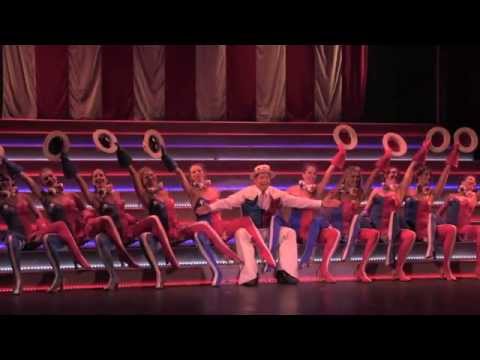
- Act II’s campaign spectacle. Patriotic color, precision choreography, and that “Parade of America” energy that looks terrific until you remember elections have consequences.
- Lyrical Meaning:
- Comden and Green write political satire that still loves the crowd. The lyric celebrates Rogers’s popularity while quietly admitting the public wants comfort more than truth. The number is the show’s sugar rush.
"No Man Left for Me" (Betty)
- The Scene:
- Betty alone, often near a piano, in a blues-inflected spotlight that finally stops pretending this is all fun. The house feels larger. The costumes feel heavier.
- Lyrical Meaning:
- This is the score’s best argument that Betty is not a supporting character. The lyric is not jealous. It is exhausted. It frames absence as a kind of unpaid bill, which ties directly to the show’s later debt spiral.
"Presents for Mrs. Rogers" (Will, Cowboys, Ziegfeld Girls)
- The Scene:
- Will returns with gifts. Ziegfeld Girls descend a staircase in glossy light, an image of wealth made physical. Then creditors interrupt and the fantasy bruises in real time.
- Lyrical Meaning:
- The lyric is material affection, which is sweet until it is not. It dramatizes a classic American bargain: love expressed through consumption, then punished by the math.
"Look Around" (Will)
- The Scene:
- Rogers with a guitar, addressing changes in the land and the country. Typically staged with stripped-back lighting, fewer bodies on stage, and more air between phrases.
- Lyrical Meaning:
- This is the show letting the mask slip. The lyric shifts from show-business patter to moral inventory. It is where Rogers stops being the “phenomenon” and becomes the observer who made him famous.
"Never Met a Man I Didn’t Like" (Will, Company)
- The Scene:
- Introduced early as a kind of signature refrain, then returned at the end as the final statement. The staging tends to simplify as it goes, as if the show is putting away its own props.
- Lyrical Meaning:
- As a motto, it is disarming. As a finale, it is an ethical dare. The lyric is asking whether warmth can function as politics when the country is breaking.
Live updates
Information current as of February 2, 2026. There is no active Broadway revival announcement in the mainstream trade cycle, but the title remains visible in two practical ways. First, it is readily licensable through Concord Theatricals, which keeps the show in circulation for regional and community theaters. Second, the cast recording is actively maintained in the streaming ecosystem via Masterworks Broadway, whose own album notes still function as a public-facing scene map for listeners.
The most recent “modern footprint” that still matters is the Goodspeed Musicals staging in 2018, supported by an education guide that documents how the piece frames itself, scene by scene, for contemporary audiences. For lyric-watchers, that matters because revivals tend to emphasize different things: some productions play the Ziegfeld gloss as affectionate nostalgia, others highlight the Depression material as the real subject. The script can support both readings. That flexibility is why the show keeps returning, even when it is not trendy.
Notes & trivia
- The show’s “show-within-a-show” premise is literal: Ziegfeld is supervising from the audience, and the setting is often described as “Time: The Present; Place: The Palace Theatre.”
- John Denver was the authors’ original pick for Will Rogers before exiting the project after a reported conflict with Peter Stone.
- The “voice” of Florenz Ziegfeld in the original production was recorded by Gregory Peck.
- Masterworks Broadway’s album synopsis describes the curtain rise on a huge portrait of Rogers before the revue frame snaps into place.
- The original Broadway run logged 33 previews and 981 performances, a strong run for a brand-new biography musical.
- The show won six Tony Awards in 1991, including Best Musical and Best Original Score.
- Working title history has circulated in production databases as “Ziegfeld Presents Will Rogers.”
Reception
The critical story is split, and it starts with what you think the show is selling. If you wanted a rigorous biography, you might bristle at the revue form and the constant editorial hand of Ziegfeld. If you wanted a Broadway evening that uses showmanship as a delivery system for civic commentary, you likely found it shrewder than it looked. Later responses have kept that divide alive: some reviewers praise Coleman’s tunefulness and the lyricists’ snap; others hear routine craft and resent the glitz.
“Unfortunately, ‘The Will Rogers Follies’ makes you doubt the sanity of the Tony committee.”
Los Angeles Times (Nov. 4, 1993)
“...a time when a solid hit musical didn’t lean on falling chandeliers and gigantic flying tires.”
Variety (July 16, 1993)
“Cy Coleman’s music and Betty Comden and Adolph Green’s lyrics... are catching.”
Connecticut Critics Circle (2018)
Awards
- Tony Awards (1991): Best Musical; Best Original Score; Best Direction of a Musical; Best Choreography; Best Costume Design; Best Lighting Design.
- Drama Desk Awards: Outstanding Musical (original Broadway production season).
- New York Drama Critics’ Circle: Best New Musical (original Broadway production season).
Quick facts
- Title: The Will Rogers Follies: A Life in Revue
- Year: 1991 (Broadway opening May 1, 1991)
- Form: Biography musical in revue style (Ziegfeld frame)
- Book: Peter Stone
- Music: Cy Coleman
- Lyrics: Betty Comden and Adolph Green
- Original director / choreographer: Tommy Tune
- Original Broadway theatre: Palace Theatre (New York)
- Original Will Rogers: Keith Carradine
- Signature musical motifs: flying (invitation and fate), rope (showmanship and control), gifts/debt (love and cost)
- Cast recording: Original Broadway Cast Recording (distributed under Masterworks Broadway branding; widely streamed)
- Licensing: Available for performance licensing via Concord Theatricals
Frequently asked questions
- Who wrote the lyrics for The Will Rogers Follies?
- The lyrics are by Betty Comden and Adolph Green, with music by Cy Coleman and a book by Peter Stone.
- Is this a straight biography of Will Rogers?
- No. It is a “life in revue” staged through a Ziegfeld Follies lens, with the producer figure interrupting and reshaping events for theatrical impact.
- What song best explains the show’s point of view?
- “Look Around” is the clearest window into Rogers as observer, while “Will-a-Mania” shows how the show turns him into a public phenomenon.
- Is there a filmed version?
- There is no widely distributed official commercial film release. Clips circulate from award broadcasts and archival recordings, and the cast album remains the most reliable at-home experience.
- Why does the score keep switching styles?
- The musical is written as a revue about a career that moved across media and eras. The stylistic changes mirror the show’s constant scene-shifts and Ziegfeld’s “bigger” theatrical demands.
- Can I legally read the full lyrics online?
- Full lyrics are generally copyright-controlled. For authorized text, use licensed materials and official publications from the rights-holder.
Key contributors
| Name | Role | Contribution |
|---|---|---|
| Cy Coleman | Composer | Wrote a style-shifting score that can headline spectacle numbers and still land intimate confession. |
| Betty Comden | Lyricist | Co-wrote lyrics that balance Broadway wit with emotional clarity, especially for Betty’s solo material. |
| Adolph Green | Lyricist | Co-wrote punchy, character-forward lyrics that keep the meta-theatrical frame legible. |
| Peter Stone | Book writer | Built the biographical spine and the Ziegfeld “editor” mechanism that controls pacing and tone. |
| Tommy Tune | Director / choreographer | Defined the show’s spectacle grammar: precision dance, staircase architecture, and parade-scale staging. |
| Keith Carradine | Original Broadway Will Rogers | Originated the role’s blend of charm, musical ease, and direct address to the audience. |
| Dee Hoty | Original Broadway Betty Blake | Set the emotional center for Betty’s arc, especially the blues-inflected Act II material. |
| Cady Huffman | Original Broadway Ziegfeld’s Favorite | Served as the show’s theatrical engine, leading frame numbers and embodying Ziegfeld gloss. |
| Gregory Peck | Voice of Ziegfeld (original) | Provided the offstage producer “authority” that interrupts and reshapes the story. |
| Billy Byers | Orchestrations (credited in album notes) | Helped shape the musical’s period pastiche and big-number punch across styles. |
References & Verification: Broadway run and theatre verified via IBDB. Production-history and casting notes cross-checked with Goodspeed Musicals student guide. Scene-to-song placements and several staging details drawn from Masterworks Broadway album synopsis. Licensing availability verified via Concord Theatricals. Awards verified via Tony Awards winners listing and production summaries.