
Waintin' for My Dearie Lyrics
Waintin' for My Dearie
FIONA:Many a lassie as ev'ryone knows'll
Try to be married before twenty-five.
So she'll agree to most any proposal.
All he mus' be is a man, an' alive.
I hold a dream an' there's no compromisin'
I know there's one certain laddie for me.
One day he'll come walkin' o'er the horizon:
But should he not, then an old maid I'll be.
Foolish, ye may say.
Foolish I will stay.
Waitin' for my dearie, an' happy am I
to hold my heart till he comes strollin' by.
When he comes, my dearie, one look an' I'll know
That he's the dearie I've been wantin' so.
Though I'll live forty lives till the day he arrives,
I'll not ever, ever grieve.
For my hopes will be high that he'll come strollin' by;
For ye see, I believe
That there's a laddie weary, and wanderin' free,
Who's waitin' for his dearie:
Me!
1ST GIRL:
What do ye do while ye're waitin' around
For your lad to come your way?
FIONA:
Well, when no one is lookin', ye kneel on the ground,
An' ye pray an' pray an' pray!
2ND GIRL:
But when lassies sit an' have no men,
Oh, how long becomes the night.
FIONA:
But I fear the night is longer when the lad's no' right.
Waitin' for my dearie is sweeter to me
Than wooin' any laddie on the lea.
GIRLS:
Dreamin' of your dearie, an' idlin' the day
FIONA:
That's how I am an' how I'll ever stay.
Though I'll live forty lives till the day he arrives,
I'll not ever, ever grieve.
For my hopes will be high that he'll come strollin' by;
For ye see, I believe
FIONA AND GIRLS:
That there's a laddie weary, an' wanderin' free,
who's waitin' for his dearie:
FIONA:
Me!
Song Overview
Review and Highlights
Quick summary
- A quietly defiant soprano scena from Brigadoon - Fiona MacLaren’s statement of values and patience.
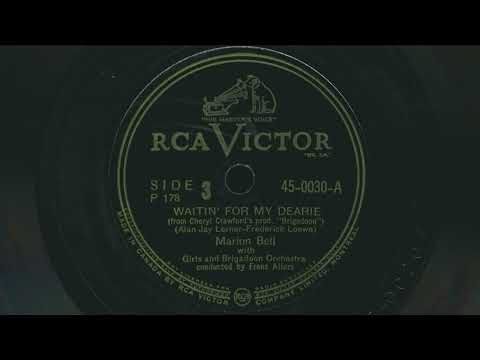
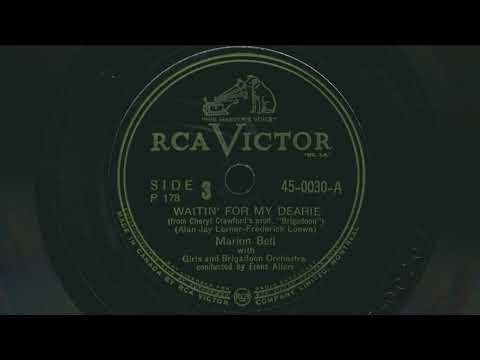
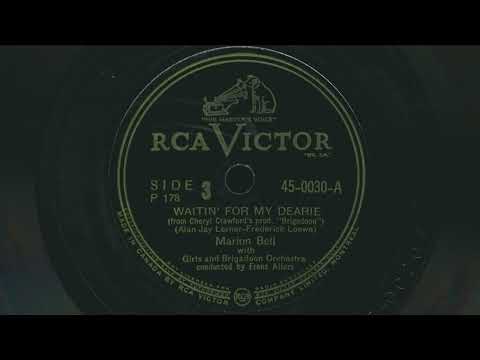
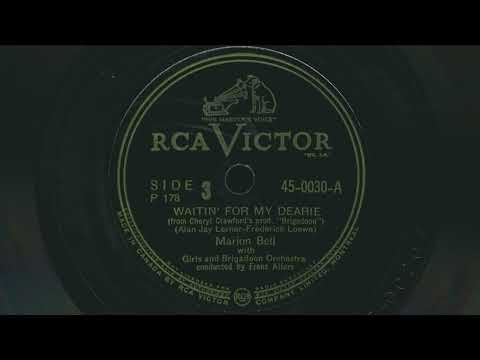
- Words by Alan Jay Lerner, music by Frederick Loewe; first performed on Broadway in 1947 by Marion Bell as Fiona.
- The number frames Act 1’s early stretch, sketching Fiona’s inner compass before Tommy meets her.
- Appears on the 1947 Original Broadway Cast album (RCA Victor), and in the 1954 MGM film - there sung onscreen by Cyd Charisse, dubbed by Carol Richards.
- Later notable recordings include Shirley Jones on the 1957 studio cast and Kelli O’Hara on the 2017 City Center concert album.
Creation History
By the late 1940s, Lerner and Loewe were sharpening a craft built on story-driven song. If Almost Like Being in Love is Brigadoon’s breakout tune, Waitin’ for My Dearie is its moral center - a lilting pledge that anchors the village’s pace and principles. In 1947, Marion Bell premiered the number on Broadway, with Franz Allers conducting and Ted Royal’s orchestrations shaping the sound of the Highlands as heard from a New York pit. The original cast recording followed in the show’s run; the song later migrated to MGM’s 1954 film version, where it was performed on screen by Cyd Charisse and recorded vocally by Carol Richards, keeping the lyric’s Scots-tinged vowels but polishing the line for cinema. Masterworks labels and reissue programs across decades have kept multiple versions in circulation, ensuring the track never fully disappears from catalog shelves.
On video and audio releases, you can hear how tempo and touch vary: some producers let the tune breathe like a slow folk lilt; others favor an “Allegretto” walk that keeps the chorus buoyant. Either way, that rocking two-beat, the brushed strings, and the sprig of bagpipe color feel like a hand on a shoulder - steadying, not showy.
Highlights and key takeaways
- Character first: The song introduces Fiona as principled, not passive. Her patience is an act of agency, not inertia.
- Folk-inflected Broadway: Loewe’s melody leans on pentatonic flavors and pastoral intervals; the harmony sits simple enough to feel rustic, with well-timed lifts to keep the soprano line gleaming.
- Text drives rhythm: Lerner’s Scots inflections (“ye,” “laddie,” “o’er”) cue the cadence. The words pull the bar lines forward.
- Stage-to-screen continuity: The film retains the song’s place near the top of the story’s arc, a quiet thesis before the plot quickens.
- Recording lineage: From Bell to Jones to O’Hara, the role keeps attracting legit sopranos who can carry warmth without affectation.
Song Meaning and Annotations
Plot
Early in Act 1, Brigadoon awakens for its one day in a century. Fiona MacLaren, preparing for her sister’s wedding, fields the usual chorus of “when will you wed?” Instead of coy deflection, she plants a flag. She will not rush into marriage to meet a timetable. She will wait for the right man - and if he never appears, she will accept spinsterhood with a clear conscience. It is in this frame that Tommy Albright, the modern skeptic on a hunting trip, will soon arrive. The number is placed so that we understand Fiona before Tommy does - we are invited to agree with her before the plot tests her resolve.
Song Meaning
Waitin’ for My Dearie is a manifesto disguised as a village song. Its surface is tender; its core is stubborn. Fiona names the pressure - “many a lassie,” “before twenty-five” - and refuses the bargain. The piece sits right on the Broadway discovery that character can be sketched by the grain of a tune: Loewe gives Fiona a line that vaults when her conviction tightens, and settles back when she considers what waiting costs. The message is not “my prince will come,” but “my standards will.” In the land of Brigadoon, where time moves strangely, patience is not just a virtue; it is protection against the whole world’s hurry.
Annotations
“I hold a dream and there’s no compromisn’.”
That “no compromisin’” declares the moral stakes. It is the first time we hear Fiona reject the village’s social inertia. The line lands at the crest of a phrase - a literal lift aligned with the decision’s lift.
“One day he’ll come walkin’ o’er the horizon.”
Pastoral imagery without sentimentality. The horizon is less a fairy-tale promise than a boundary marker. In Brigadoon, thresholds matter: the village appears and vanishes; love must cross impossible distances. The horizon is a test she believes love can pass.
“But should he not, then an old maid I’ll be.”
The lyric reframes “old maid” as a dignified choice rather than a failure. In 1947 Broadway, that was a small revolt - the kind that sneaks in under the harp line and stays with you.
“Waitin’ for my dearie is sweeter to me than wooing any laddie on the lea.”
The chorus resolves the tension. The sweetness she names is not passivity; it’s the calm of choosing your own terms. The “lea” - meadowland - keeps the imagery grounded in folk terrain, tying back to the show’s Scottish setting.
Genre and style fusion
The song braids Broadway legit soprano writing with hints of Scottish folk dance. You hear it in the modal turns and the sturdy two-beat feel - music that could hold a reel if you nudged the tempo, yet savors sustained vowels for the singer’s line. Agnes de Mille’s choreography across the score helped establish that folk dance could sit alongside American musical theater without pastiche; this number is the vocal complement to that aesthetic.
Emotional arc
Verse 1 names the pressure, verse 2 hardens the stance, chorus crowns it with joy. Each return of the refrain says: my patience is not empty time; it is filled with belief. The last tag - “me” alone on the line - is as much a signature as a climax.
Cultural touchpoints
In postwar Broadway, the frontier between folk tradition and modern doubt was busy ground. Brigadoon walked straight into that conversation. Fiona’s stance feels as current as any conversation about timelines and autonomy. And for listeners raised on studio-cast anthologies, the number has a second life on record shelves - the sort of song that launched a thousand soprano audition books.
Key Facts
- Artist: Marion Bell (as Fiona MacLaren)
- Featured: Female Ensemble in stage versions; film chorus on 1954 soundtrack
- Composer: Frederick Loewe
- Lyricist: Alan Jay Lerner
- Producer: For the 1947 cast recording session, musical direction by Franz Allers; label RCA Victor
- Release Date: March 13, 1947 (stage premiere; cast album issued during the run)
- Genre: Broadway, show tune with folk inflection
- Instruments: Orchestra with strings, woodwinds, brass; bagpipe color appears elsewhere in score to shape the sonic world
- Label: RCA Victor (Original Broadway Cast); MGM for the 1954 film soundtrack
- Mood: Resolute, bright, clear-eyed
- Length: Typically 4 to 6 minutes depending on tempo/edition
- Track #: Track 3 on many cast/soundtrack sequences
- Language: English with Scots-flavored diction
- Album: Brigadoon (Original 1947 Broadway Cast); also Brigadoon (Original 1954 Motion Picture Soundtrack)
- Music style: Legit soprano ballad with lilting two-beat sway
- Poetic meter: Mixed - light anapests and iambs shaped by dialect contractions
Canonical Entities & Relations
- Alan Jay Lerner - wrote lyrics for the song.
- Frederick Loewe - composed the music.
- Marion Bell - originated Fiona on Broadway and recorded the role for RCA Victor.
- Franz Allers - musical director for the original Broadway production and cast recording sessions.
- Agnes de Mille - choreographer of the 1947 original production, whose work framed the score’s folk character.
- MGM - studio that produced the 1954 film adaptation including this number.
- Carol Richards - vocalist who dubbed Cyd Charisse on “Waitin’ for My Dearie” in the film.
- RCA Victor - label for the 1947 Original Broadway Cast album.
- New York City Center - produced the 2017 concert revival that yielded a modern cast album including this song.
Questions and Answers
- Where does “Waitin’ for My Dearie” sit in the show’s structure?
- Early in Act 1, shortly after the villagers assemble, Fiona answers pressure to marry by declaring she will wait for the right partner.
- Is the lyric old-fashioned or quietly radical?
- Both. The setting is pastoral, but the stance is radical for its time: she would rather live single than settle.
- How does the music underline Fiona’s agency?
- The melody rises at vows (“no compromisn’,” “I believe”) and relaxes on acceptance, mirroring resolve and calm.
- Did the song make the jump to film?
- Yes. It appears in the 1954 MGM film, performed onscreen by Cyd Charisse with vocals dubbed by Carol Richards; there is also an offscreen reprise later in the picture.
- What’s a defining performance beyond the original?
- Shirley Jones’s 1957 studio-cast track is a touchstone for midcentury clarity; more recently, Kelli O’Hara led the 2017 City Center recording with luminous control.
- Why does the Scots flavor matter?
- It roots the piece in a specific community and cadence. The dialect nudges rhythm and phrasing so the ballad feels lived-in rather than generic.
- Is this an audition piece?
- Yes - for legit sopranos with story sense. It tests line, diction, and the ability to project conviction without pushing.
- Any big chart history?
- Not for this specific song. The show’s breakout hit in the broader pop sphere was “Almost Like Being in Love.”
- How did the original recording limitations shape what we hear?
- Late-1940s Broadway albums were constrained by 78 rpm discs, so some cues and verses were trimmed. Later reissues and studio-cast sets expanded the canvas.
- Does the village’s 100-year cycle color the song?
- Absolutely. Waiting is not idleness in Brigadoon; it’s the only sane way to live when your world surfaces once in a century.
- What orchestral colors suit the piece?
- Light strings with woodwind lead-ins; harp or celesta can add shimmer if kept subtle. Too much lushness blurs the lyric.
Awards and Chart Positions
The song itself did not chart in the pop market, but the Brigadoon umbrella earned hardware and enduring recognition. Agnes de Mille won the Tony Award for Best Choreography for the 1947 production, and the show received the New York Drama Critics’ Circle Award for Best Musical. The 1954 film adaptation featuring this number earned several Academy Award nominations and a Golden Globe for cinematography. According to the Masterworks Broadway and IBDB records, Marion Bell received a Theatre World Award alongside fellow cast members for the original run.
| Award | Category | Recipient | Year |
|---|---|---|---|
| Tony Award | Best Choreography | Agnes de Mille | 1947 |
| New York Drama Critics’ Circle | Best Musical | Brigadoon (production) | 1947 |
| Academy Awards | Art Direction, Costume, Sound - nominations | Brigadoon (film) | 1954/55 season |
| Golden Globes | Best Cinematography - Color | Brigadoon (film) | 1955 |
How to Sing Waitin’ for My Dearie
Think “legit soprano storytelling.” You want radiance without starch, a centered breath, and Scots-tinged diction that flows rather than sticks.
- Key & transpositions: Frequently published in F major, with common licensed options in E or F sharp. Choose the key that keeps the crest phrases luminous rather than forced.
- Tempo: Marked around Allegretto in several scores and libretti; a gentle walk - not a drag, not a clip. Aim roughly 96-112 bpm in practice and lock to the production’s pulse.
- Range & tessitura: Role guidance places Fiona’s range roughly B3 to A5. The piece sits mostly in the middle with tasteful climbs that need ring, not thrust.
Step-by-step HowTo
- Tempo feel: Internalize a rocking two-beat. Count “ONE-and TWO-and” while speaking the lyric; then layer melody.
- Diction: Let the Scots flavor color vowels without caricature. Shorten final g’s, keep “o’er” and “ye” unfussy.
- Breathing: Plan a quiet, low inhale before “I hold a dream…” and “One day he’ll come…”. Avoid audible gasps; the serenity sells the stance.
- Flow & rhythm: Do not clip the last syllable of “dearie.” Let the resolution land on the breath. Keep consonants forward so the orchestra can sit under you.
- Accents: Lean into “no compromisn’,” “I’ll not ever,” and “I believe.” These are your thesis points.
- Ensemble & doubles: If you have women’s chorus, balance their “mmm” and echo lines under your lead; avoid vibrato build-up that turns the texture cloudy.
- Mic craft: For amplified productions, hold steady distance on the big vowels; let the engineer lift you rather than chasing the mic.
- Pitfalls: The danger is over-sweetness. Keep the spine of conviction visible. Don’t rush the second verse - that’s where the philosophy settles.
Practice materials: Licensed piano-vocal scores are widely available in multiple keys. Backing tracks vary; favor ones that keep a light string pad and discrete winds so the lyric remains intelligible. Several cast/soundtrack versions - original Broadway, 1957 studio cast, and City Center 2017 - make useful reference points for tempo and phrasing.
Additional Info
Recording lineage helps explain why so many listeners know this track absent the full show. The 1947 cast album on RCA Victor put Marion Bell’s Fiona on disc with Allers at the helm. A decade later, producer Goddard Lieberson assembled a lush studio cast headlined by Shirley Jones, giving the song a stereo-era glow that introduced it to a new audience. Much later, the 2017 City Center concert with Kelli O’Hara became the reference for contemporary singers seeking an unforced, conversational simplicity.
As for performance history, the number sits near a line that Agnes de Mille drew through the show: dance language and folk gesture are not decoration but narrative. “Waiting” becomes motion - a measured walk that makes space for belief. According to Masterworks Broadway’s archival notes, this is one reason the show has stayed resilient in revivals: the score’s lilting set pieces balance spectacle with sincerity. And as IBDB records make clear, the original company’s honors - including Theatre World Awards for Marion Bell and colleagues - reflected how powerfully those elements coalesced onstage.
Critics then and now often point out that Fiona’s stance reads modern. “Standards over timelines” is not a new meme; it is stitched into American musical theater by songs like this. As stated in a Playbill retrospective timed to the show’s anniversary, the 1947 opening locked in a run that would carry Brigadoon into film and repeated revivals - which is where many of us first heard this tune in childhood living rooms, spinning on hand-me-down LPs.
Sources: Masterworks Broadway; IBDB; Wikipedia; SecondHandSongs; CastAlbums Database; Naxos liner notes; SoundtrackCollector; Apple Music; Spotify; StageAgent; Music Theatre International; Shaw Festival program.