
Vendor's Calls / Down on MacConnachy Square Lyrics
Vendor's Calls / Down on MacConnachy Square
MAN:Come all to the square!
GIRL:
The market square!
GIRL:
the market fair!
MAN:
Salted meat I'm sellin' there!
At the fair, laddie!
MAN:
Come ye to the fair!
MAN:
Ale for sale or barter there!
At the square, laddie!
GIRL:
[echoes last MAN]
GIRL:
Come all ye down!
GIRL:
Ye, in the town!
MAN:
Come ye from the hills!
MAN:
Wool 'n' cloth I'm selling there!
At the square, laddie!
GIRL:
Come ye from the mills!
2 GIRLS:
(one after the other)
Come all ye there!
MAN:
Come ye to the fair!
ALL:
Come ye, all ye everywhere,
To the fair!
Come ye from the hills!
Come ye from the mills!
Come ye in the glen,
Come ye bairn,
Come ye men.
Come ye from the loom!
Come from pail an' broom!
Hear ye ev'rywhere:
Don't ye ken
There's a fair
Down on MacConnachy Square!
SANDY:
Now all of ye come to Sandy here,
Come over to Sandy's booth.
I'm sellin' the sweetest candy here,
That ever shook loose a tooth.
I eat it myself an' there's no doubt,
'Tis creamy an' good an' thick,
So, laddies, I hope ye'll buy me out,
'Tis makin' me kind o' sick.
GIRLS:
Come ye from the loom!
Come from pail and broom!
Hear ye ev'rywhere!
Don't ye ken
There's a fair.
WOMEN'S CHORUS:
Come ye from the loom!
Come from pail and broom!
Hear ye ev'rywhere:
MEN'S CHORUS:
Oh come ye from the loom,
Ye from the loom!
Oh come ye from the pail an' broom!
Oh hear ye people,
Hear ye ev'rywhere:
VENDORS (GIRLS AND MEN):
Come all ye there,
Ye in the square,
The market fair,
The market fair,
ALL:
Don't ye ken
There's a fair
Down on MacConnachy Square?
MacGREGOR:
Salted meat I'm sellin' there
At the fair, laddie!
VENDORS:
Come all ye there!
GIRL VENDOR:
Ale, for sale or barter there
At the fair, laddie!
STUART:
Woolen clothes I'm sellin' there
At the fair, laddie.
VENDORS:
Come all ye there.
Come all ye there.
ALL:
Come ye to the fair,
To the fair!
MEG:
I'm sellin' a bit o' milk an' cream.
Come sip it an' ye will vow
That this is the finest milk an' cream
That ever came out a cow.
Though finest it is,the price is small,
With milk an' the cream alack!
There's nothin' to do but sell it all.
The cow winna take it back.
ALL GIRLS:
All of ye down from in the hills,
An' all of ye in the glen.
Come all of ye down from in the mills,
An' all of ye bairns an' men.
Come all of ye from the weavin' loom!
Come all of ye to the square!
Come all of ye from the pail an' broom!
Come all of ye to the fair!
Come ye from the loom!
Come from pail an' broom!
ALL MEN:
Come ye from the hills!
Come ye from the mills!
Come ye in the glen.
Come ye bairn,
Come ye men!
Oh come ye from the loom,
Ye from the loom!
Oh come ye from the pail an' broom!
Oh hear ye people,
ALL:
Hear ye ev'rywhere,
Don't ye ken
There's a fair
Down on macConnachy Square?
Song Overview

“Down on MacConnachy Square” arrives early in Act I of Brigadoon, Lerner and Loewe’s Highland fable. The number throws open the town gates: a swirl of vendors, neighbors, and passing gossip beckoning everyone toward the village fair. It is marketplace music - quick-footed, bright, and built for bustle - that pivots the story from mist to daylight. Within a few minutes, we meet voices who matter (Sandy, Angus, Meg among them), hear the square advertised with irresistible charm, and feel the production’s folk-dance engine kick in. The tune’s job is simple and tricky at once: build a living crowd onstage. It does that with craft and speed.
Review and Highlights

Quick summary
- Function: Early Act I ensemble that summons the town to the fair and sets up the social world of Brigadoon.
- Voices: A chorus of townsfolk with featured calls from Sandy and Angus; Meg and others thread through the crowd.
- Style: Broadway craft steeped in Scottish dance rhythms and street vendor cries, paced for stage movement.
- Recordings: Captured by the Original Broadway Cast; later preserved in the 1954 film soundtrack and major revivals.
- Story impact: Bridges the mystical prologue to everyday life, so Tommy and Jeff can meet the village on ordinary terms - at least at first glance.
Creation History
Composer Frederick Loewe and lyricist-bookwriter Alan Jay Lerner built Brigadoon around folk-dance grammar. Choreographer Agnes de Mille’s vocabulary - Scottish steps, processional patterns, and character dances - sits in the bones of this particular number. “MacConnachy Square” is engineered as staging fuel: vendors’ patter, overlapping calls, and quick cutaways give de Mille room for diagonals and crowd architecture. Orchestrations on Broadway balanced reeds, strings, and percussion in quick duple feel, leaving breath for shouted prices and sung counters. In performance, the tune’s bustle doubles as a scenic shift: by the end of the song, the stage is a fairground, and the show can flow straight into intimate scenes without a blackout.
When Brigadoon leapt to the screen in 1954, the square remained a featured moment, reshaped to film logic - choral textures brought forward, street energy kept tight for the camera. A decade later, the 1966 television version once again used the square to reintroduce the town’s pulse. Across these mediums the number keeps its core identity: it is the town, singing.
Highlights and takeaways
- Vendor calls as musical hooks: Short phrases - candy here, cloth there - are the song’s leitmotifs, knitting a crowd from fragments.
- Danceability by design: Bright duple meter with a tap-friendly snap primes entrances, exits, and comic bits.
- Character tinting: Sandy’s candy pitch and Angus’s milk-and-cream boast sketch social roles in a handful of measures.
- Seamless scene change: The number is a set change in disguise; you barely notice the square building around you.
- Folk color, Broadway structure: Scottish flavor sits inside crisp show-song form, so the tune can carry exposition without sagging.
Song Meaning and Annotations
Plot
After the mist clears and the title song welcomes us into the village, “Down on MacConnachy Square” throws the doors open. The ensemble beckons: come from hills, mills, looms. Sandy hawks sweets, Angus plugs dairy, others push salted meats and cloth. That marketplace beckoning does double duty. It’s a civic roll call and a map of trades. While the fair gathers, Tommy and Jeff encounter the village not as spirits but as shopkeepers and neighbors. The square is where Tommy can meet Fiona under ordinary sky, before miracles complicate the day.
Song Meaning
Midway between pastorale and parade, the song is about belonging. Marketplace music is always about who counts as “us.” If you hear your trade called, you’re pulled in; if you don’t, you listen and learn the rules. In Brigadoon, where time is unstable, the square plants the show on human ground: barter, flirtation, petty salesmanship, a quick roast between friends. That earthbound bustle makes the later choices - love against the clock - land with more weight.
Annotations
“Come ye from the hills / Come ye from the mills”
Two lines, two geographies. The lyric collapses Highland distance into a village radius. The chain of vocatives - hills, mills, glen, loom - is a census in motion.
“I’m sellin’ the sweetest candy here / That ever shook loose a tooth”
Vendor patter as self-parody. The rhyme is deliberately broad, signaling that comedy is part of the square’s function. It invites dance business - a wink, a shared laugh - that softens the show’s more solemn folkloric edges.
“There’s nothin’ to do but sell it all / The cow will not take it back”
Angus’s deadpan punchline pins the marketplace ethic: goods move forward, not back. Dramaturgically it telegraphs the town’s bargain with time - no returns.

Rhythm and style
The driving feel is brisk duple - a jig-adjacent snap that sits cleanly under chorus calls and de Mille’s traveling steps. You hear open-fifth drones and pennywhistle-like woodwind figures in some arrangements, though the core Broadway palette stays orchestral: strings marking the beat, reeds chattering in counter-lines, and light percussion to kick the feet. When the ensemble stacks call-and-response phrases, the meter turns into crowd noise you can choreograph.
Emotional arc
Emotion here is communal, not private. It starts as invitation, swells into cross-talk, then lands in a clear pulse: this is a living town. The humor keeps stakes low, which is exactly the point. Romance and danger will arrive soon enough; for three minutes we enjoy civic weather.
Touchpoints and echoes
Vendor-cry numbers belong to a long stage lineage - from opera’s market scenes to vaudeville patter - but Brigadoon grafts that tradition onto a folk-dance chassis. The result feels like a pageant you might stumble into if you turned the corner at the right time of morning. Later in Act I, reprises and dance interludes echo these square rhythms, reminding us that the town’s body moves as one even as individuals fall in love or slip into trouble.
Key Facts
- Artist: Original Broadway Cast of Brigadoon
- Featured: Sandy, Angus, Meg, and Townsfolk
- Composer: Frederick Loewe
- Lyricist/Book: Alan Jay Lerner
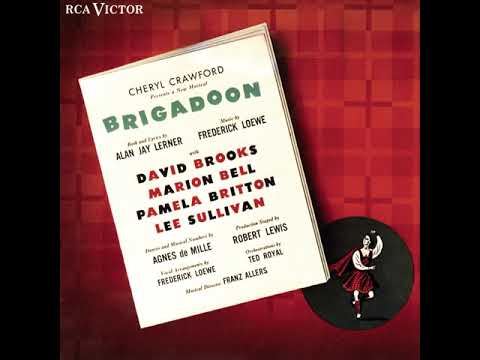
- Producer (stage): Cheryl Crawford
- Orchestrations (Broadway): Ted Royal
- Release Date (Broadway premiere): March 13, 1947
- Primary genre: Broadway musical theatre
- Music style: Ensemble vendor-cry with Scottish dance inflection; bright duple meter
- Instruments (typical pit palette): Strings, woodwinds, brass, percussion; folk color suggested in drones and fife-like lines
- Label (original cast album 78 rpm set): RCA Victor
- Mood: Festive, bustling, comic
- Length (OBC track): about 3:11
- Track # on OBC album: 2
- Language: English
- Album: Brigadoon (Original 1947 Broadway Cast)
- Poetic meter: Mixed, with anapestic lift in calls and patter
Canonical Entities & Relations
- Agnes de Mille - won - 1947 Tony Award for Best Choreography for Brigadoon.
- Original Broadway Cast of Brigadoon - recorded - “Down on MacConnachy Square” for RCA Victor 78 rpm set (1947).
- Vincente Minnelli - directed - 1954 MGM film adaptation featuring the number on the soundtrack.
- Robert Goulet, Sally Ann Howes - starred in - 1966 television version including the number.
- Masterworks Broadway - reissued - archival cast albums and studio cast recordings of Brigadoon.
- Ghostlight Records - released - 2017 City Center Encores! recording with “Vendors’ Calls / MacConnachy Square.”
Questions and Answers
- Where does “Down on MacConnachy Square” sit in the show’s structure?
- Early in Act I, right after the title tune introduces the town. It’s the first full-blooded slice of everyday Brigadoon life.
- Who leads the musical action in the number?
- Sandy and Angus get signature sales pitches, while Meg and the chorus knit the crowd together. The ensemble is the star.
- Why does the song matter for character setup?
- It maps trades and temperaments in under four minutes. By the time Tommy meets Fiona, we already trust the square as a lived-in world.
- Is this tune in the 1954 film and 1966 TV versions?
- Yes. The film uses it as part of an early montage of village life; the TV version restores it in a compact, live-television friendly form.
- What musical devices make it feel “Scottish” without turning into pastiche?
- Quick duple meter with snapped rhythms, open-fifth pedal points, and piping figures in the winds. The flavor is there, the structure remains classic Broadway.
- Does the number ever stand alone on recordings?
- On some albums it’s paired with “Vendors’ Calls,” forming a mini-suite. Original Broadway releases list it as its own track near the top of the album side.
- Any famous covers?
- Several cast and studio recordings revisit it - notably the 1957 studio cast album and the 2017 City Center Encores! release - but it hasn’t migrated into pop standard territory the way “Almost Like Being in Love” did.
- What’s the pacing like for performers?
- Brisk. Think roughly mid-140s in BPM for many cast recordings, though stage conductors adjust tempo for choreography and diction.
- How does the lyric handle dialect?
- Lightly. A few Scots words (“bairn,” “ken”) shade the lines without slowing comprehension, and the jokes land clean.
- Is there a reprise?
- Yes. Fragments return as transition material later in Act I, reminding us of the village’s group pulse.
Awards and Chart Positions
Stage awards: Agnes de Mille received the inaugural Tony Award for Best Choreography in 1947 for Brigadoon, the production that embeds this number’s movement vocabulary into the show’s identity. Cast members Marion Bell and James Mitchell earned Theatre World Awards that season. According to Playbill and other theatre records, the original Broadway run totaled 581 performances, a clear hit for a new team in 1947.
Screen honors: The 1954 film adaptation that features the square was nominated for three Academy Awards and won a Golden Globe for color cinematography. While the song itself was not singled out, its presence helps sketch the film’s village life in the first act.
How to Sing Down on MacConnachy Square
Tempo & feel: Many recordings sit around 140-150 BPM in bright duple time, with a crisp two-in-the-bar pulse. Some studio interpretations slow individual vendor lines to land jokes, then snap back to the crowd tempo. Conductors typically cue a slightly lighter beat for patter and a fuller, legato beat when the chorus stacks.
Key: Cast recordings commonly sit in A-flat major (G sharp major), with local modulations for transitions. Your production may adjust for ensemble balance and dancer comfort.
Vocal range: Ensemble-friendly. Featured vendor calls suit lyric baritone to high baritone (Sandy) and a sturdy baritone-bass (Angus). Chorus lines stay comfortable for mixed SATB, with room for tenors to ping the upper harmony on refrains.
Common issues: Over-singing the patter, muddy diction on stacked calls, and breath getting chopped by choreography. This is a stamina piece disguised as a short scene.
Step-by-step
- Tempo placement: Set a rehearsal tempo that still lets consonants snap. If your dancers need more lift, nudge faster only after words stay intelligible.
- Diction first: Treat each vendor cry as a tiny aria: vowel core, then crisp final consonants. Keep Scots words light and conversational.
- Breathing: Plan communal breaths on repeated refrains so the crowd sound swells together. Soloists breathe off-beat so the square never stops moving.
- Flow and rhythm: Lean into two-in-the-bar. Let the off-beats dance under you rather than hammering every quarter note.
- Accents: Place stress on sales words - “candy,” “cloth,” “cream” - and let the punchlines land with a half-smile rather than a shout.
- Ensemble blend: In tutti refrains, think “public voice” not “solo voice.” Straight-tone attacks, then spin vibrato only on held cadences.
- Mic craft: If amplified, step back on shouts and come in close for asides. Keep off-axis for laughter so it reads as atmosphere, not a blast.
- Pitfalls: Don’t rush the handoffs between vendors; the comedy is in the relay. Also avoid accent caricature - clarity beats caricature every time.
Practice material: Run call-and-response drills at half tempo, then at show tempo. Alternate spoken and sung versions to clean consonants. If you have dancers in chorus, staggered breathing charts taped to the wings help keep the engine humming.
Additional Info
Recordings to sample: The original Broadway cast album places the number as track two, a brisk three-minute snapshot of village life. A 1957 studio cast album expands the suite to include “Vendors’ Calls,” emphasizing stage business embedded in the music. The 1954 film soundtrack opens Act I’s village montage with the square, pushing chorus color and studio polish. More recently, the City Center Encores! recording restores the bustle with modern clarity, proving how sturdily the writing carries.
Production lineage: According to Playbill’s production records and the Broadway database, Brigadoon opened March 13, 1947 at the Ziegfeld Theatre and ran 581 performances. That success sprang in part from de Mille’s integrated choreography; her Tony that season underscored how decisive dance was to the storytelling. Studio releases and reissues since have kept the score in the ear, with Masterworks Broadway and others curating the catalog for new listeners.
Where it appears on screen: The number surfaces early in the MGM film and again in the 1966 television production headlined by Robert Goulet and Sally Ann Howes. Both versions retain the square’s function: orient the viewer in bustling daylight before romance and legend take over.
Sources: Masterworks Broadway; Playbill; IBDB; SoundtrackCollector; Apple Music; IMDb; CastAlbums; Ghostlight Records; Discogs; Wikipedia; SongBPM; Tunebat.