
My Mother's Wedding Day Lyrics
My Mother's Wedding Day
MEG:Now if ye think this weddin' day went jus' a wee amiss,
Then I will tell ye 'bout a weddin' far more daft than this.
The lad involved turned out to be no other but my pa,
An' by the strangest bit o' luck, the woman was my ma.
MacGregor, MacKenna, MacGowan, MacGraw, MacVitie, MacNeil an' MacRae;
Ay, all the folk in the village were there at my mother's weddin' day.
For pa had asked his friend MacPhee, an' Mac had come with May MacGee,
An' May invited ninety-three to my mother's weddin' day.
Then up the road came Ed macKeen with half the town of Aberdeen.
CHORUS:
Ay, ev'ryone was on the scene at her mother's weddin' day.
MEG:
At quarter to five everybody was there a-waitin' around in the room,
MacVicker, MacDougall, MacDuff an' MacCoy--everybody but the groom.
An' as the hours turtled by, the men got feelin' kind o' dry,
An' thought they'd take a nip of rye while a-waitin' for the groom.
An' while the men were dippin' in, the ladies started on the gin.
CHORUS:
An' soon the room began to spin at her mother's weddin' day.
MEG:
Then all of a sudden the liquor was gone, the gin an' the whiskey an' all.
An' all of a sudden the weddin' affair had become a bonnie brawl.
For Pete MacGraw and Joe MacPhee began to fight for May MacGee,
While May MacGee an' Sam MacKee were a-wooin' in the hall.
So cold an' stiff was John MacVay, they used him for a servin' tray.
CHORUS:
For ev'ryone was blithe and gay at her mother's weddin' day.
MEG:
MacDuff an' MacVitie were playin' a game, an' usin' MacCoy for the ball.
MacKenna was eatin' the bridal bouquet, an' MacNeil hung on the wall.
When finally my father came, his eyes were red, his nose aflame.
He dinna even know his name; he was drunkest of them all.
The people were lyin' all over the room a'lookin' as if they were dead,
Then mother uncovered the minister quick, an' she told 'im: Go ahead.
Then pa kneeled down on Bill MacRae, an' mother kneeled on Jock MacKay,
The preacher stood on John MacVay, and that's how my ma was wed.
It was a sight beyond compare. I ought to know, for I was there.
CHORUS:
There never was a day as rare as her mother's weddin' day!
Song Overview
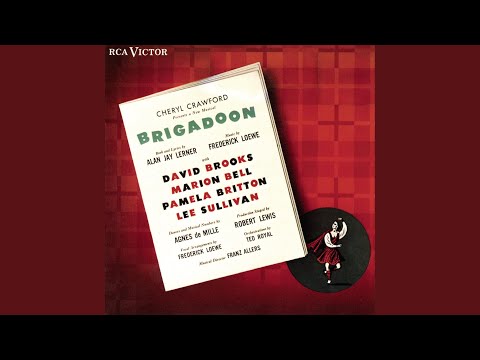
“My Mother’s Weddin’ Day” is the riotous comic centerpiece for Meg Brockie in Act II of Brigadoon - the moment the village throws decorum to the wind and Meg gleefully narrates a family ceremony that turns into an uproar. Where so much of Lerner and Loewe’s score glows with romance and pastoral calm, this number goes full tilt: names flying, liquor flowing, bodies piling, rhyme schemes tumbling down the aisle. Pamela Britton’s original Broadway turn pins the tone - sly, rhythmic, and just naughty enough - while the orchestra eggs her on with a strut that never quite spills its drink. Later recordings kept the spark alive, especially Susan Johnson’s studio-cast spin in the 1950s and Stephanie J. Block’s bright, knowing take for the 2017 City Center revival.
Review and Highlights
Quick summary
- A rapid-fire comic narrative for Meg Brockie that lands in Act II, as the town celebrates and chaos brews.
- Introduced by Pamela Britton on the 1947 original Broadway cast album under musical director Franz Allers.
- Omitted from the 1954 MGM film but restored for the 1966 ABC television adaptation.
- Re-recorded by Susan Johnson (1957 studio cast) and by Stephanie J. Block for New York City Center’s 2017 concert cast.
- Stylistically a patter song with Scottish-flavored diction, brisk tempo, and a wink baked into every rhyme.
Creation History
Alan Jay Lerner’s book and lyric give Meg a comic engine - a way to ventilate the show’s tension with saucy storytelling. Frederick Loewe fits the words to a striding tune that sits in the actor-singer’s sweet spot: quick syllables, clean stress points, and enough rests to reset the tongue. The orchestration favors bright winds and nimble strings; it sounds like a party teetering into legend.
Because Meg’s material flirted with innuendo by mid-century standards, the number ran into prudery when Brigadoon
Act II opens out - life, weddings, and a village trying to dance off the day’s bad omens. In that swirl, Meg grabs the room and tells a tale about her mother’s nuptials, a ceremony that spirals from thirst into melee. The narrative is simple: the crowd gathers, the groom is late, bottles appear, tempers do the same, and somewhere under the pile a minister gets the job done. It is cheerful anarchy, and it gives the town a dose of laughter before tragedy returns. This is community portraiture disguised as a shaggy-dog story. Through the list of names and hijinks, Meg reminds everyone who they are when the façade drops - gossipy, loyal, quick to quarrel and quicker to forgive. The subtext is solidarity: even in farce, the village shows up for the ritual and makes the marriage happen. Tonally, it is a pressure valve. By design it sits near darker turns in the show, so the humor does narrative work - giving the next scene something to contrast against. The Mac parade does two jobs at once: it localizes the story in broad Scottish strokes and sets up a percussive groove. Each name lands like a snare hit, making the comedy rhythmic as well as verbal. The clan roll call also nudges a sub-theme - the collective overwhelms the individual, so private vows become public sport. Time-stamping heightens the slow-burn. The precise clock mark makes the groom’s absence funnier and more exasperating. It’s also classic patter technique: a concrete detail resets attention before the next cascade of action verbs. A coy euphemism that lets the audience fill in the bottle. Lerner threads this line with period-tuned decorum - polite on the surface, cheeky underneath - which probably helped it fly onstage while still ruffling censors later on. Cartoonish, yes, but efficient: one image sums a room gone sideways. The internal rhyme snaps like a rimshot, and the music pins the laugh without milking it. The punch line of the entire routine. For all the chaos, the ritual survives. The staging usually plays this for one more roar, but dramatically it resets the compass back to community order. Call it Broadway patter with a folk wink. The prevailing feel is duple time with a moderate clip, cleanly accented to let consonants pop. Orchestration keeps the pocket light - winds for chatter, strings for bustle, and percussion tucked in to underline the rhymes. That balance lets the lyric drive without the band drowning the jokes. It starts as gossip, veers to farce, and lands on triumph by sheer stubbornness. Meg’s confidence fuels the arc - she tells it like a legend she owns, so by the final refrain the audience believes the town could make a wedding out of bedlam any day of the week. Scots-flavored diction (ye, wee, bonnie) and place markers (Aberdeen) broadcast the Highland setting to American ears of the 1940s. That stylization was fashionable - a romanticized elsewhere that Broadway embraced - and it turns out to be perfect oxygen for a comic song that wants both color and speed. This song did not chart on its own, but its fortunes travel with Brigadoon across media. The 1954 film adaptation earned Academy Award nominations and a Golden Globe for color cinematography, while the 1966 ABC television adaptation won multiple Primetime Emmys, including directing and lighting categories. Those recognitions helped keep the score - and Meg’s comic jewel - in circulation. Think nimble, forward, and conspiratorial - a party trick with a heart. Practical specs and a step plan: Notable recordings: Pamela Britton’s originating cut on the 1947 cast album is the template. Susan Johnson brings studio sparkle on the 1957 set with Shirley Jones and Jack Cassidy. Stephanie J. Block’s 2017 City Center performance crackles with comic specificity - a modern reference take for actors learning the piece. On the album’s format: The show’s first release arrived as a bound set of five 78 rpm discs and later moved to LP in 1951, with digital reissues following decades on. According to Masterworks Broadway’s own notes, the original album was a landmark in the label’s early cast-recording catalog. As stated in a 2010s Masterworks article, the 78 format also meant trims and compromises that later editions addressed when technology allowed. Stage vs. screen: The MGM film’s emphasis on dance and scenic magic let the pastoral romance shine while leaving Meg’s rowdier material off-camera. Television’s 1966 take corrected course, and the awards that followed kept Brigadoon - and its full score - in the cultural bloodstream. Sources: Wikipedia, Masterworks Broadway, Discogs, CastAlbums.org, Television Academy, Apple Music, AllMusic, Ovrtur, IMDb, YouTube, Tunebat.Highlights & Key takeaways
Song Meaning and Annotations
Plot
Song Meaning
Annotations
“MacGregor, MacKenna, MacGowan, MacGraw”
“At quarter to five everybody was there”
“The men got feelin’ kind of dry”
“So cold and stiff was John MacVay / They used him for a servin’ tray”
“Then Mother uncovered the minister quick”
Genre, rhythm, instrumentation
Emotional arc
Cultural touchpoints
Key Facts
Canonical Entities & Relations
Questions and Answers
Awards and Chart Positions
How to Sing My Mother’s Weddin’ Day
Step-by-step HowTo
Additional Info