
Overture Lyrics
Overture
InstrumentalSong Overview
Review and Highlights
Quick summary
- Work: Anything Goes (opened November 21, 1934) - musical comedy on the SS American.
- Function: An orchestral welcome mat - a stitched-together preview of the show sound world rather than a standalone "number."
- Writers: Music and lyrics by Cole Porter, with original stage orchestrations credited to Robert Russell Bennett and Hans Spialek.
- What you hear: A brassy, ship-deck sparkle that telegraphs witty romance, fast talking farce, and dance-forward momentum.
Anything Goes (1934) - stage musical - non-diegetic. It plays before the first scene, doing a practical job (covering late seating, settling the room) while quietly selling you the show. You get a quick tour of Porter land: snap-to attention rhythms, a jazz-age grin, and that feeling that the band can pivot from ballroom polish to nightclub bite in a heartbeat.
If you want the cleanest definition of what an overture does here, it is this: it teaches the audience how to listen. Before anyone sings, the orchestra is already telling you the rules - this is a comedy with sharp elbows, glamour with fingerprints, and dance rhythms that never stop tapping their foot.
Creation History
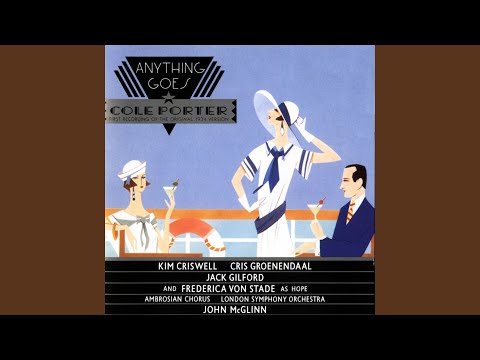
The 1934 Broadway production opened at the Alvin Theatre and ran long enough to become one of the decade's heavyweight hits. The score belongs to Porter, while the original pit sound is tied to the Broadway arranging craft of Bennett and Spialek. Decades later, conductor John McGlinn became a key figure for listeners who wanted a closer-to-1934 picture, working with Spialek late in the arranger's life and recording a reconstruction-minded studio set. Playbill, writing in 2011, framed that recording story as a kind of theatrical detective work - the sort of behind-the-scenes labor that explains why different modern versions of the same opening can feel like different camera lenses.
Song Meaning and Annotations
Plot
In the show, a Wall Street romantic stows away on an ocean liner chasing the woman he met for one electric night. Onboard, he collides with a celebrity singer, an heiress with a society tangle, a second-rate gangster hiding in plain sight, and a shipload of mistaken identities. The overture sits outside the story - but it primes you for a world where class manners, con jobs, and romance all share the same dance floor.
Song Meaning
This is not a confession, not a diary entry, not a scene. It is a mood contract. The orchestra basically says: pack light, move fast, flirt shamelessly, and do not trust first impressions. In a 1934 context, that snap-and-glitter optimism matters. You are walking into a Depression-era theatre, and the band is already selling speed, shine, and escape without pretending real life does not exist outside the lobby.
Annotations
It is a medley that previews the musical world before any character speaks.
Right - and the sneaky trick is how it lowers your resistance. By the time the first line lands, your ears have already accepted Porter's harmonic jokes and dance rhythms as the normal weather in this room.
Orchestrations for early Broadway scores were often shaped by specialist arrangers, not only the composer.
This is the heart of why the opening can vary between editions. Porter wrote the tunes and the language; Bennett and Spialek helped decide how the pit talks. Same melody, different accent.
Later reconstructions tried to recover what audiences heard at the premiere.
That impulse is why McGlinn matters for listeners who want less "revival gloss" and more period bite. According to Playbill, his process leaned on late-life collaboration with Spialek and a careful studio approach rather than a quick re-orchestration job.
Rhythm and style
The drive is dance-first: crisp two-beat swagger, swing-ready phrases, and brass punctuation that feels like a wink across a cocktail glass. Even when the texture turns smooth, it still pushes forward, like the ship has already left the dock.
Motifs and what they signal
Because this opening is built from themes you will hear later, it works like a trailer cut by someone with taste. It hints at glamour, fast talk, and romantic risk, then lets the book scenes do the explaining. The comedy lives in timing, and the orchestra is already practicing timing.
Technical Information (Quick Facts)
- Song: Overture (Anything Goes)
- Artist: Anything Goes Orchestra (representative modern credits vary by recording)
- Featured: N/A
- Composer: Cole Porter
- Producer: Recording-dependent (cast album producers vary by release)
- Release Date: November 21, 1934 (stage premiere of the musical)
- Genre: Musical theatre overture, jazz-age Broadway
- Instruments: Orchestra (brass, reeds, rhythm section, strings; typical Broadway pit forces by edition)
- Label: Recording-dependent
- Mood: Bright, kinetic, sly
- Length: Common modern cast-recording length is around 2-3 minutes (example: 2:37 on the 2011 Broadway cast recording track list)
- Track #: Usually track 1 on cast albums that include it
- Language: Instrumental
- Album (if any): Appears on multiple cast and studio releases
- Music style: Dance-band swing filtered through Broadway orchestration
- Poetic meter: N/A (instrumental)
Frequently Asked Questions
- Is this a full song with verses?
- No. It is an instrumental medley built to introduce themes, tempo, and tone before the first scene.
- When did the musical premiere on Broadway?
- The original Broadway production opened on November 21, 1934 and ran for 420 performances.
- Who wrote the music?
- Cole Porter wrote the score, including the melodic material the orchestra threads through the opener.
- Why can the opener sound different from one recording to the next?
- Editions vary, and orchestration choices matter. The 1934 production credited orchestrations to Robert Russell Bennett and Hans Spialek, while later revivals and studio projects may use different orchestrations or restored material.
- What is the most listener-friendly recording style if I want a period feel?
- Look for reconstruction-minded studio recordings associated with John McGlinn, who is widely cited for trying to recover early Broadway orchestral detail through research and collaboration.
- Is it used as underscoring inside the story?
- In the stage show, it plays before the action begins, functioning as non-diegetic introduction rather than a scene cue.
- Does the 2011 revival cast album include it?
- Yes, it appears as the opening track on the 2011 New Broadway Cast Recording track list.
- Did any cast recording tied to the show chart?
- The 2011 revival cast recording was reported to debut at No. 1 on Billboard's Cast Album Chart and also posted strong iTunes chart placements in release-week reporting.
- Is this the same thing as an entr'acte?
- No. An entr'acte is a second-act re-entry piece. Anything Goes also has an entr'acte in many published number lists, separate from the opening.
Awards and Chart Positions
The overture itself is a functional stage opener rather than a single built for pop charts, so the cleanest chart story sits with cast albums and productions around the score.
| Item | What happened | Date |
|---|---|---|
| Original Broadway production | Opened and ran 420 performances (a major 1930s run) | November 21, 1934 - November 16, 1935 |
| 2011 revival cast recording | Reported to debut at No. 1 on Billboard's Cast Album Chart | September 2011 |
| 2011 revival cast recording | Reported iTunes performance: No. 1 Soundtrack Chart and No. 17 overall | August 2011 (digital release reporting) |
| 2011 Broadway revival (production) | Won multiple Tony Awards, including Best Revival of a Musical (production-level milestone tied to the score's modern visibility) | June 2011 |
Additional Info
One funny truth about this opener is how much history it smuggles in under the tuxedo. You can hear the Broadway machine at work: Porter supplies melodies with bite, then the pit turns them into crowd control, scene glue, and a promise of dance breaks. When modern editions switch orchestration style, you feel it immediately - less like "a new arrangement" and more like walking into the same party wearing different shoes.
As stated in a Playbill feature on major recordings, McGlinn's approach to a studio set leaned hard on research and on Spialek's firsthand memory of the original sound. That detail explains why some listeners chase those recordings: not for novelty, but for the sense of sitting closer to opening night.
Key Contributors
| Entity | Type | Relationship statement |
|---|---|---|
| Cole Porter | Person | Cole Porter wrote the music and lyrics for Anything Goes. |
| Robert Russell Bennett | Person | Robert Russell Bennett is credited as a stage orchestrator for the original production. |
| Hans Spialek | Person | Hans Spialek is credited as a stage orchestrator for the original production and later assisted reconstruction work tied to the score. |
| The Broadway League (IBDB) | Organization | IBDB documents the opening date and performance run of the original Broadway production. |
| Alvin Theatre | Venue | The original Broadway production opened at the Alvin Theatre in New York City. |
| John McGlinn | Person | John McGlinn recorded reconstruction-minded studio versions associated with recovering early orchestrations. |
| Ghostlight Records | Organization | Ghostlight Records released the 2011 New Broadway Cast Recording that includes the overture as track 1. |
Sources
Sources: IBDB production record, Playbill reporting on the 2011 cast recording and major recordings feature, Ghostlight Records track list, Apple Music track listing, Library of Congress finding aid