There's No Business Like Show Business Lyrics — Annie Get Your Gun
There's No Business Like Show Business Lyrics
The costumes, the scenery, the makeup, the props
The audience that lifts you when you're down
WOMEN'S CHORUS:
The headaches, the heartaches, the backaches, the flops
The sheriff who escorts you out of town
MEN'S CHORUS:
The opening when your heart beats like a drum
WOMEN'S CHORUS:
The closing when the customers won't come
ALLS:
There's no business like show business
Like no business I know
MEN'S CHORUS:
Everything about it is appealing
WOMEN'S CHORUS:
Everything the traffic will allow
MEN'S CHORUS:
No where could you have that happy feeling
ALLL:
When you aren't stealing that extra bow
There's no people like show people
They smile when they are low
MEN'S CHORUS:
Yesterday they told you you would not go far
WOMEN'S CHORUS:
That night you opened and there you are
MEN'S CHORUS:
Next day on your dressing room they've hung a star
ALL:
Let's go on with the show
MEN'S CHORUS:
The cowboys, the wrestlers, the tumblers, the clowns
The roustabouts that move the show at dawn
WOMEN'S CHORUS:
The music, the spotlights, the people, the towns
Your baggage with the labels pasted on
MEN'S CHORUS:
The sawdust and the horses and the smell
WOMEN'S CHORUS:
The towel you've taken from the last hotel
ALL:
There's no business like show business
If you tell me it's so
Traveling through the country is so thrilling
Standing out in front on opening nights
Smiling as you watch the benches filling
And see your billing up there in lights
There's no people like show people
They smile when they are low
Even with a turkey that you know will fold
You may be stranded out in the cold
Still you wouldn't trade it for a sack o' gold
Let's go on with the show
Let's go on with the show!
The show!
The show!
Song Overview

If Annie Get Your Gun is a love story wrapped in a traveling spectacle, this song is the barker out front, grinning under the footlights. Berlin writes a show tune about show tunes, a pep talk with a wink: the business is brutal, the hours are odd, and still the chorus insists it is the only life worth having. Onstage, it lands as a team number, the company moving as one to convince Annie that the spotlight is a kind of home.
Review and Highlights
Quick summary
- Work: Annie Get Your Gun (1946) - stage musical
- Where it appears: Act I company pitch to recruit Annie for Buffalo Bill's troupe
- Primary voices: Buffalo Bill's Wild West company (chorus-led)
- Signature move: a rallying chorus that turns backstage fatigue into public confidence
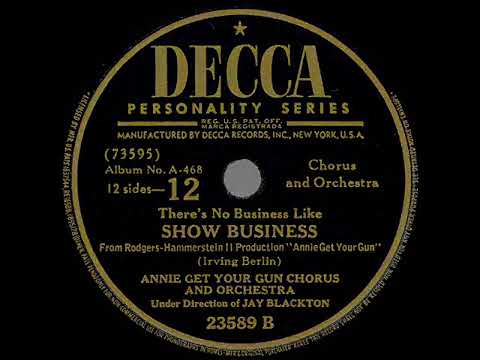
Annie Get Your Gun (1946) - stage musical - diegetic-adjacent. The company sings it inside the story to persuade Annie to join the show, which means the number is both plot action and a piece of entertainment. That double duty is why it pops: the characters need it to work, so the staging usually treats the chorus like a traveling machine, gears clicking into place.
Berlin keeps the musical line simple enough for massed voices, then lets the rhythm do the swaggering. You can hear the tune like a parade step: bright, steady, and slightly insistent. The lyric is the real trick. It does not pretend show life is easy; it reframes difficulty as proof of belonging. In rehearsal rooms, I have seen this number used as a diagnostic: if a company cannot sing it with shared intention, something else in the show is not locked yet.
Key takeaways
- Function: a recruitment anthem that sells Annie on the stage life while selling the audience on the show.
- Sound: chorus-driven Americana with brass-friendly contours and a march-like spine.
- Theatrical pay-off: a statement of identity for performers who survive by turning work into spectacle.
Creation History
Berlin wrote the song for the 1946 production, and published accounts note orchestration credit tied to Ted Royal. The number quickly outgrew its first staging, becoming a concert and television staple for Ethel Merman and later turning into the title for a 1954 film musical. As stated in the Irving Berlin official show page, the score's big titles stayed central across revivals and adaptations, and this one is the loudest handshake in the bunch.
Song Meaning and Annotations
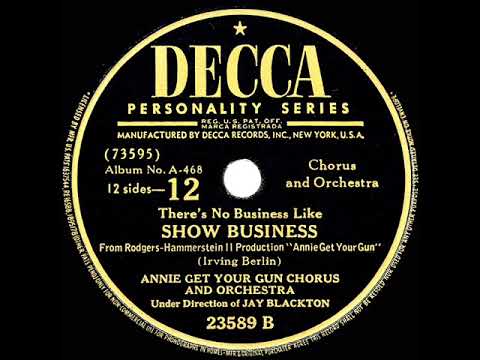
Plot
The Wild West show wants Annie. She has talent, and talent sells tickets. The company sings to tempt her into the troupe, presenting touring life as thrilling rather than exhausting. The number also signals the musical's main engine: fame is manufactured in public, one cheering crowd at a time.
Song Meaning
The meaning is the contradiction it proudly carries. The lyric admits the grind, then answers with loyalty: performers complain, then step back into the light. In other words, the song is not only a celebration of show life - it is an explanation for why people accept its terms. The chorus lands like a vow made in company, not in private.
Annotations
The company sings to persuade Annie to join Buffalo Bill's Wild West show, and the number returns as reprises during the evening.Plot-and-structure note, rewritten
The reprise idea matters. A first pass sells the dream; later passes remind the characters, and the audience, that the dream is also a job. Each return can be staged with a slightly altered temperature: bright at first, tougher later, then triumphant when the show needs to rally.
The song became one of Ethel Merman's standards and was often performed in concerts and on television, including a major 1953 broadcast.Performance history note, rewritten
This is the moment when a stage number becomes a cultural calling card. The tune is built for a big personality and a big room, and Merman's association helped it live outside its scene. I cannot blame later performers for borrowing her authority - the song invites it.
Genre and rhythm
The style is Broadway Americana with a strong chorus profile. The driving pulse is steady enough for marching entrances and crisp group diction. Even when arrangements vary, the song tends to keep that forward push, because the lyric is a pitch and a pitch cannot sag.
Key images and subtext
The lyric treats show business as a place and a tribe. It is less a profession than a hometown that travels. The subtext, especially in a staged production, is that Annie is being asked to trade privacy for applause. The company presents that bargain as a privilege.
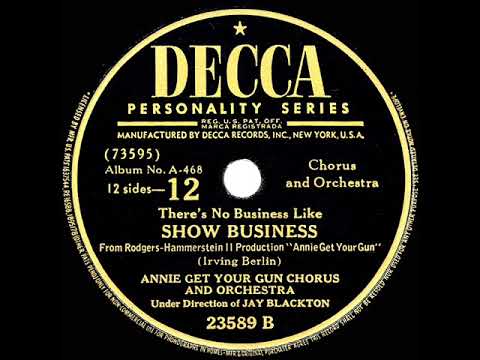
Technical Information (Quick Facts)
- Song: There's No Business Like Show Business
- Artist: Buffalo Bill's Wild West company (cast and chorus vary by recording)
- Featured: ensemble-driven (company number)
- Composer: Irving Berlin
- Producer: varies by recording/label
- Release Date: published 1946; notable charting recording recorded March 19, 1947 (Andrews Sisters with Bing Crosby and Dick Haymes)
- Genre: musical theater; pop standard
- Instruments: voice and orchestra
- Label: varies by recording
- Mood: bright, persuasive, company-proud
- Length: about 3 minutes on common cast album versions (varies by edition)
- Track #: cast albums place it early-to-mid sequence depending on edition
- Language: English
- Album (if any): 1946 original Broadway cast recording; 1954 film soundtrack titled with the song
- Music style: chorus anthem with march-like propulsion
- Poetic meter: accentual, chorus-forward (stage diction drives the stresses)
Frequently Asked Questions
- Who sings the song in the stage story?
- Members of Buffalo Bill's Wild West company sing it to persuade Annie to join the troupe.
- Is it a backstage confession or a public performance?
- Both in effect: it is sung inside the story as persuasion, and staged like a showpiece that can stop traffic.
- Why does the number return as reprises?
- Reprises let the show revisit the same slogan with changed circumstances, so the audience hears the cost and the pride in different lights.
- Did the song become famous outside the musical?
- Yes. It became strongly associated with Ethel Merman and was repeatedly performed in concerts and on television.
- Which recording reached the Billboard charts?
- Reference histories point to the Andrews Sisters recording with Bing Crosby and Dick Haymes as the version that briefly charted.
- Is it connected to a film title?
- Yes. A 1954 film musical took the song as its title, and the soundtrack album reflects that branding.
- What is the dramatic pressure under the cheer?
- The company is asking Annie to accept a life where her talent becomes a product, and applause becomes both reward and requirement.
- What should a listener focus on in a stage recording?
- How the chorus locks together on consonants and cutoffs. The number works when a group sounds like a single engine.
- Why do arrangers keep the pulse so steady?
- Because the lyric is a pitch. A pitch needs momentum, and the staging often relies on entrances, banners, and mass movement.
Awards and Chart Positions
As a single, the clearest Billboard pop-chart footprint commonly cited is the 1947 Andrews Sisters recording featuring Bing Crosby and Dick Haymes, which reached No. 25. As a cast-album track, it sits on the 1946 original Broadway cast recording, an album that reached No. 2 on Billboard's Best-Selling Popular Record Albums chart. Those two facts tell the story: the song could live as both a show moment and a radio-era standard.
| Release | Chart | Peak |
|---|---|---|
| The Andrews Sisters with Bing Crosby and Dick Haymes (1947) | US Billboard (pop charts, as cited in reference histories) | 25 |
| Annie Get Your Gun original Broadway cast recording (1946) | US Billboard Best-Selling Popular Record Albums | 2 |
Additional Info
The song's afterlife is almost a second career. Ethel Merman kept it close as a signature, and the number became a shorthand for the whole idea of stage life. One widely repeated anecdote places her singing it for a massive live television audience in 1953, which captures why the tune travels so well: it can be sung by a company in costume or by a single star at a microphone, and it still reads like a banner unfurling.
Covers range from pop and jazz to slow, lyric-complete readings that treat the verses as more than setup for the chorus. Scott Yanow's liner-note commentary on a later version points out how drastically the song can change when you stop treating it as a fast romp and let the full lyric speak.
Key Contributors
| Entity | Type | Relation (S-V-O) |
|---|---|---|
| Irving Berlin | Person | Berlin wrote the music and lyrics for the number. |
| Ted Royal | Person | Royal is credited with orchestration in reference histories for the song. |
| Buffalo Bill's Wild West company | Organization | The company sings the number to recruit Annie Oakley inside the story. |
| Annie Oakley | Person | Oakley is the character being persuaded to join the troupe. |
| Ethel Merman | Person | Merman popularized the number as a recurring performance staple. |
| The Andrews Sisters | MusicGroup | The Andrews Sisters recorded a version that reached the Billboard charts in 1947. |
| Bing Crosby | Person | Crosby featured on the charting Andrews Sisters recording. |
| Dick Haymes | Person | Haymes featured on the charting Andrews Sisters recording. |
| There's No Business Like Show Business (1954) | Work | The 1954 film musical used the song as its title and centerpiece branding. |
How to Sing There's No Business Like Show Business
This number can be sung by a single star, but it is built for a crowd. A common published vocal arrangement lists C major as the original key and a vocal range of B3 to E5. Use that information like a staging note: the tune wants clarity in the middle and enough ring above the staff to cut through brass.
- Tempo: keep it moving. The chorus is a pitch, and a pitch needs forward drive. Do not let it turn into a slow sermon.
- Diction: drill the consonants as a group. The charm is in unanimous articulation, especially on repeated phrases.
- Breath: plan stagger breathing in ensemble moments so the sound never thins. The audience should feel a wall of intent.
- Rhythm: lock the cutoffs. Sloppy releases make the number sound like rehearsal rather than performance.
- Style: aim for bright, speech-friendly vowels. If everyone sings with operatic weight, the lyric loses its grin.
- Character: treat the chorus as a collective oath. Even if the staging is comic, the company must believe what it is selling.
- Mic and balance: if amplified, keep the chorus from overpowering principals. The number should feel communal without flattening the scene's focus.
- Pitfalls: avoid pushing the top notes early. Save the biggest ring for the last chorus when the banner needs to fly.
Sources
Sources: Wikipedia - There's No Business Like Show Business, Wikipedia - Annie Get Your Gun (original Broadway cast recording), Irving Berlin official show page, Musicnotes sheet music listing, Apple Music - There's No Business Like Show Business (Original 1954 Motion Picture Soundtrack)
Music video
Annie Get Your Gun Lyrics: Song List
- Act 1
- Overture
- Colonel Buffalo Bill
- I'm a Bad, Bad Man
- Doin' What Comes Natur'lly
- Girl That I Marry
- You Can't Get a Man With a Gun
- There's No Business Like Show Business
- They Say It's Wonderful
- Moonshine Lullaby
- I'll Share It All With You
- There's No Business Like Show Business (Reprise)
- My Defenses Are Down
- I'm an Indian, Too
- Act 2
- I Got Lost in His Arms
- Who Do You Love, I Hope
- I Got the Sun in the Morning
- Old Fashioned Wedding
- Anything You Can Do
- Finale