

One Foot, Other Foot Lyrics
One Foot, Other Foot
[ENSEMBLE, spoken]One foot, other foot
One foot, other foot
[ENSEMBLE]
Now you can go wherever you want
Wherever you want to go
One foot out and the other foot out
That's all you need to know
Now you can do whatever you want
Whatever you want to do
Here you are in a wonderful world
Especially made for you
Especially made for you
Now you can march around the yard
Shout to all the neighborhood
Tell the folks you're feeling good
Folks ought to know when boys feel good
Now you can imitate a dog
Chase a bird around a tree
You can chase a bumblebee
Once is enough to chase a bee
Now you can play among the flowers
Grab yourself a hunk of dirt
Smudg? it on your mother's skirt
That little dirt won't hurt a skirt
[ENSEMBLE, spoken]
One foot, oth?r foot
One foot, other foot
[ENSEMBLE]
Now you can do whatever you want
Whatever you want to do
Here you are in a wonderful world
Especially made for you
Especially made for you
[WOMEN]
Especially made for you
To walk in, to run in
To play in the sun in
[MEN]
Especially made for you
For now you can walk
You taught yourself to walk
You puzzled it out yourself
And now you can walk
[ENSEMBLE, spoken]
One foot, other foot
One foot, other foot
One foot, other foot
One foot, other foot
[ENSEMBLE]
Now you can go wherever you want
Wherever you want to go
One foot out and the other foot out
One foot out and the other foot out
One foot out and the other foot out
And the world belongs to Joe
And the world belongs to Joe!
Song Overview
Review and Highlights
Quick summary
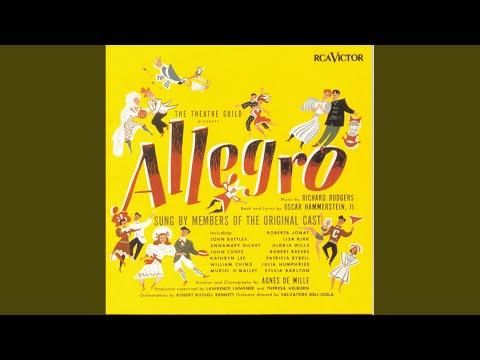
- Work: Allegro (Broadway musical, 1947) by Richard Rodgers (music) and Oscar Hammerstein II (book and lyrics).
- Number: "One Foot, Other Foot" - an ensemble passage tied to young Joe's first steps.
- Stage moment: Grandma Taylor spots the baby upright and the chorus turns a wobble into a civic-sized victory.
- What makes it distinct: It is a march you can picture. The beat teaches the body what to do.
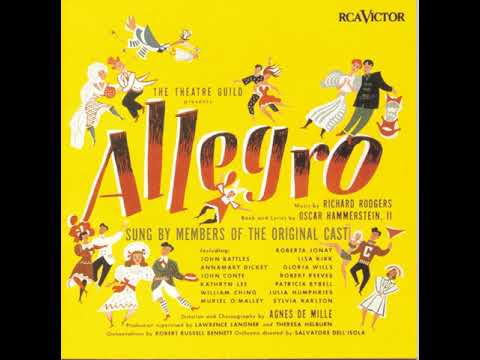
Allegro (1947) - stage musical - non-diegetic. Early Act 1: Grandma Taylor notices baby Joe preparing to walk, and the community chorus celebrates the first steps as a sudden, thrilling claim on the world. The show is built around chorus commentary, so this number is not just cute business. It is the method statement: life events get translated into rhythmic public narration.
The craft here is deceptively strict. Hammerstein writes short, action-forward clauses, then repeats the title phrase until it stops sounding like a nursery game and starts sounding like a life engine. Rodgers answers with a tune that sits comfortably in a communal mouth: clear stresses, tidy melodic turns, and a pulse that keeps everyone marching in the same direction. I like how it frames "independence" as something learned by doing, not by being told. Even the melody seems to practice with you.
Creation History
Allegro opened at the Majestic Theatre on October 10, 1947, with a form-forward approach that leaned on a large chorus to narrate Joe Taylor Jr.'s life. On the official Rodgers and Hammerstein song page, the scene description pins this number to Grandma Taylor observing Joe's first steps and celebrating his new mobility. That staging idea, turned into a march, is the whole trick: movement becomes story, and story becomes tempo.
Song Meaning and Annotations
Plot
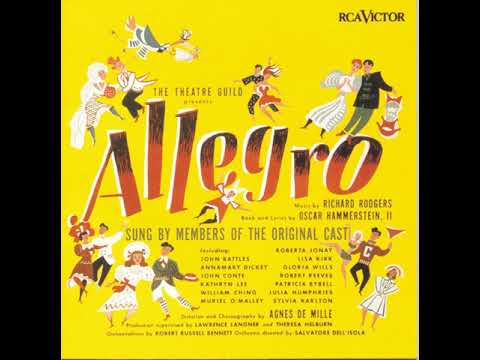
Allegro traces Joseph Taylor Jr. from birth to adulthood, using chorus commentary to compress time and to judge the choices made along the way. In Act 1, the musical shows early milestones as public rituals: the town celebrates, instructs, and quietly claims ownership of the narrative. This number sits at the childhood threshold - the first time Joe moves under his own power, witnessed and amplified by others.
Song Meaning
On paper it is about walking. In practice it is about permission. A baby takes a step, and the community treats it as proof that the world is open and reachable. But the form hints at a second idea: once you can move, you can also be steered. The title phrase repeats like a metronome, and the metronome is both comforting and directive. The emotional arc goes from wonder to momentum - that heady shift when "I can" quickly becomes "I must."
Annotations
"Pudgy legs begin to grow long ... you’re struck with a daring idea!"
This opening is pure Hammerstein: a concrete image, then a quick pivot into agency. The lyric does not romanticize childhood. It reports it, then lets the report blossom into action.
"Now you can go wherever you want ... that’s all you need to know!"
The line reads like a pep talk, and it lands like a rule. The trick is the phrasing: freedom is stated as a simple mechanical sequence. Step, step, repeat.
"And the world belongs to Joe!"
Big claim, sung fast. In Allegro, that speed matters. The show keeps asking whether the world "belonging" to you is a gift, a burden, or a sales pitch.
Style and rhythm
It is a march with a childlike surface and an adult spine. The steady beat lets staging do half the storytelling: bodies crossing, a chorus tracking the moment, the idea of progress rendered in synchronized time.
Emotional tone
Bright and forward. The joy is real, but it is framed by a chorus that never stops moving, which makes the cheer feel like the first gear in a much larger machine.
Production and staging notes
The number is frequently cited as an example of Allegro's chorus-led storytelling. Masterworks Broadway, discussing the score's variety, points to the piece as the show's march. That is a useful lens: it is less a "song about walking" than a musicalization of forward motion itself.
Technical Information (Quick Facts)
- Song: One Foot, Other Foot
- Artist: Allegro ensemble (original Broadway cast recording editions), and later studio cast versions
- Featured: Ensemble; scene anchored by Grandma Taylor in the stage action
- Composer: Richard Rodgers
- Producer: Eli Oberstein (original cast recording credits on major digital listings)
- Release Date: October 19, 1947 (commercial recording date often listed for the original cast album); stage premiere October 10, 1947
- Genre: Broadway musical; show tune; march
- Instruments: Orchestra and chorus
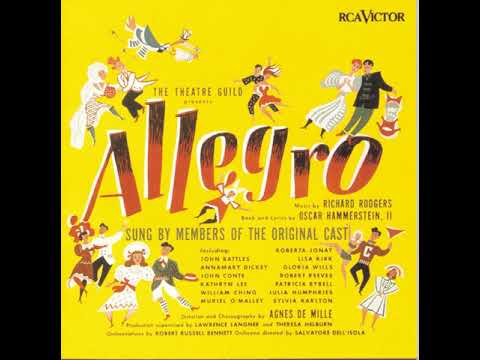
- Label: RCA Victor (original cast album issues, with later reissues)
- Mood: Buoyant, driving, forward-motion energy
- Length: About 3 minutes 10 seconds (remastered track timing varies slightly by edition)
- Track #: Often Track 2 on the 1947 original cast album sequence
- Language: English
- Album (if any): Allegro (Original 1947 Broadway Cast Recording)
- Music style: Chorus-led march built on refrain repetition
- Poetic meter: Accentual, with strong downbeats aligned to movement
Frequently Asked Questions
- Where does this number sit in the story?
- It appears early in Act 1, when baby Joe is learning to walk and the chorus frames the milestone as a turning point.
- Who wrote it?
- Music is by Richard Rodgers, with lyrics by Oscar Hammerstein II.
- Is it a solo?
- It is typically presented as an ensemble piece, with the stage action centered on Grandma Taylor witnessing Joe's steps.
- Why does the title phrase repeat so much?
- The repetition works like a metronome: it lets choreography read clearly and makes progress feel physical, not abstract.
- Is this the same recording as the 2009 studio set?
- No. The 2009 "first complete recording" is a studio project with an all-star cast, separate from the original 1947 Broadway cast album.
- Does the song appear in the finale?
- Yes, the show's finale sequence is often noted for bringing back key musical material, including this motif, as a way to close the life-arc frame.
- What is the musical style in plain terms?
- A Broadway march: steady beat, clear diction, and a tune designed for group singing and stage movement.
- Are there notable pop chart versions of this specific song?
- Not in the usual chart record. The better-known pop crossovers from Allegro tend to be different songs from the score.
Awards and Chart Positions
This song is a theatre number, not a chart single. The show around it, however, picked up major recognition: the official Rodgers and Hammerstein production record lists Donaldson Award wins for Best Book of a Musical (Hammerstein), Best Lyrics (Hammerstein), and Best Score (Rodgers). That matters for this piece because it is a textbook example of the team's formal ambition: narrative told by chorus, time compressed by rhythm, character built through communal commentary.
| Award | Category | Recipient | Result |
|---|---|---|---|
| Donaldson Awards | Best Book of a Musical | Oscar Hammerstein II | Winner |
| Donaldson Awards | Best Lyrics | Oscar Hammerstein II | Winner |
| Donaldson Awards | Best Score | Richard Rodgers | Winner |
Additional Info
The official song page supplies the cleanest dramatic capsule: Grandma Taylor sees Joe standing, and the number celebrates the accomplishment as a first taste of independence. But the show is rarely content with a single reading. The chorus that cheers can also crowd the frame, and Allegro keeps returning to that tension later - how much of a life is self-directed, and how much is coached by applause.
There is also a recording-history footnote worth having: the original cast album was issued in the late 1940s in a heavily abridged form, and a later "first complete recording" was released in 2009 as a studio project with a prominent cast. If you have only heard the studio set, the earlier album can feel like a postcard version of the show: vivid, selective, and over quickly.
As stated in Masterworks Broadway's notes on the score, this number is singled out as the march in Allegro - which is a tidy way of describing its job. The march does not only color the scene. It tells you how the show intends to move.
Key Contributors
| Entity | Type | Relationship (S-V-O) |
|---|---|---|
| Richard Rodgers | Person | Rodgers - composed - One Foot, Other Foot |
| Oscar Hammerstein II | Person | Hammerstein - wrote lyrics for - One Foot, Other Foot |
| Agnes de Mille | Person | de Mille - directed and choreographed - Allegro (1947 Broadway) |
| Majestic Theatre | Venue | Majestic Theatre - hosted - Allegro (Oct 10, 1947 to Jul 10, 1948) |
| Eli Oberstein | Person | Oberstein - produced - Allegro original cast recording sessions |
| Rodgers and Hammerstein catalog | Organization | Catalog - documents and licenses - Allegro songs |
Sources
Sources: Rodgers and Hammerstein official song page (One Foot, Other Foot); IBDB production record (Allegro, Majestic Theatre, 1947); Rodgers and Hammerstein official production page (honors and awards); Apple Music track listing for Allegro (Original 1947 Broadway Cast Recording); Discogs release notes for the 1947 cast album; Masterworks Broadway editorial notes on Allegro.