

Joseph Taylor, Jr Lyrics
Joseph Taylor, Jr
[ENSEMBLE]The lady in bed is Marjorie Taylor
Doctor Joseph Taylor's wife
[SOLO SOPRANO]
Except for the day when she married Joe
This is the happiest day of her life
[ENSEMBLE]
Except for the day when she married Joe
This is the happiest day of her life
[MEN]
His hair is fuzzy, his eyes are blue
His eyes may change—they often do
He weighs eight pounds and an ounce or two—
Joseph Taylor, Junior
[WOMEN]
When he wakes up h? wants to eat
And when he sleeps h? wets his seat
But you'd forgive anyone as sweet
As Joseph Taylor, Junior
[GRANDMA TAYLOR]
Starting out so foolishly small
It's hard to believe you will grow at all
It's hard to believe that things like you
Can ever turn out to be men
But I've seen it happen before
So I know it can happen again
Food and sleep and plenty of soap
Molasses and sulfur, and love and hope
The winters go by, the summers fly
And all of a sudden you're men
I have seen it happen before
And I know it can happen again
And I know it can happen again
Song Overview
Review and Highlights
Quick summary
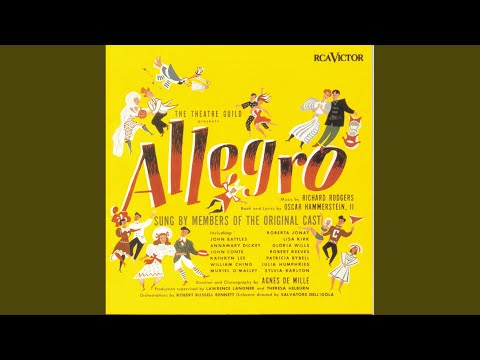
- Work: Allegro (Broadway musical, 1947) by Richard Rodgers (music) and Oscar Hammerstein II (book and lyrics).
- Number: "Joseph Taylor, Junior" (often paired on recordings with "I Know It Can Happen Again").
- Dramatic job: A birth announcement turned chorus-driven thesis statement: the town names a baby, then keeps naming him as life speeds up.
- Signature device: The title phrase functions like a hook and a label, a running tag the show can pull back in later scenes.
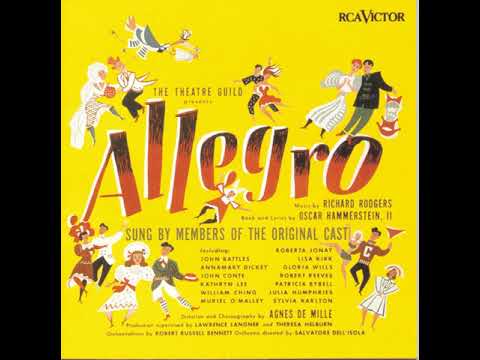
Allegro (1947) - stage musical - non-diegetic. Opening sequence, early Act 1: the community chorus celebrates the birth of Joseph Taylor Jr. and frames him as a public project as much as a private child. The effect is sly: it sounds like a party, but it also warns you how quickly a person can get drafted into other people's plans.
This is not Rodgers and Hammerstein in picnic mode. The writing stays brisk and declarative: the town sings as if it is reading a civic proclamation, and the rhythm has that march-like certainty that can feel comforting until it starts to feel compulsory. The tune is built to travel well through a big ensemble, which matters in a show that likes to think in crowds. Even when you hear it as a standalone track, you can sense the staging logic behind it: bodies in motion, lines forming, the community stepping forward to claim the narrative. As stated in the official Rodgers and Hammerstein song notes, the lyric repeats the name with deliberate insistence, and the repetition is the point: identity as a chant you inherit.
Creation History
Allegro opened on Broadway in October 1947 at the Majestic Theatre, with Agnes de Mille directing and choreographing, and it arrived with the kind of anticipation that only a Rodgers and Hammerstein follow-up can generate. According to Playbill's production record, the original Joseph Taylor Jr. was played by John Battles, and the show used an unusually prominent chorus to narrate and comment. The number "Joseph Taylor, Junior" sits right at the front of that concept, establishing the piece as a life story told with theatrical shorthand rather than literal realism.
Song Meaning and Annotations
Plot
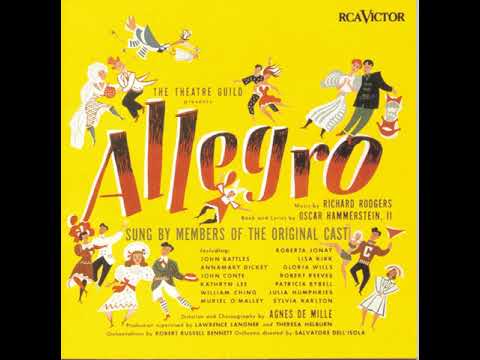
Allegro tracks Joseph Taylor Jr. from birth in a small town to adulthood, where success and status start steering his choices. The musical keeps returning to the question of who gets to define "Joe": family, community, career, romance, and the city itself. "Joseph Taylor, Junior" is the overture in narrative form: before the boy can speak, the town speaks him into being.
Song Meaning
The surface is celebratory: bells, congratulations, a newborn announced like a headline. Underneath, it is an anatomy of expectation. A name becomes a drumbeat, and the drumbeat becomes a destiny. The mood is bright, but the structure is clinical: each repetition of the full name nudges the character from personhood toward role. Style-wise, it fuses Broadway ensemble writing with a chorus-as-narrator approach: tight rhythms, communal unanimity, and a forward-driving pulse that makes the future feel inevitable.
Annotations
"Ring out, ring out, oh bells of joy... Joseph Taylor, Junior!"
Hammerstein writes the town like an instrument section: short phrases, clear stresses, and a refrain that can land on a dime. The bells are not only sound effects, they are social cues. This is a community that knows exactly when you are supposed to applaud, and why.
"He may grow older - they often do."
The joke lands because it is true and trivial at once. That is the number's quiet bite: it treats life events as predictable bullet points, which is funny until the show starts treating the character's moral choices the same way.
"Joseph Taylor - Junior!"
That clipped end-stop gives the line a stamped quality, like a file label. It is a naming ceremony, but it also sounds like an administrative act. The hook is theatrical, but it is also thematic: the show is about how a person can get processed by ambition, marriage, and workplace culture.
Genre and rhythm
Think of it as a choral march with Broadway swing in its phrasing: the rhythm keeps the ensemble unified, and the melody is designed for clarity more than ornament. That choice is dramatic. When the chorus moves as one, the character's individuality has less oxygen.
Emotional arc
It starts as a toast. It ends as a template. The number plants the idea that Joe's life is being narrated at him, and Allegro spends the evening testing whether he can reclaim the script.
Cultural touchpoints
Postwar Broadway was flirting with form experiments, and Allegro is a notable case: chorus commentary, pared-down scene transitions, and a willingness to sound moralistic on purpose. A later generation of theater-makers kept borrowing the idea that a musical could argue with itself in public, rather than just entertain in private.
Technical Information (Quick Facts)
- Song: Joseph Taylor, Junior
- Artist: Allegro original Broadway cast and ensemble (featured: John Battles as Joseph Taylor Jr.)
- Featured: Chorus and principals (opening ensemble focus)
- Composer: Richard Rodgers
- Producer: Cast-album production varies by edition (original cast album commonly issued under RCA Victor; later reissues by catalog labels)
- Release Date: October 10, 1947 (stage premiere); cast recording released in the late 1940s with later remastered editions
- Genre: Broadway musical; show tune
- Instruments: Orchestra (pit ensemble typical of the period); vocal chorus
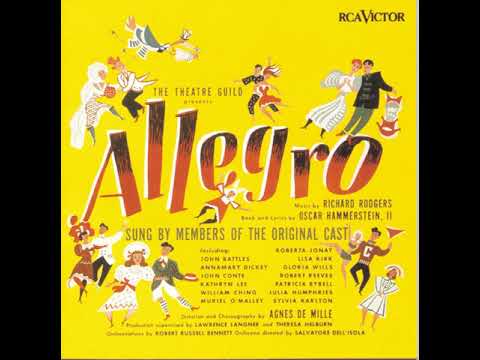
- Label: RCA Victor (original cast album editions)
- Mood: Celebratory, insistent, civic-march energy
- Length: Varies by release (often around 2 minutes for the standalone opening; some editions pair it with the next number)
- Track #: Usually Track 1 (opening)
- Language: English
- Album: Allegro (Original Broadway Cast Recording)
- Music style: Chorus-driven opening number with refrain-based construction
- Poetic meter: Predominantly accentual with strong downbeats (choral march feel)
Frequently Asked Questions
- Is "Joseph Taylor, Junior" the same as "Allegro"?
- No. Allegro is the show title. "Joseph Taylor, Junior" is an opening number within the musical.
- Who is Joseph Taylor Jr. in the story?
- He is the central figure whose life the musical follows from birth into adulthood, framed as an Everyman shaped by ambition and community pressure.
- Who performed Joseph Taylor Jr. on Broadway in 1947?
- John Battles originated the role in the 1947 Broadway production.
- Why does the chorus keep repeating the full name?
- The refrain is a dramatic tool: it turns identity into a slogan, suggesting that other people are writing Joe's life plan before he can.
- Is this number meant to be funny?
- Partly. The humor comes from the brisk, matter-of-fact lyric turns. But the comedy doubles as critique: life reduced to a cheerful checklist.
- Does the song stand alone well outside the show?
- It works as a compact opener, but its full punch lands when you hear it as the first move in a long argument the show has with success culture.
- What musical style is it closest to?
- A chorus-led Broadway march: clean diction, strong downbeats, and a hook built for a roomful of voices.
- Why do some recordings pair it with another song?
- Some releases join it with "I Know It Can Happen Again" to preserve the opening sequence flow, reflecting how the show moves scene-to-scene.
- Is there a film or TV adaptation where this exact recording appears?
- No widely documented major film adaptation is commonly credited with using the original 1947 cast recording for this number.
- What is the dramatic function of the number in one sentence?
- It introduces Joe as a person already claimed by other people's expectations.
Awards and Chart Positions
Do not look to this number for pop-chart heroics; cast-album tracks from 1947 rarely traveled that route. The show, however, did earn formal industry recognition: the 1947-48 Donaldson Awards honored Allegro for Best Book of a Musical (Hammerstein), Best Lyrics (Hammerstein), and Best Score (Rodgers). That is a tidy summary of why "Joseph Taylor, Junior" matters: it is a thesis number from a writers' project, and the project was taken seriously even when the box office was less charitable.
| Award | Category | Recipient | Result |
|---|---|---|---|
| Donaldson Awards | Best Book of a Musical | Oscar Hammerstein II | Winner |
| Donaldson Awards | Best Lyrics | Oscar Hammerstein II | Winner |
| Donaldson Awards | Best Score | Richard Rodgers | Winner |
Additional Info
The character name "Joseph Taylor Jr." is a dramaturgical boomerang: it flies out as celebration, then keeps returning as reminder. A later observer put it plainly when discussing the score's construction: the opening phrase behaves like a leitmotif, resurfacing at key points to keep the life-story frame intact. That is the number's craft lesson for theater fans: a musical can treat a name the way opera treats a theme, and the result can feel both catchy and unsettling.
For the historically curious: the original production is frequently described as an experiment in form, with chorus commentary and staging choices that aimed for abstraction rather than literal scene painting. In other words, the opening chorus is not just a musical choice, it is a staging contract. Sign it, and the evening can move like memory: fast, selective, communal.
Key Contributors
| Entity | Type | Relationship (S-V-O) |
|---|---|---|
| Richard Rodgers | Person | Rodgers - composed - "Joseph Taylor, Junior" |
| Oscar Hammerstein II | Person | Hammerstein - wrote lyrics and book for - Allegro |
| Agnes de Mille | Person | de Mille - directed and choreographed - Allegro (1947 Broadway) |
| John Battles | Person | Battles - originated - Joseph Taylor Jr. (role) |
| Majestic Theatre | Venue | Majestic Theatre - hosted - Allegro (1947 Broadway) |
| RCA Victor | Organization | RCA Victor - released - original cast album editions |
| Concord (Rodgers and Hammerstein catalog) | Organization | Concord - licenses and documents - Allegro and its songs |
Sources
Sources: Official Rodgers and Hammerstein song page for "Joseph Taylor, Junior"; Playbill production record for Allegro (Majestic Theatre, 1947); Masterworks Broadway album notes for Allegro (1947 original cast recording); Concord Theatricals show description and licensing page; Apple Music album listing for Allegro (original 1947 Broadway cast recording); New York Public Library Digital Collections (production photography).