

Winters Go By Lyrics
Winters Go By
The winters go by,The summers fly,
And soon you're a student in "High"!
And now your clothes are spotlessly clean,
Your head is anointed with brilliantine. . .
You're brimming with hope
But can't quite cope
With problems that vex and perplex,
For you don't quite know how to treat
The bewild'ringly opposite sex.
What do you suppose Jenny would do if you kissed her?
Jenny is so innocent, so frail!
You could crush her in your strong, manly arms. . .
But that wouldn't be right.
Besides she might get sore~
Might yell, and wake up her old man!
(Poor Joe!
The older you grow,
The harder it is to know
What to think,
What to do,
Where to go!)
Heigh-ho! It would be nice. . .
Think about it as you walk home.
Make believe you did it,
And make out she wasn't mad
When you kissed her.
Gee, wouldn't it be wonderful
If girls liked it too!
Song Overview
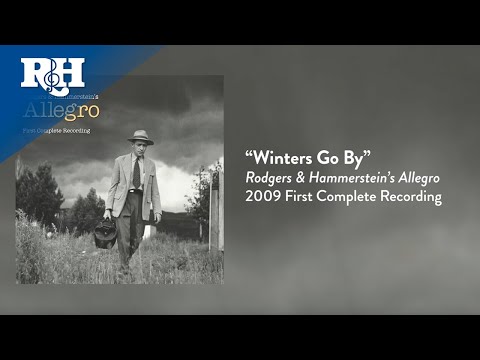
Review and Highlights
Quick summary
- Work: Allegro (Broadway musical, 1947) by Richard Rodgers (music) and Oscar Hammerstein II (book and lyrics).
- Number: "Winters Go By" - a time-lapse device inside Act I.
- Stage job: It pushes the story forward in a handful of bars, moving Joe from childhood into adolescence and courtship.
- Common modern reference point: The 2009 complete studio recording spotlights the song as a concise narrative hinge.
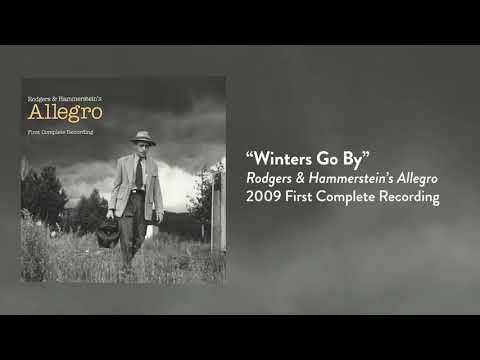
Allegro (1947) - stage musical - non-diegetic. Mid Act I, after Grandma Taylor's death: the chorus compresses time and drops us into a new chapter of Joe's life. It is not a ballad that asks for your patience. It is theatre shorthand with a tune attached, the kind that can flip the calendar before the audience has finished blinking.
Rodgers writes with a practical eye: keep the line singable, keep the pulse moving, do not linger. Hammerstein does the rest with a simple, season-based image that feels folksy until you notice the craft. Seasons repeat. People change. Then, suddenly, they do not. That is the show’s quiet warning - life can be rushed by routine and obligation, and the chorus can sound like comfort while it hustles you onward. According to the Rodgers and Hammerstein official synopsis, the song sits right at the point where Joe is now in high school and dating Jennie, and the narrative has already sprinted past childhood.
Creation History
Allegro opened on Broadway on October 10, 1947, building its storytelling around chorus commentary and fast-moving transitions. This number is a pure example of that technique: it is less a stand-alone showcase and more a scenic conveyor belt. In the 2009 complete studio recording (documented on the official Rodgers and Hammerstein recording page), the track is credited to Marni Nixon with the ensemble, which frames it as a memory-voice as much as a plot device.
Song Meaning and Annotations
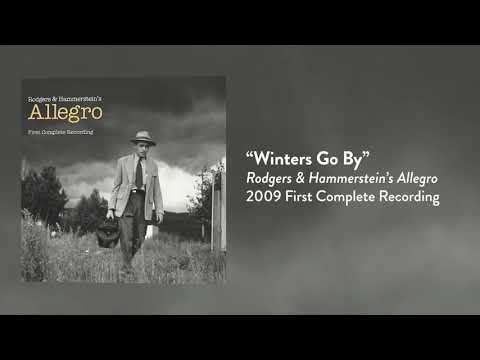
Plot
Allegro traces Joseph Taylor Jr. from birth through a life shaped by community, ambition, romance, and professional pressure. The chorus acts as narrator and commentator, skipping years when realism would stall the evening. Here, time passes after a family loss, and the story arrives at Joe as a teenager, with Jennie Brinker now central to his social world.
Song Meaning
"Winters Go By" argues that time is both ordinary and ruthless. The image of seasons gives the lyric a familiar coat, but the dramatic function is sharper: it shows how quickly a person can be carried from innocence into the confusing choreography of adolescence. The mood stays brisk rather than mournful, which is the sly part. The song does not stage grief as a set piece. It shows the cost in the way it moves past it.
Annotations
"Years pass."
That is the whole trick, and it is very Allegro. The chorus does not ask permission. It edits the story, like a stage manager calling the next cue while the previous emotion is still in the air.
"Winters go by."
Hammerstein uses the plainest phrase imaginable, then lets the audience supply the weight. We all know what it means: repetition, routine, and the little shocks hidden inside familiarity.
Driving rhythm and style
Think of it as narrative percussion. The musical line stays uncluttered so the staging can do the heavy lifting: a shift of light, a change of spacing, a new set of bodies, and you are in a different year. The chorus becomes the calendar.
Emotional arc
From loss into forward motion. The song can feel almost reassuring in its steadiness, and that steadiness is part of the critique. The show keeps returning to the idea that life moves on whether you are ready or not.
Historical touchpoints
Postwar Broadway was experimenting with form, and Allegro is a key example: chorus-as-narrator, compressed scenes, and an interest in social pressure as drama. As stated in the Library of Congress finding aid for the Richard Rodgers Collection, there is an arranger's full score for this number among the show materials, a reminder that the piece was built with practical stage timing in mind, not just melodic charm.
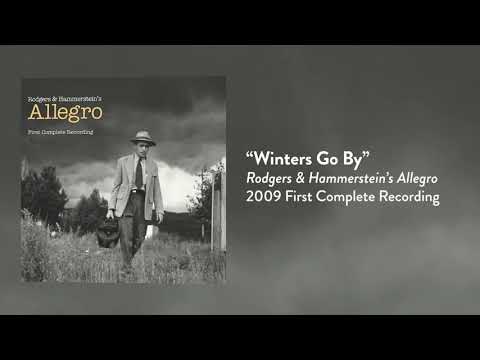
Technical Information (Quick Facts)
- Song: Winters Go By
- Artist: Allegro ensemble (stage concept); common recorded credit: Marni Nixon with ensemble (2009 studio recording)
- Featured: Ensemble narration; often framed around Grandma Taylor's viewpoint in the surrounding sequence
- Composer: Richard Rodgers
- Producer: Studio album production varies by edition; 2009 complete recording is released under the Rodgers and Hammerstein catalog via Concord distribution
- Release Date: October 10, 1947 (stage premiere); February 3, 2009 (complete studio recording release date)
- Genre: Broadway musical; narrative chorus number
- Instruments: Orchestra and chorus
- Label: Rodgers and Hammerstein catalog (Concord)
- Mood: Reflective, brisk, time-moving
- Length: About 51 seconds (2009 studio recording track timing)
- Track #: Commonly Track 9 on the 2009 complete recording sequence
- Language: English
- Album (if any): Allegro (First Complete Recording)
- Music style: Time-lapse chorus writing with clear stresses and minimal ornament
- Poetic meter: Accentual, timed to quick scene transition
Frequently Asked Questions
- Where does this song land in Allegro?
- In Act I, after Grandma Taylor's death, it advances time and places Joe in high school with Jennie now in focus.
- Is it a solo showcase?
- On stage it functions primarily as ensemble narration, even when a recording highlights a lead voice.
- Why is it so short on the complete studio album?
- Because it is built as a transition cue. Its job is to move the story, not to stop it for applause.
- Who wrote it?
- Richard Rodgers composed the music and Oscar Hammerstein II wrote the lyrics.
- Is there a reprise?
- Yes, the score includes a "Winters Go By (Reprise)" later in the show, reinforcing the passage-of-time idea.
- What is the main dramatic idea?
- Time advances regardless of readiness, and the chorus can make that advance feel both comforting and relentless.
- Which recording is most commonly linked online?
- The Rodgers and Hammerstein channel upload points to the 2009 complete studio recording, performed by Marni Nixon with ensemble.
- Does it have a pop chart history?
- No notable chart record attaches to this track; the show’s pop crossovers are associated with different songs from the score.
- What makes it feel different from a typical Broadway ballad?
- It is written like narrative editing: steady pulse, clear text delivery, and minimal decorative detours.
Awards and Chart Positions
This number is a narrative bridge, not a single built for radio-era rankings. The larger project, however, earned formal recognition. The Rodgers and Hammerstein production record for Allegro lists Donaldson Award wins for Best Book of a Musical (Hammerstein), Best Lyrics (Hammerstein), and Best Score (Rodgers). For a show often discussed as an experiment, that trio of wins is telling: the ambition was visible, and it was judged on writing craft.
| Award | Category | Recipient | Result |
|---|---|---|---|
| Donaldson Awards | Best Book of a Musical | Oscar Hammerstein II | Winner |
| Donaldson Awards | Best Lyrics | Oscar Hammerstein II | Winner |
| Donaldson Awards | Best Score | Richard Rodgers | Winner |
How to Sing Winters Go By
Performance notes vary by edition, but one widely cited set of listening metrics for the Rodgers and Hammerstein channel recording places the tempo around 107 BPM and the key in A major. Treat this as a rehearsal starting point, then adjust to your music director's chart.
- Tempo first: Set a steady pulse. The song sells time passing, so rushing destroys the illusion and dragging turns it into a lament it is not.
- Diction: Keep consonants clean and forward. This is narrative text, and the audience should catch it on the first hearing.
- Breath plan: Mark quick, efficient breaths at phrase seams. The writing likes forward motion, and audible resets break the scene shift.
- Flow and rhythm: Aim for speech-like placement on the beat. If you over-legato the line, you blur the calendar effect.
- Accents: Lean gently into the seasonal words and time markers. That is where the meaning lives.
- Ensemble balance: If you are in the chorus, prioritize blend over volume. The number works when it sounds communal, almost inevitable.
- Mic and space: In a recorded setting, keep dynamics modest and close. In a theatre, play the text out into the room, not down into the floor.
- Pitfalls: Do not treat it as a throwaway. The song is short, but it carries a structural load, and the story depends on it landing.
Additional Info
One more layer: the song is a cousin to the show’s other time-markers, but it is also a structural seam. Allegro likes to show how life milestones can be narrated by a crowd, and this number makes the crowd feel like fate. If you want an archival footnote, the Library of Congress finding aid lists an arranger's full score for the number under the Richard Rodgers Collection, with Robert Russell Bennett connected to the show materials. That is the unglamorous proof that even a short transition cue demanded careful orchestral engineering.
And there is a practical listening note: the Rodgers and Hammerstein YouTube upload states the performance is by Marni Nixon and connects it directly to the 2009 complete studio project, which is why this track is often encountered today as a compact, stand-alone clip rather than as part of a continuous scene.
Key Contributors
| Entity | Type | Relationship (S-V-O) |
|---|---|---|
| Richard Rodgers | Person | Rodgers - composed - Winters Go By |
| Oscar Hammerstein II | Person | Hammerstein - wrote lyrics for - Winters Go By |
| Marni Nixon | Person | Nixon - performed - Winters Go By (2009 studio recording track credit) |
| Bruce Pomahac | Person | Pomahac - served as musical director for - 2009 studio recording project |
| Robert Russell Bennett | Person | Bennett - prepared arranger materials for - Allegro show music items including Winters Go By |
| Concord | Organization | Concord - distributed and maintained catalog for - Rodgers and Hammerstein recordings |
Sources
Sources: Rodgers and Hammerstein official Allegro synopsis; Rodgers and Hammerstein official 2009 studio cast recording page and track listing; Rodgers and Hammerstein YouTube upload notes for the track; Library of Congress Richard Rodgers Collection finding aid; Concord Theatricals show page for Allegro; Chordify listening metrics for tempo and key.