

A Fellow Needs a Girl Lyrics
A Fellow Needs a Girl
A fellow needs a girl to sit by his side at the end ot a weary day,To sit by his side and listen to him talk and agree with the things he'll say
A fellow needs a girl to hold in his arms when the rest of his world goes wrong,
To hold in his armsand know that she believes that her fellow is wise and strong.
When things go right and his job's well done, he wants to share the prize he's won.
If no one shares and no one cares,
Where's the fun ot a job well done?
Or a prize you've won?
A fellow needs a home, his own kind of home,
But to make this dream come true.
A fellow needs a girl, his own kind of girl.
My kind of girl is you.
Song Overview
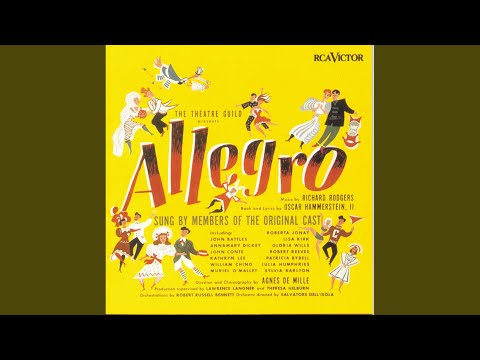
Review and Highlights
Quick summary
- Work: Allegro (Broadway musical, 1947) by Richard Rodgers (music) and Oscar Hammerstein II (book and lyrics).
- Number: "A Fellow Needs a Girl" - a porch-at-night duet for Joe's parents, overheard by their son.
- Where it lands: Act 1, on the eve of Joe leaving for college.
- What it reveals: Marriage as mutual listening, plus a small warning about the kind of adoration that can turn into a habit.
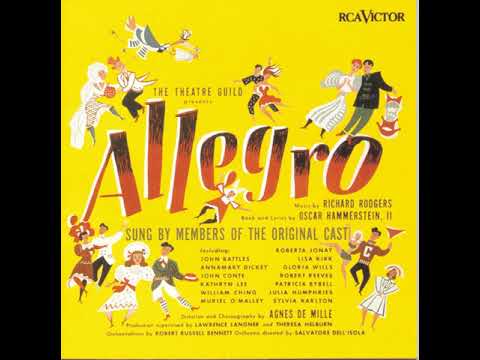
Allegro (1947) - stage musical - non-diegetic. Night before Joe's departure for college: Dr. Joe Taylor and Marjorie sit together and sing about the comforts of a long partnership, while their son listens and quietly builds his own dream of who he will become. The song plays like a domestic snapshot, but it is really a blueprint - the show hands Joe a model of love, then tests his ability to live up to it.
Hammerstein starts with a line that could be mistaken for mid-century bumper-sticker wisdom, then he keeps tightening the screws. The "need" is not framed as conquest; it is framed as rest, reassurance, a place to put your tiredness. Rodgers answers with a melody that moves in clean arcs, generous to the breath, and tailored to conversational phrasing. The result is deceptively smooth. Under the moonlight, the lyric also sketches a power dynamic: someone talks, someone agrees. That can be tender. It can also be a trap. The show knows the difference, and it lets the audience feel the difference without announcing it in block letters.
Key takeaways
- Character lens: Joe's parents sing their marriage as a shared ritual, and Joe takes notes.
- Subtext: The lyric flirts with a fantasy of constant validation, which later scenes will complicate.
- Stagecraft: Intimate music inside a show that often thinks in chorus and crowd.
Creation History
Allegro opened at the Majestic Theatre on October 10, 1947, using a large chorus and fast transitions to narrate a life story. The Rodgers and Hammerstein song page places this number on the night before Joe leaves for college and describes Joe overhearing his parents before imagining his future. Masterworks Broadway's album notes underline the same scene setup, emphasizing the parents' moonlit porch conversation as the dramatic trigger for the song.
Song Meaning and Annotations
Plot
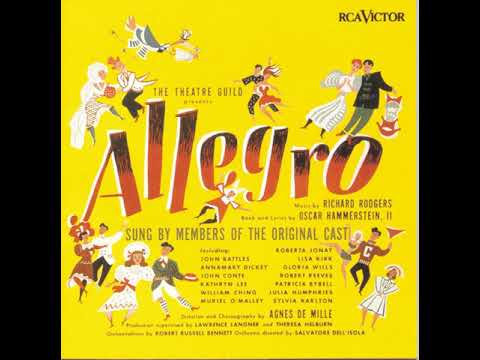
Allegro follows Joseph Taylor Jr. from birth into adulthood, with the chorus compressing time and commenting on the pressures that shape him. Early on, Joe stands on the threshold of leaving home. His parents, content in their marriage, sing about what companionship means to them. Joe hears this and begins to project the idea onto his own future, which becomes a recurring theme: what Joe thinks he wants versus what life, ambition, and romance actually hand him.
Song Meaning
On its surface, the song is a love statement from a settled couple: after the day wears you down, you want someone near, someone steady. Beneath that, it is a lyric about affirmation - not romance as fireworks, but romance as agreement. The emotional arc stays warm, but the meaning tilts depending on how it is staged: sincere gratitude in one production, a hint of complacency in another. Either way, the number is a formative imprint on Joe, a lesson he will later misread when the world offers shinier substitutes for intimacy.
Annotations
"To sit by his side and listen to him talk and agree with the things he'll say."
That line is the tell. It is affectionate, but it also exposes a wish for frictionless love. In a show about temptation and social performance, "agree" is a loaded verb.
"To hold in his arms and know that she believes that her fellow is wise and strong."
Belief here functions like a tonic. Hammerstein makes the marriage feel restorative, then lets the audience wonder what happens when a person starts chasing that tonic from the wrong sources.
"My fellow needs a girl ... so I sit by his side."
The answer is practical rather than poetic: she meets a need. It reads as devotion, but it can also read as a role she has chosen to play. Allegro loves that double reading.
Driving rhythm and style fusion
This is not a march or a chorus-cue. It is a porch song - gentle pulse, legible phrasing, and a melodic line that feels like speech with extra lift. That contrast matters inside Allegro, which often uses the chorus as a narrative engine. The show pauses the machine and lets a private household breathe.
Historical touchpoints
Rodgers and Hammerstein were writing in a moment when Broadway was willing to experiment with form, while popular singers were still mining show tunes for singles. As stated in the Sinatra discography, Frank Sinatra recorded the song as a 1947 single and it reached a Billboard chart peak in the mid-20s. That pop afterlife sits oddly next to the stage context - the song is intimate, but it proved portable.
Technical Information (Quick Facts)
- Song: A Fellow Needs a Girl
- Artist: Original cast context: William Ching and Annamary Dickey (cast album track credits vary by edition)
- Featured: Dr. Joseph Taylor and Marjorie Taylor
- Composer: Richard Rodgers
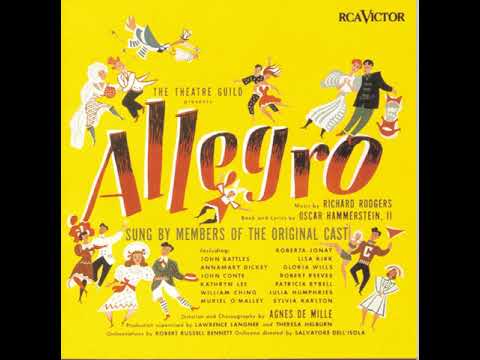
- Producer: Original cast recording sessions were conducted by Salvatore Dell'Isola, with orchestrations by Robert Russell Bennett (recording credits documented on the official production page)
- Release Date: October 10, 1947 (stage premiere); cast recording made shortly after the Broadway opening
- Genre: Broadway musical; show tune
- Instruments: Orchestra and duet vocals
- Label: RCA Victor (original cast album issues); later reissues across catalog labels
- Mood: Warm, reflective, domestic
- Length: About 3 minutes 20 seconds (varies by edition)
- Track #: Appears in early tracks on abridged cast album editions; appears mid-disc on the 2009 complete recording
- Language: English
- Album (if any): Allegro (Original 1947 Broadway Cast Recording); Allegro (First Complete Recording, 2009)
- Music style: Duet ballad with conversational phrasing
- Poetic meter: Predominantly accentual, shaped for natural speech stress
Frequently Asked Questions
- Who sings this number in the story?
- Joe's parents, Dr. Joseph Taylor and Marjorie, sing it while Joe listens from nearby.
- What is happening onstage during the song?
- The scene is set at night on the porch, with the parents reflecting on their marriage and Joe overhearing, then imagining his own future.
- Is this song a love duet or a lesson for Joe?
- Both. It is sincere marital tenderness, and it also plants an idea in Joe about what partnership should feel like.
- Why does the lyric stress agreeing and believing?
- Because the song is about reassurance as much as romance, and that emphasis can read as comfort or as a warning sign, depending on performance choices.
- Did popular singers record it outside the theatre?
- Yes. Frank Sinatra recorded it in 1947, and Perry Como also recorded it as the flip side of "So Far" in the same period.
- Is there a reprise in the score?
- Yes, the complete recording track lists include a reprise, used to echo the parents' view of marriage at a later point.
- How does it fit Allegro's chorus-heavy style?
- It is a deliberate contrast: a quiet duet inside a show that often tells the story through group commentary.
- What is the main dramatic tension inside the lyric?
- The tension between care and control: comfort that can shade into a desire for constant validation.
- Which recording should I start with?
- If you want the period flavor, start with the 1947 cast album track; if you want the whole score in sequence, the 2009 complete recording gives context and reprises.
Awards and Chart Positions
The song's theatre origin did not stop it from traveling. Frank Sinatra's 1947 single reached a Billboard chart peak at No. 24, according to the Sinatra discography. Perry Como recorded it as the flip side of "So Far" on RCA Victor 78 (catalog 20-2402), a pairing documented in discography listings.
The larger show earned major recognition: the official Rodgers and Hammerstein production page and multiple reference sources note Donaldson Award wins for Best Book of a Musical (Hammerstein), Best Lyrics (Hammerstein), and Best Score (Rodgers). Those awards matter here because this number is a craft demonstration: character built through plain speech, supported by melody that refuses to grandstand.
| Item | Detail | Date | Notes |
|---|---|---|---|
| Frank Sinatra single | Billboard peak No. 24 | 1947 | Pop recording afterlife |
| Perry Como 78 | Flip side of "So Far" (RCA Victor 20-2402) | 1947 | Commonly cited pairing in discography sources |
| Donaldson Awards | Best Book, Best Lyrics, Best Score | 1947 | Show-level writing recognition |
How to Sing A Fellow Needs a Girl
Listening guides commonly estimate the key as E-flat and the tempo around 77 BPM for the cast-album style recording. Treat those numbers as rehearsal anchors, then follow the chart in your production.
- Tempo: Set a calm pulse. This is porch-time, not curtain-call time.
- Text clarity: Prioritize consonants on "sit", "side", "listen", and "believes". The lyric is the action.
- Breath: Plan breaths before longer clauses so the line stays conversational rather than choppy.
- Legato with purpose: Connect phrases, but do not iron out the speech rhythm. Let the melody feel like thought.
- Duet balance: Keep dynamics matched. The scene is a partnership; avoid turning it into a solo with accompaniment.
- Color shifts: Warm tone on the "end of a weary day" idea, slightly brighter on the "wise and strong" affirmation.
- Acting task: Decide whether "agree" is playful, grateful, or slightly uneasy. Your choice changes the whole number.
- Pitfalls: Do not over-swoon. The power is in understatement and steady breath.
Additional Info
Two bits of theatre lore cling to this number. First, it is one of the Allegro songs that maintained a modest recording life beyond the show itself, alongside "So Far" and "The Gentleman Is a Dope," as noted in an academic survey of the musical's reception history. Second, the song was reportedly being sung during a turbulent tryout performance when scenery problems forced quick improvisation backstage - a reminder that even intimate music can be asked to hold the room together in a crisis.
As stated in Masterworks Broadway's commentary on the score, one easy listener assumption is wrong: the lyric is not Joe serenading a high school sweetheart. It is the father singing to the mother. That casting of viewpoint is the number's theatrical sting - Joe learns about love by watching, not by winning.
Key Contributors
| Entity | Type | Relationship (S-V-O) |
|---|---|---|
| Richard Rodgers | Person | Rodgers - composed - A Fellow Needs a Girl |
| Oscar Hammerstein II | Person | Hammerstein - wrote lyrics and book for - Allegro |
| William Ching | Person | Ching - originated role and performed - Dr. Joseph Taylor |
| Annamary Dickey | Person | Dickey - performed - Marjorie Taylor |
| Salvatore Dell'Isola | Person | Dell'Isola - conducted - original cast recording sessions |
| Robert Russell Bennett | Person | Bennett - created orchestrations for - Allegro recordings and materials |
| Majestic Theatre | Venue | Majestic Theatre - hosted - Allegro (Oct 10, 1947 to Jul 10, 1948) |
| Frank Sinatra | Person | Sinatra - recorded - A Fellow Needs a Girl (single) |
| Perry Como | Person | Como - recorded - A Fellow Needs a Girl (flip side) |
Sources
Sources: Rodgers and Hammerstein official song page for "A Fellow Needs a Girl"; Rodgers and Hammerstein official 1947 Broadway production page for Allegro; IBDB production record (Majestic Theatre run dates and performance count); Masterworks Broadway album notes for Allegro (1947 original cast recording); Sinatra discography single entry and chart peak; Discogs listing for Perry Como RCA Victor 20-2402; Chordify tempo and key listing; academic thesis on Allegro reception history; Wikipedia Allegro (musical) entry for recording and single context.