
Little Mermaid Lyrics: Song List
- ACT I
- Overture
- Fathoms Below
- Daughters of Triton
- The World Above
- Human Stuff
- I Want the Good Times Back
- Part of Your World
- Storm at Sea
- Part of Your World (Reprise)
- She's in Love
- Her Voice
- The World Above (Triton Reprise)
- Under the Sea
- Under the Sea (Reprise)
- Sweet Child
- Poor Unfortunate Souls
- ACT II
- Positoovity
- Beyond My Wildest Dreams
- Les Poissons
- Les Poissons (Reprise)
- One Step Closer
- I Want The Good Times Back (Reprise)
- Kiss The Girl
- Sweet Child (Reprise)
- If Only (Quartet)
- The Contest
- Poor Unfortunate Souls (Reprise)
- If Only (Reprise)
- Finale
About the "Little Mermaid" Stage Show
Release date of the musical: 2008
"The Little Mermaid" – The Musical Guide & Song Meanings
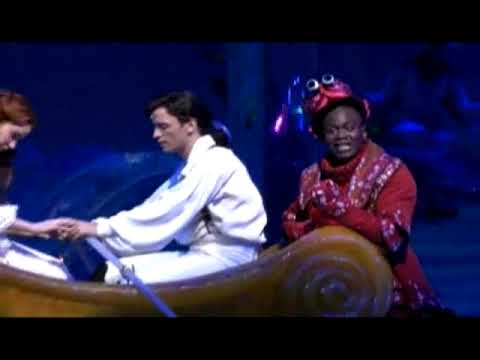
Review: the show’s thesis is voice, and Broadway makes it literal
The stage version of Disney’s “The Little Mermaid” (opened on Broadway in 2008) has a surprisingly strict agenda. It is less a romance than a transaction story: voice as identity, voice as currency, voice as leverage. The lyrics keep returning to bargains and substitutions, which is why the most satisfying material is either an “I want” confession (“Part of Your World”) or a sales pitch with teeth (“Poor Unfortunate Souls”). When the production gets noisy, the text still tries to keep the moral math legible: what you give up is never abstract. It is bodily, social, and permanent, until a father decides it isn’t.
Menken’s score wears two faces. One is the Ashman-era Broadway-pop sheen audiences already know from the 1989 film. The other is Glenn Slater’s add-on architecture, written to expand a movie that barely needs expanding. Slater’s best contribution is psychological plumbing: the added songs mostly exist to put an inner monologue where the film had montage, especially for Eric and Triton. You can hear the dramaturgy in the rhymes: Ariel gets imagery (objects, surfaces, horizons), while the palace songs tend to get verbs (teach, step, try, win). The musical style follows that division. Undersea numbers lean Caribbean-inflected spectacle and character comedy; on land, the score shifts toward ballroom energy and courtly restraint. It is a clever map of place through genre, even when the staging is fighting for clarity.
Listener tip for the cast album: play Act I straight through once before you cherry-pick. The new songs are not “bonus tracks,” they are connective tissue that explains why the plot accelerates so fast after the storm. If you only sample the film hits, you miss the show’s argument about language and power.
How it was made: Disney scale, Broadway physics, and a score with two lyricists
Broadway’s “Little Mermaid” is built on a delicate compromise: preserve the Ashman lyrics audiences can quote in their sleep, then write new material that does not sound like a different musical moved in. Officially, the Broadway production lists Doug Wright (book), Alan Menken (music), Howard Ashman (film lyrics), and Glenn Slater (additional lyrics). The result is a hybrid text where the famous numbers carry the brand promise, and the new numbers carry the plot logistics.
The production’s most discussed problem was never the music. It was the staging logic of an underwater world. Educational and production materials from the Broadway run describe a design approach that aimed to suggest water through light, translucence, and reflective surfaces rather than literal realism. That intention matters when you read the lyric writing: the show leans on precise words and repeated motifs because the eye is often busy interpreting “how” people are moving. The songs become the navigation system.
Then came the afterlife. Post-Broadway, Disney and collaborating artists revised the licensed version, reshaping the show for regional and amateur productions. Public reporting on the rework emphasizes a shift away from the original “wheel” movement vocabulary toward aerial and staging solutions that read cleaner, plus book and song adjustments that tilt the story’s center of gravity toward Triton and Ariel’s conflict. If you saw “The Little Mermaid” once and thought you understood the whole text, you may have seen one specific version of it.
Key tracks & scenes: where the lyrics land hardest
"Fathoms Below" (Eric, Sailors)
- The Scene:
- Act I opens on a ship cutting through darkness. Lanterns, rigging, sea spray. The men work in rhythm as Eric listens for something he cannot name. The ocean is both workplace and warning.
- Lyrical Meaning:
- This is the show’s first argument about myth. The lyric treats merfolk as rumor, then lets Eric behave like a believer anyway. It sets up the central irony: humans think the sea is a story, while the sea thinks humans are the danger.
"Part of Your World" (Ariel)
- The Scene:
- In Ariel’s grotto, the light narrows to a private pool of glow. She handles human objects like holy relics, stacking them into a self-portrait. The world above is a stage she can hear but not enter.
- Lyrical Meaning:
- The lyric is desire written as inventory. Ariel names things to claim them, then admits that objects are only a rehearsal for belonging. It is also a sly theme statement: language is the tool she trusts most, which makes the later bargain cruelly specific.
"Storm at Sea" / "Part of Your World (Reprise)" (Ariel)
- The Scene:
- Thunder tears the sky; the ship splinters into silhouettes. Ariel hauls Eric to shore, and the reprise arrives like a vow said while running. The ocean becomes emergency lighting.
- Lyrical Meaning:
- The reprise compresses her dream into action. The lyric no longer wonders; it commits. That shift is the hinge of the whole show: longing stops being metaphor and turns into a decision with consequences.
"Under the Sea" (Sebastian, Ensemble)
- The Scene:
- After Triton destroys Ariel’s collection, Sebastian throws a full-court press of color and rhythm at her grief. Creatures pop out of every corner; the number tries to overwhelm sadness with spectacle.
- Lyrical Meaning:
- On paper, it is a celebration. In context, it is persuasion. The lyric is a rhetorical trap: it offers comfort while denying the premise of Ariel’s pain. That tension is why the song can feel like joy and coercion at the same time.
"Poor Unfortunate Souls" (Ursula)
- The Scene:
- Ursula’s lair is theatrical by nature: shadows, smoke, and a sense of the room leaning in. Flotsam and Jetsam function like stagehands who enjoy the job too much. Ariel stands center, lit like a target.
- Lyrical Meaning:
- The lyric weaponizes self-help language. Ursula sells silence as strategy, then turns it into captivity. The craft is in the faux empathy: the rhymes sound reasonable until you notice how often the song reframes surrender as “smart.”
"One Step Closer" (Eric)
- The Scene:
- On land, the palette warms. Eric teaches Ariel to communicate through movement, with dance functioning as a substitute vocabulary. It is gentle, courtly, and a little desperate.
- Lyrical Meaning:
- This is Slater’s mission statement: give Eric something to sing that is not just “I found a girl.” The lyric turns attraction into curiosity and responsibility. It also quietly admits the problem: he is trying to fall in love with someone he cannot truly know yet.
"Kiss the Girl" (Sebastian, Ensemble)
- The Scene:
- A lagoon at night, a boat ride staged like a romantic trap. Sebastian conducts the world itself, cueing animals as if nature is his orchestra. The couple almost kisses, then the eels crash the moment.
- Lyrical Meaning:
- The lyric is deadline pressure in party clothes. It is a countdown song, which is why it reads so differently on stage than in the film. Here, romance is also crisis management.
"If Only (Quartet)" (Ariel, Eric, Sebastian, Triton)
- The Scene:
- Four corners of the story sing at once. Ariel cannot speak, Eric cannot be sure, Sebastian cannot fix what he helped set in motion, and Triton cannot locate his daughter. The stage splits into parallel pools of light.
- Lyrical Meaning:
- The lyric makes the show’s moral stakes explicit: everyone is bargaining with fate, and everyone thinks they are the responsible one. It is also the most “Broadway” writing in the score, using counterpoint to prove that the conflict is not one-sided.
"Beyond My Wildest Dreams" (Ariel)
- The Scene:
- In the palace, Ariel is surrounded by opulence and rules she cannot ask about. She sings in her head, half awe, half panic, as the court watches her like an intriguing problem.
- Lyrical Meaning:
- The lyric is the cost of wish fulfillment. Ariel gets what she wanted and immediately learns that arrival is not belonging. The words keep circling the gap between fantasy and the social reality of being “other” in a human room.
Live updates (2025/2026): what’s current now
Information current as of January 2026. “The Little Mermaid” remains a high-circulation title in licensing, with Disney Theatrical Licensing and MTI promoting it as a full-length stage show for ongoing productions. That matters because the version most companies perform today is shaped by post-Broadway revisions, widely reported as a response to what did and did not read cleanly in the original staging. In other words: the text you hear now can differ in emphasis from the 2008 Broadway blueprint.
In the broader Disney ecosystem, a new theme-park stage production inspired by the animated film, “The Little Mermaid – A Musical Adventure,” launched at Disney’s Hollywood Studios in 2025, which keeps the core songs and story in active rotation for a new audience cohort. Meanwhile, Alan Menken has publicly teased renewed interest in a UK staging conversation, suggesting the stage adaptation’s next high-profile chapter may be international rather than a straight Broadway return.
If you are hunting for a “current cast,” focus on the venue you are attending. Unlike a long-running Broadway sit-down, “The Little Mermaid” in 2025/2026 is more often encountered as a regional, community, or youth-company event, plus limited engagements. The upside: you will hear the score in wildly different orchestrational scales, from full pit to keyboard reduction, which can change how the lyrics land.
Notes & trivia
- The original Broadway production opened Jan. 10, 2008 and closed Aug. 30, 2009, following 50 previews and 685 performances.
- The Original Broadway Cast Recording was released Feb. 26, 2008 on Walt Disney Records, and it runs about 78 minutes with 29 tracks.
- Playbill reported the cast album sold over 20,000 units in its first week and charted strongly on Billboard’s cast album rankings.
- The cast recording earned a Grammy nomination for Best Musical Show Album (for the 2009 awards cycle).
- One of the Broadway-era production challenges was finding a movement language for “underwater,” which became a recurring talking point in reviews and later revisions.
- Behind-the-scenes materials from the Broadway run frame the scenic goal as “water without being water,” relying on light, translucence, and reflective surfaces to suggest the ocean.
Reception: the lyrics got caught in a spectacle debate
Critics largely agreed on one thing: the show’s engineering was the story. That is not a compliment. Reviews often treated the production as an expensive demonstration of stage mechanics that still struggled to deliver the movie’s charm. In that environment, the lyric writing became collateral damage. New songs were judged as weaker partly because they had to explain stage business the film never had to explain. When a number is tasked with clarifying logistics, it rarely wins the “sparkle” contest.
Still, there is a meaningful split between critic-room disdain and family-audience satisfaction. The score’s best-known songs remain sturdy, and the cast album is a cleaner way to hear the narrative intent of the added material, especially the Eric and Triton expansions.
“Ignore the critics, take the kids and don't pretend you're not enjoying it too.”
“This production is visually unappealing and often murky in its execution.”
“Underneath all this baroque ornamentation was a tiny, tinny little musical struggling for life.”
Quick facts
- Title: The Little Mermaid
- Broadway year: Opened 2008
- Type: Musical fantasy; stage adaptation of the 1989 animated film and Andersen tale
- Book: Doug Wright
- Music: Alan Menken
- Lyrics: Howard Ashman (film songs) and Glenn Slater (additional lyrics)
- Original Broadway venue: Lunt-Fontanne Theatre
- Musical direction / vocal arrangements (Broadway): Michael Kosarin
- Orchestrations (Broadway): Danny Troob (with additional orchestrations credited)
- Selected notable placements: “Fathoms Below” (ship), “Part of Your World” (grotto), “Storm at Sea” (rescue), “Under the Sea” (after grotto destruction), “Kiss the Girl” (lagoon), “The Contest” (final day)
- Cast album: “The Little Mermaid: Original Broadway Cast Recording,” released 2008; Walt Disney Records; 29 tracks; available on major streaming services
- Licensing status: Actively licensed (revised version commonly circulated)
Frequently asked questions
- Who wrote the lyrics for the stage musical?
- The film’s classic songs use Howard Ashman’s lyrics; the stage musical adds new lyrical material by Glenn Slater.
- Is the Broadway cast album the same as the movie soundtrack?
- No. The cast album includes the famous film songs plus additional stage numbers written to expand characters and bridge scenes, and it follows the stage show’s structure.
- Where do the new songs matter most?
- Primarily in Act I and early Act II, where the stage show needs Eric, Triton, and the palace world to speak more clearly than the film requires.
- Has the show been revised since Broadway?
- Yes. Reporting on post-Broadway productions indicates meaningful staging and story tweaks that influenced the version Disney licenses today.
- Is there a current Broadway revival?
- As of January 2026, there is no ongoing Broadway run. The title is most visible through licensed productions and related Disney live entertainment.
Key contributors
| Name | Role | Contribution |
|---|---|---|
| Alan Menken | Composer | Music for film and stage; shaped the new stage numbers and overall score identity. |
| Howard Ashman | Lyricist (film songs) | Lyrics for the best-known songs retained in the stage show. |
| Glenn Slater | Additional lyricist | New lyrics for stage expansion songs and character-development material. |
| Doug Wright | Book writer | Stage adaptation structure, added scenes, and dialogue framework. |
| Francesca Zambello | Director (Broadway) | Original Broadway staging concept and visual language for undersea life. |
| Stephen Mear | Choreographer (Broadway) | Movement vocabulary across sea and land worlds. |
| Michael Kosarin | Musical director / vocal arrangements (Broadway) | Musical leadership, vocal shaping, and related music supervision credits. |
| Danny Troob | Orchestrator (Broadway) | Orchestration credited for the Broadway production, supporting stylistic shifts between worlds. |
| George Tsypin | Scenic designer (Broadway) | Set approach that suggests water through materials and light behavior. |
| Natasha Katz | Lighting designer (Broadway) | Lighting as a core tool for making “underwater” readable on stage. |
| Sven Ortel | Projection designer (Broadway) | Projection support for environment and motion illusion. |
Sources: IBDB (Internet Broadway Database), Playbill, Time, Reuters, ABC News (Australia), MTI (Music Theatre International), Disney Theatrical Licensing, Apple Music, Walt Disney World official site, Evening Standard, Broward Center education PDF.