
Gypsy Lyrics: Song List
- Act 1
- Overture
- May We Entertain You
- Some People
- Seattle to Los Angeles
- Small World
- Baby June and Her Newsboys/Let Me Entertain You
- Have an Eggroll, Mr. Goldstone
- Little Lamb
- You'll Never Get Away From Me
- Dainty June and Her Farmboys / Broadway
- If Momma Was Married
- All I Need Is the Girl
- Everything's Coming Up Roses
- Act 2
- Madame Rose's Toreadorables
- Together Wherever We Go
- You Gotta Get A Gimmick
- The Strip
- Rose's Turn
- Bonus Tracs
- Tomorrow's Mother's Day
- Small World/Momma's Talkin' Soft
- Nice She Ain't
- Smile, Girls
- Who Needs Him?
- Three Wishes For Christmas
About the "Gypsy" Stage Show
The first performance on Broadway was made by D. Merrik and J. Robbins. E. Mermen played Rose, J. Klugman – the manager and S. Church – Louise. Scene and art designer was J. Mielziner, and suitor was Raul Pan Du Bua. Harmonious combinations and overture were delivered by S. Ramin and R. Ginzler.
The show became the nominee for eight Tony awards, in the following nominations: for the musical, the Best Actor, best of all, the Actress in the musical, the Picturesque Design, the Best Design of suits and the Best Direction of the musical – but didn't win any award, for a pity.
When the show on Broadway ended, two American tours were organized. The first tour started in Rochester and ended in St. Louis. The second one started in Detroit and came to end in Cleveland.
Release date of the musical: 1959
"Gypsy" – The Musical Guide & Song Meanings
Review: what the lyrics are really doing
Why does Gypsy land like a backstage comedy and a slow horror story at the same time? Because Stephen Sondheim writes ambition as dialogue you can sing. Every lyric is an argument. Not always with another person. Often with the self. Jule Styne supplies melody that feels like show business confidence. Sondheim supplies the little catches in the throat.
The central lyric move is pressure. Rose’s language is propulsion. She turns nouns into plans. She turns affection into leverage. That is why the show can be funny in the first act and still feel bruising by the end. The words never stop selling. Even when the sale is her own children.
Louise’s material is the quiet counterweight. She starts with nursery simplicity, then gets sharper by subtraction. In Act II, the lyric world narrows to looks, routines, and survival rules. When burlesque arrives, the show is not suddenly naughty. It is suddenly honest. The vocabulary shifts from dreaming to coping, and the music keeps smiling while the story stops pretending.
How it was made
Gypsy opened on Broadway in 1959, built from Gypsy Rose Lee’s memoir and shaped by a high-voltage creative team. Arthur Laurents wrote the book, Jule Styne wrote the music, and Sondheim took the lyric assignment in a room full of people who already had opinions about what he could and could not do. That friction helped. Rose’s voice needed resistance. It needed someone who could write brassy lines that still reveal insecurity.
The most famous “problem” in the score is also the most useful for lyric readers: how to make Rose sound like Rose while giving her lines that audiences remember. A later deep-dive on the phrase behind “Everything’s Coming Up Roses” captures the craft issue plainly, including Jerome Robbins’s skeptical reaction to the wording and Sondheim’s insistence that the phrase would read as everyday speech, not poetry.
Modern productions keep revisiting one other foundational choice: choreography. Jerome Robbins’s original staging is legendary, but it is not untouchable. George C. Wolfe and Camille A. Brown treated burlesque as research, not as window dressing, and built movement that changes how certain lyrics land. When the dance language changes, the jokes do too. The meaning follows.
Key tracks and scenes
"Some People" (Rose)
- The Scene:
- Seattle. A vaudeville house that smells like dust and ambition. Rose storms into family space with the energy of a traveling trunk. Light is practical, not pretty. She is already half-packed.
- Lyrical Meaning:
- The lyric is Rose’s worldview in motion. It draws a bright line between the people who settle and the people who push. It also reveals her blind spot: she frames her daughters as destiny, not as humans with choices.
"Small World" (Rose, Herbie)
- The Scene:
- Los Angeles. A new manager prospect, a flirtation that moves like a handshake. The staging often plays it as business romance, with Rose circling Herbie the way she circles opportunity.
- Lyrical Meaning:
- Rose uses intimacy as persuasion. The lyric sells similarity, then quietly asks for loyalty. It is charming. It is also a preview of the bargain Herbie keeps losing.
"All I Need Is the Girl" (Tulsa, Louise)
- The Scene:
- A hotel corridor or rehearsal nook on the road. Tulsa dreams out loud. Louise listens like she is learning a language she will never be allowed to speak. The light tends to soften here. The show briefly exhales.
- Lyrical Meaning:
- This is aspiration without cruelty. The lyric is simple on purpose. It shows how young performers fantasize about a future that is not controlled by Rose. Louise hears the fantasy and realizes she is not in it, at least not yet.
"Everything’s Coming Up Roses" (Rose)
- The Scene:
- June has slipped away. Herbie begs for sanity. Rose responds with a new plan and a new target. The number hits like a headlight. Big tempo. Big promises. A smile that is almost a threat.
- Lyrical Meaning:
- The lyric is motivational speech as denial. Rose renames disaster as opportunity, and she does it with such certainty that the room wants to believe her. The darker truth is in the speed. If she stops moving, she has to feel.
"Together, Wherever We Go" (Rose, Herbie, Louise)
- The Scene:
- Act II begins and the road still owns them. Louise is shoved into June’s old shape, wig included. After a blow-up, the trio tries to glue the family back together with a cheerful front. The staging often makes the togetherness look staged, because it is.
- Lyrical Meaning:
- The lyric is a pact that sounds sweet and feels shaky. It shows how show-folk comfort themselves. If you sing it cleanly, you do not have to say what is wrong.
"You Gotta Get a Gimmick" (Mazeppa, Electra, Tessie Tura)
- The Scene:
- A burlesque dressing room. Bad mirrors. Too-bright bulbs. Costumes that have lived hard. Three veterans teach Louise the trade with punchline swagger and survival pragmatism.
- Lyrical Meaning:
- Under the comedy, this is instruction. The lyric tells Louise that persona is labor, and that attention is engineered. It also frames burlesque as a kind of truth-telling, because nobody here pretends the business is pure.
"Let Me Entertain You" (Louise)
- The Scene:
- The stage manager announces a crisis. Rose volunteers Louise before she understands the cost. Louise walks out terrified. Rose feeds cues from the wings. Over time, the same tune grows bolder as Louise becomes Gypsy Rose Lee.
- Lyrical Meaning:
- The lyric is a mirror held up to an audience. At first, it is obedience. Then it becomes control. Louise learns the power of withholding, and the words start to sound like a promise she makes to herself.
"Rose’s Turn" (Rose)
- The Scene:
- Minsky’s. Louise is a star and Rose is suddenly unnecessary. Rose ends up alone on an empty stage. The light becomes performance light, but there is no act left to sell. Just a woman talking to her own spotlight.
- Lyrical Meaning:
- This is the lyric bill coming due. Fragments from earlier numbers return like intrusive thoughts. Rose stops marketing and starts confessing. It is not pretty. That is why it is irresistible.
Notes and trivia
- The show opens at a vaudeville theatre in Seattle, and “Some People” is Rose’s first big declaration of intent.
- Act II pivots when the family lands in a burlesque house, and Louise is explicitly taught the business rule: you need a “gimmick” to survive.
- The “Let Me Entertain You” strip sequence is written as a transformation over time, not a single moment, tracking Louise’s shift into Gypsy Rose Lee.
- A widely reported craft anecdote around “Everything’s Coming Up Roses” includes Jerome Robbins questioning the phrase’s clarity and Sondheim defending its everyday feel.
- The 2024 Broadway revival did not replicate Jerome Robbins’s original choreography, and it used burlesque consultation as part of its creative process.
- Concord Theatricals lists extensive rental instrumentation for stage productions, including a full reed section and strings, reflecting the score’s big-band backbone.
- “Gypsy” (Original Cast Recording) (1959) has a Library of Congress essay tied to its National Recording Registry recognition.
Reception and critic quotes
Critics tend to agree on the same paradox. Gypsy is a crowd-pleaser with teeth. The songs are built for applause, but the lyric intentions are rarely gentle. Over decades, Rose has been played as tyrant, survivor, comic engine, and tragedy. Each version changes the emotional temperature of the same lines. That is the score’s durability. It keeps letting performers argue with it.
“a dazzling new makeover with a bravura turn”
“burlesque is the place where truth gets told.”
“first performed in 1959.”
Live updates (2025/2026)
Information current as of January 27, 2026.
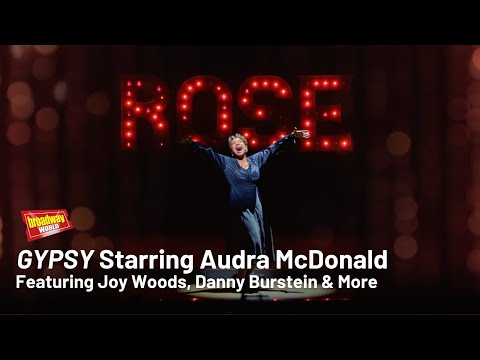
The most recent Broadway revival, directed by George C. Wolfe and starring Audra McDonald as Rose, ended its run on August 17, 2025. Its cast recording released digitally on April 25, 2025, with physical editions dated for July 25, 2025, and it later received a Best Musical Theater Album nomination for the 2026 Grammy Awards.
In licensing, Gypsy remains active through Concord Theatricals, which continues to list rental materials and orchestration needs for professional and amateur productions. That matters for SEO and for reality: this title is not “museum only.” It is a working property that keeps moving through the pipeline.
Outside Broadway, 2026 calendars already show fresh life. Examples include an announced November 2026 production by Queanbeyan Players in Australia, and a “Gypsy” listing tied to a Philharmonie de Paris production presented by Opéra national du Rhin in its 2025-2026 season.
Frequently asked questions
- Can you post the full Gypsy lyrics?
- No. Full lyrics are copyrighted text. I can help with song meanings, plot context, and where each number lands in the story, plus point you to official albums and licensed materials.
- Who wrote the lyrics and music?
- Lyrics are by Stephen Sondheim. Music is by Jule Styne. The book is by Arthur Laurents.
- Where does “You Gotta Get a Gimmick” happen?
- In Act II, in the burlesque house dressing room, where three veteran performers teach Louise what sells and what survives.
- What is “Let Me Entertain You” actually doing in the plot?
- It is Louise’s transformation mechanism. The same song shifts meaning as she shifts from frightened replacement to self-directed star.
- Is there a movie version?
- Yes. There is a 1962 film adaptation.
- What is the newest major cast recording?
- The 2024 Broadway cast recording, released digitally in April 2025, is the newest high-profile release and a 2026 Grammy nominee.
Key contributors
| Name | Role | Contribution |
|---|---|---|
| Stephen Sondheim | Lyricist | Wrote lyrics that balance show-biz snap with psychological exposure, especially in “Rose’s Turn.” |
| Jule Styne | Composer | Built a score that can sound like vaudeville shine while carrying emotional weight underneath. |
| Arthur Laurents | Book writer | Structured the story around Gypsy Rose Lee’s memoir, focusing the lens on Rose’s drive and cost. |
| Jerome Robbins | Original director and choreographer | Created the original staging grammar that defined the show’s rhythm for decades. |
| George C. Wolfe | Director (2024 Broadway revival) | Reframed Act II’s burlesque world as truth-forward and character-driven. |
| Camille A. Brown | Choreographer (2024 Broadway revival) | Built new movement language for the revival, informed by burlesque consultation. |
| Andy Einhorn | Music direction and supervision | Led the musical presentation for the 2024 revival and its cast recording credits. |
| David Caddick, David Lai | Producers (cast recording) | Produced the 2024 Broadway cast recording release. |
Quick facts
- Title: Gypsy: A Musical Fable
- Year: 1959 (Broadway premiere)
- Type: Musical
- Music: Jule Styne
- Lyrics: Stephen Sondheim
- Book: Arthur Laurents
- Based on: Gypsy Rose Lee’s memoir
- Selected notable placements: “Some People” after Rose clashes with her father; “Everything’s Coming Up Roses” when Rose pivots to making Louise the star; “You Gotta Get a Gimmick” in the burlesque dressing room; “Let Me Entertain You” as Louise’s staged transformation; “Rose’s Turn” alone on an empty stage after Louise becomes independent
- Licensing / materials: Available through Concord Theatricals (scripts and music rentals listed)
- Album status: Original 1959 Broadway cast recording remains in circulation; the 2024 Broadway cast recording released in 2025 and earned a 2026 Grammy nomination
Sources: Concord Theatricals, The Guardian, The New Yorker, Library of Congress (National Recording Registry essay), GRAMMY.com, Playbill, People, Entertainment Weekly, Broadway.com, gypsythemusical.com, Opéra national du Rhin, Queanbeyan Players, Apple Music, YouTube.