
Frogs, The Lyrics: Song List
- Act 1
- Opening Fanfare
- Invocation and Instructions to the Audience
- We Are Off On a Great Mission
- I Love to Travel
- Dress Big
- I Love to Travel (reprise)
- All Aboard
- On the River Styx
- Ariadne
- The Frogs
- Act 2
- Hymn to Dionysos
- Hades
- It's Only a Play
- Shaw
- The Contest
- Fear No More
- All Aboard (reprise)
- Hymn to Dionysos (reprise)
- Final Instructions to the Audience
About the "Frogs, The" Stage Show
Initially, the work was written by a student at Yale University in 1941, as his exam work, but the first play was made much later, in 1974, where it gave 8 hits in the same student's alma mater. After it was delivered, it has attracted the attention of Sondheim, who made a successful work, from the point of view of critics, but that was not so popular with viewers that it never often resurrected after its premiere. To be more precise – only 4 times after 2004’s on Broadway.
Some regional production was in 1975, then in 1984, but they did not attract public interest. The London production opened also in the 80's, but very short demonstration were given, which did not last even for a month (under the direction of John Gardyne).
There was nothing extraordinary in 1991 too – just 4 shows (directed by Keith Taylor), and then in 2000 only 1 concert at Washington's Library of Congress was given.
2004 was marked by the staging of it on Broadway, in the Vivian Beaumont Theater, which is owned by Lincoln Center Theater. B. Moses, C. Kattan, J. Byner, R. Bart, D. Davis, M. Siberry & P. Bartlett were in its composition at the opening. S. Stroman was choreographer & director, P. Gemignani was responsible for the music. Critics embraced the opening ambiguous. Some said that the plot was too loosely interpreted, and others – that it was fully consistent with the spirit of the comedy of Aristophane. Anyway, only 92 shows were given & the musical received 3 nominations on Drama League Awards (but did not win any).
Since 2004, there were such production: 2007 (Pittsburgh, within 1 week), Illinois (2007, one and a half month), 2011 (Florida, 2 weeks), 2015 (Sydney).
Release date of the musical: 2004
"The Frogs" – The Musical Guide & Song Meanings
Review: what the lyrics are really doing
If a musical starts by telling you how not to behave, what does it think you are capable of? “The Frogs” is a comedy that keeps slipping into moral instruction, then undercuts itself with a rude rhyme. That friction is the point. Stephen Sondheim’s lyric writing here is not just witty. It is tactical. It uses jokes as a delivery system for argument.
The show’s premise is blunt: the god of theatre goes to Hades because the living world feels stupid, numb, and dangerously satisfied with itself. The lyrics behave like a courtroom brief, but one written by a comedian. Sondheim stacks internal rhymes, fast pivots, and unexpected consonants to make ideas feel like punchlines. You laugh, then you realize you have been marched into a thesis about civic responsibility.
Musically, “The Frogs” leans into Greek-chorus structures and Broadway pastiche. The chorus does not just decorate the score. It functions as the crowd, the conscience, and the enemy. The frogs, in particular, are not cute. In the 2004 shape of the show, they represent a collective resistance to change, a group mind that pulls the hero back into the swamp the moment he tries to move forward.
The late-game contest between George Bernard Shaw and William Shakespeare can feel like a dare. It is intentionally language-heavy, and it asks for attention more than affection. When it works, the lyric design frames “reason” and “poetry” as competing survival tools. When it drags, it still reveals what the piece believes: art is not comfort. It is a call to action, delivered by people in costumes who know exactly how silly they look.
How it was made
“The Frogs” has a strange biography. It began as a student-driven, swimming-pool production at Yale in the 1970s, with Burt Shevelove adapting Aristophanes and Sondheim writing songs for a show staged in and around water. That origin matters because the piece never fully stops being a theatrical stunt. Even in a proscenium house, it keeps the feel of a mischievous experiment that accidentally learned how to argue with its audience.
Nathan Lane is the hinge between “curiosity” and “Broadway property.” He encountered the libretto early in his New York years, then helped spark a major rethinking after a Library of Congress concert and a 2001 studio recording. Lane has described the work as newly “resonant” in the aftermath of 9/11, and his 2004 book leans harder into a world-on-fire urgency, while still protecting the show’s right to be vulgar.
That 2004 revival at Lincoln Center Theater needed more than extra running time. It needed architecture. Lane expanded the story into a two-act musical and Sondheim wrote new material that spotlights individual characters, not just the massed chorus. The result is still odd. It is also more playable. It has scene engines, not only sketches, and it ends with a direct address that dares you to leave the theatre and do something.
Information current as of January 24, 2026.
Key tracks & scenes
"Invocation and Instructions to the Audience" (Company)
- The Scene:
- Before the plot even “begins,” two actors step forward and treat the theatre like a sacred site and a classroom. They set the rules. They tease you for being there. The tone is playful, but the posture is priestly.
- Lyrical Meaning:
- This is a mission statement disguised as a warm-up. The lyric insists that attention is an ethical act. It also establishes the show’s signature move: mixing low comedy with high expectation, on purpose.
"I Love to Travel" (Dionysos, Xanthias, Chorus)
- The Scene:
- A thunderclap. A cracked urn. Dionysos and his long-suffering companion burst into the world and announce a journey to Hades, even as everyone admits the journey is ridiculous.
- Lyrical Meaning:
- The lyric treats “adventure” as a coping mechanism. It is Dionysos trying to turn dread into momentum. The chorus energy makes it sound communal, while the text quietly reveals panic.
"All Aboard" (Charon)
- The Scene:
- At the River Styx, the boatman runs the underworld like a weary transit worker. The river is not romantic. It is a route. The mood is deadpan and the comedy is dry.
- Lyrical Meaning:
- Charon’s lyric makes death feel bureaucratic. That choice sharpens the show’s political edge: catastrophe is not always dramatic. Sometimes it is routine, and that is why it is dangerous.
"Ariadne" (Dionysos)
- The Scene:
- On the boat, while the boatman naps, Dionysos tells the story of his late wife. The show slows down. The light softens. For a moment, comedy stops performing and grief speaks plainly.
- Lyrical Meaning:
- This is where Dionysos becomes more than a clown-god. The lyric is tender, specific, and self-implicating. It suggests the quest is not only civic. It is personal. He is trying to earn the right to hope.
"The Frogs" (Dionysos, Frogs, Company)
- The Scene:
- The boat is surrounded. The frogs arrive in coordinated aggression, more like a marching club than wildlife. Dionysos’s fear becomes physical, and the river becomes a trap.
- Lyrical Meaning:
- The frogs are the show’s best metaphor because they are funny and mean at the same time. Their group mentality reads as a warning about any crowd that punishes change simply because change exists.
"It's Only a Play" (Greek Chorus)
- The Scene:
- Serious stakes are raised, then the chorus steps in with a shrug. The moment is deliberately infuriating. The song lets apathy sing.
- Lyrical Meaning:
- This is the show holding up a mirror to the audience’s most tempting excuse: someone else will handle it. Sondheim turns complacency into melody so it cannot hide as “common sense.”
"Fear No More" (Shakespeare)
- The Scene:
- In the contest for who deserves to return to the living world, Shakespeare answers the final subject, death, with a calm, human-scaled lullaby. The air changes. The joke rhythm stops.
- Lyrical Meaning:
- The lyric is not Sondheim’s invention. It is Shakespeare’s “Cymbeline,” placed like a jewel in a satirical crown. Its purity is the argument: language can outlast politics, and beauty can still be useful.
"Final Instructions to the Audience" (Dionysos & Company)
- The Scene:
- Back on Earth, the company faces the crowd directly. The framing snaps back to theatre-as-ritual. The show does not end with a romance or a twist. It ends with a demand.
- Lyrical Meaning:
- This is where “The Frogs” stops flirting and commits. The lyric rejects passive spectatorship. It insists that theatre is not a substitute for action, but it can be the spark that starts it.
Live updates (2025/2026)
“The Frogs” remains a rare Sondheim title in the commercial circuit, but it has been visibly active in the last few seasons. In 2023, New York’s MasterVoices presented the piece at Jazz at Lincoln Center, reinforcing how well the score plays when sung with choral precision and clear diction. The show’s comedy lands harder when every consonant is audible.
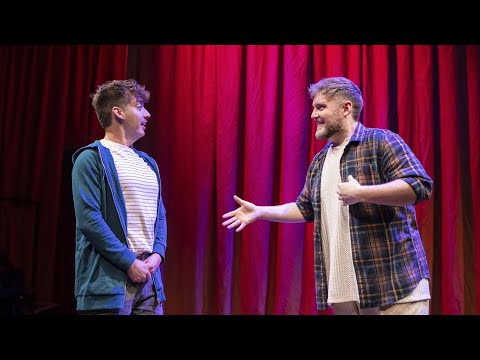
In London, a revival ran at Southwark Playhouse Borough from May 23 to June 28, 2025, led by Kevin McHale as Xanthias and Dan Buckley as Dionysos, with multiple performers sharing Pluto across the run. Reviews praised the lyric craft while still arguing about the show’s skit-like shape, which is an old argument for this title and probably a permanent one.
As of January 24, 2026, there is no announced Broadway transfer or major tour. The most reliable way to see “The Frogs” in the near term is through concert stagings, university productions, and licensed runs. The piece is built for companies that like risk, choral writing, and jokes that bite.
Notes & trivia
- The 2004 Broadway revival played the Vivian Beaumont Theater from July 22 to October 10, 2004.
- “Fear No More” uses text from Shakespeare’s “Cymbeline,” which is explicitly credited in official production records.
- Nathan Lane has described the show as “language-driven,” and the 2004 version’s climax is, unapologetically, a debate.
- Susan Stroman has discussed the frogs as figures who “don’t want anything to change,” and the staging demands athletic dancers with comic timing.
- Jonathan Tunick revisited his orchestration approach after early versions, shaped by the unusual acoustics of the original pool concept.
- The 2004 original Broadway cast recording was released by PS Classics on January 25, 2005.
- The 2025 London revival at Southwark Playhouse used rotating guest performers for Pluto across specific date ranges during the run.
Reception, then vs. now
In 2004, critics largely agreed on two things: Sondheim’s lyrics were the show’s strongest asset, and the evening could feel structurally loose. That tension has followed the musical ever since. When the comedy reads as a chain of bits, the moral argument can feel underpowered. When the staging commits to the chorus as a civic crowd, the show’s seriousness arrives with sharper teeth.
In 2025, reviews in London returned to a familiar conclusion: the lyrics are why you go, even if the book tests your patience. The strongest notices tend to quote the opening address to the audience, because it captures the show’s whole personality in a few lines: naughty, disciplined, and strangely anxious about whether anyone is listening.
“We open with the best number: a fanfare plus jaunty injunctions to the audience.”
Stephen Sondheim described the first production as “one of the few deeply unpleasant professional experiences I’ve had”.
“It’s a totally language-driven play.”
Quick facts
- Title: The Frogs
- Broadway year: 2004 (Lincoln Center Theater, Vivian Beaumont)
- Type: Musical comedy with Greek-chorus structure and meta-theatrical framing
- Music & lyrics: Stephen Sondheim
- Book: Burt Shevelove (original adaptation), with additional adaptation by Nathan Lane for the Broadway revival
- Source material: Aristophanes (405 BCE comedy)
- Orchestrations: Jonathan Tunick (Broadway production credits)
- Musical direction (Broadway): Paul Gemignani
- Notable placement: “Fear No More” text from Shakespeare’s “Cymbeline”
- Original Broadway cast album: PS Classics; release date January 25, 2005; widely available on major streaming platforms
- Recent visibility: MasterVoices concert staging (NYC, 2023); London revival at Southwark Playhouse (May to June 2025)
Frequently asked questions
- Is “The Frogs” a Stephen Sondheim musical?
- Yes. Sondheim wrote the music and lyrics, with the book adapted from Aristophanes by Burt Shevelove and later expanded for Broadway by Nathan Lane.
- What is “Fear No More,” and why does it sound different?
- It is Shakespeare. The lyric text comes from “Cymbeline,” placed into the score as the contest’s emotional clincher.
- Which recording should I start with?
- If you want the full Broadway-shaped score, start with the 2004 Original Broadway Cast Recording released by PS Classics. If you are curious about the earlier concert lineage, the 2001 studio recording is a useful comparison.
- Was the show really performed in a swimming pool?
- Yes. Early versions were staged at Yale with the production designed around a pool concept, which is part of the show’s legend and part of why the piece has always felt like a controlled prank.
- Is there a film version?
- No feature film adaptation has been released. The most common way to encounter the show is via recordings, concert stagings, and licensed productions.
- What do the frogs represent?
- In the Broadway-era framing, they are a chorus of resistance: the group that punishes change, mocks aspiration, and drags the hero back into “nothing will ever get better.”
Key contributors
| Name | Role | Contribution |
|---|---|---|
| Stephen Sondheim | Composer-Lyricist | Wrote the score’s shifting tone: civic satire, lyric precision, and choral architecture. |
| Burt Shevelove | Book (original adaptation) | “Freely adapted” Aristophanes into a modern theatrical frame that invites anachronism. |
| Nathan Lane | Additional adaptation (Broadway revival) | Expanded the piece into a two-act Broadway form and sharpened the world-in-crisis motivation. |
| Susan Stroman | Director-Choreographer (2004 Broadway) | Built athletic chorus language, especially for the frogs, to physicalize the anti-change metaphor. |
| Jonathan Tunick | Orchestrations | Translated Sondheim’s choral writing into a theatrical sound world across versions. |
| Paul Gemignani | Musical Director (2004 Broadway) | Kept the diction-first score intelligible, which is essential for this lyric-driven show. |
| PS Classics | Label | Released the 2004 Original Broadway Cast Recording (January 25, 2005). |
| Georgie Rankcom | Director (London revival, 2025) | Helmed a modern Off-West End revival that renewed attention on the score’s comic bite. |
Sources: Music Theatre International (MTI); Playbill; IBDB; The Guardian; WhatsOnStage; TheaterMania; Apple Music; BroadwayWorld.