
Radio City Christmas Spectacular Lyrics: Song List
About the "Radio City Christmas Spectacular" Stage Show
Plot Summary for "Radio City Christmas Spectacular" (2000)
This staging is about a real show, which takes place every year in the Radio City Music Hall. It was first organized in 1933, when the first Christmas spectacle was produced. Leon Leonidoff was responsible for creating an event of such format. As for the musical, it was specially created for the 2011 edition of the Christmas show and was focused on the well-known group – the Rockettes, founded in 1925. The following year, the theme was very close. It was also a celebration of the 80th Christmas show anniversary and the 85th anniversary of the dancing band.
The music for the spectacle was made by cooperation of G. Adler, M. Hummel and M. P. Walker. Mark Hummel was also the one, who wrote lyrics, together with Mark Waldrop. Linda Haberman became the director & choreographer.
The "Radio City Christmas Spectacular" is an annual holiday tradition that has been delighting audiences since its inception in 1933. The 2000 staging of this beloved musical showcases the iconic Rockettes, a renowned dance troupe founded in 1925, known for their precision choreography and high-energy performances. This particular edition celebrates the magic of Christmas through a series of festive performances, blending music, dance, and theatrical storytelling.
The show opens with a vibrant introduction that sets the holiday mood, inviting the audience into a winter wonderland filled with enchanting visuals and festive sounds. Throughout the performance, various segments highlight classic Christmas themes, including the joy of giving, family togetherness, and the spirit of the season.
One of the central narratives follows two brothers who embark on a quest to find the perfect gift for their sister. Their journey is interwoven with spectacular dance numbers featuring the Rockettes, including fan-favorite routines like "Parade of Wooden Soldiers" and "Living Nativity." These performances are enhanced by stunning visual effects, elaborate costumes, and a live orchestra that brings the music to life.
As the show progresses, audiences are treated to a series of dazzling acts that include aerialists, tap dancers, and stunning visual displays on large LED screens. The Rockettes' signature high kicks and synchronized movements shine in every number, showcasing their talent and dedication. The choreography is meticulously crafted by Linda Haberman, who also serves as the director for this production.
The climax of the show features a heartwarming depiction of the birth of Jesus, emphasizing themes of hope and renewal. The performance concludes with a grand finale that celebrates the joy of Christmas, leaving audiences filled with holiday cheer.
Overall, the 2000 edition of the "Radio City Christmas Spectacular" encapsulates the essence of Christmas through its blend of storytelling, music, and dance. It remains a cherished tradition for many families who return year after year to experience the magic of this iconic holiday spectacle at Radio City Music Hall.
Release date of the musical: 2000
"Radio City Christmas Spectacular" – The Musical Guide & Song Meanings
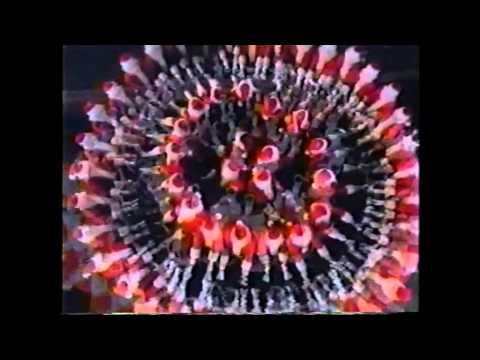
Review
Calling the 2000 Radio City Christmas Spectacular “a musical” is both accurate and slightly misleading. It is a revue with a plot-shaped spine. The “lyrics,” such as they are, work less like character confession and more like civic ritual. This show is not trying to reveal a new truth about Christmas. It is trying to make you recognize the old ones on cue.
The 2000 cast album, released by Sony and drawn from the 1999 and 2000 stage editions, is basically the show’s blueprint in 56 minutes. It is built around a neat tension: pop cheer and sacred calm, commerce and hush, New York swagger and Biblical tableau. The writing leans heavily on standards and familiar songbooks because familiarity is the brand. When the show adds newer material, it tends to do it by framing “modern” through something comfortingly retro. Even Santa’s supposed update has an intentionally old-fashioned sound.
The lyric engine here is repetition and certainty. Holiday music thrives on predictable promises. The clever part is how the staging changes the meaning of the same words. “Here Comes Santa Claus” hits differently when a letter narration turns it into a logistics problem. “White Christmas” changes temperature when it is filtered through a Manhattan postcard. And the Nativity sequence does what this show does best: it stops selling you something, briefly, and lets the room breathe.
How it was made
The Spectacular started in 1933 as part of Radio City’s original stage-and-screen model. Early versions included an overture, organ solo, a toy-shop ballet, the Rockettes’ “Parade of the Wooden Soldiers,” and “The Living Nativity.” Two of those elements became the show’s backbone, repeated season after season: the Wooden Soldiers and the Nativity.
The 2000 soundtrack sits in an interesting middle period. It is old enough to treat email and cell phones as punchlines, and new enough to package the show’s music like a real commercial album. A Playbill item announcing the recording is unusually revealing about authorship. It points out that “Santa’s Gonna Rock and Roll” comes from Henry Krieger, while “Parade of the Wooden Soldiers” is Victor Herbert. In other words, the “lyrics” of this show are a curated collage, assembled for effect rather than authored as a unified book musical score.
Choreographic origin matters more than lyric origin here. The Wooden Soldiers number, choreographed by Rockettes founder Russell Markert, survives because it has a signature physical illusion. It looks easy until you learn how much training, timing, and trust it requires. The lyric may say “march,” but the dance is doing the storytelling.
Key tracks & scenes
"Overture" (Orchestra/Company)
- The Scene:
- House lights fade. The room becomes a cathedral of brass and velvet. The overture functions as a giant inhale, with scenic elements arriving like ornaments: one at a time, deliberately placed.
- Lyrical Meaning:
- No lyrics, and that is the point. This is the show announcing its values: scale, polish, and the sense that your memory is about to be edited for you.
"Santa's Gonna Rock and Roll" (Santa/Company)
- The Scene:
- Santa arrives in a burst of modern gadgetry and vintage rhythm. Lighting tends to go bright and billboard-like. The joke is “up to date,” delivered in a style that is already safely nostalgic.
- Lyrical Meaning:
- The lyric sells accessibility. Santa is not distant. Santa is management. He answers messages. He is everywhere. The song reassures kids and flatters adults.
"First Letter / Parade of the Wooden Soldiers" (Company/Rockettes)
- The Scene:
- A child’s letter frames the wish, then the toy shop takes over. The soldiers enter in strict symmetry. The famous “fall” lands like a domino chain, a collective act of trust disguised as slapstick.
- Lyrical Meaning:
- This is where words step aside for mechanics. The lyric content is simple march-pageantry, but the meaning is discipline turned into joy, and danger turned into a clean line.
"Third Letter / White Christmas in New York" (Company)
- The Scene:
- Manhattan becomes a postcard. The tempo softens; the palette cools. In many modern stagings, the number is tied to a sightseeing fantasy, including a double-decker bus and a tour through familiar city landmarks.
- Lyrical Meaning:
- “White Christmas” becomes urban longing. The lyric is about snow, but the dramatic function is homesickness disguised as tourism.
"The Man With the Bag" (Santa/Company)
- The Scene:
- The show snaps back to show-biz pace. Quick changes. Big smiles. A feeling of backstage logistics presented as effortless cheer.
- Lyrical Meaning:
- The lyric is pure sales pitch, but it is also character writing by implication. Santa is defined by inventory. The bag is the job.
"Toyland Ball" (Company)
- The Scene:
- A ballroom fantasy where toys behave like society people. Lighting turns warm and storybook. Movement is less kick-line and more glide, giving the show a different kind of virtuosity.
- Lyrical Meaning:
- It is nostalgia with manners. The lyric treats childhood as a place you can visit, briefly, if you follow the rules of the dance.
"Welcome Christmas" (Company)
- The Scene:
- The room becomes communal. The audience is invited into the sentiment without being asked to sing. Staging often simplifies here, as if the show is trusting the song to carry itself.
- Lyrical Meaning:
- The lyric’s power is plainness. After spectacle, it argues for the small, the shared, and the repeated. It is a reset before the finale push.
"Jing-A-Ling / The Reindeer Dance / The Fly-Away" (Company/Rockettes)
- The Scene:
- Full kinetic charge. Costume texture leans plush and cartoon-bright. The choreography is meant to feel like controlled chaos, with precision hiding in the corners.
- Lyrical Meaning:
- These lyrics function like sound effects. They create motion. The meaning is momentum itself, the show sprinting toward its emotional landing.
"The Living Nativity" (Company)
- The Scene:
- The stage widens into a night sky. Animals, shepherds, and Magi arrive in procession. The lighting becomes star-focused and quiet, and the audience tends to quiet down with it.
- Lyrical Meaning:
- The show stops winking. Hymn text carries the moral authority here. The lyrics do not build character; they build reverence, which is the point of ending this way.
Live updates
Information current as of 1 February 2026.
The 2025 season was positioned as a centennial celebration for the Rockettes, and the official Rockettes calendar page described it as the highest attendance in years. MSG Entertainment also announced that, due to demand, the 2025 run was extended into early January 2026 (through January 5, 2026), with the season opening noted as November 6, 2025.
Onstage, the show continues to lean harder into tech-forward spectacle around its traditional spine. Recent coverage highlights digital projections and drones, while the classic anchors remain untouched: the Wooden Soldiers and the Nativity still do the heavy emotional work.
For 2026, the Rockettes’ official Christmas page promotes early access for groups of nine or more, which suggests planning is active even when public single-ticket calendars are not yet fully posted. If you are tracking “what changes,” look less at the song list and more at the delivery system: sound, projection, and the New York-themed sequence keep evolving because they can, while the legacy numbers stay sacred because they must.
Notes & trivia
- The 2000 audio release is credited as a cast recording drawn from the 1999 and 2000 show editions, recorded in 2000.
- The album’s track list is only 11 tracks because it uses medleys (letters plus songs) to mirror the stage structure.
- Playbill’s announcement for the album calls out a mix of composers behind the “lyrics,” including Henry Krieger and Victor Herbert, plus Irving Berlin and Jule Styne and Sammy Cahn standards embedded in the medleys.
- “Parade of the Wooden Soldiers” has been in the show since 1933 and is tied to an iconic “soldier fall” illusion that requires intense synchronization.
- The show’s earliest version (1933) is credited to Radio City stage producer Leon Leonidoff and designer Vincente Minnelli, long before Minnelli’s Hollywood fame.
- The official Rockettes calendar page explicitly framed 2025 as a 100th anniversary year for the troupe.
- The show’s modern New York sequence is often staged as a sightseeing fantasy and has featured a real double-decker bus.
Reception
The Spectacular’s critical story is consistent: even skeptics tend to respect the craft while questioning the tone. It wants to be sincere and knowing in the same breath, which is a difficult trick for holiday entertainment. When it works, it feels like a communal tradition with Broadway polish. When it doesn’t, it can feel like a luxury product with hymns attached.
Santa uses “e-mail, a cell phone, and a fax machine” in an attempt to look modern.
The tangible, classic elements remain the highlight as the Rockettes celebrate 100 years.
The centennial season includes digital projections, drones, and the beloved Wooden Soldiers number.
Quick facts
- Title: Radio City Christmas Spectacular (cast album)
- Year: 2000 (album release)
- Type: Cast recording for an annual stage revue
- Presented by: MSG Entertainment (current presenter)
- Venue: Radio City Music Hall, New York City
- Album context: Recorded in 2000 from the 1999 and 2000 stage editions
- Label: Sony
- Selected notable placements: “Parade of the Wooden Soldiers” and “The Living Nativity” as perennial anchors; “White Christmas in New York” as the city fantasia
- Availability: Widely available on major digital platforms; physical CD tracked via collector marketplaces
- Run time: 11 tracks, about 56 minutes
Frequently asked questions
- Is this a Broadway musical?
- No. It is an annual holiday stage revue at Radio City Music Hall, built around the Rockettes plus singers, orchestra, and special scenes.
- What does “2000” refer to here?
- The Sony cast recording released in 2000, recorded from the 1999 and 2000 stage editions.
- Which numbers are essentially always in the show?
- “Parade of the Wooden Soldiers” and “The Living Nativity” are documented as long-running cornerstones across editions.
- Does the show have original songs?
- Yes, alongside standards. The 2000 album includes newer material such as “Santa’s Gonna Rock and Roll” alongside classic holiday songbook staples.
- How long is the show, and is it family-friendly?
- It is typically presented as a 90-minute, family-oriented holiday production, with a mix of spectacle, comedy, dance, and the Nativity tableau.
- What is the current status for 2025–2026?
- The 2025 season ran with expanded dates into early January 2026, and official channels promote early group access for the 2026 season.
Key contributors
| Name | Role | Contribution |
|---|---|---|
| Julie Branam | Director & choreographer (current production credits) | Helms staging and precision dance architecture for modern editions. |
| Mark Waldrop | Writer & lyricist (current production credits) | Book and lyric framework that binds medleys and scenes into a single through-experience. |
| Gary Adler | Composer (current production credits) | Music contributions for modern editions. |
| Mark Hummel | Composer (current production credits) | Music contributions for modern editions. |
| Russell Markert | Founder; choreographer | Choreographed “Parade of the Wooden Soldiers,” a signature legacy number. |
| Leon Leonidoff | Stage producer (early history) | Credited with creating the first 1933 version of the Christmas show at Radio City. |
| Vincente Minnelli | Designer (early history) | Credited as a designer on the first 1933 edition, linking the show to major theatrical design lineage. |
| Henry Krieger | Composer | Credited with “Santa’s Gonna Rock and Roll” on the 2000 album announcement. |
| Victor Herbert | Composer | Credited with “Parade of the Wooden Soldiers” (from Babes in Toyland), adapted into the Spectacular’s signature number. |
| Sony | Label | Released the 2000 cast album. |
Sources: Rockettes official site; MSG Entertainment; Playbill; Associated Press; New York Theatre Guide; TheaterMania; Apple Music; Wikipedia; Discogs; People.