
Priscilla: Queen of the Desert Lyrics: Song List
- Act 1
- Overture
- Downtown
- I've Never Been To Me
- What's Love Got To Do With It
- Don't Leave Me This Way
- Venus
- Go West
- I Say A Little Prayer
- I Love The Nightlife
- Both Sides Now
- Follie! Delirio vano è questo! Sempre libera
- Colour My World
- I Will Survive
- Act 2
- Thank God I'm A Country Boy
- A Fine Romance
- Shake Your Groove Thing
- Pop Musik
- A Fine Romance (Reprise)
- Girls Just Wanna Have Fun
- Hot Stuff
- MacArthur Park
- Boogie Wonderland
- The Morning After
- Always On My Mind
- Confide in Me
- We Belong
-
Finale

- Other Songs
- It's Raining Men
- Material Girl
- True Colors
About the "Priscilla: Queen of the Desert" Stage Show
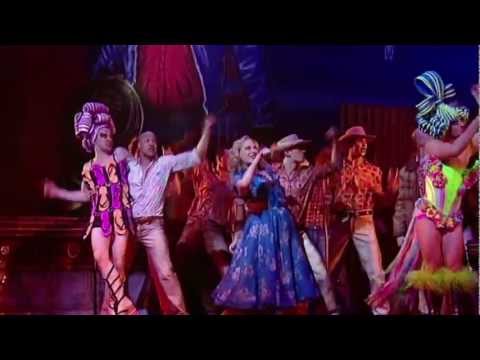
This show is great work made by Australian directors S. Elliott and A. Scott. It is an adaptation of the movie of 1994, directed by them. Debut of the spectacle happened in Sydney at Lyric Theatre in the year 2006. It received outstanding reviews and got success. After this, the staging took place in other big cities of Australia. In 2008, it came to New Zealand. Such success made the directors create West End and Broadway productions. The original version was nominated for 7 Helpmann Award and got one of them. There were also nominations for Olivier & Tony Awards. As for the latest, this musical received one for the Design of Costumes.
West End version took place in 2009 at Palace Theatre. S. Phillips became a director, S. Murphy was responsible for music, T. Chappel & L. Gardiner made costumes & R. Coleman was a choreographer. The design of staging was created by B. Thomson. The leading roles were played by J. Donovan, T. Sheldon & O. Thornton. The performances continued for two years. As for the Broadway version, it appeared in 2011. The debut happened at Princess of Wales Theatre. Among the cast, there were such actors, as W. Swenson, T. Sheldon & N. Adams. R. Coleman became a choreographer again, while B. Thomson created a set design. The costume designers were also the same as for West End spectacle. There were 526 displays and more than 20 previews in total.
Besides the English speaking countries, it has become popular in Europe and South America. The productions were created in Italy and Brazil. The show deserved a national tour in the United States, which started in 2012.
Release date of the musical: 2009
"Priscilla, Queen of the Desert" – The Musical Guide & Song Meanings
Review
How do you build a musical about identity without writing a single lyric? That is the cheeky 2009 West End wager of Priscilla, Queen of the Desert, which opened at London’s Palace Theatre after a Sydney premiere and arrived carrying a suitcase full of pop history. It mostly wins by being blunt about what it is: a road movie in heels, powered by radio-famous words that already live in the audience’s mouth. The book (by Stephan Elliott and Allan Scott) gives those words a new job description: survival, apology, belonging. The danger is obvious too. When you borrow classics, the show can feel like a costume party masquerading as dramaturgy. But when the staging and arrangements commit, the familiar lyrics start reading like character diaries rather than karaoke screens.
The core lyrical theme is chosen family, and it is delivered with shameless directness. The characters keep colliding with places that want them smaller. The songs respond by insisting on scale: bigger emotions, bigger vowels, bigger statements. That approach can feel “loud” in the pejorative sense, and some critics have said so. Yet that noise is also the point. The show’s world contains both rhinestones and real malice, and the score keeps yanking the audience between party lighting and hard white exposure. It is jukebox mechanics with a drag-queen tool kit: take a lyric everyone knows, then make it sting because a person we now know is forced to sing it.
Musically, the style is pop-disco-dance with theatrical surgery. The arrangements and musical supervision (Stephen “Spud” Murphy, plus collaborators depending on production) lean into genre shifts when the story needs them: an anthem becomes a confession; a club banger becomes a battered prayer. That shapeshifting matters because the characters are shapeshifters. The score is not original, but the use of it can be, especially when a number lands as emotional plot rather than applause break.
How It Was Made
The starting point is the 1994 film The Adventures of Priscilla, Queen of the Desert, written and directed by Stephan Elliott. For the stage version, Elliott and Allan Scott wrote the book, with director Simon Phillips brought in during development, and a design brief that was basically: make the bus a star, then make it sing. That bus is not a metaphor. It is an engineering and storytelling device, rebuilt and revised across productions, with designer Brian Thomson treating “Priscilla” like a title role that has to hit its marks and sell the joke every night.
The 2009 West End production did not arrive shy. It opened at the Palace Theatre on March 23, 2009, after previews began March 10, leaning on a high-gloss creative roster and an audience that already knew the film’s cadence. The behind-the-scenes trick is that this show’s “lyrics” are pre-existing lyrics. The authorship is in curation and context: which songs, where they land, and what the characters have to lose when they sing them. That is harder than it sounds. Pick the obvious hit and you risk a groan. Pick the deep cut and you risk dead air. The best moments here are when the song choice is both inevitable and oddly specific to the character’s wound.
And yes, there is a practical origin story hiding inside the glamour: the costume scale is part of the business model. This is one of those productions where design is not decoration, it is the brand promise. Later versions have bragged openly about the inventory, and for good reason. If you do not have the wardrobe and quick-change muscle, the show’s pacing collapses.
Key Tracks & Scenes
Below are the numbers where the lyrics do the heavy lifting. Song placement can vary by production, but these are the show’s main load-bearing moments in the stage canon (including the West End-era blueprint).
"It’s Raining Men" (The Divas, Tick, Company)
- The Scene:
- Opening night energy in a Sydney club. Hot lighting, fast costume reveals, bodies in motion. The show tells you the rules immediately: this is a performance world first, and a feelings world second.
- Lyrical Meaning:
- The lyric is pure celebration, but the subtext is defense. It is community as armor. The characters are safest when the room agrees to clap on the beat.
"I Say a Little Prayer" (Tick)
- The Scene:
- A phone call lands, and the temperature drops. Tick steps out of the group rhythm into a private pocket of light, suddenly more parent than performer.
- Lyrical Meaning:
- In this show, “prayer” is not churchy, it is anxious repetition. The lyric reads like someone trying to control the uncontrollable: family, time, and the fear of being known too well.
"Go West" (Bernadette, Tick, Adam, Company)
- The Scene:
- The bus becomes a moving stage picture. Big horizon lighting, camp choreography, a sense of forward motion that is half adventure, half escape.
- Lyrical Meaning:
- The lyric sells freedom, but it also admits desperation. “West” becomes a direction and a coping strategy: if the past is behind you, maybe it cannot catch up.
"True Colors" (Bernadette, Tick, Adam)
- The Scene:
- After the jokes, after the pose, the trio hits a quieter stretch where they cannot outrun themselves. Softer cues. Less movement. Faces visible.
- Lyrical Meaning:
- This is the show’s thesis statement without glitter: being seen is both a gift and a risk. The lyric’s reassurance lands differently when the world has already proved it can be cruel.
"I Will Survive" (Bernadette, Tick, Adam, Company)
- The Scene:
- After damage to the bus and a stretch of hostility, the locals flip from threat to unexpected allies. The stage fills. The beat returns like a pulse coming back.
- Lyrical Meaning:
- Everyone knows this lyric as a dance-floor guarantee. Here it becomes a contract signed under pressure: survival is not bravado, it is work, done in public.
"MacArthur Park" (Bernadette, Tick, The Divas, Company)
- The Scene:
- A production-number fever dream that turns absurd imagery into theatrical architecture. Lighting goes surreal. The choreography leans into the lyric’s strange logic.
- Lyrical Meaning:
- The lyric is famously overripe, which is why it fits. It externalizes emotional mess. When your life is chaos, a song that sounds like chaos can feel honest.
"Always on My Mind / I Say a Little Prayer" (Tick, Benji)
- The Scene:
- Father and son share air. The room narrows. The show stops selling and starts confessing.
- Lyrical Meaning:
- These lyrics are apologies with different manners. One is plain regret. The other is obsessive care. Put together, they become the show’s emotional payoff: love expressed without the safety net of a stage persona.
"We Belong" (Felicia, Mitzi, Bernadette)
- The Scene:
- After the road has stripped them down, the trio stands with less irony. The stage picture feels like a choice rather than a pose.
- Lyrical Meaning:
- In a story about outsiders, “belonging” is the forbidden word. The lyric functions like a verdict. It does not ask permission.
Live Updates
Information current as of January 2026.
The Priscilla brand has been busy, just not always in the same format. A new UK touring production has been announced for 2026 with casting headlined by Kevin Clifton (Tick/Mitzi), Adèle Anderson (Bernadette), and Nick Hayes (Felicia/Adam), with ATG-backed dates listing venues and marketing the familiar hit stack. This version also signals “all-new” costume work by Vicky Gill and choreography by Matt Cole, suggesting a refresh rather than a museum replica.
Meanwhile, the property tested a different engine in 2024 with Priscilla the Party!, an immersive spin that leaned harder into audience participation. It opened in London and then closed early, a reminder that even a famous song list cannot always outrun venue economics. The broader franchise also got a jolt from film-side news: reporting in 2024 described a sequel to the original movie in development with the original stars returning, keeping the Priscilla mythology culturally alive even when the stage version is between major metropolitan runs.
Notes & Trivia
- The 2009 West End production officially opened March 23, 2009 at the Palace Theatre, with previews beginning March 10.
- Tim Chappel and Lizzy Gardiner, who won an Oscar for the film’s costumes, also designed costumes for the stage musical and won the Olivier Award for Best Costume Design for Priscilla in 2010 and the Tony Award for Costume Design (Musical) in 2011.
- Later promotional and behind-the-scenes material for Priscilla-related productions has cited roughly 500 costumes, 200 headpieces, and 70+ wigs as part of the production’s wardrobe scale.
- The bus is a design obsession: Brian Thomson has created multiple versions of “Priscilla” across different productions, with Broadway’s built for versatility and sightlines.
- Myth check: Elliott and Scott wrote the book, not the lyrics. The lyrics belong to the original pop-song writers because this is a jukebox score.
- Another myth: the score is “just hits.” The arrangements often reframe songs (tempo, texture, vocal assignment) to make the lyric behave like plot.
- Song line-ups vary by territory and year. Even within the “standard” version, some numbers have been swapped or repurposed across major productions.
Reception
Critics have tended to agree on the same two things, then disagree on whether those things are virtues: the show is design-forward, and it is not shy about being a party. In 2009, some London reviews admired the spectacle while questioning the emotional density. Later takes, especially around tours and international stagings, often praised the craft of making a mixed-catalogue jukebox score feel coherent.
“Gaudy, garish and loud” and “as much about costumes as content.”
“There’s no straining at originality with the music: it cruises on famous numbers … All the energy goes into the dresses.”
“This rollicking crowdpleaser in sequins nonetheless packs enough heart to leave the masses enthralled.”
Quick Facts
- Title: Priscilla, Queen of the Desert (The Musical)
- West End year referenced: 2009 (Palace Theatre, London)
- Type: Jukebox musical (pop, disco, dance canon)
- Book: Stephan Elliott, Allan Scott
- Based on: The 1994 film The Adventures of Priscilla, Queen of the Desert
- Key West End creatives (2009): Director Simon Phillips; Choreography Ross Coleman; Production Design Brian Thomson; Costumes Tim Chappel & Lizzy Gardiner; Lighting Nick Schlieper; Sound Michael Waters; Musical supervision/arrangements credited to Stephen “Spud” Murphy (and production-dependent collaborators)
- Selected notable placements (stage canon): “It’s Raining Men” (opening), “I Will Survive” (community acceptance beat), “Always on My Mind” (father-son reconciliation)
- Cast recordings: Original Australian cast recording released in 2007; Original Broadway cast recording released in 2011. A dedicated 2009 London cast album is not the standard reference recording in major discographies.
- Label/album status: Broadway recording released via Rhino (2011); availability varies by platform and territory.
- Awards snapshot: Olivier and Tony recognition for costume design among major nods and wins.
Frequently Asked Questions
- Is there an official 2009 West End cast album?
- There is no widely cited “Original London Cast Recording” that functions as the main reference album in major discographies. Listeners typically use the 2007 Australian cast recording or the 2011 Broadway cast recording.
- Who “wrote the lyrics” for the musical?
- The lyric authors are the original pop-song writers because the score is made of pre-existing hits. Elliott and Scott wrote the book, which gives those lyrics story context.
- Does the song list change between productions?
- Yes. Major productions have made swaps and medleys, and immersive or anniversary versions have updated selections. The spine remains disco-pop, but the exact order and a few titles can shift.
- What is the single most important song for the story?
- “I Will Survive” is the emotional hinge in many stagings because it turns survival from attitude into communal action. It is where the road-trip plot starts paying emotional interest.
- Is the show appropriate for kids?
- It is usually marketed closer to teen-plus due to adult humor and themes, plus staging that leans into club aesthetics.
- What should I listen to before seeing it live?
- Pick three emotional anchors, not just the loudest hits: “True Colors,” “I Say a Little Prayer,” and “Always on My Mind.” They explain what the show is protecting under all that sequins-and-smoke.
Key Contributors
| Name | Role | Contribution |
|---|---|---|
| Stephan Elliott | Bookwriter | Co-wrote the stage book; wrote/directed the original film source material. |
| Allan Scott | Bookwriter | Co-wrote the stage book and shaped the story’s structure for musical pacing. |
| Simon Phillips | Director | Directed major productions; staged the show’s tone shifts between party and peril. |
| Stephen “Spud” Murphy | Musical supervision / arrangements | Helped reframe famous songs so the lyrics function as character beats. |
| Brian Thomson | Production design | Designed the iconic on-stage bus and the show’s large-scale scenic language. |
| Tim Chappel | Costume design | Co-designed costumes; award-recognized work translating film iconography to stage. |
| Lizzy Gardiner | Costume design | Co-designed costumes; shared major awards for the stage production’s wardrobe identity. |
| Nick Schlieper | Lighting design | Built the show’s visual punctuation, from club glare to desert hush. |
| Michael Waters | Sound design | Balanced pop-volume spectacle with dialogue intelligibility in a high-decibel score. |
| Cassie Hanlon | Make-up design | Created stage make-up language that reads at distance without losing drag detail. |
| Vicky Gill | Costume design (2026 tour marketing) | Credited with “all-new” costumes for the announced UK touring production. |
| Matt Cole | Choreography (2026 tour marketing) | Credited choreographer for the announced UK touring production. |
Sources: Playbill, The Guardian, Variety, Reuters, The Stage, ATG Tickets, Theatre Royal Newcastle, Musical Theatre Review, TDF, Wikipedia, Rhino (press release), StageAgent, Theatrecrafts, Michael Cassel Group.